When Dad Came Home Again
Ethan's Week of Secrets and Second Chances
Read story →
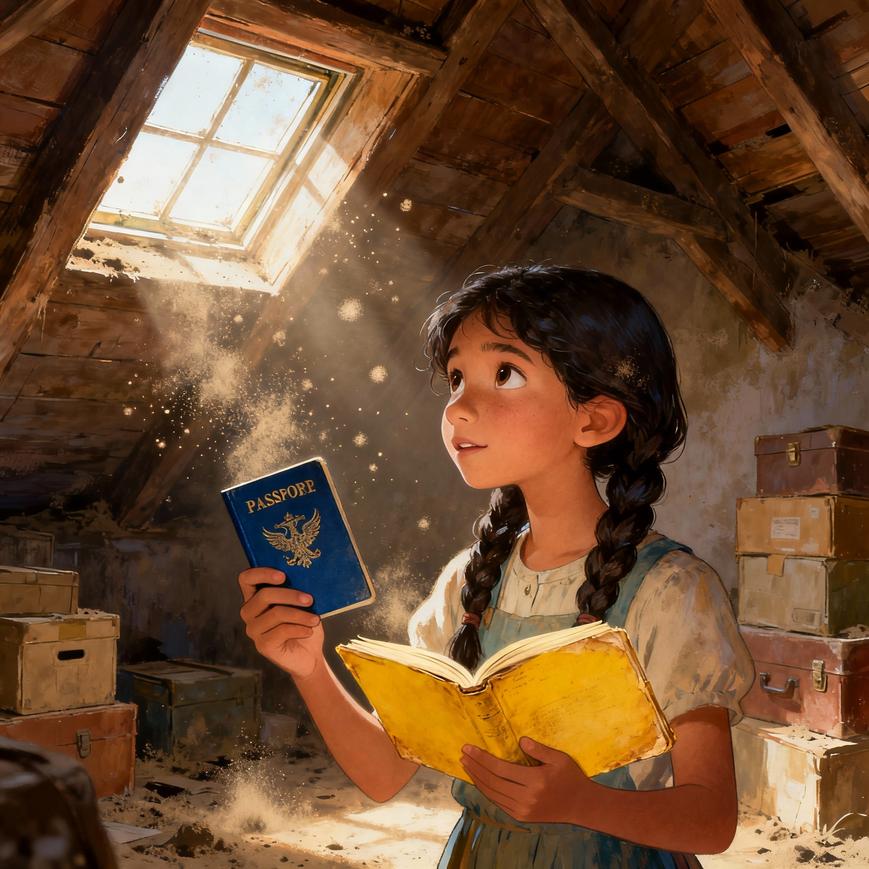
The passport in the attic didn't belong to any of the smiling, familiar faces on Maya's living room wall. Dust motes danced in the single shaft of sunlight cutting through the gloom, illuminating ancient cardboard boxes and forgotten furniture. Thirteen-year-old Maya, her dark braids tied back with a purple ribbon, carefully moved a draped lamp, searching for a prop for her history project. Her family's story, one of quiet routines and deep roots in their small coastal town, felt as solid as the old wooden beams above her head. Ancestors, she'd been told, always chose stability.
Then she saw it, tucked beneath a stack of faded picnic blankets: a small, leather-bound passport. Its cover was a deep, rich blue, softened with age. Inside, the sepia-toned photograph showed a young woman with a determined gaze and a splash of freckles across her nose. Not her mother, not her grandmother. Beneath it, a handful of vibrant, almost defiant postcards peeked out, depicting bustling European cities and sun-drenched beaches. A yellowed, cloth-covered notebook lay beside them, its pages filled with elegant, looping handwriting.
Maya carefully carried her treasures downstairs, the forgotten dust clinging to her jeans. She sat at her desk, the afternoon sun warming her back, and opened the notebook. It was a journal, penned by "Amalia." Maya's great-grandmother. The journal entries weren't about coastal town life or quiet routines. They spoke of bustling markets, train journeys, the scent of jasmine in foreign courtyards. "Today, I found my voice in a little cafe in Florence," one entry read, "watching the pigeons and writing my own truth." Another described the thrill of selling a short story to a small literary magazine in Paris.
The postcards, each a miniature work of art, sent greetings from places like Rome, Madrid, and Lisbon. "Wish you were here, but I wouldn't trade this for anything," one read, unsigned. This Amalia was not the quiet, steady woman Maya had pictured, the one remembered for her lemon meringue pie and her strong, silent presence at family gatherings. This Amalia had lived a grand, adventurous life, a life brimming with movement and creation, starkly different from the settled narrative her family had cherished.
Maya traced the faded ink, a knot forming in her stomach. The family history she knew was a comfortable, well-worn sweater. This discovery was like finding a sequined, travel-worn cloak tucked away, challenging everything she thought she knew. Her parents had always painted a picture of steadfastness, of generations who stayed close to home, rooted like the ancient oaks in their yard. Now, she held proof of a different path, a path of deliberate departure and daring ambition. Should she confront her parents? Demand to know why this part of Amalia's life had been hidden? The thought made her stomach clench. It felt like accusing them of a lie, but it also felt important.
For days, Maya kept Amalia's journal hidden. She watched her parents, her dad whistling as he tended his tomato plants, her mom meticulously organizing photo albums. Were they hiding more? She looked at old photographs, seeing her great-grandmother Amalia with new eyes. Was that a flicker of longing in her eyes in that picture by the lighthouse? A hint of restless energy in her posture? Maya began to understand that people, even parents, were complex. Their choices, their stories, weren't always simple. She realized confronting them with anger might shut down any chance of understanding. What if there was a reason? A protective instinct she couldn't yet grasp?
One evening, while helping her mom sort through old textiles, Maya took a deep breath. "Mom," she started, her voice a little shaky, "I was in the attic for my history project, and I found something..." She carefully pulled out the passport and the journal, placing them gently on the worn quilt. Her mom's eyes widened, a complex mix of surprise and a gentle sadness. Her dad, usually absorbed in the evening news, walked in, his gaze settling on the artifacts.
"Amalia," her mom whispered, picking up the passport. "We wondered if you'd ever find these."
Her parents sat with her, and the conversation flowed not with accusations, but with quiet revelations. Her mom explained that Amalia had indeed left town as a young woman, driven by a fierce desire to write and see the world. She'd returned years later, a celebrated but changed woman, carrying both triumphs and heartbreaks from her journey. The family, still reeling from the loss of a close relative during Amalia's absence, had struggled to understand her choices. In their grief, they had gently, unknowingly, smoothed over the "messier" parts of Amalia's story, focusing on her later years of quiet wisdom, hoping to protect future generations from the pain of perceived abandonment or the idea that leaving home was always an easy choice. It wasn't a lie, her dad explained, but a simplified truth, meant to preserve peace and a sense of continuity.
Understanding dawned on Maya, a warm, soft light. History wasn't just dates and facts; it was also the stories people chose to tell, and the reasons they chose them. Her parents hadn't meant to deceive her; they had tried to protect her, in their own way. That evening, her family started a new tradition. Once a month, after dinner, they would share "true memories," stories from their past, good and challenging, funny and poignant. Maya helped her parents gather all of Amalia's travel treasures and create a small, beautiful exhibit in their living room - a testament to a life fully lived, both at home and abroad.
Maya's discovery hadn't broken the family; it had expanded it, deepened it. She learned that honesty, paired with empathy, could unlock hidden connections and build stronger bonds. She gained confidence in asking difficult questions, patience to hear complex answers, and the courage to hold both pride in her adventurous great-grandmother and understanding for her protective family. Days later, Maya packed a small, blank notebook into her backpack. Its pages were empty, waiting for her own adventures, her own truths. She was ready to write her future, not as a simplified tale, but with all its beautiful, complicated possibilities, honoring the journeys of those who came before her, and respecting the quiet and the wild parts of every story.

Story audiobooks for children of all ages — a new one every day on Smarter Way Stories.