The Maple Ridge Quest
A week of clues, courage, and working together
Read story →
The day her post hit 1,000 likes, Lina felt emptier than ever. Her phone screen glowed like a tiny sun, but the warmth didn't reach her.
At lunch, the cafeteria buzzed with trays and talk. Lina Alvarez scrolled anyway. Her latest mini video-slow-motion waves slapping the pier, her sneaker skimming the foam-kept climbing. Hearts poured in. Comments popped. She should've felt proud. Instead, her stomach felt hollow, like a sand bucket with a crack.
"Refresh, compare, repeat," she muttered, half a joke to herself.
"Catch," said Ms. Rhodes, the guidance counselor, appearing at the end of the table with a paper like a wilted leaf. "Extra-credit adventure. Thought of you."
Lina caught the map. It was creased and stained with a circle of old tea. At the top, in bold, someone had written: THE OFFLINE QUEST. In the corner: Meet at flagpole, Saturday, 10 a.m. Bring water. Bring shoes you can move in. Rule #1: Phones in backpacks. No posting.
"No posting?" Lina said. The word tasted strange. She imagined a killer vlog: dramatic beats, reveal shots, a title card that snapped. But Rule #1 stared up at her like a dare.
She flipped the paper over. A doodled compass pointed to four spots: the library, the park, the community garden, and the lighthouse overlook. Her fingers twitched toward her phone again.
"Curious?" Ms. Rhodes asked, eyes kind but sharp.
"Maybe," Lina said. "Mostly to document it."
Ms. Rhodes lifted a brow. "Or experience it." Then she moved on, leaving the map behind.
Lina stuffed it into her notebook. The likes on her screen kept ticking, but the number blurred. Saturday, she decided. She'd go. Maybe she'd find a way to film on the side. Maybe she'd just see what happened.
The flagpole threw a skinny shadow across the school lawn. The sky smelled like salt and sun. Gulls wheeled over the football field as if checking attendance.
"Phones in," said a tall teen with a faded hoodie and a bright, easy grin. He carried a small plastic bin with sticky notes on top. "I'm Mateo. Former student. Organizer. You'll get them back."
Lina slid her phone in, the case warm from her pocket. It clicked against the bin floor, a sound that felt louder than it was. The skin on her arms prickled.
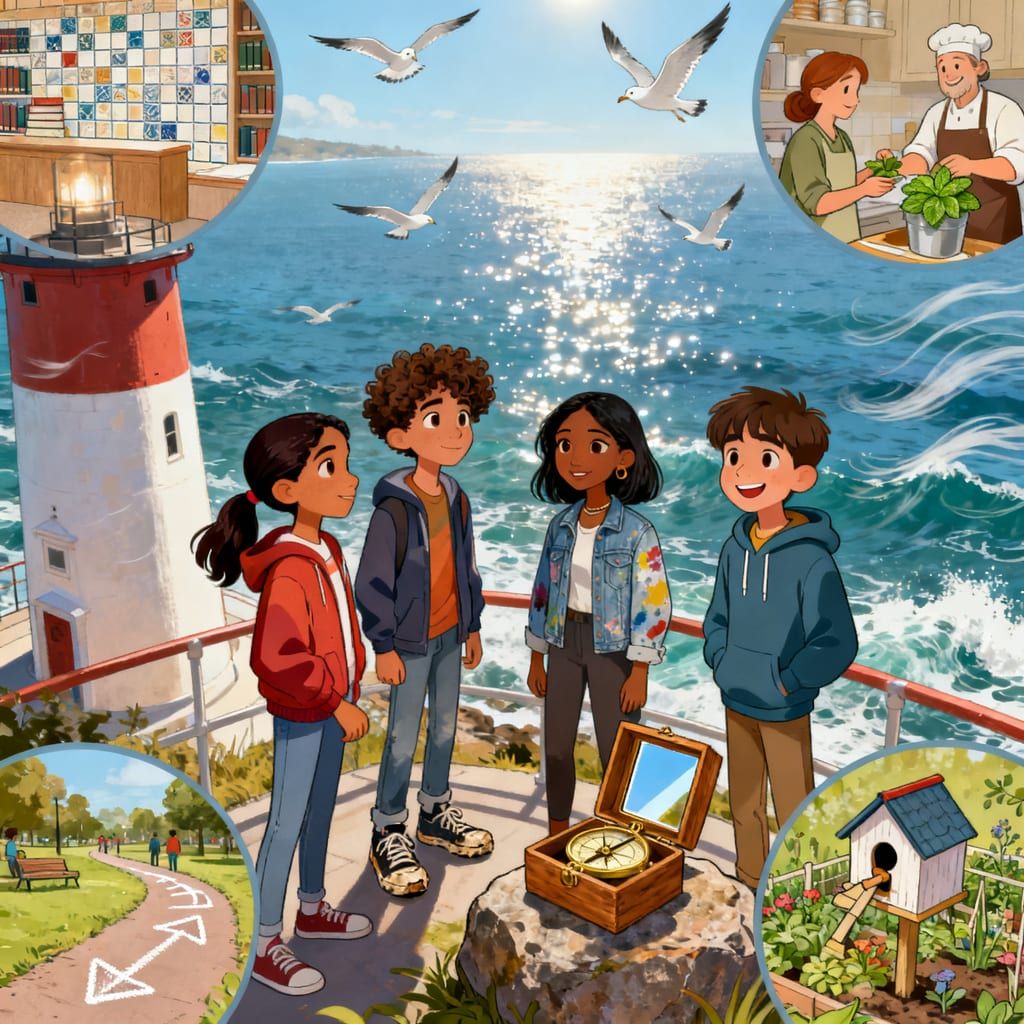
Three other eighth graders stood nearby. Eli had curly hair and scuffed high-tops and was solving a metal puzzle ring without looking. Noor wore a paint-smudged jean jacket and had a quiet, steady face, the kind that noticed things. Jay bounced on his heels, the cords on his hoodie dancing, dimples set to permanent "encourage."
Mateo handed them a fresh map and a slip of paper with a riddle: Begin where stories sleep and wake. Find a wall that tells a tale. Study, sketch, then walk away.
"The library," Eli said, smiling like he'd just cracked a safe. "Mural."
"Let's go," said Jay, already pointing his chin toward town.
Lina felt the lightness of her empty pocket. Her thumb kept twitching for a screen. She tucked her hands into her jacket.
They cut through streets that smelled like coffee and sea air. The public library rose from the corner in old brick and new glass. A tiled mural spread along the side wall-an ocean of tiny blue squares, a lighthouse, a fishing boat, faces of readers, a swirl of books turning into gulls.
"Study, sketch, then walk away," Noor read. She pulled out a pencil stub and a folded sketchbook already soft from use.
"From memory?" Lina asked.
"Looks like it," Eli said. "We have to look long enough to hold it."
They stood shoulder to shoulder, silent. The sun baked the tiles warm. A bus hissed and moved off. Somewhere, a baby laughed. Lina counted the rows of blue around the boat. She traced the lighthouse in the air with her finger, felt the tilt of it in her wrist.
Noor sketched with quick, calm lines. Lina borrowed a pencil and added the curve of a gull, then stopped. Without a camera, she had to see and choose. It felt like balancing on a narrow rail.
"Time," said Jay. "I think that's enough."
They turned their backs, sat on the steps, and sketched what they remembered. Eli squinted into the sky as if the picture hung there. "Three windows in the lighthouse," he said.
"Four," Noor said. "Two small, two big. One has a plant."
"A plant?" Lina asked, then closed her eyes. In her mind, the green flashed into place. "Okay. Yeah."
They compared drawings, laughed at the crooked boat in Jay's, fixed each other's guesses, argued gently over the size of the gulls.
Eli tapped the corner of the map. "Next clue will unlock if we match enough details." He pointed to a QR square printed there, then winced. "Right. No phones."
Mateo, who had strolled over without them noticing, held out a small envelope with a grin. "You'll be amazed what opens without a screen." Inside lay a new riddle, written in looping black ink: Follow the arrows that fade as feet fall. Trust turns where chalk whispers.
"Park trails," Noor said. "People draw chalk arrows all the time."
The park smelled like cut grass and crushed clover. Chalk arrows glowed on the pavement in pink and yellow, some sharp and fresh, some blurred by sneakers and bike tires. The arrows bent toward the creek, then away, then into a grove of pines where the light went soft and green.
At a fork, the arrows split. One path showed thick, confident dashes. The other had faint, dusty marks and a tiny drawn feather.
"Which?" Jay asked.
Eli crouched. "The fresh ones look obvious. But the riddle said fade as feet fall." He pointed to the faint track. "This."
They followed the feathered arrows over roots and around a bench where someone had left a painted rock: You've got this. Jay stuck it in the crook of a tree for the next person.
At a clearing, a wooden stake held a card in a plastic sleeve: Ask a keeper how flavor travels. Bring back a story with a smell.
"Keeper of what?" Lina asked.
Noor tapped the map. "Community garden's two blocks over."
They trotted there, breath puffing a little. Bees buzzed in a low gold cloud over rows of marigolds and tomatoes. A woman in a sun hat knelt by a bed of herbs, her gloved hands dark with soil.
"Excuse me," Noor said, smooth and sure. "We're on a quest. We're supposed to interview a keeper about a recipe."
The woman laughed softly. "I'm Samira. I keep this plot for the middle school. Flavor travels in seeds and stories. What do you want to know?"
Eli held up the card. "Family recipe?"
Samira set a sprig of mint on the edge of a wooden crate. "My grandmother's mint tea. She crushed the mint with sugar in a stone bowl, then poured hot water and a squeeze of lemon. The smell would hit the stairs and call us down." She closed her eyes and breathed in the memory. "We didn't measure much. We tasted and learned."
Lina leaned in. The mint snapped cool under her fingers. The smell was green and sweet and awake. She wanted to capture it, to frame it somehow. She reached for a phone that wasn't there and, strangely, didn't panic. Instead she asked, "Could you show us how you crush it?"
Samira grinned. "Here." She handed Lina a wooden muddler and a tin cup. Lina pressed and turned, sugar crystals scratching softly against metal. The mint darkened, and a smell rose like a promise.
"Bring back a story with a smell," Jay read. "We got it."
Samira nodded toward a leaning post by the fence. A small birdhouse hung crooked there, paint flaking. "If you're questing, you might fix that on your way. The wrens will thank you."
They found a toolbox under the shed eave. Eli sorted screws by size with quick, certain fingers. Jay steadied the post and hummed a tune without words. Noor brushed off old paint in patient strokes that lifted dust like gray snow.
Lina gripped a screwdriver. The wood fought back. A splinter slid into her palm. She hissed, then pressed her lips together.
"Hold," Jay said, steadying the birdhouse while she worked. Noor handed her tape and a bandage, no fuss, as if she'd expected this and believed Lina could handle it.
Lina breathed out slow. Turn, set, turn, set. The screw bit home. The birdhouse straightened. A jay called from the fence as if to check their work.
When they stepped back, the little house sat level, bright even with its flaked paint. Lina's palm throbbed, but it felt like proof, not pain.
"You did that," Noor said simply. Not to flatter. To notice.
Mateo appeared again, as if drawn by the sound of a solved thing. He passed them a last sealed card. "You're making good time."
They looped back past the library to refill water. Inside, cool air washed over them, smelling like dust and ink. A classmate, Tessa, sat at a table by the window, hair perfect, nails perfect, a phone propped against a latte cup. On her screen, a photo of the pier-golden hour, perfect reflection-exploded with comments.
Lina froze. Her own pier video had raced up in the morning, but this-this was cleaner, brighter. The caption sparkled. The likes surged in little jumps.
Her chest tightened. Her hand went, stupidly, to an empty pocket. She swallowed and stared at an old map on the wall instead, the lighthouse marked with a tiny star. She felt the gap open-the one she tried to patch with posts.
"I should go," she said to the carpet. "You don't need me."
Noor closed her sketchbook with a soft thud. "We're not scores," she said, voice low enough to belong to the stacks. "We're people."
Eli set a puzzle ring on the table, the metal flashing. "Also, you're the only one who spotted the plant in the lighthouse window."
Jay leaned in so their shoulders almost touched. "And you crushed mint like a boss." He smiled because that was his gift.
Lina stared at their faces. Not perfect. Real. Jay's hoodie had a stain from something green. Noor's sleeve had a tear at the cuff where paint had stiffened the fabric. Eli's curls were smashed on one side like he'd slept crooked. They were looking at her, not through her.
She blew out a breath she hadn't known she was holding. "Okay. Let's finish."
Outside, the wind had shifted. It carried the tang of seaweed and the steady hush of the tide coming in. The final clue felt heavy in her palm as they hiked the path toward the lighthouse. Steps cut into the bluff rose in a ribbon of gray, and the sky widened with every climb.
Halfway up, a couple of boards wobbled. Jay tested them with a toe and offered his hand without making a scene of it. Lina didn't take it. She set her foot with care, tested her weight, and moved on. Behind her, Eli muttered letters in a rhythm, decoding something in his head the way some people hum.
At the overlook, the world opened into a long blue. Waves stitched the horizon. The lighthouse kept its white watch, steady and tall. A wooden box waited on a flat rock, banded with brass, small enough to tuck under an arm.
"Moment of truth," Jay said, then stepped back so Lina could kneel first.
She lifted the lid. Inside, velvet lined the bottom like a stage. A simple brass compass rested there, needle dancing before settling north. A narrow mirror lay on top, no bigger than her hand, the kind that shows just your eyes and nose if you hold it close. Between them, a note in the same curling hand as the riddles:
The treasure follows whichever direction you choose. We built this when numbers told us who we were. They were wrong. Take what helps. Leave what doesn't.
Lina held the mirror. Sunlight bit the edge and threw a thin line onto her wrist. She raised it. Her face filled the glass-sweat at her hairline, sea-salt freckles, a smudge of garden dirt on her cheek. She looked alive, not arranged.
Mateo stepped up from the path, breath easy, smile small. "A group before you made this," he said. "They were drowning in 'better' and 'best.' They decided to set markers you can't scroll past."
Eli picked up the compass. "It's simple," he said, almost pleased. "No settings. Just north."
"Sometimes simple is best," Noor said, slipping the note into Lina's hand as if passing a secret.
Jay grinned. "We finished! Before sunset!" He whooped into the wind, and a gull answered like it understood.
They took a minute without talking. Waves kept doing what waves do. A fishing boat cut a slow path toward the harbor. On the bluff, grass leaned and lifted in long breaths.
Lina tucked the mirror into her pocket, feeling its thin weight against her leg.
Monday, the halls smelled like pencil shavings and someone's too-strong cologne. Lina walked past the trophy case and into the media center with a plan that didn't ping or buzz.
She sketched a poster on scrap cardboard: Make & Do Hour. Thursdays. Bring a thing you can teach or a thing you want to try. Drawing, baking, coding tiny games, fixing stuff, building planters. Real hands. Real help.
"Ambitious," Ms. Rhodes said, taping it next to the announcements. "Need a room?"
"The art room if Ms. Yates says yes," Lina said. "And the courtyard when it's warm. And the tech cart for coding days. With permission." She heard herself asking for permission instead of likes and felt something in her chest settle.
The first Thursday, five people showed. Jay hauled in a bag of soil and some cheap wood for small planters. Noor brought extra pencils and taught "ink without fear," where mistakes turned into shadows. Eli showed two sixth graders a simple cipher, their eyes lighting up when the message they'd written to themselves finally clicked.
Lina moved between stations, hands dirty, heart calm. She took pictures only after asking, then wrote little notes to go with them for the school site: who tried what, how it felt, what almost didn't work, and what did. She tagged no one unless they wanted it. She told the stories the way Samira had-by smell and touch and memory.
A week later, a new student hovered in the doorway, hoodie sleeves tucked into her fists. She watched a seventh grader sand the edge of a planter, tiny curls of wood lifting and falling like soft chips.
"You can jump in," Lina said, keeping her voice level so the girl wouldn't spook.
The girl chewed her lip. "I'm not...good at stuff." Her eyes flicked toward a phone-shaped bulge in her pocket and then away, as if the screen inside had already judged her.
Lina surprised herself by knowing what to say. "Come try something with us," she said, sliding a pencil across the table. "You're more than a number."
The girl blinked, then nodded. She sat. Noor angled her sketchbook to make room. Jay showed her how to hold a drill like a handshake, not a threat. Eli wrote her name into a simple code that she decoded herself, the letters blooming back out under her own hand.
Later, when the room had the warm, tired buzz of done work, Lina stepped into the hall. She took out the little mirror from the lighthouse and checked the dirt on her face, the wood dust in her hair, the light in her own eyes.
Her phone buzzed once in her pocket-a text, a ping from the site, who knew. She didn't rush. She tucked the mirror back and walked toward the noise of people making things. The compass lay on the media center shelf where they'd decided to keep it. Its needle held steady, pointing somewhere true. She didn't need it to know which way to go, but she liked that it was there.
On the way back in, she passed the library poster about the mural and spotted the plant in the lighthouse window without even trying. She smiled, rubbed the thin scar where the splinter had been, and opened the door.
A Ridgeview Nature Park team challenge
Read story →Story audiobooks for children of all ages — a new one every day on Smarter Way Stories.