The Maple Ridge Quest
A week of clues, courage, and working together
Read story →
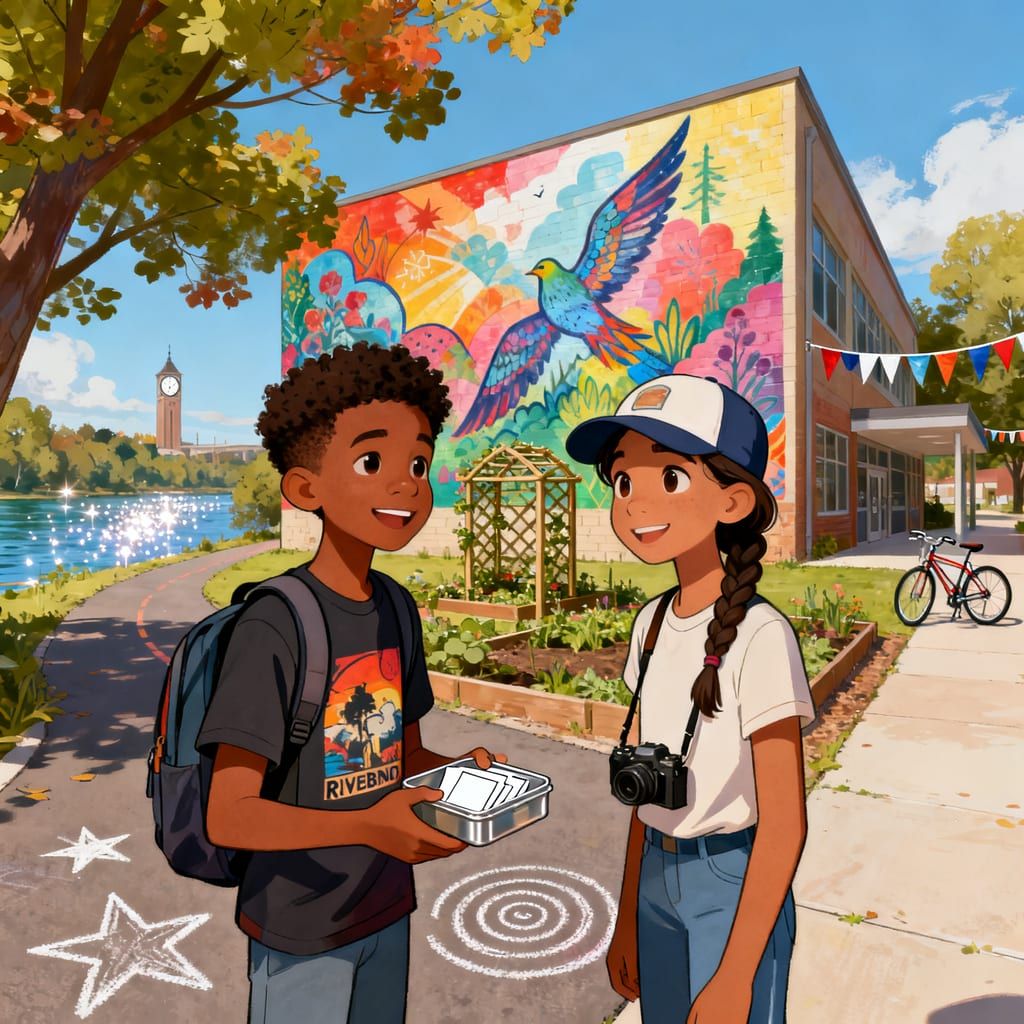
Jamal could scroll faster than anyone in eighth grade, but his brain felt like an overstuffed backpack about to burst.
He noticed it at basketball practice, when Coach blew the whistle and the team ran drills in the cool shade of the gym. The rubber ball squeaked on the floor. Sneakers hissed. Jamal kept glancing at the bleachers, to the spot where his backpack usually leaned like a quiet guard.
Except he had sprinted out the door at home and left his phone on the kitchen counter.
Between free throws, his hands twitched for a screen. He pictured his latest post dropping like a rock, comments piling up unanswered, the graph line sinking. With each layup, his chest got tighter, as if someone kept cinching a strap.
"Dude," Leila said, tossing him a rebound. Her hair stuck out of a cap, and her eyes were smiling even if her mouth wasn't. "You okay? You look like you smelled the world's worst sock."
"I forgot my phone," he said, like it was a confession.
She made an O with her mouth. "Tragic. A whole hour without your precious metrics."
He tried to laugh. It came out thin.
"Try a week off the feed," she joked. "Go feral. Touch grass. See if your thumbs still work."
"A week?" He spun the ball on his finger, dropped it, picked it up, set his jaw. An idea cracked open inside him, sharp and scary. "What if I actually do it?"
Leila tilted her head. "You? Mr. Refresh-Every-Ten-Seconds?"
"Make it a bet." Jamal straightened. "Seven days. No checking numbers. No scrolling. If I cave, I'll wear that goofy banana costume at the skatepark. Full send. Saturday crowd."
Leila's grin went feral. "If you make it, I'll help you shoot that short film you keep talking about. The one with the river shadows and bike lights."
His heart banged once, excited and afraid. "Deal." They bumped fists.
That night he locked his apps behind a passcode he told only his mom, silenced every notification, and shoved the phone deep in his backpack like it was a sleeping raccoon he didn't want to wake.
Day two, they met at the library's cool, book-scented quiet. Sun soaked the windows. A fan clicked with a lazy rhythm. Jamal pulled a worn history book about Riverbend from the shelf-murals on the cover, a faded bridge.
A paper fluttered out and landed face down. He flipped it over.
It was a hand-drawn map, on thick, soft paper. Spirals dotted the corners. Tiny stars clustered in the margins. A line of arrows wandered from the old train depot to the riverside trail, then into a web of small streets near the community center.
Leila leaned close. "Treasure?"
"Maybe a school project." Jamal traced a symbol shaped like a clock face near the depot sketch. The hands pointed to different numbers, but there was no twelve at the top. Instead, a tiny sun.
His fingers prickled. Not notification-prickle. Adventure-prickle.
"Let's follow it," she said.
They stepped into the afternoon heat, the library doors sighing shut behind them. The city smelled like cut grass and hot pizza dough from the place on Maple. Mural colors glowed on brick walls-birds mid-flight, a saxophone turned into a waterfall.
At the depot, old iron rails gleamed. A flock of pigeons strutted like critics. The clock tower sat quiet, hands frozen at three and seven.
Leila shaded her eyes. "The map clock is wrong."
"Or right in a different way," Jamal said. He remembered the tiny sun where twelve should be. He lined the map up with the tower. "What if the sun is noon, and the hands point to where shadows fall?"
They waited, sweating. A cloud slipped aside. The tower's shadow slid like a pointer across the brick plaza, nudging toward a corner bench.
Under the bench, carved on the metal support, were two small spirals and an arrow.
Leila whooped. "Analog adventure unlocked."
The second clue led them toward the river. Wind came off the water, cool and green. Cyclists whirred by. Somewhere, a dog barked like it had important news. Near a bend, they found words stamped faintly into the concrete, the letters filled with dirt and old rain: When the river forgets its name, look up.
They stood under the rustle of cottonwood leaves, heads tipped back. Above them, a string of triangle flags flickered between lampposts. On the last blue flag: a chalk star, almost washed away.
Jamal laughed, a long, surprised sound that tasted like summer. He wasn't thinking about angles or captions. Only the next step.
The trail wound them to a pocket park where a trellis had toppled in the wind. Beans sprawled in a messy tangle, leaves dusty and limp. A woman in a floppy hat muttered, trying to set the wooden frame back up.
"Want help?" Jamal asked before he could talk himself out of it.
The woman's face creased into relief. "Yes, please. I'm Tasha."
He and Leila dug their hands into the dirt. It was soft and cool under the dry crust. They lifted vines like rescued ropes. Beetles skittered. A bee drifted by, already busy. Jamal braced the trellis while Leila tied twine with quick, sure knots.
They stepped back, hands scratched, forearms streaked with soil. The beans climbed neatly again, small white flowers peeking between leaves.
Tasha pressed cold water bottles into their palms. "Y'all saved my Saturday."
Jamal took a long drink and felt the quiet in his head like a fresh breeze.
On a side street, they met Mr. Wong outside a shop that sold maps and hiking guides. The window was full of globes like moons. A bell chimed as they pushed the door.
Mr. Wong had gray hair clipped close and a pencil tucked behind his ear. He looked at the map through round glasses, then smiled like he'd found an old friend.
"I know this style," he said. "Back when I taught cartography at the college, a group of kids made 'analog adventures.' No apps. No QR codes. Just clues you could touch." He traced a tiny star. "We hid weatherproof tins around town with blank cards inside. The rule was simple: leave the place a little better than you found it, and leave a story."
"Does anyone still do it?" Leila asked.
"They will if you do," he said, sliding the map back like it belonged to them now. "Two tips. First, go slow enough to notice what's not on the map. Second, end where the colors sing." He tapped a mural brochure on the counter. The back showed the big painting behind the community center, a river of hands passing paint brushes.
As they left, Jamal glanced at his backpack. The phone inside might as well have been a rock. He didn't miss the buzz. He liked the silence between his ears.
They chased chalk spirals to the old bakery alley that smelled like sugar and yeast, to a stairway where someone had painted piano keys on every step, to the skaters' plaza where a kid in a helmet did a slow, careful ollie and fell, then got up grinning.
Jamal's legs ached in a good way. He tied his shoe by the river and noticed how the water carried light like folded foil. He and Leila argued about a riddle at the clock shop and got it wrong, then right, then wrong again, laughing until the owner, a man with oil on his fingers, leaned over the counter and nudged them toward a dusty box with the next arrow etched inside.
By late afternoon on day seven, shade cooled the alley behind the community center. The mural there exploded with color-faces, leaves, gears, a river under a night sky. At the bottom corner, painted hands held a small tin box.
The real tin sat in a crack between bricks, almost invisible.
Jamal pulled it free. His breath snagged. Inside, a stack of blank cards, a stubby pencil wrapped in blue tape, and a prompt printed on a strip of paper: Leave a story for the next explorer.
Leila glanced at him, then at the pencil. "You first."
He sat on the warm curb. His fingers were dirty. His shirt stuck to his back. The city hummed-kids calling on the basketball court nearby, a bus sighing at a stop, someone practicing trumpet three blocks away, notes brave and wobbly.
He started to write. Not a caption. Not a flex. Just what he'd learned with his feet on the ground.
I thought attention was a number, he put down, slow and careful. I chased it until everything else blurred. This week, I looked up. I listened. I fixed a trellis. I found a star on a flag. I met a man who draws maps of places you can touch. My brain feels lighter. My chest is quiet. I want more of this.
He left out any mention of the banana costume. Some things could stay between friends.
Leila added her own card, with a tiny doodle of the river winding through a maze. She placed both cards back into the tin, hands gentle, and slid it into the wall.
They stood back and let the mural swallow the moment.
On the walk home, Jamal dug out his phone. He felt his stomach roll like it was standing in line for a drop ride. He unlocked the apps. The icons blinked awake, as if stretching after a nap.
He braced for disaster-unfollows, comments stacked like storm clouds, a flat line where his graph used to spike.
Instead, the numbers had done whatever numbers do when you stop staring. A scheduled post he'd forgotten about-bike spokes in sunset light-had gone wild. It was his highest count ever. He stared at the screen, a little amazed, a little annoyed.
"Let me guess," Leila said. "You're famous now."
"Apparently my bike wheel is," he said. He shut the screen off and slid the phone back into his pocket. It felt lighter than last week. Or maybe he was stronger.
"So," she said. "Film?"
He grinned. "Storyboards tonight. Shoot this weekend. Mr. Wong might let us borrow that old tripod. We'll need night shots by the river. I want the water to look like it's thinking."
Leila made a face. "Directors." But she was smiling.
That night, at his desk, Jamal spread blank index cards in a grid, each one a frame. He sketched scenes with pencil smudges-shoes on pedals, flags in a gust, a close-up of hands tying knots around a trellis. He texted Leila a list: props, angles, soundtrack ideas. He didn't turn the notifications back on.
Before bed, he opened the window. The city air smelled like rain coming. He pictured the tin in the wall, waiting. He pictured the path of stars and arrows he and Leila had followed, now part of him the way a song sticks without the words.
Tomorrow, he decided, he would keep the alerts off. Not as a stunt. As gear. He would save his attention for trails that didn't ask for it with beeps and red dots. Trails you found by listening. Trails you made as you went.
He turned out the light and lay in the dark, a little scared and a lot ready. Somewhere, a late train hummed over the river, and in the pause after it passed, the room felt huge and quiet and full of ideas.
A Ridgeview Nature Park team challenge
Read story →
Story audiobooks for children of all ages — a new one every day on Smarter Way Stories.