The Stickers on the Clinic Wall
Boring trophies for the work no one sees
Read more →
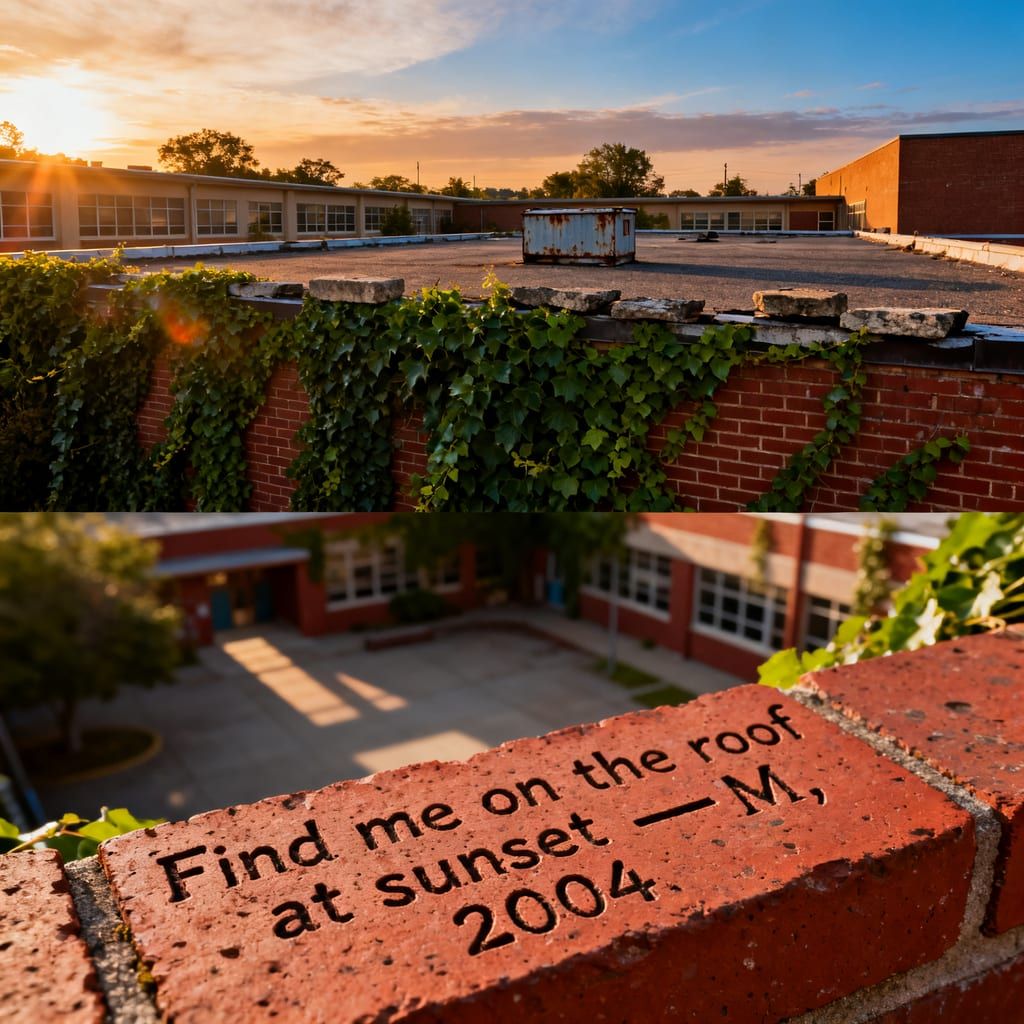
The ivy came off like wet lace, tearing in long, satisfying strips that left the brick sweating sap and dust. Luis's gloved fingers stung where the stems bit back. Night hummed around the old courtyard-moth-thick air, a halogen buzz, the muffled thud of a basketball somewhere in the new gym the donors had christened with a plaque and free pastries.
He scraped until his wrist ached. The brick wall was a patient animal, revealing itself by degrees: initials carved by bored kids, hearts with arrows gone soft under weather, a chipped corner where once a ladder probably leaned. He pulled a stubborn vine and the wall answered with a sigh and a patch of clean red.
That's when he saw the message.
Find me on the roof at sunset -M, 2004
He read it once. Twice. The 2004 lifted off the brick and hovered.
His father's year.
Luis could still smell the bleach his father carried home in plastic jugs, the citrus ghosts of it clinging to his shirts. Miguel Rivera had mowed these grounds, oiled these squeaky doors-until someone said money had gone missing from locker rooms and a custodian's key ring made an easy villain. They'd let him go with a box of personal items and a sheet of phrases that sounded like apologies but weren't.
Miguel died on a night that smelled like rain. The paramedics said it was his heart. His mother said it was something else.
Now, at thirty-eight, Luis pushed a thumb into the carved M until grit lodged under his nail. He didn't hear the halogen hum or the trickle of AC condensate. Just the old clock in his chest ticking down into that one year, that one letter.
He looked up at the roofline like a ladder was already there.
The stairwell smelled like floor wax and chalk that should've been outlawed years ago. Luis used his night-janitor key on the rusty access door. The metal scraped like a secret reluctant to be told.
Evening was going down slow over the city-rooftops like shoeboxes, antenna spines pricking a pink sky. The school's HVAC units hummed their industrial lullaby. He walked the parapet, feeling foolish, feeling twelve, feeling like a man who had promised himself not to chase ghosts and now was trotting after one.
He reached the western edge a few minutes too late for proper sunset, but the sky still held a bruise of color. A row of coping stones lined the parapet, one notched with a hairline crack. He pressed-gently at first, then with both palms. It gave a little, like a loose tooth. He slid it out and set it on tar.
Behind it, a space barely large enough to reach inside. He felt tin-cold and ridged-and tugged.
The box was the size of a paperback, speckled with rust and, on the lid, a strip of faded masking tape: M.H.
Luis's breath sat high in his throat. He worked the latch with the corner of a key and watched the lid rise as if it had been holding itself shut against years.
Inside: a janitor's key tag stamped RIVERa-one letter scarred, the memory of a name; a stack of folded letters bound with twine; a sealed envelope addressed in tidy slanted pen: Miguel Rivera.
And under the twine, a blue form halfway completed: Scholarship Application - Student: Luis Rivera.
He could feel the roof tilt. He sat, hard, on tarpaper that tacky-warmed the seat of his pants and reached for the top letter.
"Miguel-"
The ink had bled at one corner, as if a raindrop had leaned in to read. The signature line read M. Harper.
In four letters, the man Luis had only known as the principal whose portrait still hung in the old hallway looked up from a grainy photograph and took on breath.
In the letters, Harper's voice was precise, almost formal-then lapsing into apology that sounded like a prayer. He had discovered that a coach-initials C.R.-had been the one lifting cash from petty fund boxes. He had, he wrote, confronted the man. He had begun the process to clear Miguel's name. Then the board scandal hit-an unrelated misappropriation case that burned through the school like dry grass. Harper took early retirement under pressure. The noise was enormous. A quiet correction like Miguel's got buried.
"I carved the message so we could meet unseen," the older man's voice lived in the strokes. "Up here, where the sunsets make sense of things. I kept waiting to see you come through the stairwell door at dusk. I don't know if you ever will. If you do-if you find this-please let me help mend what should not have torn."
On a separate sheet: a recommendation in that same careful hand. On another: a scholarship form, the parent section filled in, his father's name in block letters copied clean, as if that might summon a path.
Luis turned the sealed envelope. It still had weight. He pressed it to his thigh until the paper warmed and gave, and he slid out the single page.
"Forgive me," it began. And then, "You are a good man. That was never in doubt."
By the time he folded the letter back along its creases, the sky had lost all its bruise and gone navy.
The assisted living facility smelled like oatmeal and lemon. A TV in a lounge blared a game show no one watched. The receptionist said, "He's in 212. Afternoon is good-he naps less then."
Luis had called first. The voice he'd remembered from the letters said, steady and thin, "Is it you? Or your father?" and then, after a pause that bent toward hope, "Come."
M. Harper was near ninety, a white shock of hair and a blanket that didn't quite cover his knees. The window framed a parking lot of SUVs and a maple in full, impossible green.
"I remember your father's hands," Harper said. His fingers worried a corner of the blanket until a thread came loose. "Careful hands. He had a way of setting down a thing as if it deserved to be there."
Luis laid the tin box on the tray table. The old man's gaze landed on it and softened.
"So you found it," Harper said. "I used to go up every evening for a month. Five o'clock, then six. I thought: He'll know. He'll find his way. I gave up too soon. That's my life's refrain."
They talked until the light on the maple shifted from gold to ordinary. Harper's voice gathered strength when speaking names-teachers, secretaries, one custodian whose laugh, he claimed, could unjam a copier. The names made a room.
"I have calls to make," Harper said finally, like a student asking for homework. "Whoever still picks up, they'll hear me say what went wrong and what it cost." He lifted his hands and looked at them as if considering their remaining work. "It may not matter to an institution. But it matters to people. It matters to a son."
Luis nodded. His mouth had more words than his throat could handle. "He thought he failed," he managed. "He thought-" The rest stayed in the room like weather.
"I know," Harper said. "I carry a matching thought." He reached for a pen with ceremonial care. "Let's begin."
They drafted. They called two retired board members, a secretary who cried, a teacher who remembered Miguel fixing her rattling window "without being asked-he just listened to the glass and knew." Harper promised notarized statements. He typed a new recommendation for Luis: Teacher Preparation Program, Classroom Aide to Candidate. The old precision returned to his hands.
When Luis stood to go, Harper held the blue scholarship form. "This is obsolete," he said, half a smile in it. "But I can do something else. Don't argue."
"I wasn't going to," Luis said.
"You were," Harper said, pleased. "Good. Argue for other things."
His mother unfolded the letters at the kitchen table like she was folding laundry in reverse. The afternoon light turned her hair silver at the edges. When she reached the apology, something opened in her face and she bowed her head, the way she did at church without anyone asking.
She had not cried when Miguel died. Not in public. Now, tears came like an old debt finally collected. Luis did not offer words or tissues. He watched the letters do what they were meant to do.
A week later, he cleared a patch under the courtyard wall where the ivy had been fat as a cat. He asked the custodian crew to help set up a folding table. Students came because anything happening after school with cookies was worth a look. Mr. Alvarez from science brought a kettle and paper cups. The new principal stood back, unsure where to fit her hands.
Luis didn't plan a speech. He held the tin box. He held the key tag. He read the one sentence carved into brick as if it were a psalm.
"Find me on the roof at sunset." He let the year hang there until it found everyone's ears. Then he said his father's name aloud. He watched names work again-the way they can pull people into a circle without anybody noticing they have stepped inside.
No one clapped. The courtyard held a different kind of praise.
Months unspooled: a notarized statement arrived on heavy paper; a small blurb in the local paper ran corrections disguised as a human-interest story. His mother pinned the article on the fridge with a magnet shaped like a mango.
Luis got an email with the subject line: Conditional Admission. He read it twice, the way he'd once read a note on a wall. He showed up to his credential program orientation with a pen, a spiral notebook, and a promise to a man who once set down chairs as if they deserved their place.
In October, the facility called. Harper had died quietly in his sleep, the nurse said, like someone who had finally set down something heavy. A week later, the school received a notice of a small grant: The Miguel Rivera Second Chance Fund, seeded by M. Harper.
Luis stood at the copy machine, reading the letter, and laughed once despite himself. The hum of the machine sounded, for a moment, like approval.
A year later, he stood in the same courtyard, now in a button-down that still felt like costume. His after-school robotics club scattered around a folding table: two girls arguing over a sensor, a boy coaxing a stubborn wheel into alignment with a flathead, a kid with bitten thumbnails naming each screw size with more reverence than some people give saints.
They'd hung a small plaque near the brick, nothing flashy-just a date, a name, and a line about setting things right. The ivy had been trimmed to a polite frame.
One of the sixth graders, a quiet girl with a ponytail too tight, traced the carved words with a careful finger. "What's this mean?" she asked.
"It's a note that waited," Luis said. "Some notes do."
They looked at him like he might have more, but the robot twitched then, came to clumsy life, and the circle broke into delighted noise. Luis knelt to steady a wire that kept popping free. He had always liked the work of making small connections-how a circuit behaved when you respected its path.
As the sun lowered, the brick warmed under his palm. He didn't talk to the wall. He didn't have to. Still, there was a moment-a private, sideways thing-when he felt like his father had found the roof after all, like they were both there at sunset, finally on time for what they owed each other.
The plaque threw a modest shadow. The robot turned in a slow, triumphant circle. The students shouted over each other with the good kind of chaos. Luis watched and, in the muffled gold of evening, understood: some second chances arrive with a late postmark and still deliver everything that matters.
Thirty seconds at a time, they practice a different inheritance
Read more →
Story audiobooks for children of all ages — a new one every day on Smarter Way Stories.