Two Houses and One Quiet Heart
A daughter learns to read between the lines of a life split in two
Read more →
Maia always met new arrivals at the curb-between luggage and first breaths in this new city. Autumn leaned hard through the glass doors of the resettlement office, yellow leaves pressed onto the sidewalk as if they might be catalogued, filed. She watched the four figures approach with the cautious choreography of the displaced-the child hugging a rolled blanket, the grandmother's gait shuffled and dignified, the quiet talk between parents that moved like water over stones.
Names and Beginnings At the front desk, Maia adjusted her badge. The lanyard itched against her neck, a small distraction-a detail better attended to than the anxious pulse in her throat. 'Welcome,' she said, careful to offer a smile that was warm but not bright enough to seem false.
Noor extended her hand first, tiny and steady. 'I'm Noor. This is my mama, Leila, my baba, Amir, and my teta, Fatima.'
Their names bloomed in Maia's notebook: Noor with a doodled sun for the girl, Leila and Amir in tidy capitals, Fatima underscored twice. She led them through the lobby filled with government-green chairs, past a bulletin board stippled with phone numbers and half-torn flyers-*English classes, help wanted, halal groceries three stops east.
Domestic Cartography The apartment was box-like but filled with weak sunlight. Noor's backpack emptied itself quickly-colored pencils scattering like seeds, paper crumpling against the small formica table. 'In Syria, we had lemon trees right outside,' Leila ventured.
She fingered the swim tag Miriam had affixed to the house keys and looked out at the view: autumn trees, scattered playground equipment, the worn optimism of a new address. Maia explained the boiler, the rental stove's fits of rebellion, the awkward hum of the fridge. Amir listened, nodding in the slow language of men who have learned to wait.
Fatima touched the kitchen counter as if it were a strange altar. Noor began naming things aloud, first in Arabic, then English: - Door. باب.
- Table. طاولة. - Chair.
كرسي. She drew their silhouettes in colored crayon, her fingers smudged rainbow. Sometimes she looked at Maia and asked, 'What's this called?'
gesturing toward a teacup, a window, a door chain. Maia answered patiently, letting the words settle between them like stepping stones.
Quiet Wonders Days folded into one another-appointments, forms, buses that ran late, the blank patience of waiting rooms. One afternoon, in the parking lot behind the agency, Noor balanced on the saddle of a battered bicycle, knees wobbly beneath her long skirt. 'Like a bird,' Maia said, jogging beside her.
Noor laughed, dark hair streaming out, and for a moment Maia saw the possibility of flight in her. Leila and Amir watched, arms entwined, Leila's hope a shield tremulous and thin. Fatima sat on a low wall, sunlight slanting across her face, her hands busy with a string of beads.
She never spoke-a stroke had stolen the words from her mouth-but she traced prayers in the air, knuckles moving with quiet determination, lips forming the shapes of songs from home.
The Photograph Some evenings Maia stayed after, sharing pale tea at the kitchen counter. Noor would press a picture into her hand: a stove drawn with impossible flames, a cat curled on a rug, a single apple on a blue plate. 'We did not have a blue plate in Aleppo,' Leila said once.
'Noor wanted one, so she draws it.' It was Fatima who handed Maia the photograph. She offered it with both hands, eyes steady behind fragile glasses.
In the wrinkled image, a little girl stands in front of a makeshift cot, blanket wrapped around narrow shoulders, mouth set in a wary half-smile. There's writing on the back in looping English: October 1999 - Shelter, Augsburg. The memory came in fragments-a knotted scarf, the taste of oranges, a woman's arm curled around her.
Before foster families, before America, there was this: the yellow blanket, warmth offered by nameless hands. How could I have forgotten? Maia's breath snagged in her chest.
Fatima's finger pointed gently-first to the photo, then to Maia's face.
Full Circle In the days that followed, the work felt lighter. Translating a landlord's thick, impersonal letter became an act threaded with solidarity. Filling out Noor's lunch form, Maia wrote her name carefully, determined to anchor it from being lost amid checkboxes and bureaucratic shorthand.
She lingered over tea, letting the evening hush draw close. Some kindnesses, she realized, were unremarkable until they returned to you-folded in a photograph, a drawing slipped under your door.
Continuity The shelter corridors always smelled faintly of bleach and hope. Maia met the next family as dusk blue'd the windows, cradling a blanket across her arms-the same rough wool she'd clung to years before. She handed it over gently, smiling at the sleepy-eyed toddler pressed close to her mother's knee.
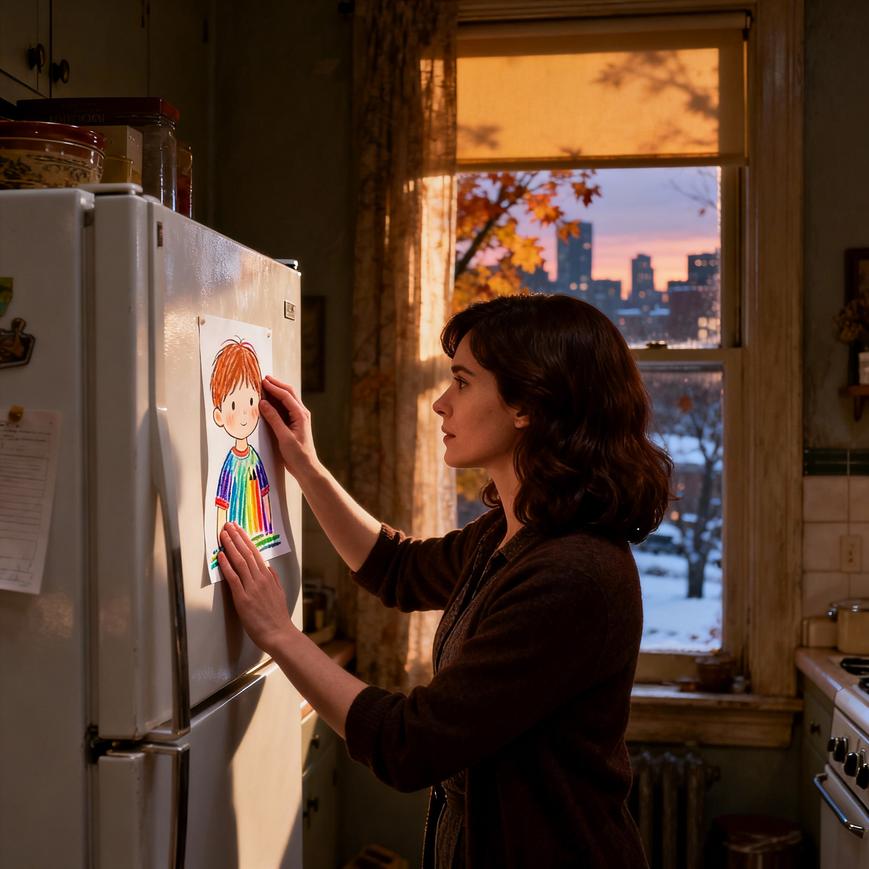
That evening, alone in her apartment, Maia smoothed one of Noor's drawings-a lemon tree with roots tangled deep and branches reaching skyward-onto the refrigerator with a trembling magnet. Autumn crept at the window. The paper fluttered into stillness-a small thing, yet everything, quietly enduring in the foreign sky.
A daughter learns to read between the lines of a life split in two
Read more →
A fog-draped night, two souls found, and the quiet shape of a life
Read more →
Story audiobooks for children of all ages — a new one every day on Smarter Way Stories.