Two Houses and One Quiet Heart
A daughter learns to read between the lines of a life split in two
Read more →
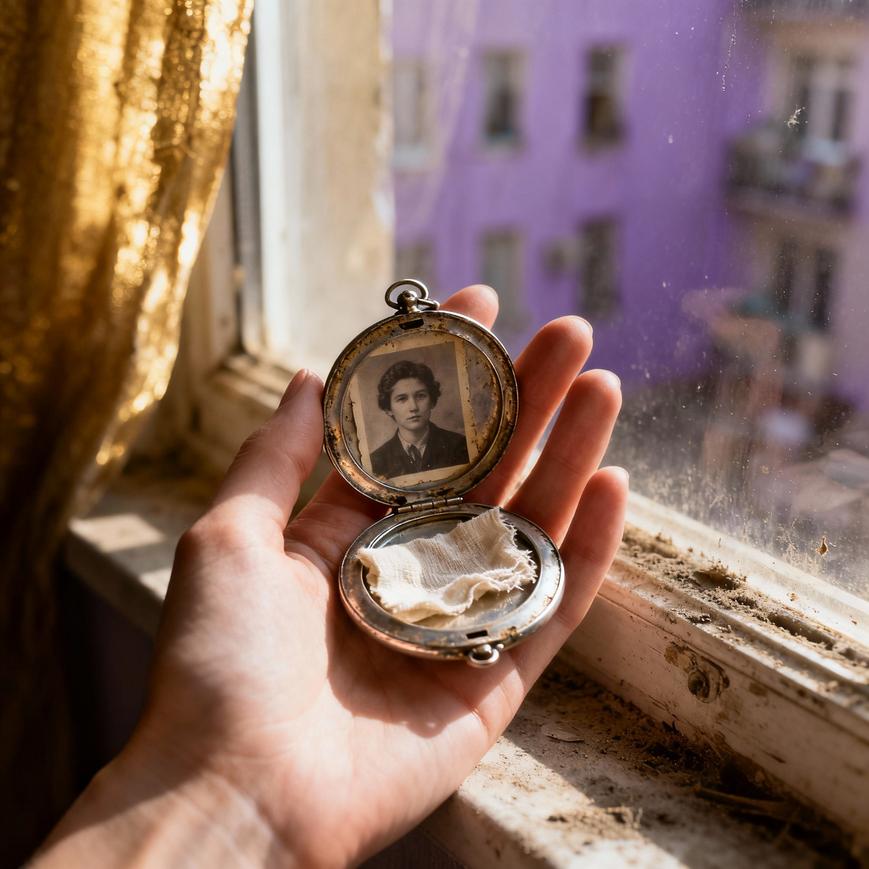
Mira found the locket by accident-her fingers grazing metal as she nudged a brittle copy of The Joy of Cooking out of a basket labeled 50¢. The thrift store behind the bus depot swelled with late-afternoon sea air: sharp with salt and old cloth, sweet where the volunteer had crushed a lavender sachet between her palms. The locket-a palm-sized oval, pivots at the hinge, its chain nesting inside like a sleeping thing-rested beside a cracked blue creamer, utterly out of place and, suddenly, hers.
She shouldn't buy it, she thought. Her life ran on straight lines, not charms and keepsakes. But in the locket's dull glimmer-beneath the thrift shop's humming lights-she felt leaned-toward, as if some quiet hand beckoned. She placed a folded bill by the till. The volunteer, a woman with a buttoned collar and a plait snagged with safety pins, smiled faintly when Mira asked where it had come from.
"It was donated with a box of recipe cards," the woman said, rolling the locket in her palm before handing it back. "From a house up on Bennington, the yellow one with violets in the curb garden."
Back home, night pressing cool against glass, Mira sat at her kitchen table-cookbooks and coffee rings framing a stage. She pried open the locket. Not jewelry, quite; more reliquary. Inside, pressed to one side, bloomed a sepia photograph: two women-one whose hair clung to her temples with the damp energy of youth, the other older, watchful, unsmiling. Mira's eye caught the matching locket at both their throats. Beneath the photo, a linen scrap folded soft with age, bearing lavender stains. When she lifted it free, a phrase in threading and ink appeared: Keep her safe.
One line, heavy blue floss, looped deliberate-another underneath, crooked, letters slanting left, as if written by a different hand in a moment of haste. She pressed her nose against the linen: lavender and something saltier. She pictured the hands that stitched, searching for a shape or accent she could claim as her own.
Her phone buzzed. She ignored it. The puzzle's small gravity began to turn.
Two days later, in the knock-flat sunlight of Bennington Avenue, Mira walked past the yellow house with a curbside tangle of violets. An old neighbor watered zinnias; his shirt was bright and worn at the collar. When Mira showed him the photograph, he frowned, thumb trembling over the older woman's face.
"That's Grace Haldane," he said. "Nice lady, moved here after the floods. She took in fosters. The younger one-maybe one of her girls? That pendant-she never took it off." He looked at Mira then, searching. "Always said it was a promise. Or a reminder. Something given to her when she was just a slip of a thing."
He retreated, uneasily. Mira walked home briskly, the square of linen burning her palm.
She slipped the locket beneath her pillow that night. Slept lighter than usual. Dreamed of a woman-her eyes dark winged, voice shaped by a language Mira felt she should half-know-tucking the locket in an envelope stitched with rain, lavender fields, thunder.
The municipal archive was quiet, dust-mote air and chairs that squeaked with every shift. Mira requested records for Grace Haldane and orphan care from the 1960s. The clerk slid a box onto the counter: receipts, faded applications, and finally-a brittle card, the kind children used for spelling. -for transfer of property: gold locket, initials H.R. to Grace Haldane, November 1962. See: Bluebell Orphan's Home closure files.
Something loosened. Mira fingered the locket at her throat, heart thumping. The receipt was signed twice-once in careful loops, once shaky, childlike. The phrase Keep her safe was scrawled at the bottom as a closing benediction.
Next to the receipt, a file with an earlier photograph-a girl, no older than twelve, holding the locket and standing beside a woman Mira had begun to recognize: the curve of her chin, the strong line of her nose. The archive clerk leaned over.
"She was well known," he said quietly. "People who came over after the war, some lost everything-except the promises they kept. That locket passed through a few hands, I think. Grace didn't keep it when her time came."
By spring, Mira unearthed no tidy origin. Only stories, layered-each woman tending or surrendering the locket in a turning point. The birth grandmother, who folded hope in linen and sent her daughter across the channel. The foster mother, quiet through her own storms, who wore the locket through lost winters and left it for another girl when she could not bear to remember. And-in a final, improbable record-a transfer out of state, adoption final, the locket left behind for "M.P.," initials stitched later, initials Mira wore now.
Mira sat on her fire escape, locket warm in her hand. Below, the city vibrated-children racing on the pavement, someone's mother calling from a lit window, the last burn of lavender in the garden air. She thought of the voices in her life who stayed; the ones who left but left small mercies behind. Her mother's hands, the arch of a shoulder in a photograph, the threaded phrase passed down a line of women who'd chosen again and again to keep the promise, Keep her safe.
We are made of so many mothers, Mira thought, the locket's weight surprisingly right at her throat. So many homes. So many ways to carry each other forward.
She fastened the locket closed-once, firmly-letting the click echo softly in the new dark.
A daughter learns to read between the lines of a life split in two
Read more →
A fog-draped night, two souls found, and the quiet shape of a life
Read more →
Story audiobooks for children of all ages — a new one every day on Smarter Way Stories.