Two Houses and One Quiet Heart
A daughter learns to read between the lines of a life split in two
Read more →
Maya had forgotten how wind off the bay could slap you awake. This morning, it bullied the mist off Main Street, tangling her hair as she hurried through the high school's glass front. She nearly collided with the janitor, a stooped man with seagull-white hair, who grunted and shuffled aside.
Inside, the hallway smelled of floor wax and perfumed paper. At her locker, an anxious girl fidgeted-a tangle of elbows squeezing textbooks, eyes glassy. Maya-a visitor, invited back to talk about design-straightened to offer a smile. The girl's voice came out pinched:
"Do you know where... is there a machine in the restroom?"
Maya registered the flush, the crossed ankles. She remembered-that look, herself at fifteen, praying not to stain her jeans.
She found her purse, offered a crumpled pad with an apologetic shrug. A slip of relief passed between them, sheepish and swift, before the girl darted away.
That afternoon, Maya sat at her grandmother's drop-leaf table, light carving shadows across sun-faded linoleum. The old sewing box waited, lacquer dulled by decades, tucked between a sack of rice and mismatched mugs. Maya lifted its lid, fingers tracing the gloss of spools and the neat coil of red embroidery thread.
Maya wound the thread between her fingers, recalling the moth-rich scent of her grandmother's arms, the sure, silent way she repaired torn hems and let nothing be wasted. Quiet hands, useful as rain.
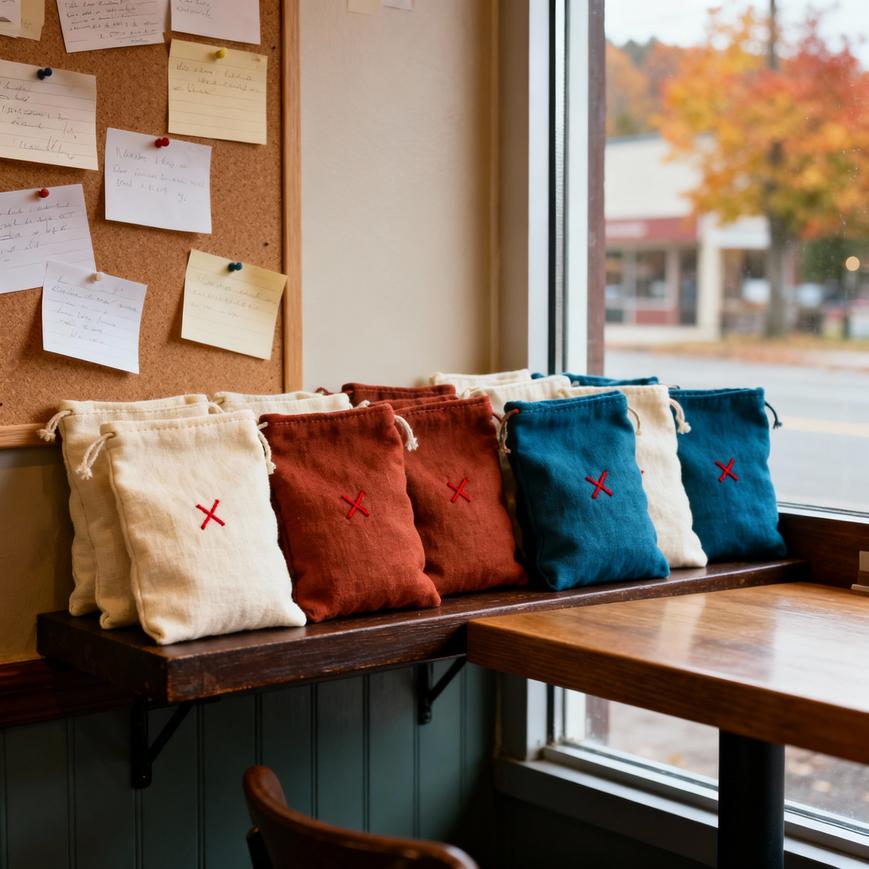
On impulse, she scavenged a stack of scrap fabric: soft florals, sturdy gingham. She stitched simple pouches-small enough to tuck into a pocket, each sealed with a staccato cross of red. Fabric pricked, drawn, knotted. It felt both practical and ceremonial, a way to say: You are seen.
At the corner café, she set a basket by the register-a laminated card read: Take one if you need. Leave some if you can. -Red Thread
The librarian raised an eyebrow as Maya placed another shelf beneath the community corkboard. At the center, she left a draft map, pins marking new sites-coffee shops, the library, the old rec hall.
Nights, she stitched and listened. Footsteps echoed in the empty street; someone taped a five-dollar bill to a pouch. On the volunteer board, an anonymous hand scribbled: "Thank you."
At first, the shelves were a whisper-small, almost out of sight. Then came the letters. The town councilwoman called to schedule a meeting. Maya's voice warbled when she answered; she pressed the phone to her chest between sentences.
"Isn't it best," the woman said, "to handle these matters discreetly? Bathrooms are private for a reason."
A retired navy man, red-faced and loud at the council meeting, called the pouches "indelicate." Someone suggested metal coin machines-"like in the old days."
Maya swallowed her answers. No one mentioned the girl at the locker, or the others like her-only the idea of trouble, as if menstruation itself could knock on a door and refuse to leave.
One Saturday morning, she found a shelf empty but for a note written in shaky ballpoint: _This helped my daughter. Thank you._
The next week: a smear of lipstick on the café window-_SHAME_.
Maya's hands shook as she replaced the shelf, tying a new red knot. She hesitated, staring at her grandmother's old sewing box where it perched on her kitchen counter-a totem, silent and unimpressed.
That night, searching for more thread, Maya's thumb caught on a notch at the base of the box. The partition lifted, and in the square beneath lay a stack of faded cloth pouches-each stitched with the same tidy red cross. Beside them, a small ledger book, the spine cracked but tenderly held together with masking tape.
Inside: names and years, and, next to each, careful checkmarks. "Miss H, 1979-school nurse," "Dropped-laundromat." "Chapel-Mrs. Parker in need." The handwriting was her grandmother's: looping, dignified. Pages and pages-a quiet constancy of care, hidden in plain sight.
Maya held a pouch to her chest, breath caught. Across decades, her grandmother, too, had chosen quietness without apology-neither boast nor secret, just necessity. It wasn't only tradition to embolden, but memory.
A slow transformation rippled through the town. The councilwoman relented, then pledged shelf space in the library basement. The barista started volunteering, sliding pouches onto the shelf in the pre-shift hush. A father, broad-shouldered and bashful, pinned a letter: _Men need this for their girls too._
One Friday, Maya arrived to find a row of teenagers-two girls and a boy-fingering the pouches, reading the handwritten notes inside. The boy grinned, "My sister-she says these are the nice kind."
Maya just nodded, lips pressed against a smile.
In time, the act became town ritual: drop-off boxes at the bakery, spare pouches traded with half-whispered gratitude. The red thread-a sign as simple and sure as a lighthouse-bound strangers to one another, not as donors or recipients, but as participants in something neither private nor shameful, merely necessary and kind.
On windy mornings, Maya sometimes paused at the shore, palms full of red thread, light caught in its bright, fine twist. She thought of her grandmother, the ledger, the girl at the locker, and the humble revolution stitched quietly from pocket to shelf. The wind smelled softer now. If she closed her eyes, she could almost hear-across the hush-the gentle click of needle through cloth, a promise continuing, quietly, in red.

A daughter learns to read between the lines of a life split in two
Read more →
A fog-draped night, two souls found, and the quiet shape of a life
Read more →
Story audiobooks for children of all ages — a new one every day on Smarter Way Stories.