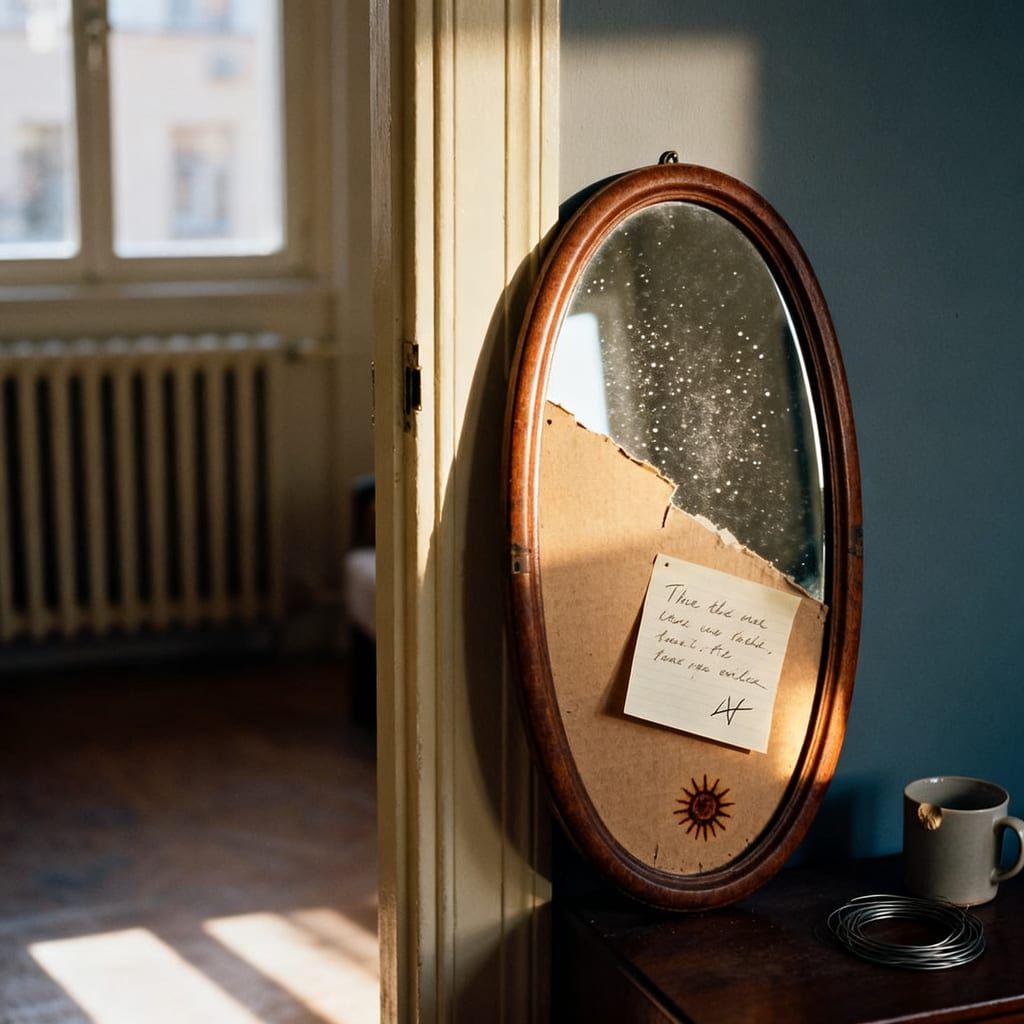
What the Mirror Couldn't Hold
A frame, a note, and the rooms they make inside us
Read more →
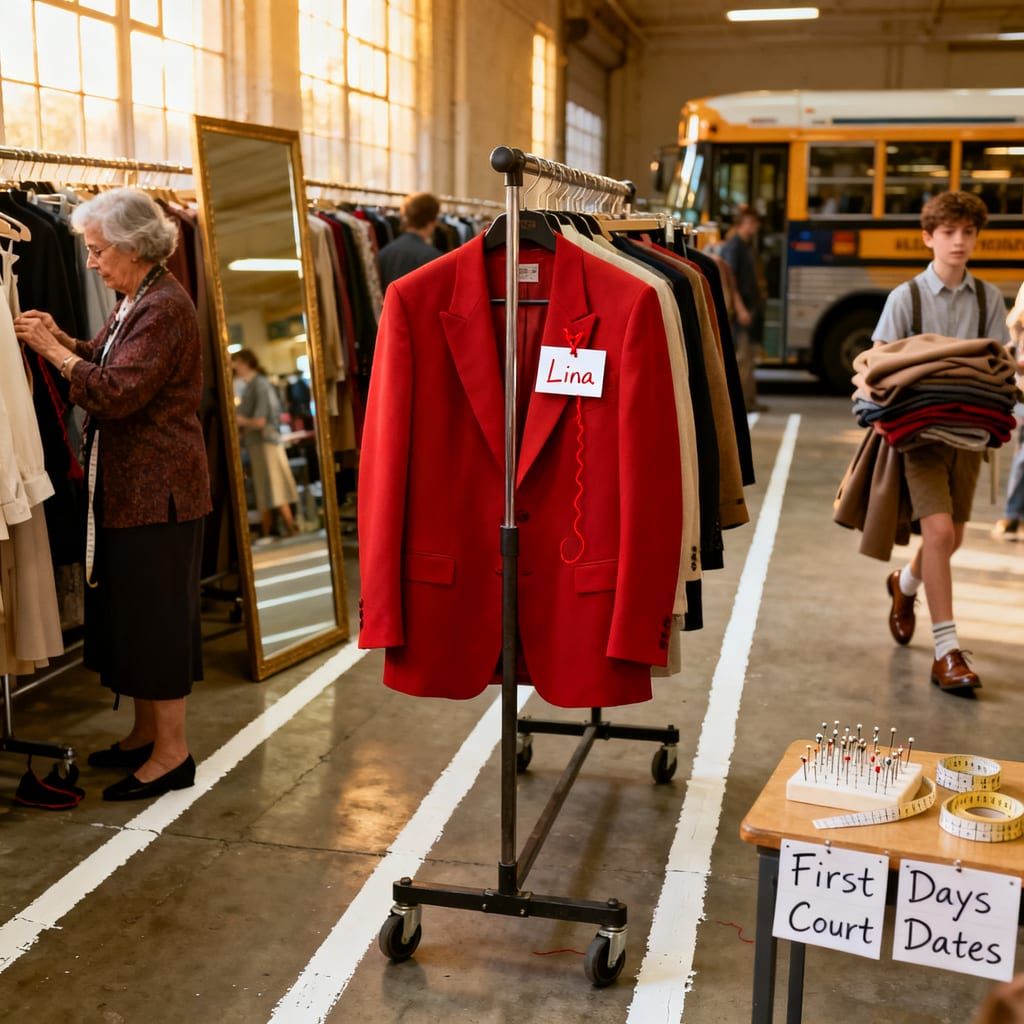
She found it at the bottom of a donation bin, folded like an apology.
A red blazer-hem let down with care, shoulder pads tamed into something human, the inner pocket where a name once lived neatly unpicked and replaced with a blank tag. Lina brushed lint from the lapel and felt the weight of it, the way it promised a back to square itself, a spine to be believed.
The back room behind the community arts center had been a place for forgotten props: papier-mâché pears, a tangle of extension cords, a broken stool with paint-splattered legs. Lina spent her nights stocking the city's neon-bright supermarket shelves and her early mornings there, swiping dust into the light, unearthing floor space with the stubborn joy of someone who knows what a room can mean.
She measured with a cracked tape and marked with blue painter's tape-two racks here, a low shelf there. She wrote labels in a careful hand: Court Days. First Days. Cold Mornings. Feet That Don't Apologize. She kept the emails short and signed them the way that made questions slide off: L. Torres.
When a friend texted, "They said I looked too much like my application didn't," something in Lina tilted toward action and never righted itself. She hung the red blazer at the far end of the first rack. Blank tag. Waiting.
Word spread the way kindness does in a city that remembers itself on hard weeks. A retired seamstress named Ruth showed up with a metal tin of chalk and pins, sunlight caught in her white hair. "You need alterations," she said, not as a question. "I'm terrible at sitting still."
A shy teenager named Rey practiced walking in oxfords between racks, turning in the mirror to see a future from another angle. "They squeak," Rey whispered, delighted by the sound of their own steps. "Like they know I'm trying."
A bus driver dropped off a bag of winter coats-still warm from the bus, somehow-and stayed to build shelves, tapping the boards into the studs like knocking on a neighbor's door. "My route goes past here," he said. "Figured I should see where the coats end up."
They called afternoons Name Days. Anyone could come, try on something, and write their chosen name on a tiny card tied with red thread to the hanger until the item found a home. The cards lifted and fluttered when the door opened. Names-some familiar as a favorite song, some new as rain on a dry street-gathered in clusters. Rey wrote carefully, hands steady. Ruth's pinched mouth softened when she sewed on labels that read simply: Yours.
Lina arranged blouses by sleeve length and jackets by mood. She checked the mirror at different heights so no one would have to crane to see themselves. In quiet moments she wiped fingerprints from the glass with the hem of her shirt, catching her own eyes in the reflection and looking away too quickly, like meeting a neighbor on a day she wasn't ready to talk.
There were ugly comments online, of course-the drive-by kind, punctuation thrown like gravel. Lina turned off notifications and turned up the radio in the back room, where the music was always just loud enough to make laughter feel at home. A neighbor complained about "traffic," and Lina baked a lemon loaf and walked it next door with a schedule in hand: set hours, parking reminders, a promise to keep the sidewalk swept. The neighbor took the loaf, sniffed, and a week later left a box of hangers on the steps. "My sister moved," she said, eyes not quite meeting Lina's. "Too many clothes. Thought you'd make better use."
The city inspector came on a gray Tuesday with a clipboard that seemed to make him taller. He tapped measurements on the door with a metal ruler and pointed at the floor. "Occupancy limit isn't clear. Paths are narrow. That mirror-" He paused at the mirror, at a jacket hanging beside it labeled Big Interview. His voice softened a shade. "Look, I have to write this up."
"Write what you need," Lina said calmly, her ribs tight.
That night, a sponsorship fell through with a polite email stacked with words like realignment and fiscal quarter. Lina stared at the screen until the letters swam, then sent a different email to a lighting tech she knew from the arts center. She bartered spare rigs and cables in exchange for a rolling rack on casters and a mirror that made everyone stand taller. After the swap, she slid the mirror into place and stood behind it, just out of sight, to make sure there were no gaps where someone could feel watched.
Underneath the doing, Lina kept to the edges. People hugged her at the door and she managed their gratitude the way she handled inventories-counting it, stacking it on a high shelf. Useful was a skill. Useful was a way to pass.
The inspector's warning landed on a Wednesday like a bad chord. "Noncompliance," he said, lips heavy around the word, like he didn't enjoy it either. "You'll have to close until you fix this."
"By when?" Lina asked.
"By yesterday," he sighed, then glanced at the red thread cards and something eased. "By Friday."
The message traveled with the speed of need. Volunteers rushed in with tape measures and maps. The bus driver returned with a can of white floor paint, laughing at his own painted fingers. Ruth showed up with her arms full of black-and-yellow tape and a garment bag over her shoulder.
"New pathways," she announced, waving the tape. "We're going to stripe like a sports arena."
"Please don't make me wear a mascot head," Rey muttered, carrying a stack of folded jeans.
They measured exits, moved racks two inches this way and three that, painted crisp lines on the concrete floor that led to an exit like a promise. Someone brought pizza. Someone else queued up a playlist from Name Days, and the room hummed-brushes against denim, chalk against fabric, a chorus of yes, higher, there.
Under the hum, Ruth unzipped the garment bag on the worktable.
The red blazer lay inside, newly lined, its silk a quiet river. The handwork in the shoulders smoothed the years. A slim seam ran down the back like a sentence finished at last.
"It needs a first photo," Ruth said, setting it on its hanger with reverence. "Every piece should know where it begins again."
Lina swallowed. The room blurred for a second, then sharpened to edges-tape corners, laughter, the inspector's gray look hovering in memory. She lifted the blazer. The weight settled onto her forearms, warm from the bag as if it had been waiting under a lamp.
"Let's do it," Rey said, nervous grin bright as the oxfords they had broken in one squeak at a time. Rey was in a white shirt and a pair of navy pants with a proper hem-Ruth's work, of course-that didn't puddle at the ankles. "We can start the board." Rey pointed to a black foam board propped by the mirror, a handful of white paint pens in a jam jar. "Name, date, what you're stepping into."
Ruth turned down the radio and the room's energy softened around them like fabric draped over the shoulders. People drifted closer without crowding.
Rey dipped a paint pen and looked up. "What name should I write for the event?" The grin flickered. Their eyes-so carefully brave-found Lina. "Yours, I mean. What name do we write?"
The question cut the room's noise into a listening that wasn't a hush so much as a gathering. Not a demand, not a corner-just air making space. The paint pen clicked in Rey's hand: ready.
Lina had navigated whole days without answering that question aloud. She had built a door and held it open for others and stood, always, on the threshold. The word lived in her mouth like a stone softened by years of turning.
She slid the blazer off its hanger and into her hands. The lining whispered against her skin. When she put it on, the weight kissed her shoulders in a way that made her bones remember. The mirror did not startle her this time; it offered back a person she recognized as the one who had been carrying boxes, lifting shelves, signing emails with a letter to hide a life.
Her throat tightened. She looked at her reflection and then away and then back, like testing a light. She reached for the jam jar. Her hand did not shake.
"Lina," she said, the name landing with a softness that felt like truth finally exhaling. "Write Lina."
Rey's smile broke open, wide and simple. They wrote carefully: Lina - First Photo Night - Stepping into the room I built.
Ruth, eyes shiny the way afternoon windows get, pinned the tiny card through the blazer's hanger, then, without asking, pinned another to the lapel. "For you," she said, her voice so steady it made the moment steadier too.
Around them, a few cheers rose and then settled into practical tasks-as if the best way to honor a name was to make sure the floor paint dried in time, the paths remained clear, the pizza stayed warm. Lina laughed, and the sound surprised her with how easily it sat in the air.
By Friday the paint snapped white against concrete, the aisles widened to exactly the inches the clipboard required. The inspector returned in a shirt that looked less pressed, a paper bag in his hand. He glanced at the mirror, at the lines, at the red blazer's flash by the doorway where photos had been taken and retaken.
"You did it," he said, softer than before. He held out the bag, awkward as a teenager. "My son-he, uh-he went through a phase of only buying button-downs. Doesn't wear them now. Thought maybe..." He trailed off.
"Thank you," Lina said, and the words landed somewhere deeper than politeness. She took the bag and felt its weight: a small contribution, a kind of apology, a beginning.
The official reopening wasn't a ribbon-cutting so much as a current. People arrived in little clusters, shoulders brushing, names on cards flicking like wings as the door swung. Rey stood by the mirror, oxfords polished to a small shine, showing their first-day photo to anyone who asked and some who didn't, because sometimes joy needs witnesses. "I start on Monday," they said, trying to sound casual and failing in the best way.
The bus driver pointed proudly at the shelves he'd hung. Ruth pinned a hem with needles clenched in her teeth, humming an old tune that threaded through the chatter. On the board, in a row like small lighthouses: Marco - Court Date - Speaking in my own voice. Talia - First Shift - Pockets that fit my hands. Rey - First Day - Learning my route.
The red blazer moved in and out of frames like a lucky comet. It hung for a minute on a hook while someone wiped their eyes. It draped sharply across a young person's shoulders for a photo sent, with trembling thumbs, to a group chat that lit up with hearts. It returned to the rack with its card flipped forward, the pin catching the light.
By late afternoon, the neighbor who'd once complained about traffic wandered in with a tray of sliced oranges and a cautious smile. "I brought extra napkins," she said, as if to soften her entrance. "Also, I have a brother who-well. I didn't know this was what you were doing." Her eyes drifted to the board, the names, the paths like clean lines on a map.
"It's what we're doing," Lina said, sweeping a stack of folded scarves straighter. The we slid warm in her mouth. She pulled the red blazer from the rack and ran a hand over the lapel, a check as natural as breathing.
The inspector hovered near the door, then stepped aside to hold it for a newcomer with a garment bag. People threaded around one another like the room had learned its own choreography. In the mirror, the angles were kind.
Near closing, Lina found a quiet pocket of hallway, voices carrying like a radio from the main room. She faced the small window where the afternoon settled, a wash of gold along the floor paint that had dried to a perfect line. She lifted her phone and took a photo-not of herself, not exactly, but of her hand on the red blazer's sleeve, the tiny card pinned at the lapel like a heartbeat.
Behind her, laughter rose, then softened, then rose again. Names were tried on and kept or set back gently on the rack to wait for their person. Shoes found feet. Jackets found backs that lifted. The door clicked and opened and clicked again.
Lina slid her phone into her pocket and stepped back into the light of the room that had made room for her. The board on the wall glowed with new lines of paint, steady hands. Community is not a thing you own, she thought, not a thing you can hold. It's something that holds you, if you let it.
She did. And the red blazer-first photo taken, beginning again-glowed at the edge of another frame as someone lifted it with care.
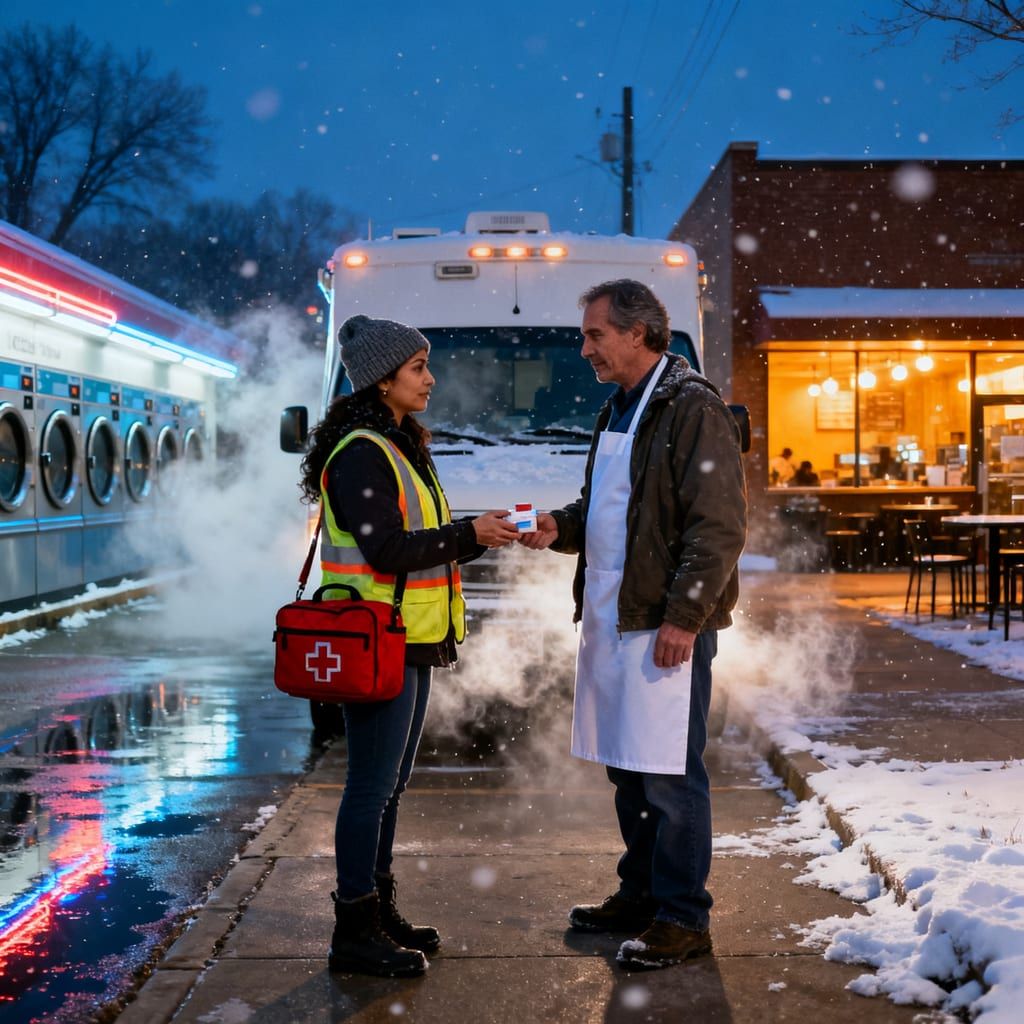
Between a laundromat's hum and a café's light, a van keeps score another way
Read more →
Story audiobooks for children of all ages — a new one every day on Smarter Way Stories.