Threads for Chosen Names
A room, a red blazer, and the courage that fits at last
Read more →
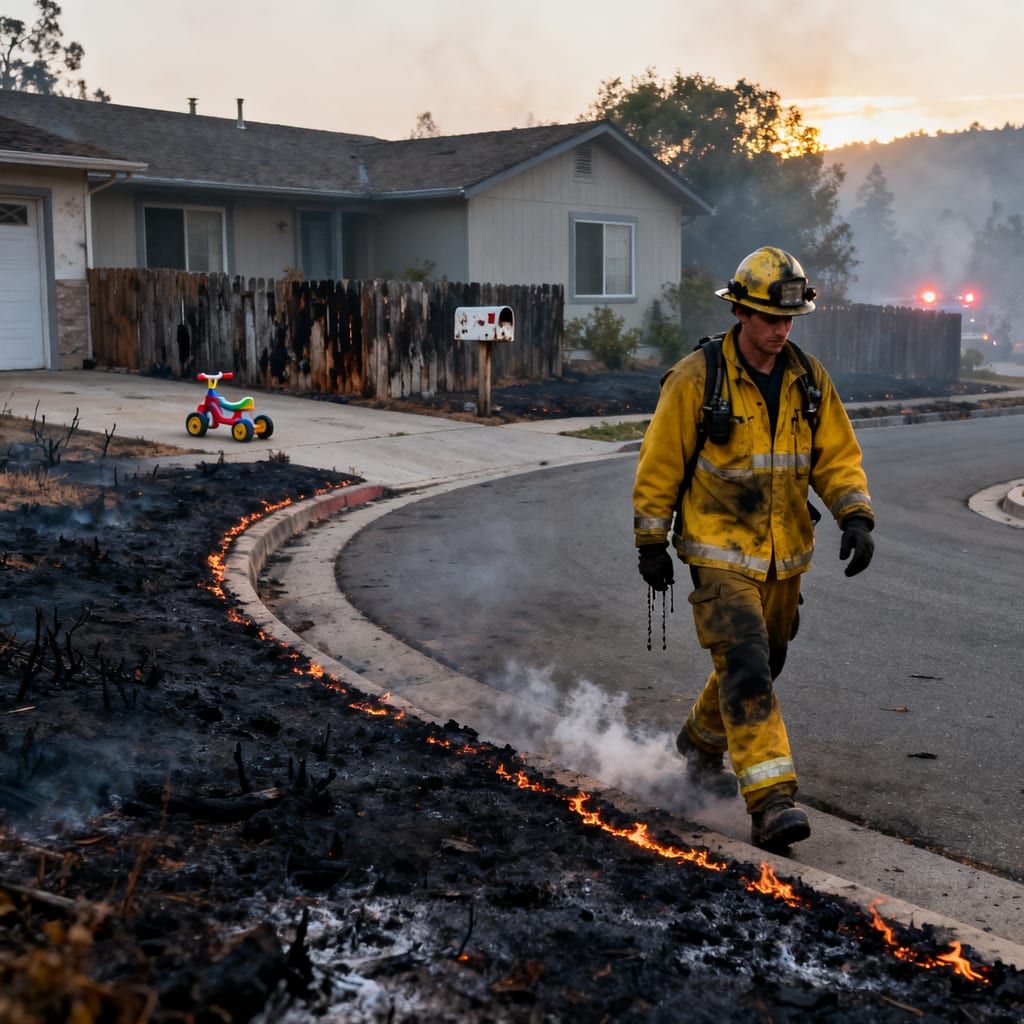
The smoke comes first-sweet and sour, sap-sugar and melted plastic-pressing the sky into a dull, worn coin. Jonah watches the ridge take flame like a seam ripper catching thread, a ragged orange crown pulling loose in the wind.
He tastes ash at the back of his throat. His radio hisses with overlapping voices, oxygen-starved and impatient. Down the slope, the town hunkers under its own breath. He can feel it-screen doors, dog bowls, a piano with a lace runner-all of it waiting, listening.
They stage engines along the cul-de-sac: eight tidy homes with vinyl flags snapping limp and wagon tracks etched into the concrete like old laughter. A basketball hoop leans at the end of a driveway, net sun-bleached to memory. Jonah steps off the engine and his boots find the powder of a lawn gone summer-dead. He knocks on a stucco pillar with his gloved knuckles as if to greet an old friend.
"Reyes," his captain calls, "you've got structure triage. Mark gas meters, clear up against the fences. Embers'll ride in here once that head turns."
Copy, he says with a nod, already moving. He scans roofs for wood shake, drags a hose loop around a mailbox with a bronze bear on top. The bear is grinning.
Somewhere a doorbell camera chimes with its pleasant, indecent little song.
Dispatch breaks in over the tactical channel. "Engine Seven-One, homeowner at 12 Alder Loop on Ring feed. She says she left a-uh, a box? On the piano. She's at the evac center. She's... calm."
Twelve Alder. Jonah's pen stills on his triage tag. The house at the top of the loop with the azalea hedge. Lemon oil and rosin. The quick, dry tap of a metronome. A voice that laid consonants down like stepping stones.
He looks up. The hedge is taller now, glossy leaves trembling with heat.
The wind flips. He hears it before he feels it-something about the pitch of the fire, the way it inhales. The main head, which had been clawing along the back canyon, puts its shoulder toward them. A hundred little embers leap the draw like kids with kites.
"Command, this is Seven-One," the captain says, the calm borrowed and well-used. "Head's angling at the subdivision. We need to anchor off the loop. Requesting permission for a backburn along the greenbelt fence. We don't hold it there, it'll ladder into the attics."
A beat. A different kind of wind rushes the radio-decision dropping.
"Seven-One, you're a go. Keep it surgical."
Jonah runs his palm over the rough knit of the drip torch strap and feels the old ache in his shoulders, a hotshot's muscle memory. Light to stop light. The first fire he ever saw in a kitchen pan had been a bright, greedy tongue; his mother's scream had been another kind of siren. He sees again the black cleaver of scorch up the apartment wall, the landlord's tight mouth, the way his father's truck had held everything they could take. He has been chasing and taming versions of that tongue for twenty years.
The camera chimes again. The captain jabs a finger toward the azalea hedge. "Make it quick, Reyes."
Jonah nods before he knows he's nodding.
The front door is stubborn, the stick of paint heated to tack. He shoulders it and the house exhales. Smoke has a way of finding the corners where pictures hang; it curls their edges like pages of a book near flame. The hallway is a gray throat. He drops to a crouch. There-a piano, upright, its crown polished to a soft, old shine. A shoebox sits on the runner like a loaf of bread waiting to be sliced.
The heat is not yet violent here, but it is certain. He breathes through a bandana, eyes watering. On the floor, face-down against the baseboard, a picture frame waits as if someone set it there deliberately and changed their mind.
He slides the shoebox under his arm. His gloved fingers fumble the frame. He flips it. A boy with dark hair stands in a stiff shirt beside a woman with bright, bird-quick eyes. The boy's violin sits awkward in the cradle of his chin. The woman's hand hovers near his wrist like a blessing waiting on permission.
"Mrs. Ellery," he says aloud, the name landing like a stone into a well.
The metronome on the piano ticks once-no power, but sound still dallies in wood.
Outside, the fire's breath grows rough. Time collapses. Jonah tucks the frame flat against his body, box pressed to ribs. He retraces his steps, the house's sightlines swimming in a low, brown fog, and stumbles back into the raw light.
"Good?" the captain calls, not looking, already unfurling line.
"Got it," Jonah says. He sets the box and frame in the engine cab, snaps the door shut like punctuation, and lifts the drip torch. Fuel sloshes in its belly. The wick catches-a short, defiant candle.
"Heads up-lighting!" he barks to the crew. They are already spacing themselves along the fence line bordering the greenbelt-a parched strip of mown grass and ornamental trees that has made this cul-de-sac feel like the end of something gentle for three decades. He feels the wrongness of what he's about to do like a splinter under nail-and the rightness like a cool hand to the forehead.
He tilts the torch and the grass hisses, then folds. The fire he makes is low, humbled by intent. It walks where he invites it. It meets the wind not like a dare but a negotiation.
"Keep it tight," he says. "Watch for slop-over under those cedar rails."
The fences go early, resin spitting like a cat. Hedges curl, edges brown and then give. Embers peck at his neck. He stamps a spot fire with the flat of his boot, smell of singed rubber stitching to his calves. The greenbelt's feathery maples surrender in small prayers of flame. Above them, the ridge line roars past with its blind hunger-and then trips, stumbles, is suddenly made less by the black Jonah has walked into being.
"Hold the corner," someone shouts. Water thunders. Steam blooms in a brief, private fog.
They make a ring of absence for the main head to find, and it finds it, and it starves. The cul-de-sac holds-charred fences like broken piano keys, mailboxes singed down to their metal bones, but roofs unbitten, windows still eyes instead of mouths.
When it is over enough to speak in complete sentences, Jonah slumps against the engine and feels every year, every unreturned bowing, every apology knotted and unstated. The shoebox waits behind glass like a small, plain animal.
He carries the box into the evac center at the high school gym-floor wax and old sneakers ghosting up from the boards. Fluorescent lights flatten everything into an honesty it never asked for. Cots stand in two rough rows, blankets like rows of newly planted fields.
She is where he knows she'll be-sitting straight-backed with a music teacher's posture, hands folded as if holding a rest between measures. Her hair has gone to winter. Her eyes are the same cadence of blue, precise without being unforgiving.
"Mrs. Ellery?" he asks, feet suddenly too heavy, voice too boy.
She looks up, and her face rearranges itself around knowing. "Jonah Reyes," she says, like naming a song you knew before it climbed the chart. "You got tall."
He laughs, then doesn't. He holds out the box and the frame. "You asked. I had to-I mean, I could." He wants to tell her everything, but the words feel like they have to pass through smoke to reach her.
She rests her palm on the cardboard as if taking a pulse. "Thank you." She takes the frame, fingers finding the tiny chips he noticed on the side. "You remember this day?"
"I remember my wrist kept wanting to go rogue," he says, and mimics the bird-flap she used to correct with one fingertip and a murmured, Try again, Jonah. Time is a kinder teacher than most, he thinks, and some people borrow its tricks.
She opens the box. Inside, rubber bands loosen with the sigh of an overworked substitute. Stacks of envelopes lay blunt as bricks-names in her neat, upright print. She moves a few aside and there, like a shy animal in the hedgerow, is his own. J. Reyes. The J is an eighth note without the flag.
"I wrote it after you stopped coming," she says. Her voice doesn't go wobbly, and he loves her for that. "And then... the fire at your place. I didn't want to bother your family when you were already so... displaced."
He nods. "It was my fault," he says, out of habit, the old sentence already well-greased by use.
She looks at him, the way she would when he rushed a measure. "We don't have to decide that today."
He isn't sure if he's ready to put the sentence down, but he sets it on the bench beside him for a while. She slips her finger under the flap and opens the letter.
"Dear Jonah," she reads, and then stops. "You should." She presses it into his hands.
His chest feels like it's been sanded. He reads.
You always kept time for others, even when you couldn't find it for yourself. You waited for the younger ones to tune, you laughed when you missed a note so they wouldn't be afraid to, you held the door with your instrument case in one hand because you have always had another hand free. If you don't play, that will be all right. Music lives in behavior, too.
There is a line about the kitchen fire-about how flame is a tool that doesn't know the difference between pasta and curtains without a steady hand. There is a line about his silence. Then:
I heard-small towns hum-that you're thinking about fire academy. If money is the wrong kind of kindling, let someone else tend it. An anonymous friend has asked to help.
He looks up. The gym carries voices the way a shell carries sea.
"You?" he asks, not wanting to turn it into accusation and failing a little.
She smiles. "I've watched too many boys think they had to go without because the world told them loss was a ledger. The world is wrong as often as it is right."
He wants to tell her about a dozen night shifts, about red skies that make noon into Mars, about saving the edges of other people's photographs. He wants to tell her about what he did an hour ago-the way the greenbelt bowed into black because he asked it to.
"I lit off your greenbelt," he says instead, quiet as confession. "We needed a line. Fences went. It held." He waits for the flinch.
She blinks, tears collecting and not spilling. "Sometimes you burn what you love to save what you can't live without," she says. The sentence lands between them with the weight of a well-made chair. "That strip of grass could come back scrappier. Or it won't. But those houses-those people-" She reaches and taps the letter. "Promises have to live somewhere."
His radio murmurs a new set of assignments, a faraway metronome stepping them into the next movement. He slides the letter back into its envelope, suddenly greedy to keep it uncreased.
"Thank you," he says, and it means for the box, for the money he didn't know had his name on it, for the way she put a hand beside his wrist and never once forced it down.
Dawn is the color of dishwater. The cul-de-sac stands inside a ring of black like a pupil in a tired eye. Fences lean half-char, half-stubborn. Mailboxes sulk, paint bubbled into accidental art. A plastic tricycle sits in a yard with one wheel slightly melted, like it's pretending to be lazy.
Jonah walks slow. The grass along the greenbelt is now a soft, brittle scrawl of snowfall ash. Every step leaves his boot print, temporary and declarative. He checks under eaves, peeks into crawl spaces for the sly orange of a sleeper. He hears someone a street over laugh-not-laugh on their phone, the way people do when they're listing what they still have to someone who can't see it.
He stops at 12 Alder. The azalea hedge looks like it went through a hard winter overnight. On the porch, a wind chime made of old spoons hangs quiet, each one freckled with soot. He presses a knuckle to the doorframe, a half-knock offered to a house that listened when he asked it to wait.
His radio whispers fresh wind, new edges. The day will keep asking. He thinks of the shoebox in Mrs. Ellery's lap, of letters like small lanterns, each one meant to be opened at the exact hour someone needs to see their own name lit.
He used to think saving homes meant walls kept standing. Now he imagines the inside-the promises under magnets on fridges, the notes tucked into lunch boxes, the apologies folded into drawers, the thin, stubborn paper that can carry a person through a smoke-choked night.
He heads back to the engine, the backburn line a dark, honest curve at his left. A wind lifts-cooler now-and runs a hand through the ash. It doesn't care what is burned or spared. It only moves.
Jonah does what he can: he draws his lines, he walks them in the daylight, he reads his name out loud without flinching. He keeps a hand free.
Between a laundromat's hum and a café's light, a van keeps score another way
Read more →Story audiobooks for children of all ages — a new one every day on Smarter Way Stories.