Two Houses and One Quiet Heart
A daughter learns to read between the lines of a life split in two
Read more →
Lena remembers the doll mostly by its eyes-halved, circled with brittle blue. She was eight, waiting for her sister on the chalk-starved steps of Willow Elementary when she found it propped against the brick, a pink arm askew, the painted lashes scissored by cracks. She carried it home, heavy with a grief she couldn't yet name, and wondered why someone had left it, hoping, maybe, that someone else would know what to do.
Years pressed on. She grew into practical shoes and short, sturdy hair, learned to say yes and then no in the right order. At thirty-six, Lena had catalogued the quiet despairs that arrived at the clinic after midnight-trembling young fathers, silent mothers in torn sweaters. Not criminals, she'd argue, skimming hospital transfer forms. Just lost people, needing time.
The Willow Street baby box began as a rumor inside her own head, a solution to the nights that went sideways, to the phone calls that ached like bruises. The board was unconvinced-old men in creased shirts, a councilwoman who circled the idea's edges with bureaucratic caution. But Lena pressed, one deliberate meeting at a time.
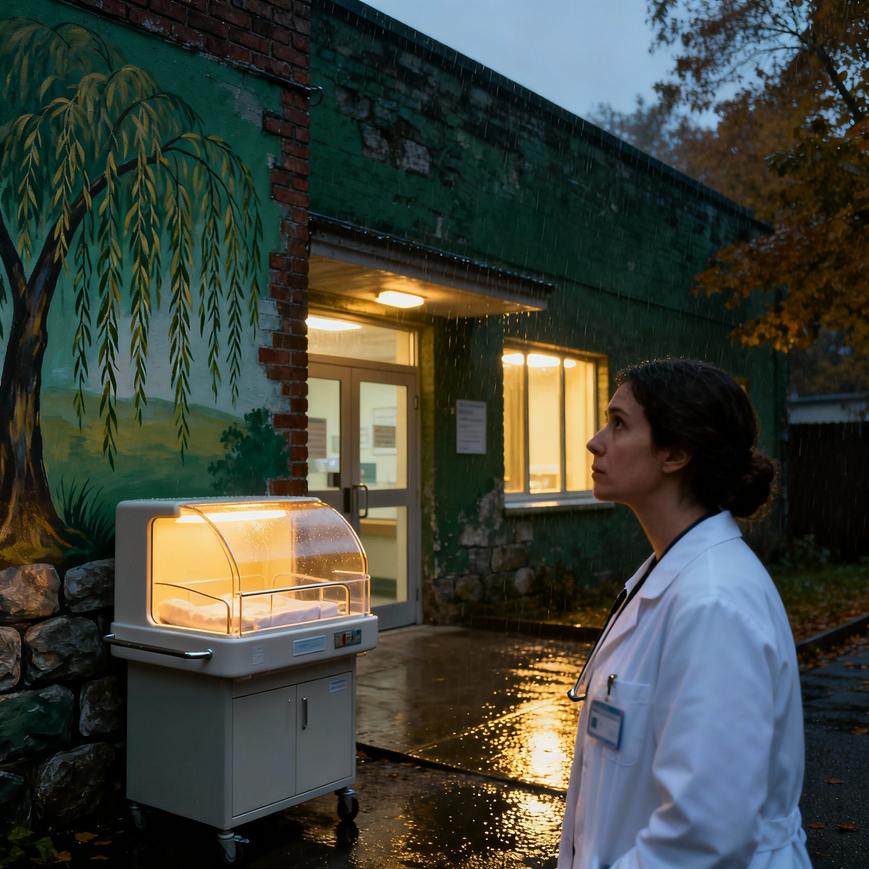
The retired carpenter, Mr. Harlan, built the box in his garage. It was cedar and thick insulation, a little heated cave that hummed faintly if you pressed your ear against it. A woman from church, Mrs. Beal, donated knitted blankets, no two alike. Elena, a fifteen-year-old with purple hair and bitten nails, painted willow branches around the entrance: green with shadow, their tips trailing down the stucco like careful fingers.
Neighbors paused in the autumn drift, muttering. Some crossed the street. Others left pastries or bruised apples near the door, as if unsure whether the box was a mercy or a magnet. Lena fielded questions with hands folded, eyes steady. There were no easy answers under the bright, ruffling leaves.
In the clinic's quietest hours, Lena's phone glowed: a message here, a call there, sometimes just a number that never spoke. Women arrived hunched inside old coats, faces shuttered. More than once, Lena pressed a mug of tea into cold hands, whispering that forgiveness, like safety, sometimes needed hiding places.
Red tape knotted around every decision. Forms signed in blue ink, meetings that spooled out with the slow drag of skepticism. But by November, the box blinked on-a small, silent niche beside the clinic's door, beneath the arc of willow painted branches, waiting.
Some mornings, children in backpacks stood quietly and watched it, as if looking for magic. Lena checked the blankets, folded her hands over small, knitted hearts. She couldn't sleep the night it started to rain and didn't stop.
She heard the bell from her office, a thin chime through the darkness. She moved quickly, practiced in the way of nurses who don't waste time. The city hissed with autumn rain, and Lena's own memory-eight years old, the cracked doll-tugged at her heels.
The infant was wrapped snug, already sleeping. Rainwater dripped off the eaves. Lena's breath made a cloud against the glass. She lifted the baby with careful hands, whispering promises out of habit, out of hope. There was a blanket-soft, crocheted, the very blue of somewhere safe.
She flattened it for warmth, then paused. The stitches danced with an old floral pattern: a spiral of petals, scalloped corners, and in one edge-a slipped red thread, visible only if you knew how to look. Her mother taught the stitch to just two daughters, holding their small hands over yellow yarn in a kitchen that always smelled like soap and cumin.
Lena pressed the blanket to her cheek-not for warmth, but for the ache of recognition. Ana. She tasted her sister's name like a bruise, memory unfurling: the drift apart after their mother's funeral, angry words gone sour, years of silence thick as old soup.
Police lights, council scrutiny, television crews holding out microphones-they came and went. The clinic filled with opinions and casseroles. But Lena said nothing, fingers skimming the blue blanket, keeping the secret with a nurse's practiced silence.
The baby-named Lucia by the staff-stayed in the nursery, drowsy with a peace Lena had only seen in children free of knowing. It took three days before Lena found Ana's note: tucked beneath the bassinet, a brief looping script. No excuse, no apology. Just: "She's safer here. Please love her the way we once promised each other we'd be."
Lena stood at the window, the willow mural trembling in the early December wind. She pressed her fist to her mouth, thinking of all the ways mercy works-sometimes anonymously, sometimes at impossible cost, sometimes in the messy folds of a quilt handed down for generations.
The box became quieter after that-less a controversy, more a part of the ordinary street: branches painted against winter brick, a warm space no one spoke of directly. The neighborhood learned to leave it alone.
Lena met Ana in the church parking lot weeks later. Words hung unsaid between them, as fragile as the doll's cracked eyes once were. They didn't talk about failure or forgiveness, only about Lucia's sleeping smile, how her fingers curled as if knitting all by themselves. Autumn browned the willow leaves, and the wind carried everything unsaid along the quiet curve of Willow Street.
Lena grew in the waiting-small changes, small mercies. She continued her midnight shifts, folding clean blankets, breathing in the hope that arrives, sometimes, by surrender. In the end, the baby box was less about surrender and more about what the community, and family, made room for: not answers, but safety. Not erasure, but a place to begin again, quietly, under willow branches, one deliberate stitch at a time.
A daughter learns to read between the lines of a life split in two
Read more →
A fog-draped night, two souls found, and the quiet shape of a life
Read more →
Story audiobooks for children of all ages — a new one every day on Smarter Way Stories.