Kaiya and the Brave New Shell
Small steps make big courage under the waves
Read story →
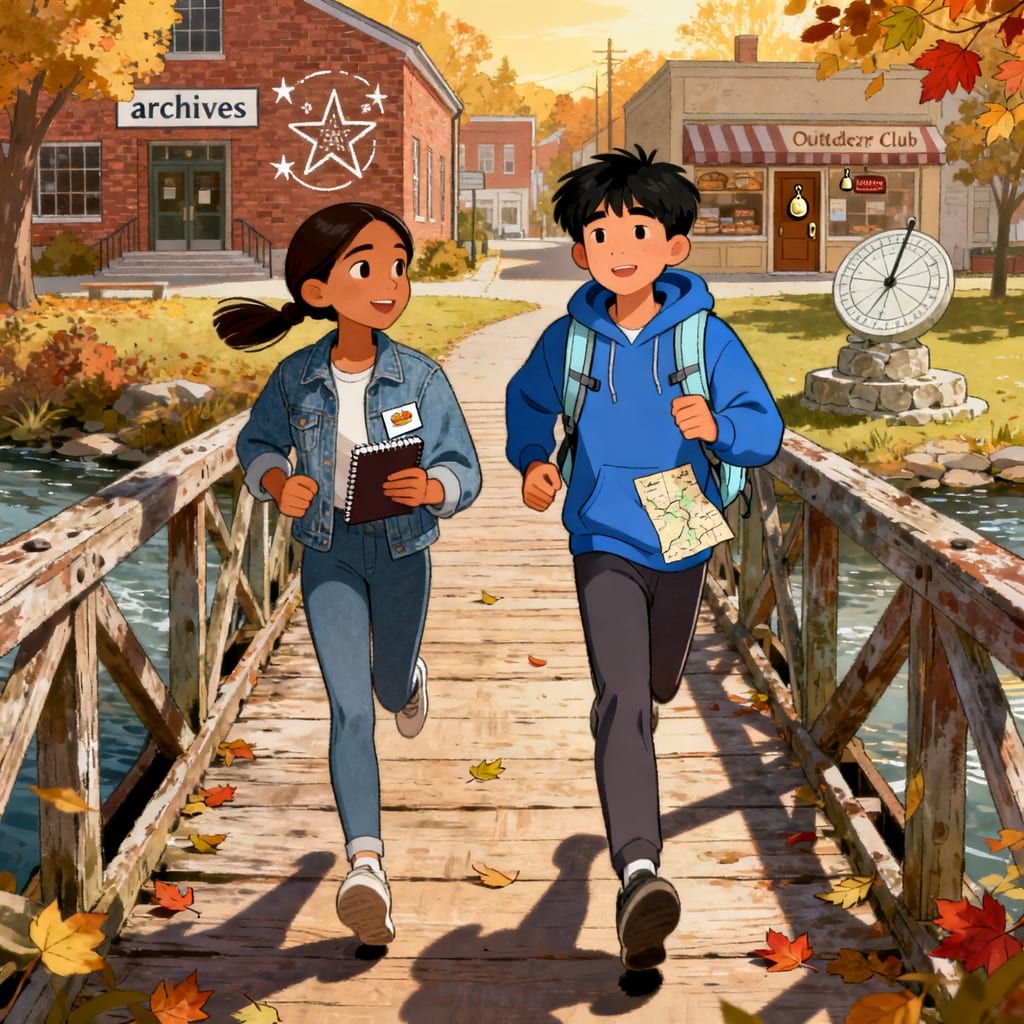
The school's Heritage Dash began with a map only two people could read-ex-best friends Lina and Jayden.
I held the printout like it might burn. Thin lines traced our neighborhood, crisscrossed with in-jokes from seventh grade. The crooked star by the library said, "Secret Galaxy." The little doodle of a cat near the bakery had whiskers we'd argued over for an entire afternoon. I didn't need the bold instructions at the top-Pair up, collect five clues, record a final one-minute oral history-to feel my stomach knot. I could already hear seventh-grade whispers, like wind through lockers.
"Ortega, Park," Mr. Kim called. "You're together. Journalism and Outdoor Club. Perfect combo."
I tucked a loose strand of hair behind my ear and kept my face still. Jayden's jaw twitched. He wore his blue Outdoor Club hoodie, muddy at the cuff, like always. We hadn't spoken in two years. I still remembered the morning my essay appeared on the class forum-my private words suddenly public. I'd blocked his number before lunch.
Now, the Heritage Dash didn't care about old battles. It wanted stories from five town landmarks by Sunday evening: the old footbridge, the river inscription, the community bakery, the park sundial, and the library archives. Every pair had to figure out how to navigate, how to listen, how to not get drenched if the weather decided to make things interesting.
"Let's just...get this done," Jayden said, eyes on the map, not me.
"Fine," I said. "Start with the footbridge?"
He nodded, shoulders set, like he was tightening a pack for a long trail.
By afternoon the river smelled like wet leaves and cold iron. The footbridge's rails were slick from a morning mist, and boards creaked a warning with every step. Jayden tested a plank with his heel. I watched his weight settle, steady and patient. He walked like the bridge was an old friend he didn't entirely trust.
The first clue waited under the middle plank: a painted arrow and a smudge of chalk numbers-3/5-maybe telling us which clue we were on. I crouched, balancing my notebook against my knee.
"Careful," he said.
"I know," I said, even as my sneakers slipped a fraction. His hand shot out, warm around my elbow, then gone. We both pretended not to notice.
At the riverbank, flat stones rose like stepping discs. The instructions said to follow the stones to read an inscription. Water licked at the edges, quick and cold. I hesitated.
"You want me to go?" Jayden asked.
"I can do it." My voice sounded smaller than I wanted.
He didn't argue. He just crouched and tested each stone with his boot. "Step there," he said. "Not the one that shines. That's algae."
With my notebook clamped to my chest, I bounced from one rock to the next. When I reached the last stone, I crouched low. A line of carved letters hid just above the waterline: "Listen where the town keeps time; shadows tell the names." The park sundial. I sketched the carving fast, numbers and curves and a tiny leaf ground into the edge.
Back on shore, wind carried the smell of cinnamon and yeast from across town. My stomach growled on cue. We followed our map past rowhouses and elm trees to the community bakery.
Inside, air warm and sweet wrapped around us. The glass case flashed sugar. A gray-haired man in a flour-dusted apron looked up. "Heritage Dash kids?" he asked, eyes creasing kindly.
"Yes, sir," Jayden said. "We're looking for a clue."
The man grinned and pulled a recipe card from a wooden box. "You have to earn it," he said. "Tell me one story you know about this block."
Jayden opened his mouth, then closed it. He looked at me.
"In fourth grade," I said, "the power went out during winter parade week. The bakery gave out warm rolls so kids waiting for rides wouldn't be cold."
The baker's eyes softened. "My wife's idea. She was good at ideas." He slid us the card. "Take care of this. It's a copy of my mother's sweet-bread recipe. What you need is on the back."
We flipped it over. In neat script: "At noon, the sundial tells more than time. Watch the name that vanishes."
We bought one cinnamon knot, split it without speaking, and ate while walking. Sugar stuck to my fingers. I licked them and pretended not to see Jayden doing the same.
At the park, the sundial stood on a low stone platform, surrounded by bronze plaques with names of donors from different decades. The gnomon-the metal triangle-cast a sharp shadow. Kids played tag nearby, squeals drawing bright lines through the air. Clouds moved like slow ships.
"It says noon," I said. My phone read 11:59.
"Watch carefully," Jayden said. "Shadow's going to slide."
When the minute changed, the shadow inched past a small plaque near the edge. For a breath, the name there disappeared under darkness: E. Navarro, 1987.
"E. Navarro," I wrote. "But why does it matter?"
Jayden shaded his eyes with his hand. "Maybe it's a direction. Navarro Street runs behind the library."
"That's not on the posted clue list," I said. "The library is. Archives."
"Your map shows a star there," he said, tapping the old doodle. "Secret Galaxy."
The words snagged between us like a net.
We had drawn that star at a rickety library table at age twelve, laughing so hard the librarian had shushed us twice. We'd called the archives "Secret Galaxy" because of the way the old binders smelled like attic and moonlight.
As we walked, leaves brushed sidewalks in soft hisses. I wanted to stay focused on the clues, but the quiet kept filling with unsaid things. Finally, they pressed too hard.
"I thought you shared it," I said, not looking at him. "My essay. It was mine." My voice didn't wobble. It landed like a smooth stone, but I felt the shiver afterward.
He stopped on the path. A dog barked somewhere, a short, surprised sound.
"I didn't," he said. "I swear." He slid his hands into his hoodie pocket like he needed them anchored. "My account was locked that week. I forgot my password. I tried to tell you. Every text bounced."
"I blocked you," I said. "Before first period ended." The memory tasted like library paste. "Everyone knew lines from it. The part about my mom working nights. The part about how the house sounded at two a.m."
"I know what it cost you," he said. Not angry. Just full. "I hated that you thought it was me."
We walked again. A jogger passed, headphones bright blue, breath misting. I could feel a door inside me, unlatched but not open.
The library's wooden doors made a faithful thud when they closed. Cool air smelled like paper and dust and hand sanitizer. Ms. Patel at the front desk looked up over her glasses and then lit up.
"Well, if it isn't my favorite mapmakers," she said. "Heritage Dash?"
"We think the final clue is here," I said, showing her the star on the map. "Secret Galaxy."
She laughed softly. "I haven't heard that in a while. Come on."
We followed her down to the archives room, where metal shelves held boxes labeled in careful black marker. The hum of the dehumidifier was steady as a heartbeat. Ms. Patel pulled a thin folder from a box marked LIBRARY EXHIBIT-NEIGHBORHOOD MAPS-SPRING.
"I saved some things when the school forum crashed that spring," she said. "Seemed important. Old tech logs, print cues. Not sure why I kept them. Instinct."
She set the folder on the table and stepped back. Jayden and I stood shoulder to shoulder without meaning to. I opened the folder. Inside: a print queue page with a list of file names and timestamps, and a sticky note in Ms. Patel's sharp handwriting: "Confidential file left on public terminal-please remove ASAP."
A file name burned on the page: ORTEGA_PERSONAL_ESSAY_FINAL.docx. Timestamp: the exact morning my words had flown loose.
"Who printed it?" I asked. My throat worked around the words.
Ms. Patel pointed to a note in the margin. "A substitute. He asked to photocopy student samples for a writing prompt. I told him to use the staff machine, but he was in a hurry. He must've opened your file by mistake on a public terminal. When I saw it in the queue, I called the tech aide. By the time he arrived..."
"It was gone," Jayden finished. He let out a breath like he'd been underwater for two years.
I stared at the page until the letters blurred. The anger I had worn like a jacket slid off my shoulders and puddled at my feet. In its place was something stranger-lighter, but edged.
"I'm sorry," I said, turning to him. The words felt like stepping onto a stone that looked too slick and finding it steady anyway. "I thought you-"
"I'm sorry, too," he said. "For not finding a way to reach you. For giving up when you blocked me. I should've tried harder."
We stood with the hum of the dehumidifier and the smell of old paper around us. Ms. Patel gave us a quiet nod and went to the other side of the room, busying herself with a box that didn't need attention.
I took out my phone and opened the Heritage Dash app. The final task blinked at the bottom: Record a one-minute oral history from your route. Tell a story that belongs to your town.
"This is our town," I said, flicking my eyes to the folder. "And our story."
He half laughed. "It's messy."
"History usually is," I said.
We found a quiet corner by the map drawers. I hit record. The red dot pulsed.
"Once," I began, "two kids made a map. They marked the places that felt like theirs-bridges, a bakery, a sundial that swallowed a name at noon. They trusted each other with stories."
Jayden picked up the thread. "Then one story escaped. It hurt. They stopped talking. Years turned heavy."
"We followed our old lines this weekend," I said. "We found a recipe card and a carved sentence and a shadow that hid a last name. And in the archives, we found a record of what actually happened."
He leaned closer to the phone, voice low but clear. "We found that the worst part wasn't a person. It was a mistake and a silence."
We let the recorder catch a beat of library hum before I tapped stop. The app showed fifty-nine seconds. I could see our reflections in the glass of the map drawer-two shapes a little taller than I remembered, faces older in ways only we would notice.
"Ready to finish?" Jayden asked.
"Yeah," I said. My chest felt open, like windows after rain.
Outside, afternoon slanted gold through the trees. We jogged toward the school, shoes thudding a steady pattern. The footbridge didn't groan this time; we knew which boards to trust. By the river, kids balanced on the stones, laughing when their shoes splashed. The bakery bell chimed as someone went in for warm bread. The sundial's shadow stretched like a careful hand.
At the finish line, teams clustered with clipboards and flushed faces. Mr. Kim waved us over. "You made it," he said. "Upload your oral history."
I hit submit. Jayden lifted a hand, awkward, then turned it into a light fist bump. I met it with my own. Not a promise, exactly. More like a marker on a trail.
"We should probably redraw the map," he said. "Add new stars."
I thought of the archives folder, of Ms. Patel's steady presence, of the way the wind had lifted my hair on the bridge and how he hadn't made a big deal of catching my elbow. I thought of the recipe card and the vanished name and the sharp little pain that wasn't sharp anymore.
"Yeah," I said. "This time with a legend that explains more than streets."
He laughed, and I did, too. Not like we used to-not all at once-but enough to send the old echo moving ahead of us, making room.
On Monday I'd have a draft to write for the school site. He'd have trail markers to repaint for Outdoor Club. There would be awkward pauses. Maybe dumb jokes to cover them. But a door had swung open and stayed that way. We had a map again, between then and now, and enough daylight to see where our feet were going.


Story audiobooks for children of all ages — a new one every day on Smarter Way Stories.