The Map to Welcome Home
An Adventure Day becomes a quiet quest
Read story →
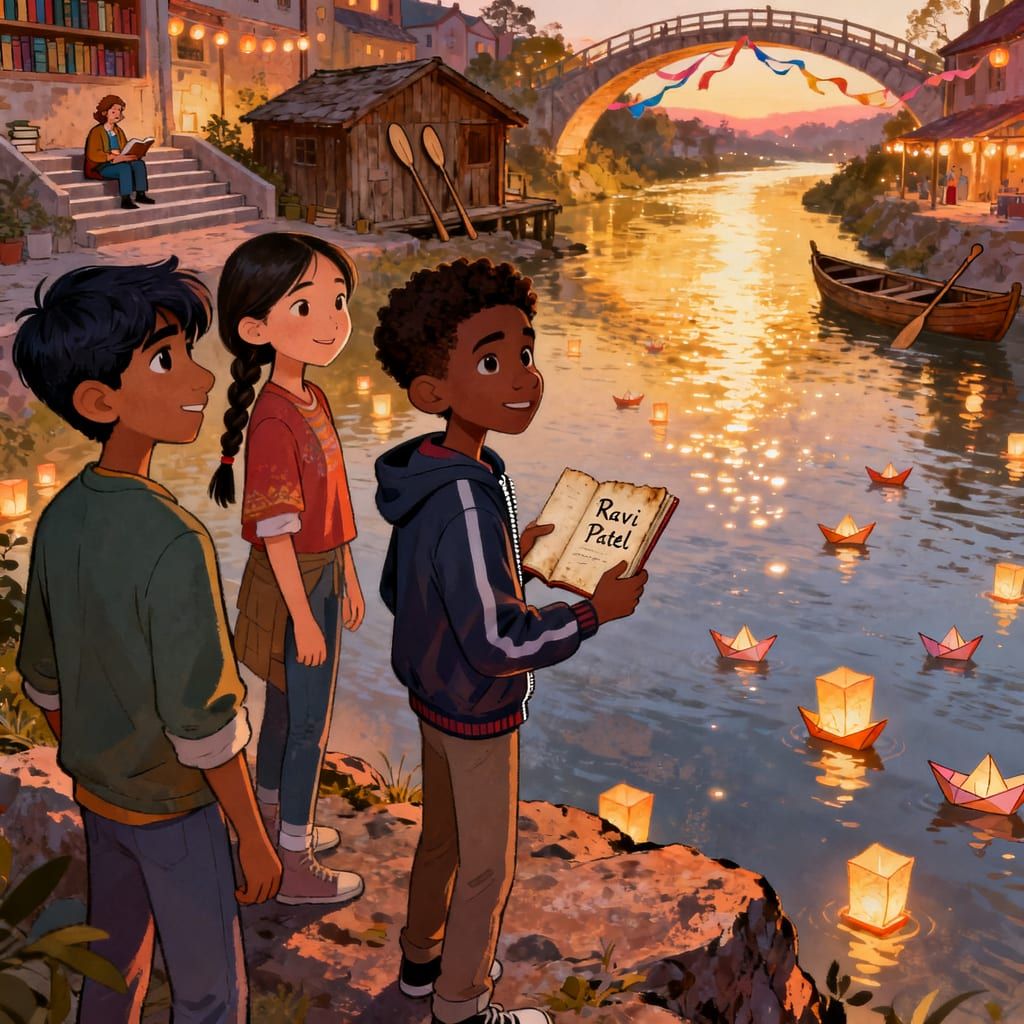
Arjun had a question that wouldn't sit still, even during the noisiest festival of the year.
Music threaded through the riverside streets like bright ribbon. Vendors clanged ladles against pots. Lanterns waited in rows, paper skins folded soft as moth wings. Arjun walked between his parents, their hands brushing as they hummed a tune they'd sing on the main stage later. He nodded when neighbors called his name. He smiled in the right places. But his real attention kept slipping inward, like a pebble dropping through water.
He didn't want to break anything. Not the songs. Not the way his dad's voice warmed the word "welcome." Not the way his mom always touched his shoulder right before the lanterns were lowered to the river. Still, the questions moved beneath him, restless as fish.
The community adventure challenge sounded like a perfect distraction-maps, clues, sprinting from place to place, doing it all with his friends Mei and Jamal. Their class had split into teams that morning. The rules were simple: hit the checkpoints, solve each clue, notice more than you think you should.
"Team River Riddlers," Jamal declared as he slapped the folded map against his palm. "Ten points for best name."
"Zero points for bragging," Mei said, already scanning the first hint. "Meet on the library steps. Listen for a story that isn't on the page."
They ran, dodging strollers and a dog in a bandana. The library steps were warm from the sun, and the brick smelled like dust and old rain. A storyteller sat near the door, reading to a circle of kids who leaned forward, open-mouthed. For a moment, Arjun wanted to sit too. He loved the way voices made pictures.
"Listen for a story that isn't on the page," Mei repeated. She closed her eyes. "Hear that? Not the reading. Under it."
Bicycles ticked as their wheels cooled. A fountain hissed somewhere close. Wind tugged at a string of bells and made a thin silver sound. And from the far end of the plaza came a melody from an old radio, not quite in tune, patient and hopeful.
Jamal grinned. "That's our story." He pointed to a plaque by the railing: A line from a poem about rivers carrying what we place in them. On the back of the plaque, a small sticker with the challenge logo held their next clue.
"Symbols speak," Mei read. "Find where oars sleep. Look where sun and varnish make a secret."
The boathouse sat low and long by the docks, its wooden sides dark with years of weather. Inside, the air was cool and smelled of rope, oil, and river. Dust swam in shafts of light. Oars were stacked like sleeping limbs along a rack, polished smooth by hands.
"Where sun and varnish make a secret," Arjun said softly. Morning light slanted through a high window and flashed off a glossy blade. He ran his fingers along its edge and found, tucked behind a crate beneath the rack, a thin, weathered journal tied with a fraying ribbon.
"That can't be part of it," Jamal said, but his voice dropped.
"Maybe it is," Mei said. "The instructions said notice more."
Arjun loosened the ribbon. The first page was stained where a water drop had dried decades ago. On the inside cover, careful printing spelled a name he knew by heart: Ravi Patel.
He stared at the letters until they blurred. His grandfather's name. His grandfather who had taught him to make paper boats that didn't tip, who smelled like cardamom tea, who had passed away last winter after a gentle month of goodbyes.
"You okay?" Mei asked.
Arjun nodded, but the nod didn't feel loyal to what he felt. He brushed his thumb over the name as if it were a braid that might come loose.
He turned a page. The entry was dated during a River Lantern Festival forty years ago. The handwriting tilted forward, eager and a little unsure.
I like the songs, it read. I like the way the river answers back in light. But sometimes I don't know what I believe. I want to. I want to because it feels like standing near a campfire-warm for reasons I can't fully say.
Arjun swallowed. His chest filled with something that was not quite relief, not quite ache. He read more.
Today I sat by the docks and listened to birds. They didn't argue with themselves about whether the sun rose. They just sang. Maybe my questions aren't enemies. Maybe they're birds I'm still learning to recognize by sound.
He closed the journal for a second and held it against his shirt. The wood of the crate pressed into his knee. Outside, someone shouted across water, and a gull answered like laughter.
"Next clue?" Jamal asked, gentle now.
They found it taped under the oar rack: a drawing of a footbridge with a narrow path behind it and the words, Count what carries you over.
The footbridge arched over the narrowest part of the river like a cat's back. Planks flexed softly under their steps. On both rails, tiny ribbons fluttered-blue, gold, cotton printed with stars. Each ribbon, Mei explained, was tied by someone making a wish or a thanks.
"Count what carries you over," Jamal said. "One: these boards." He stomped lightly. "Two: the rope. Three: the bolts. Four: the people who built it. Five: the river that allows it to be a bridge at all."
Arjun laughed. "Philosopher Jamal." His laugh came out looser than he expected.
A woman paused near them, struggling with a heavy bag and a stroller wheel that snagged between planks. Without speaking, Mei crouched and lifted the wheel while Jamal took the bag. Arjun steadied the stroller's handle. The woman's face softened. "Thank you," she breathed.
Arjun's palms tingled. The ribbon near his hand ticked against wood in the breeze, like a clock.
On the other side of the bridge, another sticker gleamed beneath the rail. The clue read, For the last point, rise early. Bring light, or bring a promise. Meet the day above the river where the first boats look small.
Mei pointed at the map. "That's the overlook. Sunrise."
"Bonus for noticing kindness," Jamal added, reading the small print beneath. "We just got that." He bumped their shoulders, one then the other, as if to even the score.
They sat on the grass awhile, legs long in front of them. Arjun opened the journal again. He read about lanterns lit in cupped hands, about a boy who wanted to feel the same glow inside without pretending. One line hooked him and held: I think I can love the people who love the rituals and still let myself ask what the rituals mean to me.
Wind pushed at his hair. On the far bank, someone practiced a festival song, the notes wobbling sweetly.
They met in the blue hour before dawn, breath clouding as they climbed the trail. The town below looked smaller without its noise, its roofs soft with mist. The river lay long and quiet, holding the moon's last sliver.
Other teams gathered in pairs and trios, sleepy but buzzing. A teacher checked off names with a flashlight. "Leave something meaningful," she reminded them. "A note, a drawing, a promise. Then watch. Just watch a minute."
Arjun sat on a flat rock with Mei and Jamal. He set the journal on his lap and flipped to a page whose edges were darkened by many thumbs. The entry listed small things: the smell of oranges at midnight, the scrape of a match, a cousin's joke that made everyone drop their careful tones. At the bottom, a line in different ink-maybe added later-said, I don't think the river is asking me to be certain. I think it's asking me to be honest and kind.
He didn't know if his grandfather had meant for anyone else to read these words. But the ribbon had been loose. The journal had been easy to find. And isn't that what you do with a light? You set it where someone can see.
"What will you leave?" Mei asked.
Arjun unfolded a small piece of thick paper. He had drawn a simple compass the night before without really knowing why-four points, a steady needle, a ring of river around it like a world. Now he understood more than the lines had told him. He wrote in tiny letters: Keep looking, keep listening, keep warm.
Jamal placed his ticket stub from the kiddie boat rides, an inside joke that meant more than it looked. Mei tucked a braid of grass that she'd tied on the trail, ends neat and true.
They stood as the first light broke. It came slow, then all at once, and the river accepted it the way it accepted everything-boats, leaves, lanterns, questions.
Downstream, early boats moved like small stars set carefully adrift. Someone's whisper reached them from the far end of the overlook. The whole group went quiet without being told. Arjun felt the quiet go inside him, past the noise of should and must, past the humming songs he still liked, to a place that could hold more than one kind of light.
He placed the compass drawing under a stone beside the path, where others had left folded notes and chalk sketches. He set the journal next to it for a moment. Then he picked it up again, uncertain. Was it his to give?
He turned to the back page and found one last short entry that made his throat tight:
If you find this, I hope you are someone I love. I hope you are curious. Keep walking with us, even if your steps are your own.
He exhaled. "I'll bring it tonight," he said to Mei and Jamal. "To the community table. People should see it. My parents should see it."
Mei squeezed his shoulder. "Good plan."
Jamal zipped the map into his jacket. "Best treasure we could've found."
By evening, the town was a bright river of people. Drums thumped in friendly patterns. Strings of lights drew gentle halos on faces. Arjun's parents found him near the stage, cheeks ruddy from singing. His mom's scarf had slipped to one side; his dad's shirt was dusted with glitter from the craft booth.
"I found something," Arjun said before his courage could wobble. He held out the journal. "At the boathouse."
They read the name. His dad's eyebrows lifted. His mom put a hand to her mouth, then lowered it and smiled in a way that carried many years.
They stood shoulder to shoulder and read. His dad's thumb smoothed a crease as if calming it. His mom laughed softly at the orange entry. When they reached the last page, all three of them were quiet, but it wasn't the kind that left a gap. It was the kind that built a bridge.
"I wondered, too," his mom said after a moment, eyes bright. "When I was your age. I didn't know how to say it without sounding ungrateful."
His dad nodded. "Asking is part of growing. Your grandfather asked, and he led our songs anyway. He led them with his whole heart."
Arjun let out a breath he hadn't realized he'd been rationing. The sounds around them sharpened-the skirl of a flute, the soft slap of water against the dock, the murmured greetings weaving a net of care.
They carried their lantern to the river, the three of them. His dad cupped the match. His mom steadied the paper shell. Arjun reached into his pocket and took out the compass drawing. He slipped it beside the little candle so the inked needle pointed toward the current.
"Ready?" his dad asked.
"Ready," Arjun said. He felt ready in a way that didn't mean finished. It meant he could begin and keep beginning.
They knelt and lowered the lantern until the river took its weight. Light trembled, then steadied. The boat drifted out, joining others that bobbed and turned like a conversation.
Later, at the community table where anyone could leave something for anyone else, Arjun set the journal in the center. He folded the ribbon beneath it but didn't tie a bow. A small card stood in a wooden block nearby: Share what helped you. He slid the journal against it.
Kids and grown-ups moved through, pausing to read, to touch, to think. Mei and Jamal sidled up with paper cups of sweet tea. "You did it," Mei said.
"Yeah," Jamal added. "And we still got second place." He grinned. "Which I will complain about forever."
Arjun laughed. The question inside him was still awake. But it had stopped pacing. It sat with him now, legs swinging over the river's edge, watching the lanterns and the people who loved them. He could walk with all of it-the songs, the stories, the quiet-and find his way one careful light at a time.
A neighborhood search, a steady dog, and a new plan
Read story →Story audiobooks for children of all ages — a new one every day on Smarter Way Stories.