Grease and Grace at Spoke House
In a shuttered laundromat, a city learns to roll again
Read more →
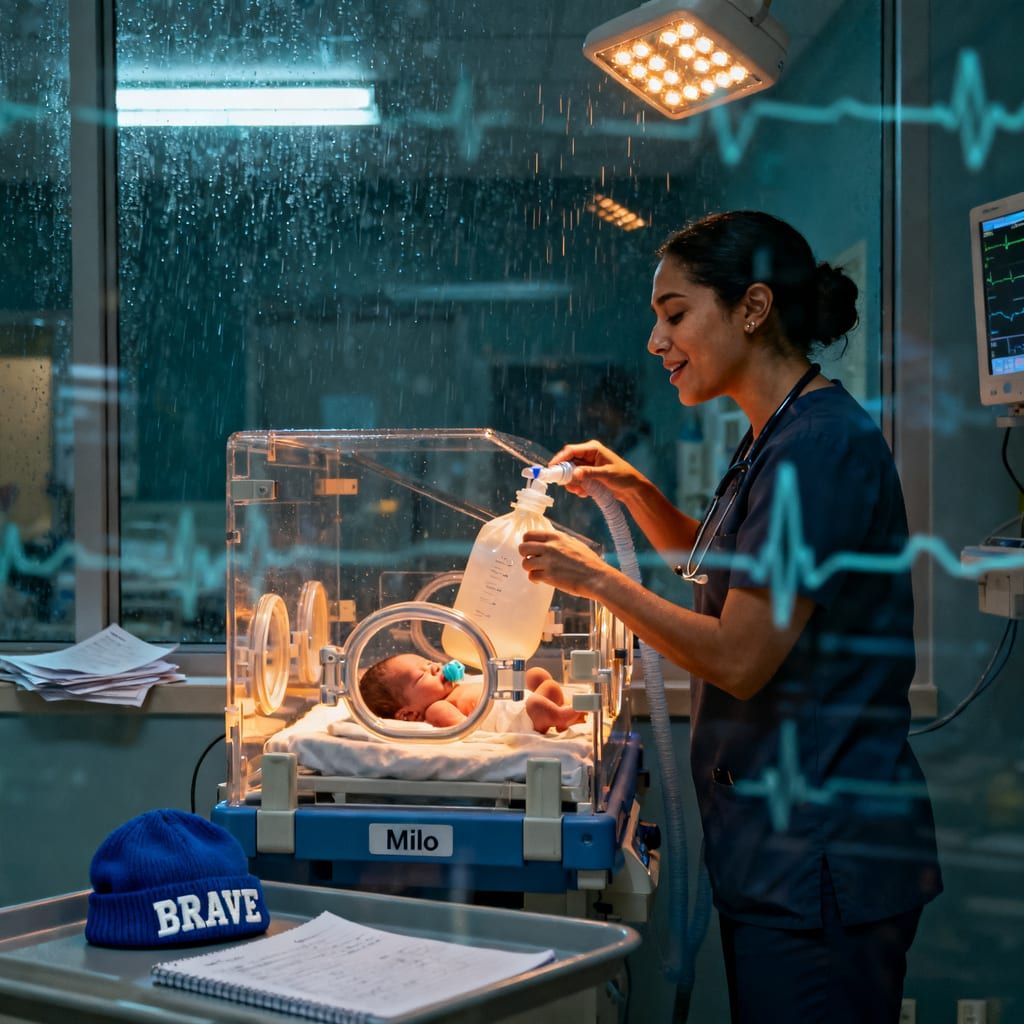
By the time the city exhales and the elevators stop announcing visitors every five minutes, Nora Alvarez knows the rhythm of the night. She moves through the NICU like a careful tide-checking lines, calibrating drips, whispering steady words to tiny fighters in their clear, humming worlds.
Her tune follows her, uninvited. A fragment of comfort she never learned on purpose. She hums as monitors blink, as pumps sigh, as oxygen hisses in the hush between alarms.
Milo is twenty-six weeks and the color of a sunrise still considering itself. In his isolette the heat is precise and the humidity keeps guard. His ribs show the mathematics of breathing-how the smallest rise can count as victory.
His father comes nightly with a notebook of questions. How much weight gain counts? Why does his chest dip there? When will he know we're his? He asks them softly, as if loudness could bruise the air.
His mother lingers at the threshold, hands hidden in sleeves, eyes refusing the reflection in the plexiglass. She traces the edge of the door with her thumb as if testing for splinters.
Nora learns not to hurry her. She leaves a tissue box placed two inches closer one night than the night before. She dims the overhead lights a touch more when the mother visits, pretends the switch needs two tries.
Her ritual begins almost without permission: three lines on a card no bigger than a matchbox, tucked near Milo's isolette where only a parent would notice.
you're doing enough.
you're doing enough.
you're doing enough.
She writes it as though one repetition is not truth until it's repeated twice.
Lyle, the respiratory therapist, wears his exhaustion like a shrug. He calls the work a tide that only takes and then laughs, but without humor, as if the joke reached him through several closed doors.
"You humming snowed me into staying through my break," he tells Nora one night, clicking a ventilator screen back to its gentle loop.
"Occupational hazard," she says. "Consider it free anesthesia."
He huffs. "Cheaper than coffee." He lingers at Milo's doorway longer than his list requires, his fingers hovering over the tubing the way some people hover over a sleeping child's hair. His badge photo shows a man seven years younger and four thousand nights less tired.
Nora moves, quiet as a metronome. Warm blankets, a clean syringe, a steady hand. In the hush between alarms she tells Milo about sun-warmed laundry-how shirts hold the afternoon light in their cotton. She tells him about the noise of a city waking up: buses releasing breath, dogs clattering nails on sidewalk, a barista's first hiss of steam like a promise.
"You haven't earned this yet," she whispers. "So I'm lending it."
He flexes-startle reflex, anyone will say. Nora believes anyway.
The storms come hard that week. Rain needles the windows and turns the parking lot into a mirror pitted with lights. The intercom stutters with late arrivals and lost umbrellas. The generator's maintenance sticker says last inspected in a month she doesn't like.
She pockets a knit blue cap from the volunteer bin on a break she forgets to take. The cap is the size of her palm. The word BRAVE is stitched in white that puckers slightly at the edges. She turns it over once, twice. Not yours, she reminds the small, secret place that wants to keep it.
It happens in the way bad things sometimes do-first a flicker, then the steady on-off of a toy you'd swear you replaced batteries for. The monitors stutter, alarms flash, a rising chorus that stops so suddenly it is another kind of siren.
For an instant there is only breathing. Human. Soft. The hiss of oxygen keeps time like an old clock ticking from another room.
Training hooks into Nora's muscles. She is already moving before anyone names the thing. Hands position a mask. She squeezes the bag-one and two and three and release. Rainbow tubes snake from stands like seaweed, swaying with the motion she makes.
"Bag until we land the backup," Lyle says, voice like gravel sliding. He is already at the next bed.
Parents are shepherded to the hallway. Milo's father drops his notebook and pages scatter-frantic birds. His hands snatch at lines of questions now turned to confetti.
"Sir, with me," someone says, and he goes because to stay would break him.
The stairwell becomes a lifeline as they transfer the smallest first, then the merely small, step by counted step to the lower floor where the backups hum steadier. Nora hums too, that same tune, the one that never announced its origin. Her breath matches the squeeze and release.
Milo's weight is less than a sack of oranges. His chest rises, a tide obeying a stubborn moon. Tiny fingers find the edge of a rolled towel and curl as if to hold on to the idea of here.
"Keep that rhythm," Lyle says behind her, and for a beat it sounds like a blessing.
They move as if rehearsed, which they have been. Eyes track skin tones, the blanch and return like tidefoam. The hiss of oxygen, the squeak of rubber soles, the soft stammer of an older nurse's prayer.
Then-hafta of an hour or twelve breaths or seven corridors later-the backups hold. Lights steady. The monitors reboot, their green and gold ready to narrate.
The chaos ebbs. It leaves a bright ring around everything, like water that has retreated from shore.
A day-shift nurse appears with a battered binder for incident notes-a relic held together by tape and habit. It smells like dust and lemon cleaner. The cover is a collage of unit stickers and an old label maker's insistence: NICU-LOG.
Nora takes it to the break room at dawn when the sky outside is washed to gray silk. She writes what needs writing: times, initials, actions. Her fingers tremble and then stop.
When she closes the binder, a page flutters free and lands faceup. A Polaroid of a preemie dated the year she was born. The ink has bled a little at the edges, pooling into the soft blur of skin.
Beneath it, a looped script: For Nora A., who learned this lullaby before her lungs did.
Her name. Her year. The hum in her chest finds its source and breaks into a different kind of breath. Something unknots; something else takes its place, familiar as a song you didn't know you knew the words to.
She lifts the photo with a care that is almost reverence. The baby's hand is the size of a thumbnail. A knitted cap-white-tilts like a crown.
Lyle steps in, salt stains up his pant legs from unknown floors. He sees her face before he sees the picture.
"You okay?" he asks, softer than he was built to sound.
She turns the Polaroid so only she can read it again. She presses it flat on the table and smooths the curl of the corner with her thumb.
"Yeah," she says. "I think I've been okay longer than I knew."
They repair the unit in a week. Milo's numbers begin their gentle climb-oxygen down, grams up. The arc that means more mornings crowded into afternoons instead of the other way around.
Milo's mother starts coming closer. One night she stands with her palms around a cup of hospital tea as if it might tell her something. The next, she leans against the isolette's edge and watches the blue line of Milo's saturation hold steady for ten full minutes without dipping. She exhales like someone who has been wearing a too-tight dress for months.
On the third night she slips one fingertip into the porthole. She doesn't look at Nora. She looks at Milo, who curls that miniature finger around hers because the reflex insists and because it's a good rule to follow what insists on love.
She stays.
Nora brings the knit cap from the volunteer bin. She almost says she found it and then doesn't-what matters is the giving. She almost keeps it, because the word stitched in white feels like a private answer, but she hands it to Milo's father instead.
He grins like a man surfacing. "BRAVE," he reads, and for the first time his voice doesn't break on the B.
Lyle lingers in the doorway. A machine chirps to say everything is fine and he laughs as if someone just told him a very old joke he finally understands.
In the waiting room a new card appears tucked beside the coffee machine, written in a careful, familiar hand: To the next parent who thinks they can't do this-you already are.
Nora finds it on her way in and leaves it where it is. Some notes are meant to be stumbled over.
At noon on a Thursday, a postcard lands in the break room, smudged with fingerprints and something like joy. Milo with cheeks like bread rolls, eyes open to the light as if it's a friend he remembered. The postmark is last week. The scrawl says: Home. Thank you. We'll never hear a storm the same way again.
She pins it beside the old Polaroid with two identical pushpins. The space between them feels like a bridge she's been crossing all along. On one side, a baby who learned a song before her lungs did. On the other, a boy who learned the world in the quiet hours between heartbeats.
The vending machine thunks awake. Someone in scrubs argues gently with a resident about whether sleep counts as a luxury or a skill. Nora hums without looking for the note. It finds her anyway.
When the next storm rolls through and the windows blur with rain, she walks the unit with her careful tide. She checks lines, calibrates drips, and whispers steady words into the humming air.
The lullaby holds. It always has.
Story audiobooks for children of all ages — a new one every day on Smarter Way Stories.