The Silence Between First Cries
A night of rain, light, and belonging
Read more →
On the first morning The Common Bowl opened, the bell above the door chimed like it was testing its voice. Rain had left the sidewalks with that metallic smell that hints at starting over. Sahana taped a handwritten sign beside the register, pressing the blue painter's tape hard with her thumb.
Everyone eats. Pay with cash, time, or a recipe.
She stepped back and looked at the words as if they might change under fluorescent hum. Her palms were damp. The soup-chana dal simmered into gold-breathed from the pot in slow, steady waves. Rice waited in its stainless tray, fluffed like a plan you can count with your fingers.
Okay, then. Begin.
They came as if someone had whispered her address into the wind. A nurse with tired eyes and a red line on her cheek from a mask. Two men in work boots who counted coins twice and folded bills once. A gig driver who kept his phone on the counter and watched a pink dot crawl across a map.
A retiree in a trench coat scuffed smooth at the hem warmed his hands by the steam. "Potatoes?" he asked, hopeful as a child.
"Dal today," she said, lifting the ladle. "Potato on Thursday if the produce guy loves me." He smiled with half his mouth. When she set the bowl on the tray, his fingers shook.
People paid. Some with five-dollar bills, soft from pockets. Some with change that rang like small bells. One woman slipped a recipe card under the tip jar-a family red bean stew-then took her bowl and sat with her back against the window like she belonged to it.
Sahana kept her eyes level when hands were empty. Her thanks weighed the same no matter what crossed the counter. She scraped the foil pan with the edge of a spoon to get every last bit. When the room emptied for the lull between lunch and night shift, she stood in the pantry doorway and counted cans like rosary beads, knowing the order of the labels by heart.
A local reporter with a camera the size of a loaf of bread came on a Wednesday. He asked gentle questions, snapped a picture that made the cafeteria chairs look charming. The piece called her "a beacon" and the blocks started sending more people-retirees with stories, quiet men with gentle hellos, nurses who smelled of antiseptic and coffee.
Then the blogger happened.
He had a jaw like a doorstop and a voice that smiled when his eyes didn't. He bought a bowl, photographed it, and later the words landed on her phone with the violence of a dropped pan: performative charity... magnet for freeloaders... undermines real work.
The next day the jar collected more air than money. The landlord left a message he swore was just to "touch base." The word "base" suddenly felt like a place you could fall through.
"People like free things," a man in a neon vest told her over a bowl he didn't pay for. "But they don't like paying for people who like free things." He said it without malice. Just a fact the way a bus schedule is a fact.
She made stew and smiled and straightened the napkin dispenser and washed her hands until the skin at her knuckles cracked. At night she fell asleep to the thrum of the refrigerator and woke to the math she couldn't bend.
You started this. No one asked you to.
One night the thunder stitched the sky shut. The prep list leaned against the salt with a sigh that felt like her own. She was wiping the counter clean for the sixth time when she saw it-an unmarked envelope by the shaker, pale as a bone.
Her first thought was a health inspector. Her second, a prank.
Inside, thick paper. Rent for three months. A slip of notebook torn jagged at the edge. For the bowls we didn't have once.
The words reached a place in her chest she didn't know was still tender. She looked up as if the donor might be standing in the doorway with a halo of kitchen light.
She imagined a tech person passing through, moved by novelty, soothed by absolution. She imagined a woman wearing good shoes and a practiced smile. She told herself not to imagine at all.
She hid the envelope beneath the register, shut down the lights one by one, and listened to the rain negotiating with the awning.
He was there at dawn, thin against the wind, the trench coat hanging like a remembered habit. Mr. Delaney had been coming since the second day-the man who asked for potatoes, who ate slowly, eyes on a point only he could see.
He held a napkin, folded careful like church. "Didn't want to catch you in the rush, miss," he said. "Got something for you." He slid the napkin across the counter with two fingers. On it, written in shaky block letters: Nora's Potato Soup.
"Your wife's?" Sahana asked, because it felt right to say her name.
He nodded, chewing a thought. "She-well. She made it when the money got low. The trick is you fry the onions long enough to forgive you." He didn't meet her eyes. "And if there's milk, all the better, but water'll do. We ate it out of mugs so it felt like more."
He tapped the corner of the napkin and swallowed. "About last night," he said, and the air inside the café changed. "I can do the pots. After close. No one has to see me." He breathed once, as if surfacing. "I can pay what I owe with this."
The realization came quiet, not like a bell but like a hand on a shoulder. For the bowls we didn't have once. His nails were yellowed at the tips, nicotine stained. The collar of his coat remembered more winters than he did.
"I don't want-" He stopped, cleared his throat. "I didn't want you to look at me like I was a hole in your boat."
Sahana touched the napkin. "Then look at me while I say this," she said, and waited. When his eyes finally rose, she let him see how full her face felt. "Thank you. For the envelope. For the recipe. For trusting me with your after-hours."
The laugh he gave was more exhale than sound. "Sink and me, we're acquainted," he said. "I used to be a custodian. Before all this," he added, as if the whole country were a room they had both been asked to leave.
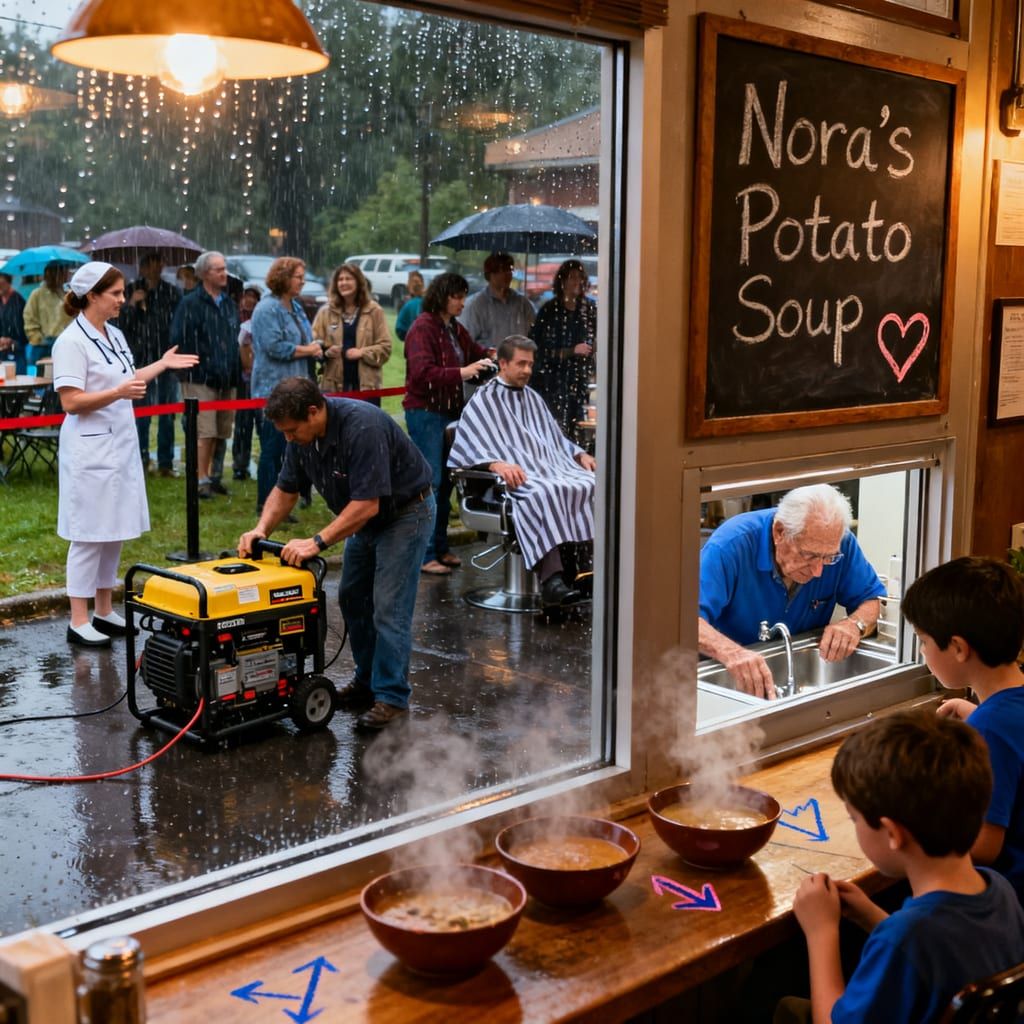
She wrote Nora's Potato Soup on the chalkboard and drew a small heart beside it. When the first bowl left the counter, the cook line clapped its spatulas in a quiet syncopation. Mr. Delaney held his shoulders in a new way, as though his spine had been reminded of itself.
A week later the sky pulled the plug on the block. The freezer clicked, shuddered, died. For a heartbeat, there was only the drum of rain and the swear she didn't let reach her lips.
"Coolers," she said into the dark, because movement was the only kind of prayer she knew. She dragged the heavy lids open while the remaining cold had authority. Packages of chicken, bags of peas like little emerald pillows. Ice melting in patient sheets.
The door banged, then swung wide. "I got a generator!" the barber from two shops down called, rain tattooing his shoulders. Behind him, the neighborhood assembled as if summoned by an instinct older than their leases.
Someone wheeled over a propane grill, its legs wobbly but willing. A nurse divided the line with two cones and a roll of tape, voice crisp and kind. Kids chalked arrows on the wet pavement, the colors smudging into bright rivers. The UPS guy, still in uniform, balanced a stack of spoons on a pallet jack like a joke he'd just invented.
"Fire in three," the barber said, pulling a cord hard. The generator coughed, then settled into a throat-clearing hum. The café lit up, not pretty, but brave.
Sahana ladled like a woman possessed. The chicken went on the grill with a hiss like praise. Nora's soup took to the pot with the grace of something finding its way home. Mr. Delaney, sleeves rolled, worked the sink, the steam softening his hair into boyhood.
Halfway through the downpour, a man with a soaked baseball cap cupped his hands around a bowl like it was a bird. She knew his jaw before she knew his name.
"Hey," the blogger said, not meeting her eyes. Rain dripped from his chin. His phone stayed asleep in his pocket.
She handed him potato soup without a pause. "Seconds for the walk home?" she asked. The question landed between them like a coat someone had held out.
He nodded. No speech. No lesson. Just heat in the hand.
He returned the next day with a camera, but he didn't aim it like a weapon. He pointed it at the street where the chalk ghosts still glowed. He framed the barber angling the generator, the nurse moving people forward with a touch on the elbow, the UPS guy wiping spoons on his shirt like it mattered.
He photographed the wall by the register. The ledger had started as a joke-a way to keep track that wasn't keeping track. Paid: $0. Paid: my recipe. Paid: an hour Tuesday. Paid: I sang to your radio while I swept.
He wrote what he had missed the first time. The piece didn't go viral for her face. It went viral for the hands-rough, brown, pale, ringed, unadorned-offering and taking like two steps of the same dance.
The jar grew heavier without bragging. Pledges landed with the grace of raindrops: small, steady, surrendering to a larger shape. The landlord came in for lunch, said nothing about base-touching. Left a twenty. Came back with his wife.
The Common Bowl didn't swell into myth. The freezer still rattled when it woke. On Sundays, Sahana still counted cans until the paper labels looked like a blur. There were hard days when the jar yawned like an open mouth and the inbox thickened with need.
On those days, she pulled open the drawer and read the torn slip-For the bowls we didn't have once-and felt the room steady around her, like a ship that remembers where the deep water is.
After close, the music turned low. The chairs stood on tables like sentries. Mr. Delaney at the sink, sleeves damp, whistled a tune that couldn't decide if it was happy. He'd shown her how to angle the pans so the water did more of the work. He told her Nora baked biscuits once in a toaster oven on a coffee table when their gas got cut off. "They tasted like rebellion," he said, as bubbles clung to his wrists.
She folded towels, stacked them into neat white spines. Wrote the next day's menu in chalk-dal, rice, Nora's Potato Soup with a heart drawn shyly beside it. The heart smudged at the edge where her hand had brushed, leaving a soft thumbprint.
At the door, Mr. Delaney tugged his coat close. "Boss," he said, testing the word and letting it go. "Thanks for the shift no one sees."
She looked at his posture, the way standing at the sink had lifted something inside him. "Thank you for the thing everyone feels," she said. He nodded like a man who'd found the right bus after years of wrong ones.
Outside, the street shook water from its shoulders. Inside, the kitchen held the day's heat like a secret. She turned the sign to CLOSED, but the promise on the paper still faced the glass, letters steady in the reflected light.
Everyone eats. Pay with cash, time, or a recipe.
She locked up and listened, for a moment, to the hum of the refrigerator returning to itself. The bell above the door was quiet, catching its breath. In her pocket, the note warmed under her thumb.
For the bowls we didn't have once. The words sat there like a hand and a reminder. She clicked off the last light and stepped into the night, the smell of rain and onions following her down the block, the price of a warm bowl not counted in dollars, but in the way a man stood taller after dishwater and steam.
Story audiobooks for children of all ages — a new one every day on Smarter Way Stories.