The List of Last Chances
Nights, names, and the quiet work of not giving up
Read more →
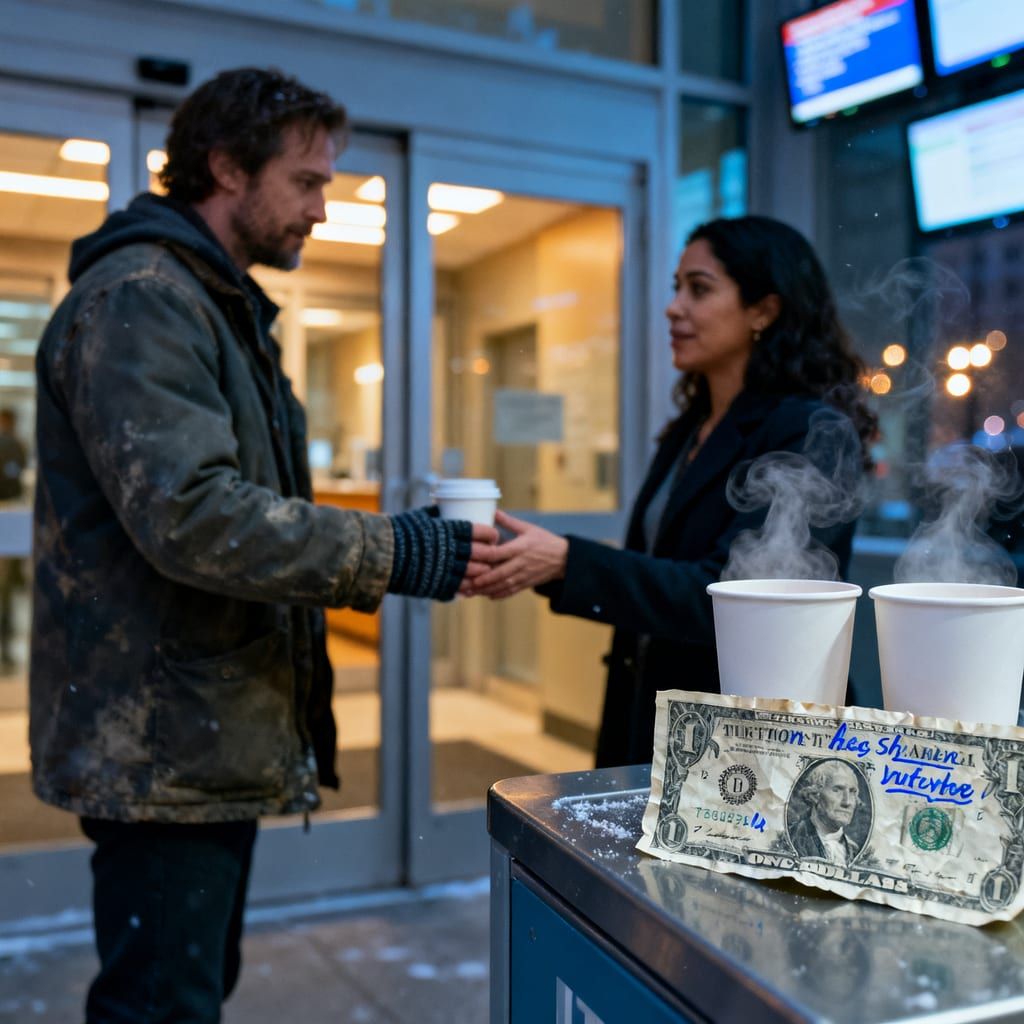
The dollar stared back from Washington's collarbone like a dare.
When Lena cracked a twenty at the South Loop bodega, the cashier slid her a crumpled single tattooed in blue ink: "When you need a sign, this is it. Buy two coffees. Give one away. - R."
Her first feeling was annoyance-at the universe for being corny, at the bill for being bossy, at the way the letter R leaned like a person catching their breath. She folded the single without meaning to, pinched it tight enough to smooth its wrinkles into her palm.
She was late for a pickup, the app chiming like a small, persistent conscience. The windshield wipers groaned. Outside, Chicago pressed winter to the windows: a slurry of old snow and fresh wind, streets shining like they'd been licked by something cold with bad intentions.
The hospital rose up at the end of the avenue, all glass and lit rectangles. Lena had been avoiding it, which was an art she practiced: circling blocks, pretending there were faster routes, finding excuses that sounded reasonable said out loud. Not today, mom. Not that hallway. Not that coffee kiosk with its syrup bottles and the woman who used to know your order.
The dollar warmed under her glove. It was ridiculous to let a piece of paper steer. It was also ridiculous to keep not saying the words she owed. Between two ridiculousnesses, she took the exit she never took and slid into a thirty-minute parking spot like it could break the spell.
Inside, steam stitched the air. The kiosk hissed and breathed like a small engine. Someone laughed too loudly; someone's phone chirped a melody like an apology. Lena ordered two coffees-nothing elegant, just drip with room-and stood with both cups, heat licking at her fingers through the cardboard.
She hovered by the automatic doors. People ghosted past-badges bouncing, scarves unlatching from throats. She hated herself a little for waiting on generosity with a deadline. Who do I think I am? The question came in her mother's voice and her own.
A man sat on the low stone wall that edged the indoor planter. His hands were wrapped in fingerless gloves that looked clean in the way you maintain when clean is a thing you work for. His posture wasn't collapsed. It was formal, careful, as if the world was a table and he'd been taught not to bang his cutlery.
"Would you-" Lena started, and stopped, and tried again. "I have an extra. It's hot."
He looked up like he'd been expecting a quiz. Brown eyes, a weather-creased face, a beard that had gone rogue and then been convinced to try again. He reached for the cup like he was being handed a glass ring.
"Thank you," he said. "That's decent."
Decent. Not kind. Not saintly. A word with soles on it.
When Lena slipped the marked dollar back into her pocket, she fumbled, the bill flared, and he saw the blue scar of it.
He went very still.
"Can I see that?" he asked.
She handed it over before she had time to craft a reason not to. He read the words as if there might be another message hidden in the fibers.
"My brother," he said finally. "Rafael. He used to write on singles when he was getting chemo. Told me he was broke on strength but rich on stubbornness." A smile that had been folded a long time unfurled. "He'd sneak them back into the world, like birds. Said if money was going to move, it should carry a dare."
Lena's fingers tightened on the other cup. Her mouth filled with the taste of coffee and a memory of hospital broth. "R," she said softly.
He nodded. "R. That kiosk," he tilted his head toward the counter. "That was his stage."
They walked the few steps to the counter together, a small procession-her with two coffees, him with a bill carrying someone else's breath.
The barista was a woman with silver braids and a pin shaped like a tiny blooming thing. She saw the dollar and her face changed, like a song she hadn't heard lately had started up under the noise.
"Another one," she said. "They still sprout."
"You've seen others?" Lena asked. She felt her body lean forward as if called.
"Oh honey, for years. They pop up when the mornings are hard. Like that tune you hum when you don't know you need it." The barista's gaze snagged on Lena's eyes with a softness that both warmed and ached.
The counter had a tip jar with coins and a five folded into a triangle, a constellation of sugar packets orbiting it. Lena took the marked single and, without ceremony, slid it in among the coins. Let it speak to someone else, she thought, a little relieved to be the courier and not the keeper.
The man-Marcus, he said when she finally asked-reached out and pressed the dollar back into her palm. Not hard. Not insistent. Decided.
"Keep it," he said. "Until your hands stop shaking."
"I'm not-" she began, and then looked down. Her right hand trembled like a small animal sleeping under her skin.
He sipped the coffee, closed his eyes the way you do when something hot navigates a cold throat. "My brother taught me that sometimes you hold the thing until it doesn't hold you."
Lena tucked the dollar into the pocket inside her coat, the one that zipped. She wasn't a talisman person. She wasn't even a person who said the word talisman out loud. But the bill rested there with a quiet weight, not sacred, just present.
They stood at the counter longer than made sense for strangers. Marcus told her Rafael liked the morning shift because the light found him then. He told her about the stubbornness, the maps Rafael drew with his finger on tabletops, the days when words were too expensive and he paid in looks instead. He didn't package it as a tragedy. It came out as a weather report, a thing that had happened to the air.
When they parted, he bumped her elbow with two fingers, a gesture like knocking once on a door you're allowed to enter.
The week bent around the dollar. Lena started leaving earlier, adding five minutes to talk instead of scroll, like slipping an extra sock into a boot. The bill wasn't a magic trick. It was a responsibility that felt less like weight and more like posture.
On a rainy Tuesday, she bought two coffees from a corner stand that smelled like wet cardboard and fresh cinnamon. She handed one to a woman in a blue airport blanket posted under a bus shelter, her leg jiggling against a duffel bag like a metronome. Their hands touched for the length of a pulse.
At a gas station off the expressway, a daycare worker in a fleece with cartoon cats patted all her pockets and turned pink when her card blinked red. Lena handed over a five for the sandwich before she thought about it, the way you swat a mosquito and only later decide your principle about not killing insects. They both said thank you at the same time and then grinned like they'd told each other a secret.
She made calls she'd been postponing the way you postpone winter tires. The hardest was to Miriam, her mother's best friend, who had left three messages after the funeral that Lena had parked in the garage of later.
"I need the recipe," she said when Miriam picked up. "For the arroz con gandules. I pretended I didn't care and I can't-" She didn't finish.
Miriam exhaled something that sounded like relief and steam. "Come this weekend," she said. "Bring the pot you pretend isn't dented."
Lena's hand did not shake.
She returned to the hospital not to skirt the doors but to sit in a waiting room with a woman crocheting a blanket with inconsistent tension. They shared a bag of almonds. They didn't exchange names. It felt like church without the rules.
The dollar lived in her pocket like a sleeping dog-there, a presence, not demanding.
A week later, the bodega's bell jangled under the weight of someone's exit and pressed its sound into the thin air. Lena bought a pack of gum and a bottle of water that promised electrolytes like electricity in a friendly suit. The cashier made change without looking up. Lena glanced, ready to stack the singles without ceremony.
Ink snagged her eye.
Different bill, same hand. Same looping R. On its edge, a slanted line: "If this reaches you again, it means you listened."
She stood very still while the door opened and the outside pushed in, full of exhaust and too-bright sky. The dollar she'd been carrying hummed in her coat like a remembered lyric. The new one's message landed somewhere below her ribs, in the room she'd been avoiding.
She thought of the kiosk's hiss, the silver-braided barista, Marcus's measured grip, the way her mother would rub the back of her head when she'd done something stupid and something brave at once. She thought of all the singles moving like birds with navigation wired into their bones.
The universe, if it was trying to be corny, had committed to the bit.
Lena tucked the second bill next to the first. They didn't feel like trophies. They felt like instructions written on receipts you keep in your wallet in case you need to return something you can't return.
Outside, the wind bossed the day around. She pulled her scarf tighter, breath fogging like speech she hadn't made yet. On impulse-superstition, defiance, muscle memory-she steered toward the hospital.
Marcus was there, legs stretched, watching people pass like they were weather. When he saw her, his face arranged itself into welcome without surprise.
"You found another," he said, as if he'd been tracking the current.
"It found me," Lena said. "Apparently I listened." Her laugh tilted.
He took the coffee she offered-she'd bought two without thinking about it, her arm remembering the choreography-and cradled it like kindling. "Rafael would like that," he said. "He always believed listening was a loop. It comes back."
They stood with their cups, the kiosk shushing and sputtering, the doors breathing, the hallway doing its corridor work of carrying people from one version of themselves to another. Lena reached into her coat and felt the two bills, edges softening, paper growing fur at the corners from being handled.
"I keep wanting the big thing," she said. "The grand fix. A sign that knocks. And then it keeps being this. This small."
Marcus's mouth tipped. "Small isn't not enough." He blew on his coffee. "It's just honest about the size of a day."
Lena looked at the jar on the counter, at the ring of coins like an orbit. She didn't put the bills in. Not yet. She wasn't hoarding. She was carrying. There's a difference no one teaches until paper tells you it.
She imagined the dollars as a quiet crowd, riding pockets and registers, slipping into hands already busy doing what hands do-typing, counting, holding, letting go. A chain with no scoreboard, only links.
The barista caught her eye and nodded at the cups like a benediction. The fluorescent lights hummed in a key lower than speech. A woman in purple scrubs popped the seal on a yogurt and winced.
When Lena left, the wind hit her full in the face, bright and rude. She walked into it. The city carried on with its salted stoops and its buses sighing at curbs and its pigeons arguing about nothing important. Her phone buzzed with a ride request. She accepted.
At the red light, she touched the inside pocket of her coat. The paper was neither heavy nor light. It was a reminder written in a stranger's script that had crossed and recrossed the geography of her avoiding until it found the moment she'd chosen to obey.
The light changed. She turned left, then right, then left again, following the blue line on her screen, which was not a prophecy so much as a suggestion. Snow started again, small and undecided, a practice version. Lena's hands on the wheel were steady.
She drove toward an address she'd never been to, thinking about recipes and waiting rooms and second cups. The city pressed its cold palm to the window and she pressed back with heat poured from a paper lid.
Behind her, the hospital doors kept opening, kept closing. The kiosk held its post. Somewhere, in a register drawer or a back pocket or a jar beside a bell, a dollar cleared its throat and tried again.
Three inhales, a room full of armor, and a city exhaling by degrees
Read more →
Story audiobooks for children of all ages — a new one every day on Smarter Way Stories.