Where the Fire Meets Home
A backburn, a shoebox, and the promises we keep
Read more →
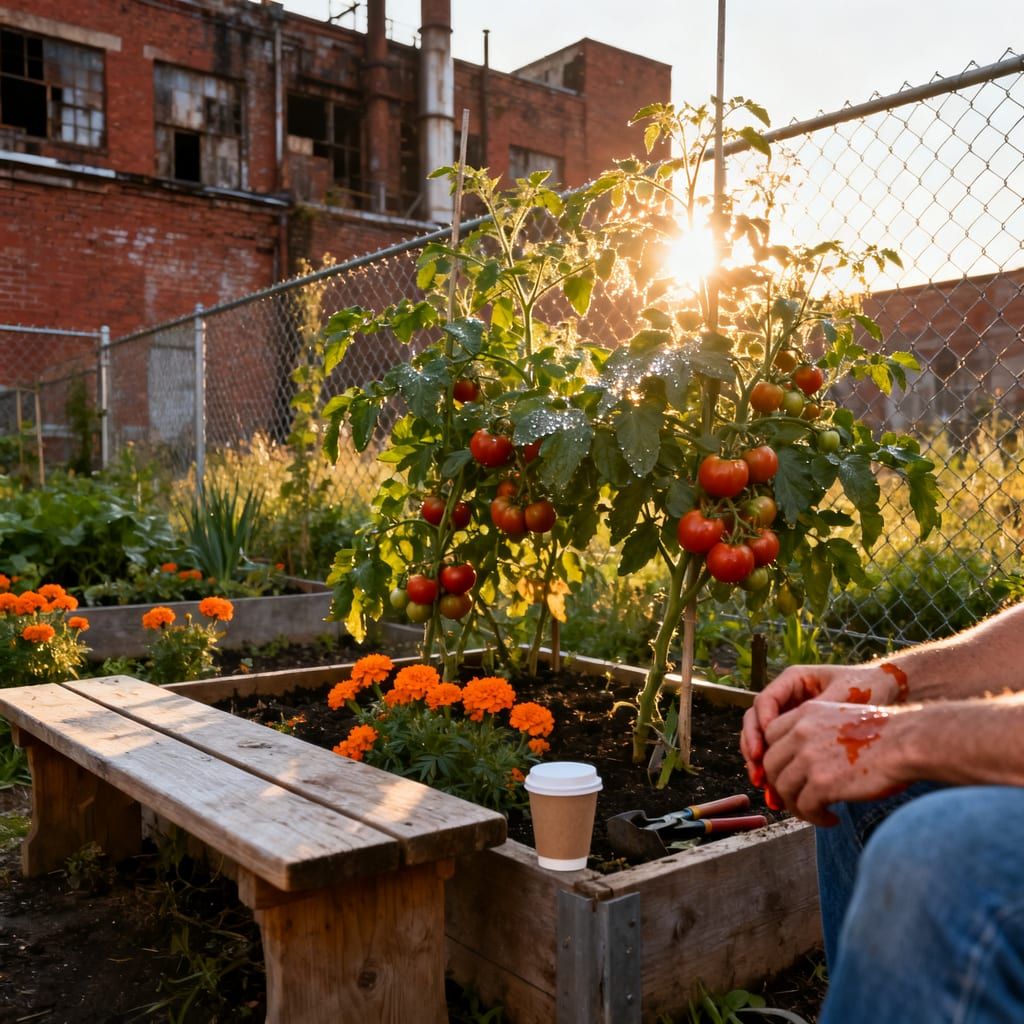
By the time the frost let go, the courtyard behind the old factory felt like a held breath. Chain-link hummed when trucks rolled past on the street, brick walls kept their cool even in sun, and the patch of dirt Elena Ruiz had argued into being looked smaller than a promise.
She set down a crate of trowels and seed packets. Coffee steamed in paper cups. Above, a gull pinned the air and drifted toward the river.
The first group came out hunched in hoodies, eyes swiveling without landing. Five of them, new to routine, new to mornings without something else in the bloodstream. Cautious like deer, or people who had already told their stories too many times.
"Grab a tool," Elena said, voice even. "We'll start light. Loosen, don't fight. Roots and recovery go the same way-what we give the ground decides what gives back."
They didn't laugh at the line. They didn't need to.
They learned each other by work. Tasha, ankle monitor shining dull under leggings, refused to kneel and, instead, stood to rake, back straight, chin set. A man named Jem picked stones and made a neat pile like punctuation. A quiet older woman, Hattie, patted the soil after planting, as if settling a blanket over a nap.
Rafi Ortiz wore a hoodie with the sleeves shoved to the elbows and banter like a hoodie for his face. "You got heirlooms in here?" he said, peeking into a packet. "Like, antique tomatoes? They come with a certificate?"
"They come with stories," Elena said. "And thin skin. Be kind."
He grinned to show he was listening and then said nothing when silence threatened to settle, tilting his attention toward the beds, pockets weighting his sweatshirt into parentheses.
Elena moved with a calm that felt borrowed from a deeper season. She showed them how to pull compost through with their hands-palms in, fingers raking like combs. How to tuck pea seeds in two knuckles down. The chain-link clicked whenever the wind changed. Somewhere inside the center, a microwave chimed.
By the second week, the bench by the back door developed a nervous habit of cups-black coffee cooling to sheen. They gathered there before walking the rectangle, listing what was possible. Peas on netting. A run of greens. Tomatoes later, after the last frost night.
That Thursday, a hand rake went missing. So did the packet with the faded photograph of crimson tomatoes stamped on the front.
The counselor, Marta, gave Elena a look across the dim hallway-heavy under the humming fluorescent. "We can't keep losing supplies," she said, like a sigh that had lost its words.
Elena nodded. "I'll keep the gate open."
Marta tilted her head, a measured warning and a kind of tired faith.
They worked anyway. They always did. Elena's palms took on the sweet rot smell of compost. She taught them how soil remembers-how last year's drought still lived in it, how a season of kindness could change what had been hardpan.
"Some seeds need fire," she told them one gray morning, stooping to tug a knot of old roots. "They sleep for years until heat cracks their shell. It's not death. It's a plan."
Rafi had turned away, hands jammed deep in his hoodie. He moved along the fence like he had to keep it company. His pockets were definitely heavier than the week before. He joked about coffee and the weather and the price of onions, but his eyes went soft when Tasha watered, careful arcs that darkened soil without breaking it.
"I water like this," Tasha said, voice low, "'cause I wish someone had done it for me. Not all at once. Not to drown." She shrugged, as if the words slid out without permission.
The peas found the netting and climbed, green fingers on white cord. They shared losses in slivers like seed coats-thin, glossy, not yet opened. One morning Hattie said, "My son called," like she was talking about a bird at the feeder.
Elena listened and tried not to count her own years. She knew the number without wanting to-how many 24-hour chips, how many 30-day tokens. The heavy round one they gave her when the number hit nine, a bronze the color of good soil after rain. She had not told them. She tucked that coin beneath the first bed on the first day, a private anchor in case her hands trembled.
June arrived humid and impatient, and the afternoon the sky broke, it broke with warning-metallic tang, leaves stilled, air thick as a held breath. "We should get inside," Marta called from the doorway.
"Five minutes," Elena said, tilting her face to the sky. "We'll drop markers and-"
Thunder stitched itself across the brick. The first fat drops hit. Then the rest came-sheets, a curtain yanked. Water shouldered through the chain-link as if it had an appointment, a brown river bulldozing the beds they had just amended. The netting whipped and sagged. Markers toppled. Topsoil went dark and movable and then was simply gone.
They ran for the door, laughing because it was absurd and because sometimes you laugh when you can't swear at God in front of a counselor. Inside, the smell of wet concrete and coffee. Palms glossy, hair slicked to foreheads. Elena put her hand flat on the cool brick and breathed until her ribs counted themselves.
When the rain let up, they went back out. Mud held everything the same way grief does-flat, egalitarian.
"Hey," Rafi said gently, toeing near the fence line. "What's this?"
Something glinted, half-buried like a thought. He crouched and dug with two fingers, careful. He rubbed the disk on his shirt until the nine at its center gleamed like an eye.
"Whoa," he said, softer yet. "Nine."
He looked at Elena. So did Tasha. So did Jem and Hattie and even Marta, one hand shading her eyes as if this were a stage and a spotlight had found them.
Elena's mouth thought about a smile and then didn't. The part of her that had practiced distance felt a plank go out from under it.
"It's mine," she said finally. "I put it there. First day." Her throat worked. "I'm nine-" She heard her own voice catch and let it. "Nine years."
Nobody clapped. Nobody had to. In the quiet, rain ticked from the chain-link in metronome taps. The garden, stripped to its bones, seemed to be listening too.
The director called a meeting the next morning, tie askew, urgency smelling sharp like new plastic. "We can't withstand this kind of loss," he said, nodding toward a ledger as if the rain had balanced itself in columns. "Supplies, theft, damages-this isn't sustainable."
Marta kept her gaze on her pen, twirling it. Elena folded her hands to stop them from making a case with the air.
"It was a storm," Elena said, even. "And a coin. Mine." She met the director's eyes. "Recovery isn't a controlled environment. Neither is a garden."
He pinched the bridge of his nose. "We're on thin funding. Maybe we pause the program until-"
"Until what?" Elena asked, not unkindly. "Until it's easy?"
He didn't answer. He didn't have to. The pause hung in the doorway like weather.
That night, Elena walked the beds alone, mud lightened to a dull crust, the city humming beyond the wall. She could close the gate, return the tools to the closet, let the rectangle go back to dirt and dandelion. She could take the coin home and keep what it meant to herself.
She pressed her fingertips into the places the water had taken, feeling the voids. The soil was not gone; it had moved. It knew how to hold and how to let go. So did she.
A week later, the morning heat stitched shirts to backs. The group drifted out in lopsided twos, uncertain. Rafi came last, carrying a sagging cardboard flat of spindly tomato seedlings. The box left damp crescents on his forearms.
"I owe you a rake," he said before anyone else could. He set the box on the bench. "And seeds. I took 'em." He lifted his chin, jaw at a stubborn angle. "I wanted to show up with something alive."
Silence doesn't always punish. This one held him, then let him go.
"I traded a shift for an old shop light," he added, looking not at Elena but at the seedlings-thin stems, leaves like small hands. "Windowsill's got just enough south. Smelled like dirt in my room for the first time in forever. Sorry. And also... not sorry." He winced at his own truth, then grinned like a boy caught doing math in his head.
Tasha stepped forward, the court bracelet's red light blinking like a heartbeat. She unlatched it, thumb steady, and placed it on the bench beside the tomatoes. "I can sit," she said, not asking anyone's permission.
They sank to their knees in the soft places. Elena went to the bed's edge, scooped a hole with both hands, and pressed her coin back into the earth-not hidden, not displayed. Anchored.
"I should've told you," she said, meeting each gaze without blinking. "My brother didn't make it. I almost didn't. I don't keep that coin because of pride. I keep it because some days you need proof you were here."
"Then we'll mark it," Hattie said, practical as a list. She pushed a smooth stone over the spot and set it upright like a tooth. "So we don't forget."
Elena nodded, throat a warm ache. "We begin again," she said. "We always can."
They amended the beds with fresh compost a landscaper down the block had dropped off with a shrug-"Can't use the extra, sweetheart"-and the air sweetened with the smell of spent leaves and black tea. Rafi taught Jem how to tease apart the roots without breaking them. Tasha watered low and slow, patient as a lullaby.
By noon, the flat was empty, paper pots slumped in a tired smile.
Summer didn't spare them. Aphids came and went. Someone ghosted the program and then returned, thinner and quieter, and nobody mentioned it, only made room in the circle again. The director stalked the edges once, saw the bench Rafi had started sanding at the woodshop and set under the elm, and kept walking.
A woman from the block leaned over the chain-link one afternoon with sunflowers in a paper bag and gossip about the weather. Kids started tossing a ball against the brick and missing on purpose so they could barrel in for water and leave their laughter like graffiti.
"Smell that?" Marta said in late August, eyes half-closed. "Tomatoes. Like August thought up a cologne."
They tied stems, pinched suckers, lost a few to rot and learned to read the shoulders of a tomato, the way they go from stubborn to sigh.
Elena moved among them in a rhythm she trusted now. She stopped counting months. She let the coin be where it was, a weight at the garden's pulse. When she dreamed, the garden came to her-the chain-link singing, the marigolds burning small suns around the tomato row, the peas browning and rattling like tiny bones that wanted to be planted again.
It came crisp, not cruel. The river breathed fog in the mornings. The marigolds held their orange like scandal. The bench took on the satin feel of a thing that had been touched by many different hands.
They planned a harvest lunch on a day the light went honey-thick. The tomatoes heaped in a blue plastic tub the color of a shallow ocean. Rafi brought bread-too much, which is to say enough. Tasha arrived with salt in a little jar. Hattie had a knife she'd sharpened the night before while the kettle sang.
They ate with their hands because it was simpler and because napkins felt fussy in the face of juice. Tomato flesh gave up sun and rain on their tongues. Seeds clung to wrists. Laughter came up without anyone pushing it, the kind that lives low and sustains.
"This one's the best," Jem said around a mouthful, as if he'd discovered something sacred. "Tastes like... August."
"Like somebody remembered me long before I showed up," Tasha added, surprising herself. She wiped her wrist with her thumb and licked it clean. "Like that."
Rafi leaned back on the bench he'd finished, palms splayed, a man testing the strength of something he built. "Yo," he said to Elena, eyes bright like he'd found the punchline to a private joke. "You know how you said the soil remembers?" He tilted his chin toward the beds, toward the stone that marked a coin and a choice. "Feels like it's... remembering us back."
Elena felt the sentence land and root. She looked at them-sauce freckling knuckles, bracelets and watches and scars catching the sun-and then at the rectangle of dirt they had turned and turned until it was a place.
Wind walked the chain-link so it sang soft, almost a lullaby. From somewhere beyond the wall came the distant clang of something that used to be a shift bell.
She raised her coffee in a toast that wasn't a speech. "To what we tend," she said. "And what tends us."
No one said amen. No one had to. They passed the salt and tore bread and ate the last tomatoes warm from the bowl. Around them, marigolds held the line against frost. Beneath them, a coin kept its place, remembering years as patiently as seeds remember rain.
Long after they left the courtyard to its evening-after the cups were stacked, and the bench sat with its back to the brick like an elder, and the chain-link cooled in the shade-the garden remained. It breathed between red brick and old fence, a small, stubborn square of ground where hands had made a promise and then kept it, one measured watering can at a time.
Story audiobooks for children of all ages — a new one every day on Smarter Way Stories.