Two Houses and One Quiet Heart
A daughter learns to read between the lines of a life split in two
Read more →
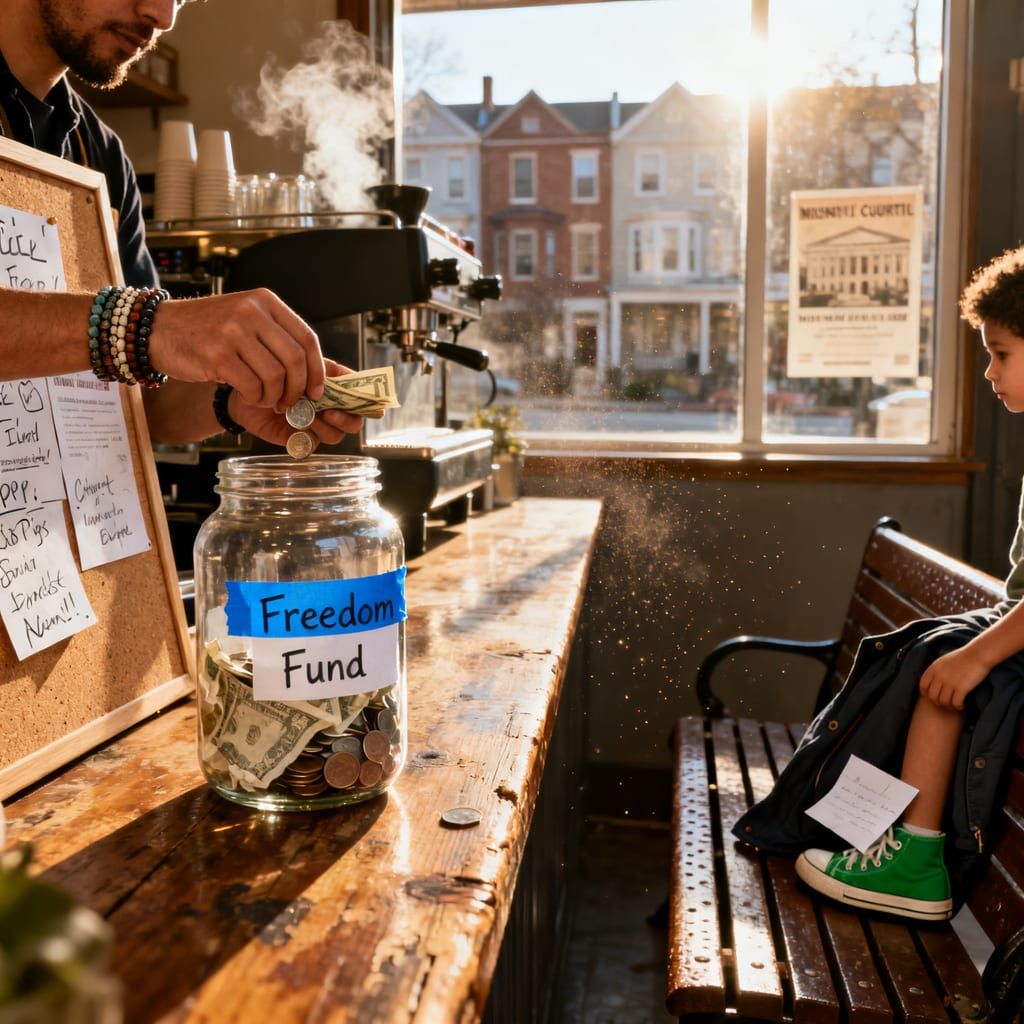
The jar appeared on a Wednesday between the croissants and a stack of mismatched mugs-a squat glass with a blue painter's tape label that read, in black marker: Freedom Fund.
Pennies glinted like fish scales. A folded five leaned against the glass, a small sail. Jordan Alvarez, thirty-two and newly unemployed, stood behind the counter with a Sharpie still uncapped, the smell of espresso and permanent ink mixing in the air.
"Freedom Fund?" Mei, the morning barista, raised an eyebrow, tamping grounds with a deft wrist. "You sure you don't want 'Community Jar' or something less... dramatic?"
He capped the marker. "Dramatic is a man in lockup because he missed a court date for a traffic ticket."
Mei's face changed. "Luis," she said softly. "My brother. He lost a week's wages. Almost lost his job."
Jordan nodded. "It's math," he said. "Fifty bucks is the difference between someone making rent and sleeping on a floor. I can spreadsheet math." He forced a smile he didn't feel. "I can't stop a storm. But maybe I can hand out umbrellas."
They set the jar near the register. The first hour, it swallowed two quarters, three dimes, a button, and a note scribbled on a napkin: Thank you for seeing us.
He built the fund the way he'd built product roadmaps-columns, color-coding, a tab for outcomes-but now his sprint planning involved courthouse calendars and SEPTA schedules. He put in twenty dollars of his own and watched it go out and come back like a lung. Someone posted bail on a Friday; they appeared in court on Tuesday; the money returned, slightly wrinkled, ready to breathe again.
He learned the courthouse fast: the coffee burned in Styrofoam cups; the floors shined with false promise; the benches, wooden and narrow, dug crescents into his thighs. He sat beside a nurse in scrubs who wrapped her hands around a cup until the heat left it.
"My shift starts in thirty," she whispered. "If they keep him, I can't do twelve hours and pick up my kid."
"You won't have to," Jordan said. He didn't promise, exactly. He thumbed at his phone, numbers and names scrolling-a small city of people who'd dropped coins into a jar with a brave label.
A public defender with sleep-crumbed eyes slid into their row, loosening his tie. "Calendars are clogged like arteries," he muttered. "People think it's a line-orderly, fair. It's more like a traffic jam in a thunderstorm." He gave Jordan a look that carried both thank you and be careful.
A judge set four-figure bail for a shoplifting charge-diapers and groceries in a canvas tote. Jordan's stomach knotted. He swallowed anger that tasted like pennies and coffee grounds.
"I can cover a hundred and fifty," he whispered to the defender. "And text reminders for court. And a ride."
It wasn't enough and also, for that woman clutching the canvas tote, it was everything. She didn't cry when she walked out two hours later. She just exhaled, like she'd been holding her breath since Tuesday.
A local blog found the jar. "Loose Change, Locked Doors," the headline read over a photo of Mei's bracelets glinting as she counted out singles. The tip jar became an online form with three questions and an auto-reply that promised: We'll try.
Neighbors hosted a yard sale on a windy Saturday, a parade of histories on card tables: a stroller with a worn handlebar, a stack of baby onesies, a box of tools still tattooed with a grandfather's initials. A boy with green sneakers tugged his mother's sleeve.
"Can our stroller help someone's Tuesday?" he asked, serious as a clerk.
"It can," Jordan said. He taped a PAPER: $15 sign on the stroller, then watched a woman with gray in her braid hand him exact change. She didn't look up, and he didn't ask why her mouth was pressed into that thin line of holding it together.
He learned the other math: most cases ended without trial. Bail wasn't a verdict; it was a hinge. He built a text-reminder system that sang chimes a day before court: Don't forget your papers. Don't forget your childcare receipt. Reply 1 for a ride.
At two in the morning, his phone bloomed with alarms. Missed bus. Toddler with a fever. A man named Kevin, voice shredded with shame, left a message: "I thought justice meant your day in court. I didn't know it meant a day you can't afford."
He kept showing up anyway. He delivered coffee and sat with grandmothers who pinched the hems of their skirts and students who bounced their knees to a metronome of panic. He watched mechanics rub grease into clean palms, trying to anchor themselves to something familiar.
On a Sunday, his mother came over with Tupperware and a puzzle book-two rituals of care-and sat on his rowhouse couch, feet tucked under her like she was bracing for a story she didn't want to tell.
"You're on TV," she said, half-joking, patting his knee. The news had done a thirty-second segment-Jordan in a blue hoodie, hair uncooperative in the wind.
He shrugged. "It's a jar and a spreadsheet."
She watched his face as if it were a storm map. "When you were nine," she began, and he felt the floor tilt. "When we said your father was 'working out of town'-he wasn't." She twisted the ring she always forgot to take off when kneading dough. "It was an unpaid fine. He couldn't cover it. We didn't know what to do. He was... gone. For six weeks."
Jordan's breath snagged. We made it sound like possibility, he thought. We named absence a paycheck.
"He came back angry," his mother said. "Not at us. At the machine. We thought the story needed to sound better to be survivable."
They sat with that until the radiator hissed them back into the room. Outside, someone dragged recycling bins down the sidewalk, blue plastic rasping against concrete.
By May, the fund had bailed out nineteen people. Sixteen appeared in court on time. Three were late but showed up within a week. No one disappeared.
There was a rally on a Tuesday-handmade signs blooming on sticks, voices braided into one rope. Jordan stood on the courthouse steps with Mei and the nurse in scrubs and the woman with the canvas tote. A boy with green sneakers sat on a railing, swinging his legs.
An officer in a hard, neutral face told them to step back. People shuffled, a tide obeying. Jordan didn't. He wasn't trying to be a symbol. He was tired and stubborn and full of a week of missed buses. He stood his ground, hands open, palms empty.
"Sir," the officer said, and then there were hands at his elbow and the thud of a door, the fluorescent bloom of a holding room where time lost its edges.
Booking breathed with bureaucracy. A clock on the wall ticked like it was chewing. A man on the next bench hummed a tune without a melody. Paperwork blurred. Jordan asked for his phone; it was a small rectangle of power he couldn't have.
An officer with a voice like a receipt read out a number. Jordan stared at it. He could recite half the donors to the Freedom Fund from memory, the names like beads: Trina who runs the daycare, Mr. Ortiz who fixes bikes, the firefighter who'd slipped twenty into his palm without a word. He could not call any of them.
He swallowed and waited. Everything in him itched to pace, to argue, to make a deck that explained the inefficiency of this, look, the cost per hour of human possibility draining into this fluorescent floor. Instead, he thought of his father in a room like this, summer humming outside and six weeks ahead of him. He closed his eyes.
Six hours slid over him like raincoats he couldn't shrug off. His name was called. "Release," someone said, bored. Paper. Signature. A door that required a code he didn't know. Then air that didn't smell like bleach.
He sat on the steps, hands shaking with something he would not call fear. Mei pressed a bottle of water into his palm.
"They covered your bail," she said. Her bracelets chimed. "Anonymous."
Anonymous turned into a folded note in his coat pocket, found that night when he was too wired to sleep. It was written in block letters on a torn envelope: You helped me first. $120. Groceries and diapers. I kept my job because you texted me to bring my childcare receipt. Consider this a baton. -R.
He pictured her canvas tote. The way her hands had been steady when everything else shook. He sat at his cheap kitchen table and laughed, one bright, startled burst. Then he pressed the note to his forehead and let the quiet afterwards say what he couldn't yet.
The next morning, he walked to the coffee shop. The bell over the door rang like a small applause. The jar was there, taped label softening with use. A child held a handful of coins, the way kids hold frogs-careful but thrilled.
"Can I?" the boy asked, palm outstretched. His green sneakers were scuffed.
"Please," Jordan said, and watched the coins drop with their tiny metallic chimes.
He opened his laptop and added a line to the spreadsheet: R. - returned, rerouted. He had stopped calling it a bail fund in his head. It felt more like a current-you dipped your hand in and felt a pull that was not yours alone.
His mother texted a photo: him at nine with a gap-toothed grin, legs too thin for his shorts. Below it, she wrote, I'm proud of you. Also: I'm sorry for not telling you sooner.
He typed back, It's okay. Then deleted it and wrote, Thank you for telling me. Also: Want to come to court with me Thursday? He saw the typing bubble, then a heart, then: Yes.
Summer leaned into the city. Hydrants opened. The courthouse air-conditioning sputtered and failed and resumed like it had a grudge. They kept showing up. Jordan texted, drove, printed maps with little X's. He learned the names of security guards and the coffee preference of the clerk who could find misplaced files in half the time of everyone else.
He watched a grandmother fold her grandson's hoodie into a neat square and set it on the bench beside her, as if order could make a door open earlier. He watched a mechanic peel at the edge of a callus until it bled, then swipe at it with a napkin he'd pulled from his pocket. He passed tissues and cough drops and, once, a granola bar that had melted into a single forgiving mass.
"I thought justice meant your day in court," a woman muttered to no one, to everyone. Jordan didn't correct her. He sent her a reminder with a heart emoji and picked her up at six the next morning, the city not yet fully awake.
He could feel the shape of the machine-gears grinding, teeth catching-and also, beside it, something else building. A lane with no posted speed, made of rides offered and couches cleared and notes in coat pockets.
One afternoon, as the light slanted just so across the coffee shop floor, a man in a Phillies cap slid a twenty into the jar without looking Jordan's way. "My cousin," he said to the counter, to the croissants, to the wall. "You helped her. She made it to court. Judge said 'thanks for showing the paperwork.' She cried all the way home and then went to work."
Jordan nodded. Words weren't always necessary. The jar made its own noise.
Later, he walked home through rowhouses that leaned toward each other like neighbors trading recipes. On his block, someone had chalked a hopscotch that skipped four to get to five. He stepped on the squares and didn't correct it.
At his desk, the spreadsheet blinked back. He added another line: Nurse-appeared. Mechanic-rescheduled, then appeared. R.-paid it forward. He clicked Save. Outside, a bus he had missed a dozen times that spring roared by, and he felt an unreasonable affection for its clattering insistence.
He thought of the jar's first coins, the way the Sharpie had bled into painter's tape, the blue going fuzzy with hope. He thought of a boy's green sneakers, his mother's hands, his father in a room with a clock that ate hours.
He closed his eyes and saw a baton-a simple baton, scuffed and warm from other hands-moving forward. Not a neat circle, but a lane beside the circle, parallel and stubborn. Loose change, locked doors, open hearts. It wasn't justice. It was what people did until justice remembered them.
And the jar waited, glass catching light, ready to breathe again.

A daughter learns to read between the lines of a life split in two
Read more →
A fog-draped night, two souls found, and the quiet shape of a life
Read more →
Story audiobooks for children of all ages — a new one every day on Smarter Way Stories.