The Porch Light Stays On
A bungalow where arrivals become landmarks
Read more →
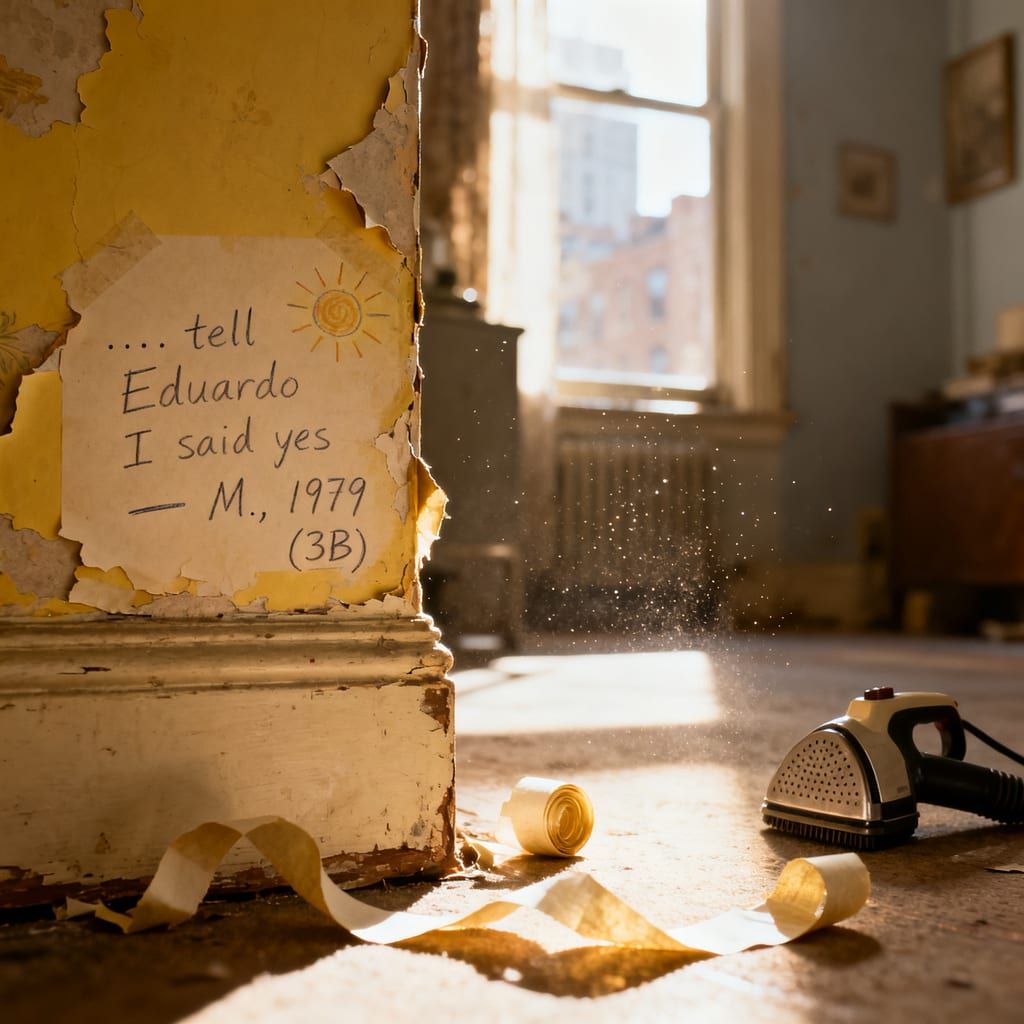
The apartment breathed when the windows were open-old wood swelling, paint seams lifting, heat pipes ticking as if they were trying to say something. The light came in like honey, catching the dust Lina raised with her steamer. She pressed the nozzle to a corner of yellowed wallpaper and felt the old paste loosen beneath her palm.
It peeled away in a soft sigh. Behind it, not the expected plaster, but pencil on raw wall: a scrawl that looked like laughter caught mid-sprint.
If you find this, tell Eduardo I said yes. -M., 1979 (3B)
A small sun, childish and sure, was sketched beside it.
Lina let the paper curl to the floor. Her heart did the thing it had been doing since June-the stutter-step between ache and hunger. The radiator hissed as if it knew.
She took a photo without meaning to. The word yes seemed to linger in the steam rising from the kettle she kept on a borrowed hotplate. In the bright, stubborn quiet of the room, the message echoed.
The job was a budget renovation for a client who wanted "minimal interventions" and "maximum charm." Lina had nodded and signed because the rent on her new studio was due and because her chest still felt like the inside of a cracked bowl.
She measured. She sanded. She sorted screws into a chipped teacup she'd found in a cabinet. She was trying on steadiness like a coat still too big, sleeves getting in the way of her hands.
By three, the building hummed with someone's radio on a far floor. The scent of someone's onions drifted down the hall. On the counter, her phone lit with a name she'd been not-answering for a week-Maya, an old collaborator with a risky glint to every idea.
Lina turned the phone face down. The pencil sun on the wall looked back at her, unblinking.
"La Morales?" the super said, when she asked about an Eduardo, trying to keep her voice from tipping into the fever of curiosity. He wiped his hands on a rag and leaned in the doorframe of 3B like the building itself-scuffed, tolerant, older than his patience. "Eduardo Morales, sure. Five D. He's been here longer than the plaster. Lost his wife, oh, six years now. Keeps to himself. Collects mail for the plants in the hall when the neighbors go out of town."
Lina hesitated. It felt like holding a match too long, that bright little note warming parts of her she'd promised to let cool. "I found something," she said. "On the wall."
The super shrugged in the ancient way of supers, which seemed to mean: the building has roots and secrets; do what you must.
She washed her hands before she knocked. She couldn't have said why-that the oils of grief might be something you should come to neatly.
Eduardo opened the door with a cardigan folded over his shoulders the way a man wears both the thing and the memory of the person who bought it. His eyes were steady as handles. Behind him, a kitchen table with a shallow bowl of lemons and a checkered cloth ironed crisply along the edges.
"Mr. Morales?" Lina held out her phone. Her hands did not shake. "I'm working in 3B. I found this behind the wallpaper."
He took the phone without touching her fingers. The photo shone in his palm. He didn't speak for a breath, then two. The apartment was full of the sound a refrigerator makes when it tries not to intrude.
"That's her M," he said softly, and the floor tilted; the room rearranged itself around a presence Lina could almost see. He touched the air above the M as if it were fragile. "My Marisol. She looped it like a ribbon." He smiled without showing teeth. "Come in. Please. Tea?"
At the kitchen table, the steam rose in ribbons. Eduardo fished two chipped cups from a cabinet, one with a hairline crack like a river delta running from rim to handle. "She had a way with yes," he said, when Lina asked, almost apologizing for asking. "Back then, I had a ring in my coat for months. Months. I'd put my hand in my pocket and feel it there like a stone that might sink me or save me, and then I'd say, maybe next week. Maybe when the rent isn't a worry. Maybe when my mother forgives me for not going into the shop."
He wrapped his hands around his tea as if to contain the past's heat. "Marisol-she did not argue with my fear. She left me little yeses. Under the ashtray. In the cuff of my winter sweater. A Post-it tucked in the sugar canister that just said, 'In case you forget: yes.' It was like walking through a house that kept agreeing with me being in it."
He glanced at the phone again. "We married anyway. Eventually I asked. I never found that one. Behind the wallpaper." He laughed softly. "She must have hidden it to make the walls complicit."
The kettle clicked off. In the corner, a spider traversed a seam of the ceiling with the dignity of a tightrope walker.
"She died six years ago," he said, matter-of-fact, the way a fact hardens to survive. "She would have liked you finding it. She was very fond of-what is the word-echoes."
Lina wrapped her fingers around her cup until the heat stung. The ache in her chest pressed an ear to the story's door.
Back in 3B, the late afternoon went gold as a coin held up to the sun. Eduardo had walked her to the door and, with a small bow of his head, said, "If you have the time, peel a little more. For me."
So she did. She scored gently below the penciled sun, letting the steamer soften thirty-seven years of stubbornness. The paper gave way in a slow reveal, like breath in winter.
Below the first line, faint and thinner-as if written in a hurry with a worn-down pencil-another sentence waited.
If it's too late to tell him, pass it on.
Lina sat down on the drop cloth without meaning to. The words landed in her like a stone tossed into a lake whose surface had pretended to be still.
Pass it on.
She had gotten very good, lately, at not passing anything on. She kept replies in drafts. She kept chairs half-assembled overnight because finishing meant something else would start. When Maya called-Maya of audacious budgets and sleepless elation-Lina listened to the ring as if it were weather. She told herself the safest answer was no answer.
She pressed her palm to the wall. Plaster cool under her skin. "Okay," she said, to the empty room. To the woman who had drawn a sun the year Lina's mother was eight years away from meeting her father. To the hum of a building where lives stacked like paper, like time.
She took a fresh sheet from her sketchbook and drew a sun with quick rays, not caring that the lines weren't straight. She wrote:
Eduardo-
Found this beneath the first. Marisol was making sure the future could hear her. Thank you for the tea. -Lina, 3B
She added her own small yes at the bottom without any explanation: Yes to more light, yes to risk, yes to building.
She slid the note under his door and felt, absurdly, that she had passed a warm object from her hands to his.
At home, evening pooled in the corners of her studio like paint. She took a shower and stood with her forehead against the tile, listening to the city conduct its nightly rehearsal: sirens learning their lines, laughter taking the sidewalk.
She dried her hair. She set her phone on the scarred kitchen table that had come with the lease-three cigarette burns like a constellation. The screen reflected her face back too honestly.
Her thumb hovered over Maya's name. The quiet in the apartment rearranged itself; it sounded like a held breath the moment before water breaks from a glass.
She hit call.
It rang. It rang. The sound threaded through her like a stitch, pulling edges back together. On the third ring, Maya answered, half out of breath, already laughing. "Park! I was starting to think you'd moved to a convent. Tell me you're ready to be poor and thrilled."
Lina laughed, the sound surprising her with its brightness. "I'm ready to be something," she said. "Tell me everything."
They talked drafts into blueprints. They said numbers like they were learning to pronounce a new language. By the time they hung up, the city had leaned into night and Lina's table was a battlefield of quick sketches-sunlight across a lobby wall, the arc of a staircase that had been ugly for so long it forgot how not to be, the bones of a studio that could hold two people's fear and make something sturdy of it.
In Five D, Eduardo bent to pick up the note slipped under his door. He read it at the sink with the faucet running as if he could listen and drink at the same time. The little sun wobbled slightly, rays uneven, declarative as a child's first alphabet.
He opened a drawer and pulled out a magnet shaped like a sun. Marisol had won it in a raffle by guessing the number of jellybeans in a jar. He pressed the paper to the fridge and the magnet to the paper and stood for a moment with his hand on both, making the wall complicit again.
He pictured Marisol in 1979, hair tied up with a scarf, pencil tucked behind her ear, the apartment full of damp paper curled like petals on the floor. He said out loud to an empty room, to a kitchen that had agreed with him for years, "I heard you." Then he turned off the faucet and dried his hands.
In 3B, Lina cleared a corner of her table and tacked up a piece of foam board. She moved from pile to pile, gathering what the week had offered: a torn rectangle of the old wallpaper with its nicotine-yellow fatigue, a photo of the penciled sun, a swatch of linen the color of overripe pears, a paint chip called Afternoon Walk that was almost-but not quite-dusty gold. She pinned them in a loose constellation.
The building settled. Somewhere, someone dropped a spoon. Someone laughed and then stopped quickly. Outside, the air was that early-September compromise between summer and the thing that comes after it.
Lina stepped back. The board looked like a story told without speaking. It glowed from within in a way that had nothing to do with the light.
She wrote a single word at the top, in her neat draftsman's hand.
Yes.
The next morning, the hall smelled of Mr. Li's jasmine tea. A neighbor's child dragged a scooter past 3B with deliberate racket. Lina opened the windows. The apartment breathed.
Steam rose where she pressed the nozzle to the next section of wall. Paper sighed open. Her phone, face up on the counter this time, buzzed with a message from Maya: "We're doing this? Say yes so I can tell the broker."
Lina didn't look. She let the hiss of the steamer answer for her a moment longer, warm and certain.
Then she set the tool down and picked up the phone with wet fingers. She tapped what needed to be tapped and watched the letters arrange themselves.
Yes, she wrote. Let's build it.
Across the hall, in Five D, a man lifted a magnet and touched it again, just once, as if to make sure it held.
The wall waited, then gave way.
Story audiobooks for children of all ages — a new one every day on Smarter Way Stories.