The Porch Light Stays On
A bungalow where arrivals become landmarks
Read more →
The kettle's lid never sat right. Each time Priya poured, it shivered against the steam like a nervous tooth. She took a photo on her phone-sunlight slid across the scratched steel, her plant in the background half-leaf, half-dust-and typed, "Free to anyone who needs a start."
She hit post in the neighborhood Buy Nothing group and set the kettle on her stoop with a square of blue painter's tape, a quiet flag against the city.
By morning, the kettle was gone. In its place, a gray envelope pinned beneath a pebble. The handwriting looped carefully: "Thank you for tomorrow's tea.-Lucia."
Priya stood in her doorway with bare feet and a coffee she didn't finish. The street yawned awake-bus brakes sighed, a bodega gate rattled up, somewhere a radio wandered through a salsa line-and something inside her loosened, like a jar finally opened.
After that, the block began to move.
A pair of child's boots, muddy at the seams, reappeared later on smaller feet that thudded happily past her stoop. A box of mismatched mugs-World's Best Aunt, a chipped flower rim, an ugly brown one from a dentist's office-became a teacher's class set, posted later that week with a photo of sticky hands raising ceramic and a caption: "Hot cocoa party success. Thank you, neighbors!"
An older man who sat often at his window-thin, trim mustache, slippers at all hours-posted a photo of a fat folder. "My late wife's recipes," he wrote. "I can't cook for one. Maybe you can." His name in the group was Mr. Alvarez.
When the folder left his hands, a tide returned. Aluminum trays knocked on his door with tamales and tarts, soups with written labels in black marker. He began to appear on stoops holding a fork and smile like a small badge. "Practice," he'd say of the quilt squares he started piecing from donated fabric. "My wife used to do this. I'm learning her language again."
Priya watched strangers align into neighbors. She wasn't loud about it. She printed directions and taped them above her desk: No judgment. No money. Only ask. When items went missing before pickup, she stuck blue tape with names on boxes, like vows. "Trust is the currency," she wrote in the group once, a little embarrassed, and turned her camera off during the Zoom call she was supposed to be leading.
At night, from her bed, she read the group posts the way someone else might pray. A rice cooker needed. A bag of mangos that would turn if not used today. A desk lamp. A story about a divorce folded into a request for a ladder. A thank-you typed with too many emojis because feeling has no grammar.
Momentum invited friction, as it always does. A rare bike component appeared: a derailleur that could be the difference between late and on time. In private messages, a reseller offered cash above what it was worth. Screenshots made rounds. The thread singed.
In the comments, a single father named Jamal wrote, "I could use this for delivery shifts. My current setup's stuck."
Priya stepped in, as steward rather than queen. "Let's honor the ethos," she typed. "No cash, only need. If you need, you ask. If you can give, you do. And we trust one another to tell the truth."
They took a neighborhood vote, which felt both silly and holy. The component went to Jamal. Days later, a photo: his bike against a dawn sky, the asphalt pink-edged, his caption a breath: "Fast wheels under tired feet. Thank you."
The reseller left angry comments about freeloaders, about rules that made no sense in a city this expensive. Someone rage-quit the group with the flourish of a gif. Priya closed her laptop hard enough to tremble her cup. In the after-silence, the block kept giving-because the block was not the comment thread. It was the papery rasp of plastic bags on stoops at 6 a.m., the chime of "Got it!" texts, the way someone's "Thanks" could expand a Monday.
On a gray Tuesday, her boss's face arrived in a little square and said words like "pivot" and "restructure" until Priya's ears became bowls of static. She lasted through the call, smiling at the right tremors of air. She closed the laptop. She sat for a long time without blinking.
Rent was a number in her head like a drumbeat. Her mother's old sewing machine lived on a shelf in her hall closet, wrapped in a towel that still smelled faintly of sandalwood soap. They had ordered it secondhand when Priya was thirteen, her mother teaching her seams by touch and story-hold the cloth like it can hear you; let the line be your breath.
She could sell it. She could post it on another app and take the dinged-up cash and count her choices. Her thumb hovered over that other icon and her chest felt hot with a grief that had no sentence.
Instead, she opened the Buy Nothing group.
"It taught me patience," she wrote beneath a photo of the gray case and her own knees, paint-splattered. "Maybe it can feed someone else's."
Her breath hitched as she typed, I might need help back soon, and that's okay. Then she deleted that sentence and left only what felt like a door: "Free to anyone who needs it to make or mend. No questions."
A woman named Lien wrote back in careful English that seemed to cup each word. "I can use to mend uniforms and make small things to sell. I am learning. My hands are quick."
When Lien arrived, she wore a ponytail that revealed a soft, worried forehead and a canvas tote so mended it was its own flag. She touched the machine the way you greet a sleeping animal. "Instruction?" she asked, palms open.
Priya taped the booklet to the case and tucked in a spool of sky-blue thread from a notion box she had kept for years. "For luck," she said, hearing her mother's voice double her own.
On the sidewalk, they stood a little too long, both pretending they didn't want to say more. "I'm on the second floor, buzzer two," Priya said finally. "If it jams."
"I bring you something when I learn to do it right," Lien said, and smiled with her whole face.
Priya closed the door behind them and leaned against it. It felt like setting a piece of her mother in a river and not knowing where it would travel, only that it would.
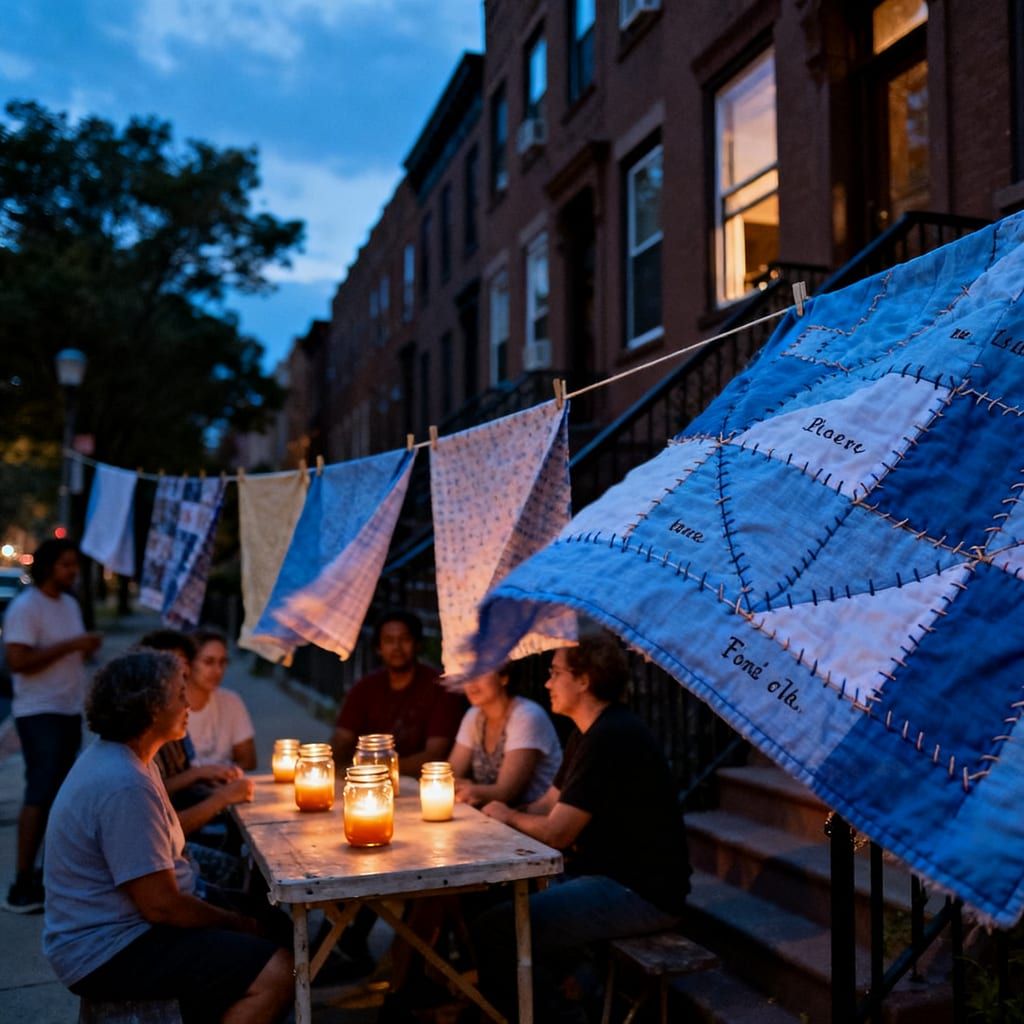
In July, a storm rolled in and cracked the sky in half. The lights went out block by block like a row of mouths shutting. For a breath, the city held its own darkness. Then candles bloomed in jars. Windows opened. Voices rose.
Without screens, the street remembered itself. Someone yelled, "You good up there?" and someone else yelled back, "Need batteries?" A battery-operated radio dialed past static and landed on a cumbia that floated like laundry.
Priya dragged her building's folding table down the stairs, its metal clacking like a drumline. She wrote LIGHT SWAP on a scrap of cardboard and taped it to the front, then spilled her own drawer of last-resort things across the table: a tangle of cords, twenty AA batteries, two rolls of medical tape, menthol cough drops, matches.
"Batteries for candles," she said to whoever wandered near. "Ice for insulin. Stories for time."
Lucia came first, her scrubs wrinkled and hair tucked under a scarf. She had the wobbly-lidded kettle like a relic. "I brewed mint before the fridge died," she said, and poured into paper cups.
"That kettle's seen some things," Priya said.
"It's very brave," Lucia agreed. Her laugh had a tired gold to it.
Jamal arrived with his bike and a milk crate rigged with bungee cords. "Top floor's got two elders," he said, breathless from stairs. "We ferrying?"
"Ferrying," Priya said, and handed him a tray of sandwiches someone's son had assembled with careful hands and lopsided cheese.
Mr. Alvarez came with a quilt folded over his arm, colors peeking like little parades. "Practice," he said again, but his eyes were bright in a way that made Priya set down the tape. "With a new friend's machine."
Lien followed, a shy comet in the candlelight, clutching another quilt. Behind them, others materialized with lengths of fabric strung between stoops like sails catching a breeze none of them could see. Old concert tees became constellations. A polka-dot dress ran as a ribbon through patchwork. Someone's tablecloth, burned once into the shape of a comet, became a comet again.
Children ran underneath, their hands outstretched to skim the low-hung seams. The quilts turned the blacked-out block into a tent, a cathedral, a soft city under the hard one.
"We stitched these from what people gave," Lien said softly, standing beside Priya as if they were guarding a secret garden gate. "And... I add something. Small."
She lifted a corner. In the seam, in sky-blue thread, tiny letters walked. Priya leaned close, the candle behind her making her shadow taller.
For the first cup of tea, one read.
Another seam, another whisper of blue: For fast wheels under tired feet.
Priya's throat grew tight. A third: For the hands that let go so we could hold.
She looked at Lien, who watched her with a nervous hope that made Priya remember thirteen, the first time her mother let her guide a hem alone.
"You did this," Priya said, but she didn't mean the stitches.
"We did," Lien said, and gestured at the block as if it were a person they both knew.
The blackout made neighbors linger in ways daylight never let them. Someone told the story of the first apartment they could afford with heat. Someone else recited a poem from high school by heart and nobody laughed. Lucia poured tea and listened more than she spoke. Jamal ferried foil-covered plates up and down like a metronome keeping the night in time.
Priya pinned notes with the last of her blue tape to the table: Who needs ice? Who has a spare inhaler? The questions and answers began to braid.
Inside the quilts, the block's earlier gifts had been stitched into a language. The kettle's wobble had become a thank-you along a seam. The bike part, now a line across the quilt's edge, hummed a road song. Mugs clinked like quiet bells whenever a breeze bothered the sails.
Priya stood in the middle of it and felt the old coil of her work life unwind from her ribs. I am not my calendar, she thought, surprising herself. I am this table. I am these small notes in sky blue.
When the lights came back-one flicker, then two, a cheer rising like confetti-no one rushed inside. They finished their cups. They took down the quilts with careful hands. Mr. Alvarez folded his with the slow precision of folding a flag.
"Keep the machine as long as you need," Priya told Lien, though she knew now it wasn't hers to keep or lose, not anymore.
"I make more," Lien said, touching the edge of fabric like a friend's shoulder. "We can sell some cheap. Or just... give. People need warm."
"People need warm," Priya echoed, and for once repeating something felt like making it truer.
Back in her apartment, she set the gray envelope from months ago next to her keys. She had saved it, though she couldn't have said why. She smoothed its edges with her thumb and listened to the hum that always comes right after a blackout-the city remembering its own heartbeat-and thought of her mother's voice: Let the line be your breath.
On the group page, a new post blinked into being: "Leftover candles on stoop at 42-11. Also extra rice. Also, anyone need a job lead? My cousin's place is hiring."
Priya typed, "I can help with resumes." Then, on a second line, "Free to anyone who needs a start."
Outside, in the re-lit dark, the quilts hung a moment longer, catching that last trace of wind, carrying messages that would hold even when folded away.
And on a shelf where her sewing machine had been, there was a space that felt, somehow, full.
Story audiobooks for children of all ages — a new one every day on Smarter Way Stories.