Two Houses and One Quiet Heart
A daughter learns to read between the lines of a life split in two
Read more →
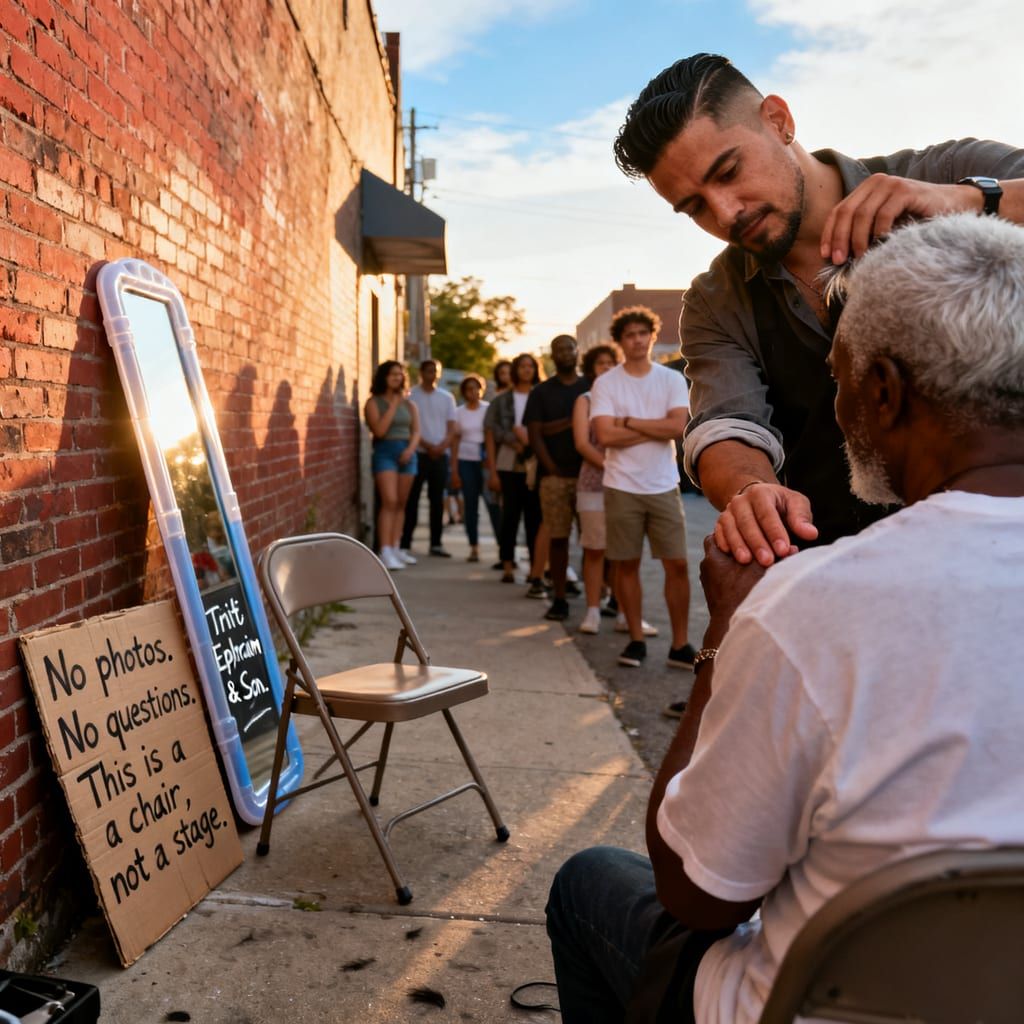
By noon the alley smells like sun-warmed laundry and old coffee-the outreach center vents steam from a dish sink, and somebody's left a cardboard tray dotted with thumbprints of ketchup. The bricks hold the heat and bounce it back, a slow breath against Leo's forearms as he snaps a cape around a shoulder and makes a small weather of clipped hair.
He props his phone on a milk crate the first Sunday, angled at chin height. The screen is black glass, his reflection a ghost over other people's faces. He tells himself the short videos will help-proof that he's still got the hands, that the boutique made a mistake when they let him go with a shrug and a severance packet. In a feed that forgets everything by morning, a good fade might last the day.
The line forms out of nowhere. A man in a suit that shines at the elbows, a teen holding a skateboard close like a pet, a woman who stares at her shoes until she looks up with a sudden decision.
"Fade," the man in the suit says. "Like my brother's wedding. Tight on the sides. I want my mother to gasp." He grins, then turns it down, as if a smile is something you're only allowed once.
"High and tight, right," Leo says. His clippers hum a reassuring hymn. The man tips his jaw to the sky as if praying.
The woman with the staring shoes sets her palm on the back of the folding chair and doesn't sit. "Bangs," she says. "Not straight. Like I woke up brave. I have a thing tomorrow." She swallows, and her throat is a small machine working.
"What kind of thing?" Leo asks, more habit than nosiness. The boutique taught him to fill silence, to make a chair a stage you would pay to be on.
She sniffs. "Judge thing." She glances at his phone and a lightning bolt of refusal crosses her face. "No recording. No. I can't be anywhere."
He thinks of the bookings he doesn't have. Of the way a time-lapse snip-snip makes hearts stack and inquiries trickle. A petty sting lifts in his chest-then something else pries the sting apart.
"Got it," he says. He flips the phone face down, slides it beneath the crate. The woman looks at him with relief that feels too heavy for such a small act.
"What's your name?" he asks, softer now.
She looks past him, at the alley's mouth where the street widens to sun. "Mara," she finally says, then flinches. "For today."
"Okay, Mara-for-today," he says. He combs her hair forward and lets it settle into a fringe that changes her entire gaze. When he lifts the mirror, she refuses that too. "I know what I asked for," she says. "I don't need to see it yet." Her voice thins on the edges. "I'm...borrowing a name," she adds, so quiet he almost pretends not to hear. "I'll bring mine back when it feels safe."
When he unsnaps the cape, she brushes the fallen strands from her lap like wiping crumbs, meticulous. She leaves without looking up, and he stands in the drift of her hair as if the air has learned a new way to hold itself.
A week later, a sixty-second clip of a different client-tight fade, curls coaxed into obedience-trips over the line between seen and seen-by-many. Comments spill in like a parade he didn't plan. Someone recognizes the stoop behind the outreach center. Someone else tags a first name.
The man does not come back.
Word travels faster than him, cutting across the alley's soft rumor. A whispered decree: he posts faces. People stay away long enough that the outreach volunteer with the key lingers in the doorway and says, "You okay, honey?" in a voice made for bandages.
Leo deletes the video. Then he deletes all of them. He returns with a flattened box cut into a sign and a black marker that bleeds through his fingers. He writes: No photos. No questions. This is a chair, not a stage.
He buys a cheap mirror with a plastic frame, the kind you tilt on a dorm dresser, and props it against the crate. The glass is clean. It holds only what chooses to stand before it.
He changes other things he can afford to. A fresh cape for each person-he learned to fold hospital corners in a former life, and he brings that reverence here. He asks, before the clippers sing, "How do you want to be called today?" Not name, not nickname, but how.
He learns to kneel at the end, to brush hair from shoulders and collarbone with a quiet care that feels like sweeping a front step before anyone wakes. He says without saying: your mess doesn't scare me.
On a sweltering Sunday that tastes like pennies and ice, a man in a canvas coat steps into the rectangle of shade as if stepping into a photograph. He's older by ten Leos-silver hair like rainwater, jaw the geography of a life outdoors. He waits when the sign says wait, hands folded over something stuffed into his pocket.
When it's his turn, he sits with the dignity of someone entering a sanctuary and says, "High and tight. 1986, if your hands can remember it."
Leo laughs. "My hands don't go that far back. They know the 'aughts' and the 'now' and that one season when everyone wanted to look like a K-pop star."
The man grins, wide and startling, and pulls a crumpled shop towel from his coat like a relic he's smuggled through time. "We'll help them," he says. "I'm Gideon."
Leo lifts the clippers to Gideon's temple, the hummingbird buzz there where pulse meets skin. He starts careful. The hair falls in light-washed swirls, and Gideon's voice falls with it.
"I used to run a place," Gideon says. "Ephraim's. Named for my boy. We had a jar of lollipops that lasted exactly six days at a time. We had a mirror I hated."
"Hated?" Leo keeps the comb moving, the conversation riding the rhythm.
"Mirror tells you the truth, or it tells you the last thing you believed," Gideon says. "After I lost the lease, then the boy-I stopped trusting which one it was."
A cowlick rears its stubborn crown at Gideon's crown. Leo reaches and the clippers snag a whisper too deep. He breathes to apologize, but Gideon's hand comes up-not to scold, but to redirect. He closes Leo's fingers over the comb and guides them back like teaching a waltz.
"Feel the grain before you tame it," Gideon says. His palm is warm. The line behind them shifts, and a murmur passes like a choir hum.
When Leo finishes, Gideon squints into the little mirror but doesn't really look. He fishes in his pocket and produces a bus token, old brass rubbed tender. He presses it into Leo's palm.
"I don't take money here," Leo says. "I don't want..." He doesn't finish. He doesn't have the right to tell this man what charity looks like.
"Payment isn't about price," Gideon says. "It's about not leaving the chair owing yourself." He folds Leo's fingers closed. The token is warm, then cools. Leo pockets it like a vow.
Weeks fold themselves into a season. The alley acquires the regulars of any place with a chair and a gentle rule. Names are like birds-they land, they leave, they circle back with a twig of news.
Mara returns after court with the hot wind pushing her hair into her eyes. She looks different and the same, the way a song sounds with the bridge you didn't hear the first time.
"Well?" Leo asks, not what happened, just well?
She shakes her head. "Not yet," she says. "But the judge looked at me and said, 'You came as yourself.'" She pulls a bent photograph from her wallet like a playing card she doesn't expect to win with and places it in Leo's hand. A laughing eight-year-old with a bowl cut beams up, one tooth missing, light line of snot under her nose that makes the smile real.
"Hold her for me," Mara says. "When I can't." Her voice is held together by thread, but it holds.
The photo warms in Leo's pocket next to the bus token. He adds to his ritual because of it-he brushes a shoulder, straightens a collar, asks, "Do you want to keep the curls?" and "Do you want to look like your argument or your rest?" People meet his eyes differently when he kneels. They don't flinch from their reflection if they've chosen it.
Gideon returns with an old brass key on a string and a story about a shop that no longer exists. He speaks of tile that popped in the winter like knuckles, of the smell of talc and Barbicide, of a boy who would sweep with too much enthusiasm and chase the last hair across the floor like it might run.
"You trust me with your neckline?" Gideon asks. Something else is within the question, a test of the chair's rule turned back on the man who made it.
Leo looks at his hands, ink-stained from the sign, hair-dusted like a baker's. He sits. He tucks the cape into his own collar as clumsily as anyone. The alley's brick radiates summer into his shoulder blades. He feels the vulnerability settle-a small, bright weight.
Gideon's fingers tremble and then steady. The cheap mirror catches the two of them in an accidental portrait-one man learning to receive. The other remembering he still can give.
On the curb, someone starts clapping. It's wrong to clap for a haircut and exactly right to clap for this-for the exchange, balanced for a heartbeat, of care and being cared for. Heads turn. People who never look at one another look, and this time no one raises a phone. The air holds the moment like cupped hands.
Leo feels the line of his neckline sharpen, a clean horizon. He exhales something he didn't realize he was holding-the urge to prove. The mirror, he understands, had been tilted toward him all along. He'd been watching himself be good instead of watching the goodness land.
He goes home carrying the day in his pockets: brass token, girl's grin, a few stray hairs that cling like mica. In the thrift store's free bin, he digs out an old sandwich board with ghosted letters that once spelled Daily Soup. He wipes chalk dust across his palms and writes in a hand that tries to be steady: Ephraim & Son.
He props it against the alley wall the next Sunday. The outreach volunteer with the key reads it and smiles like she knows a secret he doesn't yet. The line moves as usual-buzz, brush, thank you-and then Gideon comes, coat off this time, forearms mapped with pale scars that might be stories.
He sees the board. His face alters as if a shadow stepped away. His eyes glass over, not wet so much as reflective.
"Ephraim was my father," he says. A simple correction with all the years inside it.
Leo stands straighter. He hears again: We're all borrowing names. It passes through him like a key turning, tumblers lining up. He did not give anyone dignity in this alley. He guarded it, like a bouncer at a door that doesn't lock, like a hand cupped around a flame until the wind died down and the person holding the match could make their own light.
Gideon sets the brass key on the crate. "For luck," he says, then grimaces. "Or for show. We all put up signs to remind ourselves who we are."
"We do," Leo says. He touches the token in his pocket, the photo beside it, the chalk drying on his fingers.
He turns the cheap mirror so it faces the chair just so-catching enough of the face to be honest, letting enough of the world in over the shoulder to be kind. He adjusts the cape around the next person who sits, a lanky teenager who says he wants to look like his brother's wedding.
"What's your name today?" Leo asks.
The boy thinks, chewing the inside of his cheek, then says a name Leo suspects is not the one on his birth certificate. The clippers begin to sing.
Above the alley, someone waters a geranium from a fire escape, and the drops hit the pavement with tiny dark bursts. The city keeps doing its thousand loud things. In the rectangle of shade, the chair waits; the mirror waits; the hands remember.
When Gideon passes by on his way to the bus stop, he taps the sandwich board with his knuckles. "Looks good," he says.
Leo smiles. The board creaks in a breeze that smells like soap and rain coming. For a second, he thinks he can hear the rustle of a lollipop jar somewhere, the papery twist of wrappers. He doesn't turn to look for it. He keeps his eyes on the grain, his touch light, the line clean-and lets the names, borrowed and true, settle where they belong.
A daughter learns to read between the lines of a life split in two
Read more →
A fog-draped night, two souls found, and the quiet shape of a life
Read more →
Story audiobooks for children of all ages — a new one every day on Smarter Way Stories.