The Porch Light Stays On
A bungalow where arrivals become landmarks
Read more →
The salad sweats in its plastic clamshell while Aisha flicks through gray wireframes, her thumb steadying a coffee mug that keeps trying to kiss the keyboard. The office hum is a sound she wears like a sweater-air vents, laughter near the fridge, a printer clearing its throat.
She is not supposed to be here, where here is the half-built genealogy feature, a sandbox studded with dummy profiles and placeholder trees. But her cursor hovers, the way it did when her great-grandmother used to begin a story and then hold the silence until someone leaned closer.
One wrong click opens the past like a trapdoor.
A digitized ledger blooms in a window: 1841, Hancock County Plantation Inventory. Columns of names and numbers so neat they make her eye twitch. Lina, seamstress, age 17. Then a string of measurements-waist, wrist, shoulder, bust-that read like a dress pattern written as a person. Her throat tightens at the precision, the way someone's hand once pressed and recorded with a pencil that doesn't know it can bruise.
The name moves like a whisper under her ribs. Her great-grandmother's voice, rasping in the dark Atlanta heat: a girl who could sew a thimble into moonlight, the cloth so fine the night kept slipping through it. Aisha shakes the mouse. The page doesn't vanish.
A search bar blinks. Her fingers, acting on a permission she doesn't remember granting, type the county, the year, the word seamstress. A museum page surfaces: Folk Art Collection-Star Quilt, Unknown Maker, Hancock County, c. 1840s-1860s. The photo is all starlight and grit, cream triangles flaring into indigo, a faint stitch line along one edge like a river trying-and refusing-to be straight.
Her lunch break disappears with the tab.
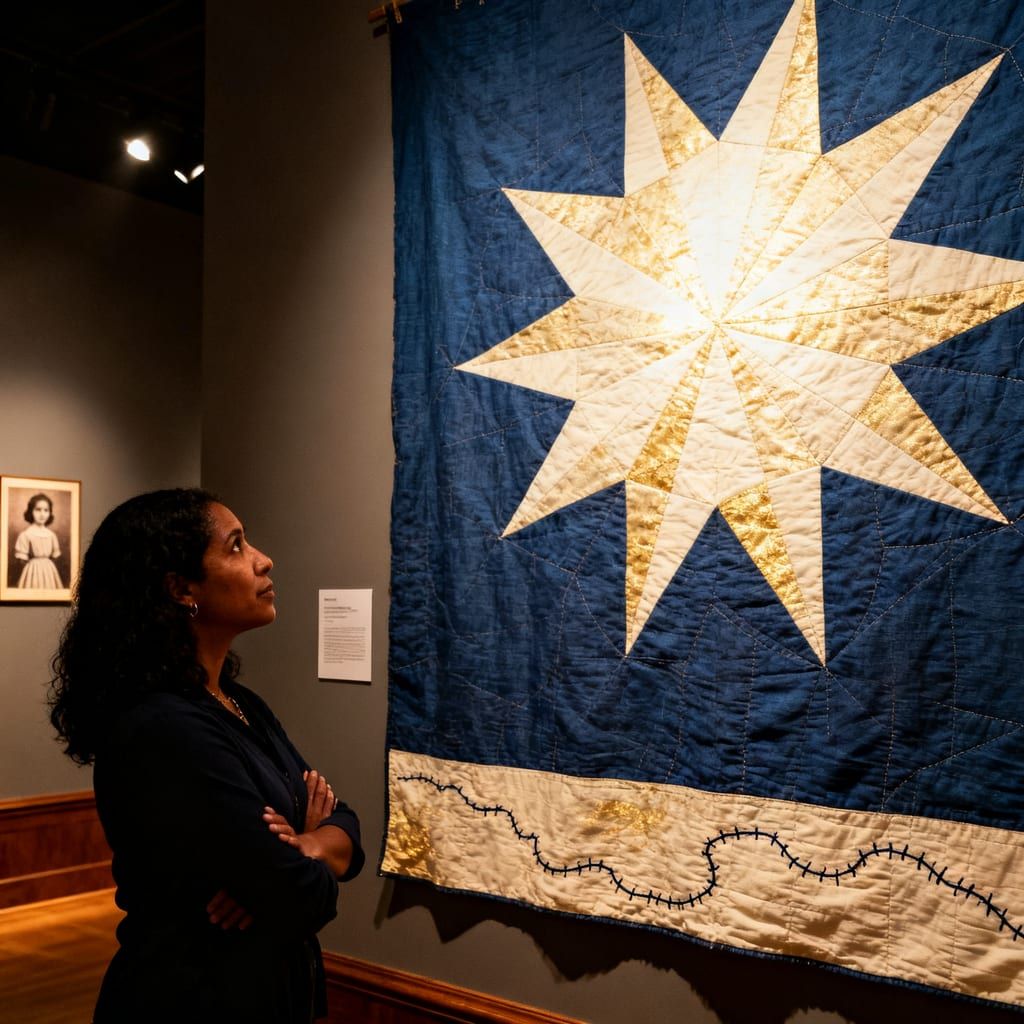
On a drizzly Saturday the building looks like a ship with all its lights out. Inside, the folk art gallery is a hush of wood floors and carefully arranged breath. The quilt hangs under low light, more night sky than bedcover, each point of the star pricked from someone's day.
She crosses her arms without thinking. In the tintype beside it, a girl in a borrowed dress stands the same way, eyes forward, jaw set like a seam. The caption: Unidentified young woman, c. 1865. Her hair is parted clean down the middle as if the part could make the world even.
"You see it too," a voice says, resting on the space between them.
An elderly woman has appeared as if unrolled from the wall-thin cardigan, sensible shoes, an expression like a screened porch. Her name tag reads RUTH in neat block letters.
"I keep telling Maintenance to adjust the frame," Ruth says. "They tell me it's level. I tell them the line's got its own mind."
"It looks like a river," Aisha says, and hears how sure she sounds.
Ruth nods. "Oconee Creek. The way I was told it bent near the cypress." She glances at the tintype. "My grandmother used to call this 'the girl who could outstare a storm.'"
Aisha's crossed arms tighten. "You knew the place?"
Ruth inhales and lets it go through her nose. "My people owned it," she says, not ceremoniously, but like dropping a stone where it needs to land. "Hancock County. The ledger with all the...items. I grew up with it in a trunk. This quilt lived under my grandmother's bed. A warm lie folded tight."
The words tilt the room. The quilt seems to lean closer.
"Someone made it," Aisha says softly. "Someone with a name."
"Lina," Ruth says. "Seamstress. Seventeen in 1841, as if that can fix a person in amber." She points at the faint river. "She and others met at the creek at night. Passed news. Stitched messages into cloth. My grandmother talked around it like a chair she'd walk by and never sit in."
Aisha steps nearer to the glass. At the bottom corner, nearly swallowed by the dark, two tiny letters gather themselves: A.M. Her pulse skitters.
"I didn't see that the first ten years I walked by," Ruth says. "They were added later. Alma Mae. She hid the quilt in 1921 when there were men with torches looking for a reason. Her granddaughter was your great-grandmother."
The world narrows to the corner of cloth, to the seam where one woman's initials anchor another's work. The ledger's cold columns crease into a spine; Aisha's shoulders fall under the weight of it and lift again.
"How do you-" She can't finish the sentence. It keeps unrolling.
Ruth smiles like a cracked cup that still holds tea. "Because when I donated this, a woman came in and touched the glass just there." She mimics the motion. "She said her Nana kept a quilt under the bed and told stories about a girl who sewed moonlight. She had your cheekbones. And your way of asking the question without breaking it."
Aisha swallows. Heat pins itself to the corners of her eyes and refuses to budge. She thinks of her great-grandmother's lap, a field of wrinkles that made a better map than any atlas. A thimble into moonlight. She thinks of all the names as stitches holding a thing together.
"Do you-" she tries again. "Do you have any...paper? Like... provenance?"
Ruth's smile turns sly, private. "We have more than that." She glances around as if the quilt might scold her. "But come sit first." She leads Aisha to a bench under a mobile of hand-carved birds.
Ruth opens a drawer in a low cabinet with the discretion of a magician revealing nothing and everything. Inside, foam cradle, museum tissue, the reverent quiet of stored breath. She lifts a clear sleeve. "Found this tucked into the binding when we examined the quilt. Edge had been repaired and someone had...written themselves in."
She peels back the plastic. The paper is browned like old pie crust, the ink a faded river of itself. The handwriting is round and careful, each letter practicing dignity.
Aisha leans forward. The words come steady, with a tremor at their edges she feels in her own teeth.
_To any daughter who needs to begin again,_
_This was made when I was told my hands were not mine. I put a river where there was none so I would remember where to meet my people. Keep it in women's hands. Let it live in a house with windows and a table where bread is cut. If you need a name to go by when you don't have one, take mine for the day and use it till it fits._
_Lina_
The name is a seam tied off at the end.
Aisha's hands hover over the sleeve as if heat hovers over a stove. She feels, impossibly, a small tug in her palms, the ghost-weight of fabric being passed across time.
"Years after emancipation," Ruth says low. "Someone mended that corner and slipped the note in like a prayer under a tongue."
The bench creaks. A child runs past on soft shoes, laughing, a sound like wind through reeds. The quilt keeps being the night it is; the river keeps its refusal.
She returns on a Wednesday with a list of names printed in 12-point Calibri because she cannot bring herself to use Times. She asks permissions she doesn't usually ask and finds them granted. The museum posts a flyer with a border of triangles.
They meet small at first, six folding chairs in a semicircle, the quilt between them like a shoreline. Aisha reads the ledger aloud-the brutal list of given names and takings-and lets each one ring until the room is a bell. Ruth sits with her hands folded, the way she might hold a fragile egg. A man with the last name Caldwell, a white man with sun-red ears, says his grandfather never talked about the farm. A woman with a silver braid that skims her back says her aunt used to wash a quilt without getting it wet. Someone laughs at nothing and then cries at the laugh.
They bring coffee and cornbread. They trade maps of creeks drawn from memory, where lanterns once bobbed like moths. They memorize the way to say each other's names with clean stitches.
On the third Wednesday, a girl in a Howard sweatshirt asks if she can touch the glass. The guard says no with sympathy. The girl breathes on it instead, and in the small halo she traces a curve with her finger. A river repeats itself inside a breath.
Aisha keeps coming. She leaves the museum and goes to her office where the screens take the light and give it back in rectangles. She opens a design file and renames it: "Lina_flow_v1.fig." She tries it again on a ticket, then an email signature. The L surprises her with how it looks attached to her own.
At the county court she scrawls on a form under the fluorescent throb. A clerk with velvet eyelashes reads it and looks up. "It's pretty," she says. "Rolls off."
"It was always there," Aisha hears herself say. It feels like unbuttoning a high collar.
She doesn't make an announcement. She lets it show up the way the river stitch does-small, insistent, only crooked when you need it to be.
On a quiet Sunday she stands again before the quilt with no border, the way it insists on spilling out of its own frame. The room smells like clean wood and the ghost of lemon oil. Ruth is off that day. The gallery attendant pretends not to notice Aisha talking under her breath.
"Lina," she says, tasting it. The L slides, the i lands like a pin.
Her palm meets the glass, not touching, just there. She traces, invisibly, the river's bend, the place where the line pulls aside, interrupts perfection for the sake of truth. She thinks of a teenager in 1841 with a pattern of another girl's body laid over her own. She thinks of a woman in 1921 folding and hiding and praying into a corner. She thinks of herself, a woman in a city of cranes and asphalt, making neat frames where there are none-and learning when to let a thing run.
From a side hall the murmur of new visitors rises, a tide of shoes and questions. Somewhere, someone will pause, cross their arms to hold themselves together, and meet a gaze across glass.
Aisha-Lina Aisha-keeps her hand near the river stitch. The crooked line does what it has always done. It points.
Story audiobooks for children of all ages — a new one every day on Smarter Way Stories.