Two Houses and One Quiet Heart
A daughter learns to read between the lines of a life split in two
Read more →
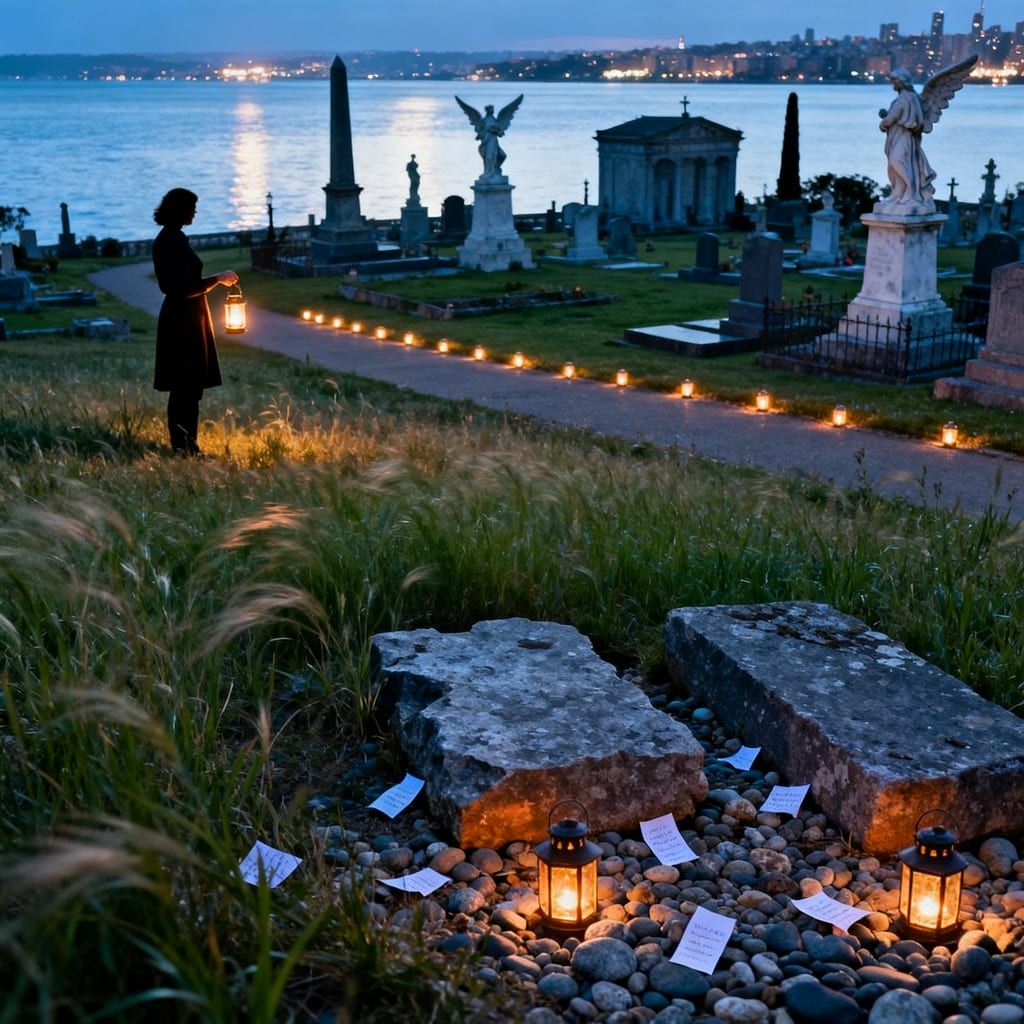
Eli Navarro times his tours to the first flicker of streetlights.
By then the gulls have folded their white knives and the bay throws back a last glimmer, and people-couples in linen, a teenager with a camera, a woman in a cardigan-cluster at the iron gate and look to him like he carries an old story in his pocket.
He does. Many, neatly rehearsed.
He greets them by first names, counts heads, and lifts his lantern. "We'll keep to the path," he says, voice pitched hush-museum rather than haunted house. "Our city keeps its histories tidy-mostly."
He knows where the angels with chipped noses catch the salt, where the weeping maiden leans her marble cheek against a book-names rendered in gothic script, dates bracketed by hyphens like the breath someone took between beginning and end.
He points to an obelisk. "Captain Hargreaves," he says, and there is the sea-whisper of phones raised, shutters fluttering like moths.
He can catalog the ornamental ivy, the palmettes, the stone that pinks in summer heat and the one that stays cool even under August.
He is thirty-seven; he was a substitute teacher before guiding the living through the quiet. Meaning is a thing he holds up to the light and turns.
Beyond the manicured sculpture and spider lilies is where his script thins-the earth pitches down toward the water, wind lifting the grass like a slow applause.
There, the stones grow scarce. A few lopsided markers, a handful of initials, then a stretch of field where the cuentos were never carved.
He hates when a guest asks, "Who's here?" and he must answer with his palms. The wind answers anyway.
The first time he finds a note, it is cut to the size of a matchbox and held by a pebble pale as a tooth.
He crouches. The paper smells faintly of lemon and something he can't place-church wax, maybe, or old books.
"Once I sewed sleeves near the docks," it says, written in a hand that has known grocery lists and recipes, careful but untrained in calligraphy.
He tucks it into his vest.
The next evening, another: "I was known for the rosemary bread."
Then: "I kept three buttons from his jacket."
They catch him behind the rib, these scraps. More than any admiral's epitaph ever has. He reads them in the soft after-hours light in his rented room, the fan chopping the air, the marina's bell like a metronome.
He brings the notes to the library, scans old bulletins from St. Teresa's with their curling edges, checks the newspaper archives where the ink still ghost-stains fingers. He reads church suppers and raffles, harbor accidents, the births and bake sales.
He learns the town as if it's a map that keeps folding itself into his pocket.
On the next tour, where the field unravels the pretty narrative, he doesn't skip anymore. He pauses.
"Listen," he says, and his lantern flares on a tuft of foxtail. "Some names didn't get carved. But they were here, in the seams."
A woman in the group-silver bob, sandals with thick straps-unwraps a sweater around her shoulders, as if cold has entered with the words.
He reads: "I was known for the rosemary bread."
Her hand flies to her mouth. "My Aunt Lety," she says, voice gone small. "She baked for the fishermen. She'd send the sweet ends for the kids."
Someone behind them hums, the low sound people make when something tilts and clicks into place.
Another evening, when the fog comes in like gauze, he reads, "I kept three buttons from his jacket," and a man with a bristle of gray hair makes a sound like the swallow before a sob.
"My grandfather," the man says. "He told us his brother came home soaked from the shipfire, and all they found later were buttons in his drawer."
He is a mechanic, it turns out, who has never walked past the iron gate before.
They come back-the aunt's niece with a Tupperware of rosemary bread that she says is close but not the same, children with lanterns shaped like stars, elders in rain hoods. They begin to tell what's been waiting in them.
He starts keeping an eye out for who might be leaving the notes.
The groundskeeper on Tuesdays is a man with a red cap who nods but says little. There is a teenage volunteer who likes to sit in the shade and scroll her phone, her earbuds blinking blue.
And then there is Rosa. He has seen her for years and not seen her-soft voice, careful hands, no badge but always a rake, always early.
He finds her at the shed behind the angel with the missing thumb, coiling a hose like a sleeping snake.
"Hi," he says, sticking out a hand because he has not yet figured out how to ask the true thing.
She takes his hand, palm cool. "You are the one who speaks kind," she says.
He laughs because he is shy. "I try. Eli."
"Rosa," she says, and looks past him toward the field as if it's telling her something.
He waits until she finishes tying the hose and then tries a sidelong question. "Have you seen the little notes out by the paupers' field?"
Rosa blinks, a tremor of thought like a moth behind glass. "Notes?" she says, neutral.
"Someone's been writing down memories. They're... good."
Her mouth softens. "Ah," she says. "Well. Maybe people remember things." She pats his arm and goes into the shed.
He stands a long time with the taste of rosemary in his mouth-funny how words can do that.
Weeks end. Tours swell and thin. He trims his script, lets in more air.
One afternoon, the wind scouring the grass to silver, he finds a note damp at the corner from dew: "I took the ferry to see the lights and did not get off in time."
It is too precise not to be true.
He circles back to the shed. No Rosa. The door is ajar, its hinge sighing.
Inside, the place smells of oil and lavender. A sweater hangs from a nail, pilled to softness. In the corner, behind a stack of clay pots, a dented cookie tin sits like a thing that has been waiting to be found.
He hesitates. Then he opens it.
Inside, paper slips, cut with determined, wavy scissor lines. Some are blank. Some are written on in the same careful hand. A few have a second line, in a different pen, where dates or places have been added-learned, perhaps, as someone told them to her over the years.
There is also a receipt, folded thin, the ink gone gray. "Settlement," it says, dated a decade and a half back, the amount small in government terms and first-home-in-our-town generous.
A line glows at the bottom, handwritten in a looping flourish: "Endowment: Children's Garden-by request of estate of laborer, unclaimed."
He thinks of the garden in spring-the little hands crushing mint between their fingers, the parents smiling badly to hide tears, the blue watering cans left in neat rows. He thinks of a man no one named who did not want his last kindness to be loud.
The door clicks. He looks up.
Rosa stands there, her face open like a field in morning.
"I wasn't stealing," he blurts, and realizes how dumb it sounds.
She smiles, very slightly. "You found them."
"I think I was supposed to."
Rosa steps in and touches the tin as one might a sleeping pet. "I write them down," she says softly. "When I hear. In line at the bakery. At the bus stop. Sometimes in my sleep. Before they..." She opens her hand. "Poof."
He looks at her, at the way her gaze lands and wavers. "It gets harder?" he asks, not unkindly.
"It is fog," she says, and taps her temple. "Some days I am in it. Some days I am the lighthouse."
She puts the tin in his hands. "You keep them safe," she says. "Tell them when I can't."
When the city circulates a plan with a diagram and a cheerful font-overflow parking curving like a bite taken from the paupers' field-there is a public comment form, a period to object, a phrase like ancillary necessity.
Eli is not a man who likes to raise his voice. He has learned to guide people toward the thing without spooking them.
He makes a new flyer: Stories of the Unnamed.
He borrows lanterns and strings them low along the path, little planets hovering over grass, light pooling where ankles brush seedheads and sandspurs pinch.
They come in twos and fives and a church van, people who have been before and people who have not, drawn by a rumor that something is being remembered.
He begins where his words usually falter. He holds the notes as if they might fly off.
"Once I sewed sleeves near the docks," he reads, and a woman in a knit cap nods like she has been waiting for this sentence all week.
"I was known for the rosemary bread," he says, and someone in the back lifts a Tupperware, this time shared quietly, piece by piece passed hand to hand.
"I took the ferry to see the lights," and a boy whispers, "My dad," and his mother's hand goes to the back of his head like a prayer.
He threads in what he has learned, not as a lecture but a lace. "A seamstress named Luz rented a room on Market; St. Teresa's bulletin lists a bake sale with R. Vega as volunteer. A shipfire the year we all remember sent shirts hissing into steam."
A stranger-broad-shouldered, face like he's been working in wind all his life-breaks open at one detail no one else knows: "He sang 'Volver' off-key," Eli reads, and the man laughs through tears that come fast, surprising him.
"He did," the man gasps. "We thought that was just ours."
The lanterns blink in the breeze. A child chases a moth. Somewhere a gull laughs as if at an old joke.
The next week, paperwork hushes. Donations arrive-checks with shaky signatures, a wire transfer from a restaurant group, a mason offering labor. All earmarked to keep the field unpaved. The parks department posts a revised plan, the cheerful font now bent around a preserved green.
Rosa has fewer good days. She comes to one more dusk tour, stands with her hands clasped, eyes closed like she is listening to a far radio station.
He walks her back to the shed. She sits on a stool, breath coming easy as sleep. "You are doing it," she says, and pats his sleeve.
When she passes, a week later, the groundskeeper with the red cap calls him first. "We found her list," he says in a voice that wants to be strong. "Under the mat. Your name at the top."
Her marker is modest-stone the color of river mud, her name shallow-cut, the hyphen bracketing the years so gently it feels like a hand on a back.
On the first tour after, he adds Rosa to his script.
He thinks for a long time about the word unnamed and how it both tells the truth and misses it.
He stands at the field's lip, the grass glimmering with the day's last, and says, "Rosa Vega kept a tin under the shed." He tells them about the ferry lights, the buttons, the bread, the check that made the children's garden grow. He does not say hero; he does not have to.
He reads one more slip from the tin, one he had saved because it felt like a benediction or a dare: "I liked the way the wind sounded here."
People look out over the field at nothing, at everything. The lanterns hitch and bow. A boy holds his mother's hand and does not squirm.
After they leave, he walks the rows slow, lantern low so the grass glows at the roots.
He tucks the notes back under pebbles, like seeds going into ground.
The bay draws in its breath. Somewhere in the city, a siren lifts and falls.
He knows the angels and the ivy and the elegant dead who paid for their names to endure. He knows now, too, how to stand in a place with no instructions and not have to fill the silence-how to hear what the wind keeps saying.
At the gate, he turns and sees the field again-uneven, mostly unmarked, spared.
His script has a pause in it now that feels not like forgetting but like the page between chapters you do not turn quickly, your hand waiting, the story not done but listening back.
He smiles into the dark. "We'll keep to the path," he whispers to no one and to everyone. "Mostly."

A daughter learns to read between the lines of a life split in two
Read more →
A fog-draped night, two souls found, and the quiet shape of a life
Read more →
Story audiobooks for children of all ages — a new one every day on Smarter Way Stories.