Two Houses and One Quiet Heart
A daughter learns to read between the lines of a life split in two
Read more →
Late autumn laid a hand on the river and stilled it, a pewter streak under the old trestle. Aaron stood at the edge of the brush, breath fogging, fingers stiff from a morning of sorting through his mother's winter coats and the drawer of rubber bands she saved for years. A freight rumble far off. The vines looked thicker than memory, the way childhood places shrink in the mind and swell in the body.
He pressed through anyway, burrs clinging to his jeans, shoes sinking in leaf rot. The air under the trestle was colder, grittier. It smelled like damp chalk and grape skins and the iron tang of the river. As a boy he'd named this space with his brother like it was a country. Today, thirty-six, burned out and newly emptied of a parent, he ducked beneath the same sag and felt the old tilt of secrecy-then stopped.
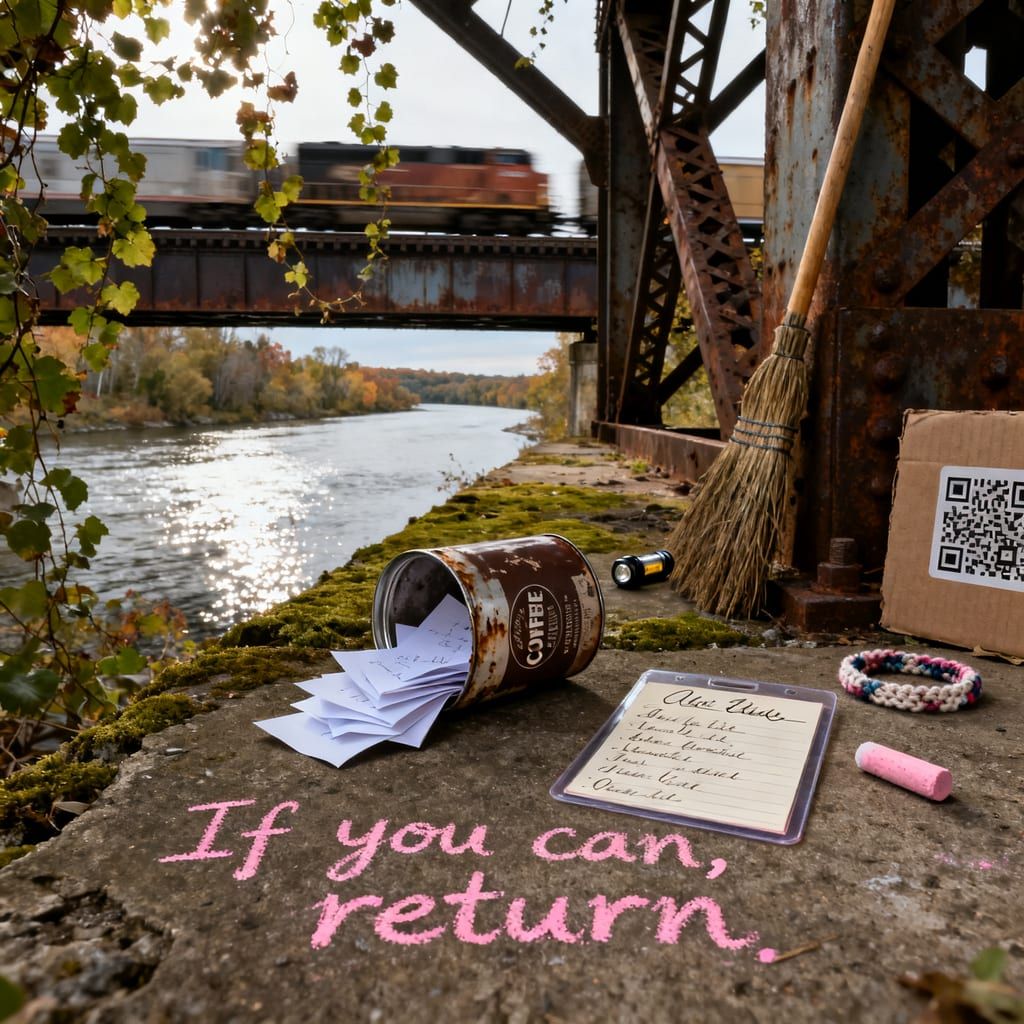
He expected spiderwebs spun like fences, the coffee tin rusted through. Instead the tin sat where they'd kept it, lidded and dented, stuffed with folded notes. A pencil stub lay beside it, worn down to a prayer. On the concrete: chalk outlines chalked fresher than fear-rule boxes scrawled in a kid's careful print. He knew the words before he could see them: No tracing. Quiet hours. Leave it better.
He laughed once, a bark that startled the starlings overhead. He'd written those rules at twelve years old with Luca standing guard, both of them swollen with the belief that they could keep anything safe.
He worked the tin open. The clatter echoed. Inside: paper soft as petals, pages folded and re-folded, a few dried clover heads, a ribbon, two bus transfers, a pair of bandaids still sealed. The pencil smelled faintly of cedar.
He crouched, knees popping, and began to read.
A spiral notebook, small and blue, dated back twelve years. Spidery hand-"I am hiding from the fight at home. Thank you for the quiet." Block-print-"Nursing student on break. Gonna pass out if I don't stop. Whoever left the flashlight, angel." Slanted script-"Delivery driver, night shift. Left a sandwich for the next tired soul. It's ham. Sorry if you're vegetarian."
His cheeks heated at the breach and didn't. The feeling of trespass lived alongside a fragile wonder. The notes braided across seasons, across years: scattered days like seeds and the vines had taken. He could see them-a kid with a backpack tucked under their knees, a woman in scrubs counting her breaths to the wash of passing cars. The place was a lung.
A page addressed "To Original Keeper" stopped him. The letters were teenage-neat, the signature two initials he hadn't written in two decades. AV. His face tightened like it does when a doctor presses a sore spot.
He turned another slip and felt his chest fall open.
It was yellowed at the edges, the lines sinking to sepia. "Aaron, I'm sorry," it read. "About the bike, yeah, but mostly the yelling. I shouldn't have said you were nothing without the fort. I was mad about more than the bike. I don't know how to fix us. I came to say it here because maybe you'll actually come back to listen. - L."
He touched the paper with the careful pad of a finger. A decade and a half of friction hummed between his arteries. He could smell their old arguments: oil and heat, August sweat, the sour of fear when their mom worked doubles and the electricity bill bossed their meals.
Beyond the tin, chalk lines across concrete told stories of caretakers he hadn't imagined. Newer rules signed with initials he didn't recognize. "If you borrow the blanket, tuck it back dry." Someone had drawn a small broom. Others had left actual brooms, bristles splayed, leaning like tall grasses at the edge. There was a tarp patched at the corner, the exact color of the one he and Luca once stretched between rebar in spring.
He read note after note. An art teacher left stick after a storm and two boxes of chalk for "the next hands that need to say something to stone." A mail carrier wrote, "Route 8. If I find granola bars in my pocket at the end of my day, they land here." Someone signed "M." and added, "Key to Second Street Community Fridge behind the post with the red x. Pass it on."
A newer slip, jagged from a receipt edge: "Your mom said this was a good place to breathe. She was right. Thank you, Miriam."
He blinked. The river breathed. Train hum shifted like a sleeping animal.
Under the tin, as if someone had slipped it there with ceremony, a laminated index card waited. His mother's cursive threaded across the lines, neat but leaning forward like always in a rush.
"Rules for here:" she had written.
"- No tracing.
His throat warmed. He saw her at the kitchen table with the catalogues spread, a cup of tea she never finished cooling to skin temperature. He hadn't realized she came down here. He hadn't realized how she believed in edges-that what people needed most was a place held soft and steady.
A crocheted bracelet lay beside the card, clumsy rainbow. There was a tiny flashlight with a strip of tape labeled "for pockets," a button that read RIVER KEEPERS, a cardboard square inked with a black-and-white pattern.
He held the square up. A QR code. Someone had printed it with care, laminating corners with clear tape. "Audio," a note said in thin felt-tip, arrow pointing.
He stood, swayed, and scanned with his phone.
The sounds arrived slowly: wind, a low thrum of train, water on submerged rock. Then voices, layered, crossfading like strangers stepping into a shared kitchen.
"Whoever started this, thanks for the held breath," said someone with smoke in their voice. "There were nights I forgot how to inhale."
"RN student at St. Claire-practicing blood draws on oranges-if you left the hand warmers last January, I love you," said another, laughter cracking like ice thawing.
"Route 8 again," the mail carrier said, amused. "Got a new pack of bars, oat this time."
A voice, calm and competent: "This is M. The key's still hanging on the nail behind the post. Please return the key. We don't need chaos at the fridge."
Then his mother's voice. Younger than it had any right to be, carrying that smile he heard on the phone when she wanted him to eat. "This is Miriam Vega. Swept leaves today. Tucked peppermint tea and two bandages in the tin. Found a drawing of a fish. Who drew the fish? It's wonderful."
Aaron sat without meaning to. Gravel pressed through the denim. He listened to the rustle of the microphone, the scrape of chalk as someone tested sound.
And then-
"Hey," came a voice, too close to the mic so the P's puffed. His brother's, unmistakable even with the years scraped thin. "It's Luca."
The air tilted. Luca's voice had a hoarseness that only showed up when he'd been crying or yelling.
"I messed up," Luca said. "I took your bike and I lied and you were right to be mad. But I was mad too. I wanted out and I didn't know how to ask without making you feel small. I said that thing about you being nothing without the fort. I didn't mean it. You made a place that kept people. That matters. I'm leaving this here because the rules felt like church to me. Keep this till he comes back, okay?"
There was a shaky inhale. "Aaron, if you hear this, call me. Or don't. Just know I know."
The file clicked softly and ended in the river's endless shush.
Aaron's hand found his chest without asking permission. He sat with the tin and the notes and the afterimage of the sound. Strange how you can be heat and ice at once.
His phone screen dimmed; he woke it and scrolled to Luca. A number he'd kept muted for years, a habit that felt suddenly juvenile, like the way he'd pass his brother's old street too fast so as not to see his truck and feel everything at once.
He typed, erased. Typed again.
"I'm at the trestle," he sent finally. "I heard you."
Three dots bloomed, vanished, bloomed. He set the phone down. It was enough to let the dots exist.
He pulled his hoodie tighter and reached for the chalk. His fingers remembered how it dusted your skin, how it made splotches your mother would thumb off your cheeks with a wetted towel.
He added a square beneath the rules, the words slow and careful to keep them from wobbling.
"If you can, return."
It sat there in cheap pink like an invitation past and future could sign together.
He folded a note-a first in twenty years-and wrote, "Original Keeper checking in late. Thank you for keeping watch. Thank you, M." He didn't sign his initials. He left the page with the others like a current going the other way.
The house key weighed his pocket. He set it in the tin and felt foolish, then right. The realtor could make a copy. The key wasn't for locks now.
His phone buzzed. A message from Luca: "I'm two exits out. Don't move."
Aaron laughed, the sound catching on a bramble, and sent back a thumb and a heart, the way men who have not known how to talk say I love you with their entire forearms.
He swept a corner with the broom. Leaves whispered. He found a tea bag his mother might have tucked-peppermint-and set it upright like a small flag.
He imagined the next person ducking under the vines after a long day, balled-up shoulders easing. He imagined them seeing the chalk boxes, the neat laminated card. He imagined them picking up the flashlight in winter and blessing the stranger who'd thought to tape "for pockets" to its side.
He sat until his legs went numb and the light took on that late-afternoon thickening. A train crossed the trestle, slow, its bolts and seams speaking. Dust sifted down in sighs. The river shrugged and kept going.
When he crawled back through the vines, bracken snapped, and a chill lifted the hairs along his arms. He paused with his palm on a post graffitied with the word STAY. He'd always thought staying meant weakness, like the town was a net and he was a fish. Now the word felt like a different verb entirely-an act, a keeping.
He didn't say any of that out loud. He pocketed the chalk stub and left the rest.
On the path up to the road, his phone vibrated again. "Traffic," Luca wrote. "Ten minutes."
"I'll be here," Aaron answered.
He turned once and looked back. Under the trestle, the space glowed the way certain windows do at dusk, invitation without demand. In the center, the coffee tin waited, its lid catching a slice of waning light. The chalk boxes were crisp as new footprints. His mother's words hovered at the edge of them, three simple rules that had held a town's small braveries.
Aaron breathed in, slow to the count he'd taught himself on product launches and panic attacks. The air tasted like iron and grapes and peppermint.
He was not twelve. He was not lost. He touched his phone to make sure the dots were still dots. Then he stepped toward the road, the river still speaking below, and let the path hold him until footsteps-familiar ones-broke the leaves behind him.
He didn't turn yet. Some returns deserve a few extra heartbeats. Under the trestle, what they'd made kept doing its quiet work.
And on the concrete, chalk drying in the cold, one last line waited for whoever needed it next: If you can, return.
A daughter learns to read between the lines of a life split in two
Read more →
A fog-draped night, two souls found, and the quiet shape of a life
Read more →
Story audiobooks for children of all ages — a new one every day on Smarter Way Stories.