Two Houses and One Quiet Heart
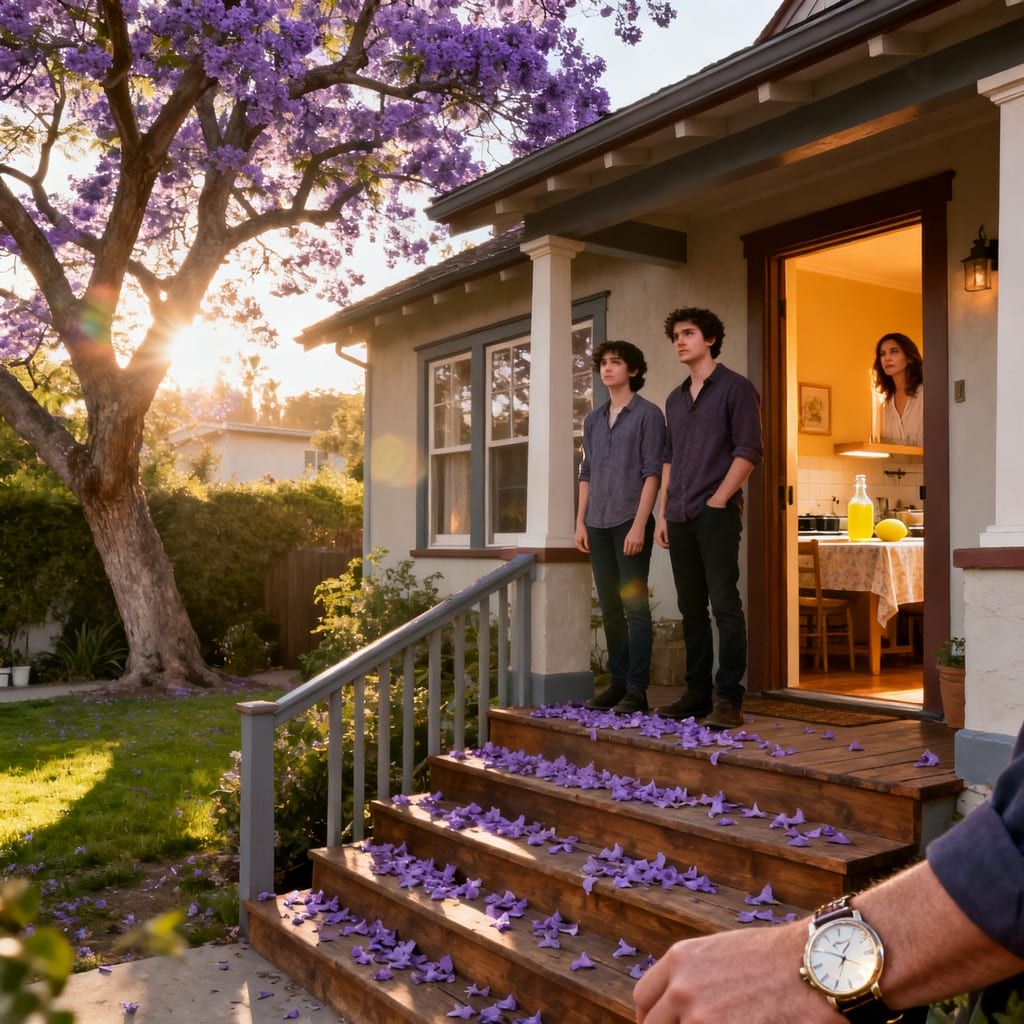
A daughter learns to read between the lines of a life split in two
Read more →
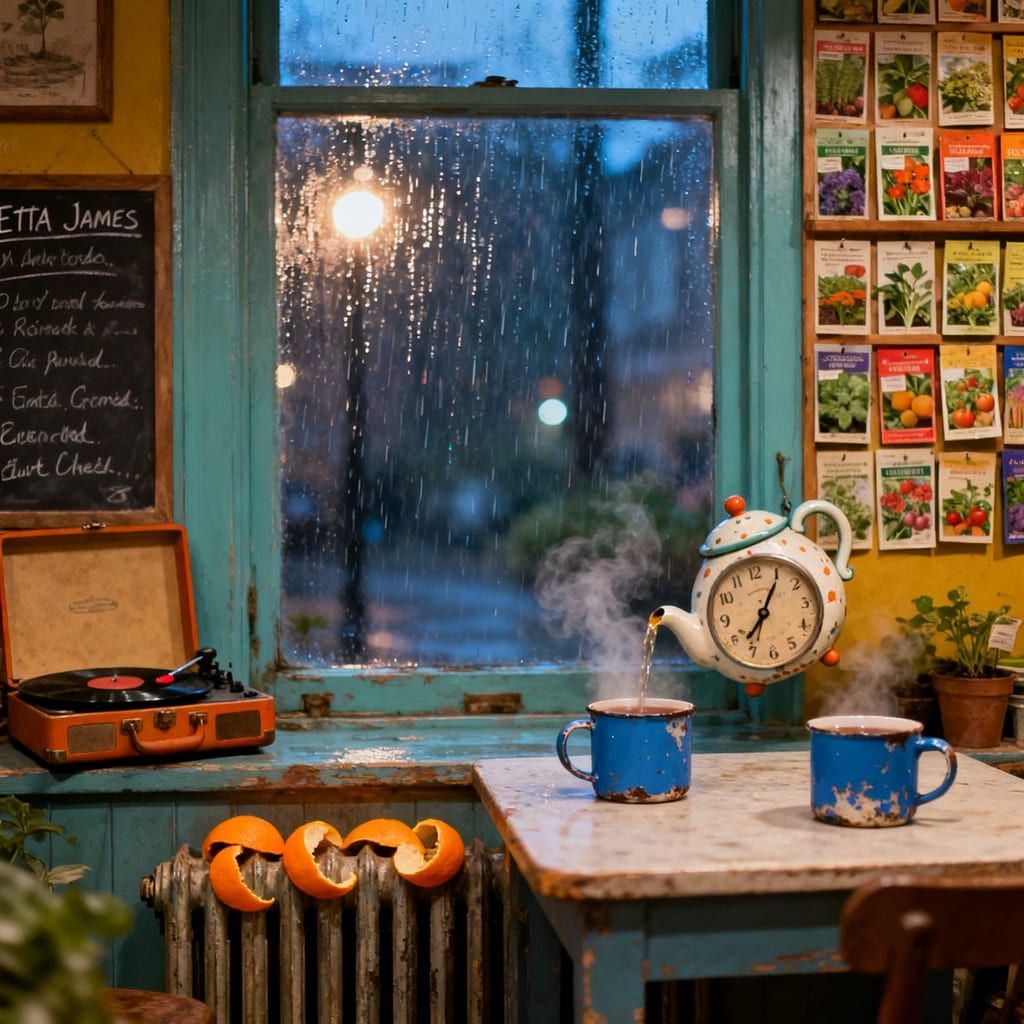
The rain came sideways the day the laundromat became a café, angling under umbrellas like it had a key to the city.
Inside, clocks poured tea.
They did not tick so much as breathe-ceramic kettles painted with numerals around their bellies, spouts like minute hands. Steam ribboned from them as if time itself could warm your palms. The neon LAUNDERLAND sign still hung in the front window, letters half-burned, but someone-Lina-had looped a paper banner beneath: memory café, open when it matters.
She opened the door, and rain-smell-metallic, electric-slid in. The room was a chorus of new soft things: seed packets pinned to one wall, a spectrum of small envelopes in tidy rows; a record player with sleeves cataloged by decade; a chalkboard menu of prompts instead of specials.
Tell me about the shoes you loved.
What did rain smell like in your first apartment?
Who taught you how to whistle?
Lina Alvarez, thirty-seven, wore a denim apron with threads that remembered other lives. The apron had a bleach spot shaped like a crescent moon, a ghost from the laundromat days. She moved quickly and then slowly; she'd learned that was the rhythm of care.
Her grandmother had drifted away in small sips. Not a sudden storm, not a flashing diagnosis. Just mornings where the coffee dripped longer, where Maria Alvarez's hand hovered over the sugar bowl like she was waiting for instructions from a future that never arrived. Lina had sat on the edge of her grandmother's bed on the last day, holding a cooling hand and making a promise with no contract, only salt and breath: I will make a place where the forgetting feels less like a cliff and more like a wide soft meadow.
The city gave her a shuttered laundromat and a modest grant. The rest arrived one stranger at a time.
Mr. Patel came first and apologetically. He stood in the doorway with an umbrella still open, as if he didn't trust closed things. His wife, Asha, once a mathematician, held a spiral notebook upside down and tapped equations in the air with her finger.
"I heard-" he began.
"Come in," Lina said. "We have tea that thinks it's an afternoon. And oranges that remember every summer."
From behind him, April pushed in a wheelchair with tattoos blooming down both arms-violets, tiny sparrows, a compass pointing home and then home again. Her mother, Lisette, hummed something under her breath-two bars of Nina Simone that landed like silk on an upturned palm.
Later, a tall man in a wet hoodie hovered by the seed wall, scanning the envelopes like they were a code he could crack. "I'm Jonah," he said. "This is Sara."
Sara looked at Lina and smiled a lopsided smile that slipped just at the edge. "Hi, Brother," she told Lina, then laughed at the wrong punchline.
"Let me get you a seat," Lina said, and set down a chipped blue mug at table three without thinking why that felt right.
The café learned how to hold people the way good chairs do-without notice. Someone always put a record on, and someone always peeled an orange near the radiator so the room smelled like sun pretending to be domestic. The chalkboard prompts led to stories that didn't need names to land.
"Mary Janes, patent leather," April's mother said, and April drew them in the condensation on her water glass.
"Rain?" Asha mused. "First apartment? It smelled like my sister's hair oil burning, and mint leaves on the windowsill because the kitchen had no vent."
Jonah found a quiet corner by the window, near the place where a row of washers once lived. He watched Sara's face the way people watch a train schedule when they're late-hungry and a little angry at physics.
"Try this," Lina would say, setting a bowl of lavender between them or a bag of grass seeds to rattle or the tiniest bell. Tell me about a sound you thought you lost.
There were bad days. There were days when someone's father tried to walk out barefoot in January and Lina, without judgment, guided him back by offering her scarf like a rope. There were days when Asha solved nothing and could not forgive herself and Mr. Patel sat with his hands on his knees and blinked into slow surrender.
But there was also the hum that builds when strangers start calling the same place "ours." The volunteer board filled and refilled until a high schooler named Mae with purple bangs took the last Thursday slot and never missed it.
"You run this like a product sprint," Mae said, half-admiring, half-teasing. "Except the deliverable is... feelings?"
Lina laughed. "We ship soft landings," she said. "Two-week iterations."
He left the note on a Tuesday. No rain that day, only a sky rubbed thin, and the clocks pouring tea like normal. Lina found the paper folded under the bell jar of honey, the words written so firmly the letters had edges.
I can't do this anymore.
No name, but she knew the angle of that grief, the desperate flatness of it, like a road with no exits. She stared at the chalkboard where she'd written Tell me about a door you almost didn't open.
Her first hysterical thought was structural. Had she missed a variable? Had she overfit the model? Then her grandmother's hand-always, even in death-touched her shoulder from some internal architecture and stilled her.
She looked up. "I need help," she said, to no one and everyone.
The café answered back like a muscle.
Mae glanced at the clock-an actual clock this time, not a kettle-and said, "Bus station. People go there when they need to not be followed but still want a schedule watching them."
Mr. Patel unfolded receipts from his wallet the way magicians pull scarves. "I saw Jonah this morning," he murmured. "He paid cash. Abandoned his tab." He handed Lina the register slip where a coffee stain had bled like a tiny map of an island.
April took out her phone. "Lisette had a lucid patch before lunch," she said. "I hit record because she... she said Jonah's name like she used to say my father's when he came home late. With-like-sunlight."
They moved without looking back. The café could hum without them for an hour.
The bus station had the particular fatigue of places built for leaving. Fluorescent lights flickered with the steadiness of the sun. On a metal bench under an advertisement for a mattress company that promised to remake your childhood, Jonah sat with his hood up and his hands clean in that wrong, careful way of a man who'd washed them too long to stop feeling what they'd touched.
Lina slowed a few feet away. She'd learned not to arrive like a solution.
"I have tea," she said finally, like an apology. "I stole a paper cup from the gentleman at the kiosk. I'll pay him back."
Jonah didn't look at her. "I'm a coward," he said.
"Mm," Lina said. The tea sloshed, steadying. "What kind?"
He blinked, still not turning. "What kind of coward?"
"Tea," she said. "It's earl grey pretending to be confident."
He laughed once and it sounded like a coin dropping.
"Can I sit?" she asked. He shrugged, and that was consent enough. She poured, the paper cup sagging a little, the steam bright as possibility.
"April recorded something," she said. "Only if you want it."
He flinched as if sound could bruise.
"It's Sara," Lina added softly. "Between. She said your name."
He swallowed. "What if I can't go back," he said into his hands, "and be the person she thinks I am on those days?"
"You won't," Lina said. She felt the truth settle between them like a coat. "But you can go back and be the person who shows up for the person she is. That's... that's a different job. It's harder. It's also-" She didn't finish. Words could ruin the simplest bridges.
She pressed play.
On the little phone speaker, foggy and fine, Sara's voice emerged like a bird slipping through. "Jonah," she said. A breath. Then, brighter, "Jonah," again, the syllables rounded the way you say the name of water.
He folded in half. Not broken-hinged. The kind of bend people make when they're re-stringing something.
"Okay," he said into the cup when the recording ended. "Okay. I thought I was supposed to be remembering for both of us. I forgot I could be held."
They sat under the flicker. Buses inhaled and exhaled. The ad above them clicked mournfully to the next image. The tea went the exact amount of warm that means drink now or regret it.
"Let me walk you," Lina said finally.
He didn't argue. He stood. His hood fell back like a tide.
Back at the café, April had set out plates of lemon cookies for no occasion-we make occasions, she'd once said, with a shrug-and Mr. Patel was pretending to do a crossword so no one would ask if he'd been worried.
Sara was in a good patch, as if her mind had overheard the plan and decided to cooperate. When Jonah appeared, she looked up and her pupils dilated like shutters flying open.
"Jo," she exhaled.
He nodded, knees softening. Not fixed. Held.
That night, when the rain finally began, it came soft, the way rain remembers after a long drought how to be a guest and not a thief. The clocks poured tea for all the returns that did not come with parades.
Weeks later, on a Wednesday that arrived like a hand on a back-gentle, encouraging-the caregivers locked Lina out of her own café.
"Rude," she said, banging on the glass in pantomime, playing their game. Her joke breath fogged the window into a coin she could spend later.
"No peeking," Mae mouthed through the door. She'd made a sign from a file folder: reverse memory night. come back in one hour, bring nothing but your face.
Lina walked the block in circles. She counted the tiny weeds between the sidewalk cracks like lifeboats. She stood under a tree and let the rain tap her hairline. She tried to picture what had them whispering, what string they were threading.
When they opened the door, she didn't step so much as fall forward.
The café was itself and also not. Someone had moved the small table near the radiator. On it sat her grandmother's chipped blue mug-the mug she'd accidentally left at the café one September night and then forgotten she'd ever told anyone about. From the record player, Etta James rose like a benediction. The track skipped once at minute one-fifty-eight-the same cruel, beloved skip Lina had grown up cursing.
Orange peels warmed on the radiator, releasing an old apartment she hadn't thought of in years: fourth floor walk-up, windows that stuck in summer, the neighbor across the hall who sang opera at 2 a.m. The room smelled like bringing in groceries on a Thursday and fogging up your glasses.
Mr. Patel stood by the teas, dignified as ever, pretending he'd done nothing. April pretended to adjust a plant and blinked very fast. Mae, arms crossed to hold herself together, said, "We took your chalkboard away. Tonight you don't prompt. We do."
On the chalkboard someone had written in a hand Lina recognized as her grandmother's, because grief teaches you forgeries: Sit. We know the rest.
Her knees gave instructions to her body-fold, breathe, surrender-and for once she obeyed. She wrapped her hands around the chipped blue mug and felt the exact scratch of glaze where her grandmother's ring had nicked it years ago.
She did not cry. Crying is one way a body releases. So is holding very still.
They sat with her, not interrogating, not narrating, not building. Just scaffolding an hour so she could stand in the middle of it and own nothing except her pulse.
Later, after the oranges turned dull and the tea learned room temperature, Mr. Patel cleared his throat. "We thought," he said, "the person who keeps everyone else's memories might need to borrow one."
Lina smiled into her cup. The rain thinned to a damp whisper. There was a humming-a human one-that replaced the one the machines had left when they carried the washers out.
"I built this place to save what slips," she said, voice steady, surprised. "But maybe-" Her throat closed around the word. She let it. She didn't need to finish. The room finished for her by continuing to be itself.
The café would never be a miracle. Miracles ask for belief. This place asked for chairs that didn't wobble, for hot water at the edge of boiling, for a teenager to show up on Thursdays even when her algebra was complicated, for a record player that had to be coaxed with a butter knife when the arm stuck.
Time kept doing what it does-it poured. Some days it tasted like over-steeped tea. Some days it tasted like the first orange of the season, stubborn to peel until that one moment when the skin surrendered in a single glorious ribbon.
People kept arriving. A woman who taught herself to whistle again by practicing into a flour jar. A man who hated the feel of wool and found peace in the cool rubble of dried beans. A nurse who worked nights and needed a place where afternoon existed at 7 a.m.
Whenever Lina refilled a kettle, she'd watch the steam like a small sermon. The clocks poured tea. They did not promise a past, and they did not hoard a future. They offered what they had: a warm now held carefully between two hands.
On the chalkboard one morning, Mae had written without asking permission: Tell me about a door you built for someone else.
Lina looked at the wall of seed packets-the saints of basil and marigold, of heirloom tomato and wildflower, each one a possible future sleeping in paper-and breathed a little larger.
Outside, rain learned again how to be soft. Inside, the room learned again how to be a body. The clocks, faithful, kept pouring.
A daughter learns to read between the lines of a life split in two
Read more →
A fog-draped night, two souls found, and the quiet shape of a life
Read more →
Story audiobooks for children of all ages — a new one every day on Smarter Way Stories.