Two Houses and One Quiet Heart
A daughter learns to read between the lines of a life split in two
Read more →
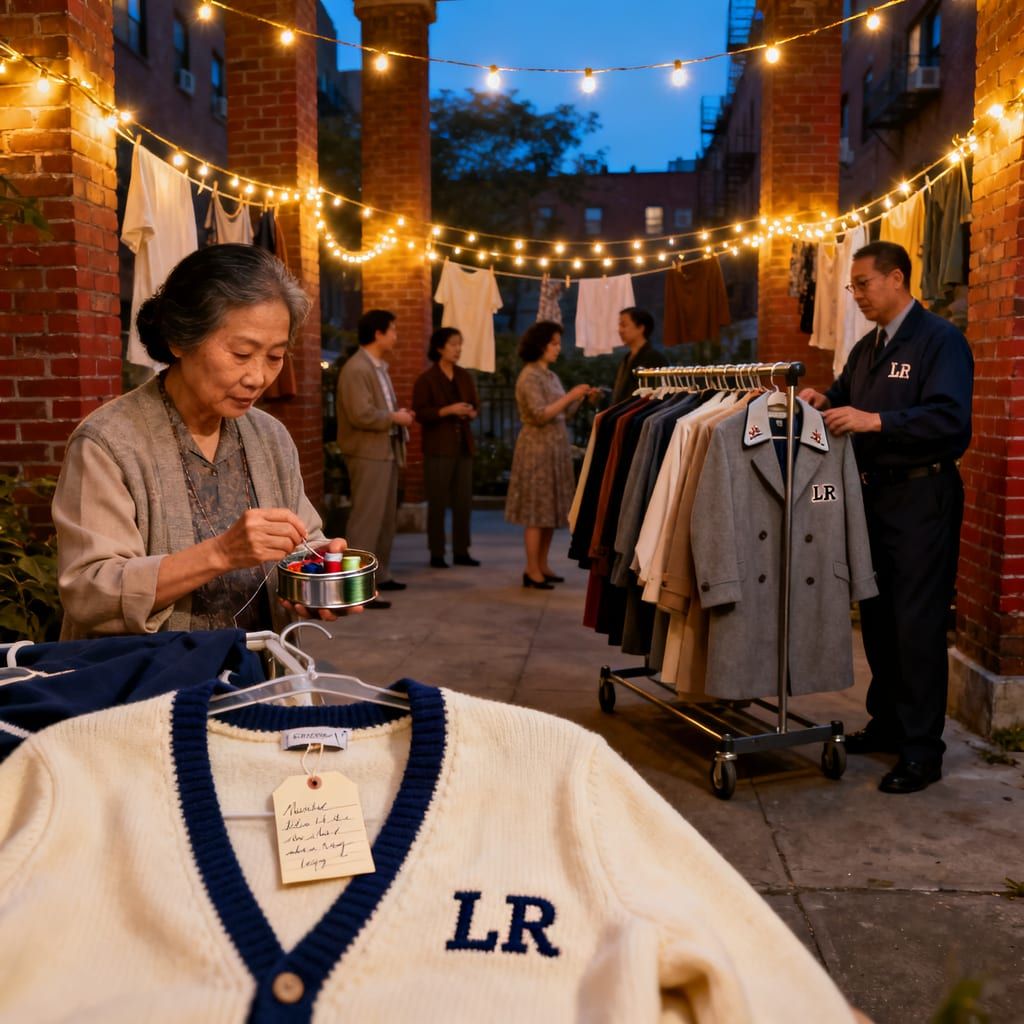
Lena taped the last index card to the line and felt the tug ripple down the cord, a thrumming that travelled through wooden clothespins and the sleeves of a dozen strangers. Wind bumbled into the courtyard, lifting cotton and cedar and a faint sweetness of detergent into the new blue of spring.
She had printed the rules in thick, shy fonts and taped them to the wrought-iron gate: take what you need, bring what you don't, no guilt, no money. Underneath, in a smaller line that had cost her three reprints and a gulp, she'd added: please attach a memory.
By nine, the courtyard bricks still held winter. By ten, the stroller wheels began to click against the threshold and the first card fluttered on the twine: "First date dress. We laughed about a broken zipper." Then: "Dad's sweater, the winter he taught me to parallel park."
Lena expected a trickle-a neighbor or two, maybe the barista from the corner place if his shift ended early. She set out two folding tables, a borrowed garment rack, a jar of clothespins, and a pen taped to a ball of twine like a leash.
Instead, the gate squeaked and did not stop.
Parents maneuvered double strollers around the planter of tulips someone had coaxed out of a shadowed corner. A barista she recognized by the tattoo of foamed milk on her forearm lugged a suitcase thudding with band tees. An older woman arrived with a canvas bag and a pair of mending scissors whose points flashed like two quick minnows. A teenager in an oversized hoodie slipped in wordlessly and hovered at the edge, eyes moving along hangers with reverence-like he'd walked into a museum where the paintings could be tried on.
"Are we doing tags?" the barista asked, breathless, tugging a shirt that declared something political and tender.
"Yeah-there." Lena handed over a stack of index cards. "It can be anything. A feeling, a place." She almost said a reason, the kind she'd been hunting at three a.m. while hate-reading an article about textile waste and scrolling through an app that wanted to sell her the version of herself that slept better, cooked better, dressed better. You make screens more irresistible for a living, she'd thought. Make something else irresistible.
By noon, the courtyard was a geography of clotheslines. Dresses swayed between brick pillars. Caps and scarves nested on the ledge like waiting pigeons. People wove among racks, reading memories that made them laugh into their sleeves, or pause, fingers stilled on buttons.
"Do we negotiate?" someone asked, holding up two jackets as if comparing apples.
"No money," Lena said. "No guilt. Just-" She gestured to the cards. "Just that."
A woman traded a blazer that had seen twelve mediocre presentations for a chambray shirt with a coffee stain shaped like Florida. The tag read: "Spilled in Atlanta, didn't get the job. Wore it anyway." Lena liked her instantly.
Clouds folded in on the sun with the lazy drama of a curtain. A breeze decided to be spring after all. Someone's toddler crawled under a table and emerged wearing a silk scarf like a cape. The teenager in the hoodie-there was a carefulness to him, the way he held lapels as if they might bruise-surprised himself into a smile when a navy peacoat made him stand straighter.
"Interview Monday," he muttered, not looking at Lena, as if saying it to the coat would make it truer.
"You look like the person who gets it," she said lightly. "Keep it."
He blinked at her, then at the tag dangling off the button. It read: "Wore this to quit a job I hated. Kept my hands warm."
At two fifteen, the lights in the lobby blinked and died. The building sighed-an audible hush. Someone's playlist fizzled mid-chorus. In the apartment windows, fans slowed to stillness, and a neighbor's sourdough starter was left to its own devices. The brownout rolled down the block, paling the bodega's neon, sucking the pharmacy's automatic doors open and holding them there like a gasp.
The courtyard, in its pocket of air and brick, reshaped itself. A dozen hands went skyward with phones, flashlights popping into being like small, new moons. Someone unearthed a coil of string lights from a moving box labeled CAMP and grinned as they tacked it along the fence. The bulbs hummed to life with a stubborn glow, as if they'd taken a personal oath.
"That's better," someone said. "Now it looks like a scene."
In the gentle pocket of light, the older woman with the mending scissors rose. "I'm Mei," she said, voice clear but unhurried. She opened a tin-a plump cushion of pins, a parade of needles, thread in soft little doughnuts of color. "If we are to swap, we should mend."
They gathered in a half-moon on the courtyard stoop: a ripped cuff, a snagged sweater, a child's knee gone shiny with play. Mei threaded a needle and taught without announcing she was teaching: "Buttonholes are small mouths. Let them speak, not shout." She showed how to tuck a tear under and whisper it shut. She turned a coffee stain into a crescent, embroidery thread glinting like a secret.
Lena watched shoulders lower. Stories sidled out as hands worked. A man with paint under his nails admitted he'd kept an ex's sweatshirt for the way it smelled after the dryer. A nurse in cartoon scrubs rolled her eyes at cheap seams, and Mei nodded, her own eyes doing a dance between sorrow and expertise.
"In the factory," Mei said, feeding blue thread through a woolen cuff, "we raced the clock, always. Your hands learn to hurry. Later, you must teach them slow again."
Phones quieted. The courtyard felt older, like the bricks had remembered their kiln. Laughter made loci. The teenager tugged the peacoat around his shoulders and sat so far forward his knees were sharp mountains. He practiced a handshake in the air and startled himself into a grin again.
"You'll do fine," Mei said, without looking up.
A metal cart squeaked at the gate. The building superintendent, Mr. Rahman, eased in with a garment rack cloaked in clear plastic like rain. He was a polite weather system of a man, whose keys sang his approach and whose footsteps you learned to trust by their patience. He parked the rack where the string lights made halos over hangers and peeled back the plastic.
Coats-wool and cashmere and the puffed warmth of someone's November. Cardigans in gentle heathers. A trench whose belt had learned the curve of a certain waist and kept it. Each collar wore small navy initials, stitched with neatness bordering on devotion.
"Unclaimed," he said, almost apologetically, rubbing a thumb along a lapel as if apologizing to it too. "Collected, cleaned, kept ready."
Lena felt a nudge of familiarity-as if she'd turned a corner into a street she used to live on. Her eyes snagged on a cream cardigan whose buttons were mother-of-pearl and one was not, replaced years ago with a close-enough cousin. The letters inside the collar-LR-were tidy and sure.
Her own initials, from before she knew the hyphen would look good between names.
The world narrowed to texture: the nap of worn wool, the paper-soft wear at the cuffs, a small stretch at the elbow where her mother wrote grocery lists at the kitchen table. She slid her hand into the pocket. Her fingers found a ridge of cardstock.
A theater stub-Queens Theatre, a spring matinee, the date stamped in smudged ink that made her throat lift and tighten. Behind it, paper rustled: a grocery list in her mother's handwriting, neat as a trellis. Limes, cilantro, cumin-then "paper towels, the good kind," and "call Lena about the dentist."
"Mr. Rahman," Lena said, but her voice was somewhere down a hallway. Her mother had moved out of the building years ago, out of the city soon after, the cardigan draped over a chair one day and gone the next.
He nodded, tired and kind. "I mend what I find," he said quietly. "If someone asks, I return. If not, I wait. This one-" He touched the LR. "I thought it wanted to stay close."
For a beat, Lena thought of her screens, their endless prompts to upgrade, dismiss, allow. The carrots of alerts, the stick of red dots. Of asking users to trade their attention for ease, of her own exhausted thumb translating everything into decimals of approval. She had wanted this day to weigh more than that. She hadn't imagined it would put a cardigan into her hands that smelled faintly of Irish Spring and cumin, of her mother's small, relentless care.
She swallowed, the air in her chest cauterized and bright. "Thank you," she said, which felt silly and also like the only possible sentence. "I didn't know-"
"I did not either, until today," he said, smiling into his mustache. "There is a right moment for each thing."
Mei had drifted over, eyes taking in the cardigan's tidy scars. "Good stitching," she observed, approving his initials. "Care remembers itself."
The brownout held, but the night did not feel like lack. The string lights hummed on, a low chorus. A woman slipped a winter coat around the teenager's shoulders and pulled the collar snug. "For luck," she said, and tucked a safety pin into his pocket like a tradition she'd just thought up.
Two neighbors who had only ever exchanged holiday nods found themselves bent over a shirt together, measuring a hem by eye and laughter. The barista traded a Misfits tee for a wool hat and a recipe for lentil soup offered on the back of a tag. A man who looked like he could lift a piano volunteered to carry bags down three flights. Someone left a Ziploc of spare buttons in the thread jar, the kind of quiet donation that keeps time.
Mei told a story about a factory floor's fluorescent buzz and the day she decided her daughter would not know that sound as labor. Mr. Rahman told a story about a winter heat outage and blankets handed door to door. The courtyard made a small archive of kindness, each scene tied with rough twine.
Lena moved through it like someone touring a new house and recognizing her own furniture. The cardigan lived on her arm, heavy in the best way. In her head, her mother was tapping in with commentary-Too thin for February, mi amor; the buttons, see, they always crack if the needle is too fat-and Lena, for once, let the voice speak without swiping it away, without filing it under She Meant Well.
By cleanup, nothing felt like an ending. They wrote "Swap & Mend - first Saturday" on the back of an old moving box and propped it in the lobby. The jar on the table obliged, not paper bills but small spools of thread, a fistful of safety pins, a visit of buttons that had been waiting at the bottoms of drawers for a reason.
The teenager hovered at the gate, peacoat on, hair combed by the certainty of a next step. "Thanks," he said to no one and everyone, his voice bigger than earlier.
"Bring your interview story back next time," Lena called, not because she needed proof, but because she wanted to stitch the thread a little longer.
He nodded, shy and taller than before, and disappeared into the block's soft dark.
Alone in her apartment, Lena set the cardigan on the back of a chair like you'd seat a guest. She smoothed the sleeves, thumbed the mother-of-pearl, and tucked the theater stub back in its pocket, where it made a paper heartbeat against wool.
Her phone lit up on the counter-a row of emails, all demanding something they pretended was urgent. She turned it face down and let the quiet air fill back in.
On her kitchen table, the stack of leftover tags waited, pale and ready. She picked one up and wrote, in her mother's block letters by habit: "Cardigan. Saturday groceries. Limes, cilantro, cumin. The list got longer; we learned to hold it." She tied the card to a spool of navy thread and set it in the jar for next time.
Outside, a transformer somewhere thrummed awake; an apartment across the way blinked into brightness. Here, the string lights in her head stayed on. The courtyard lived behind her eyelids-the way clothes moved like flags, the way names stitched themselves into collars, the way a city's unseen work had surfaced in a rack of cardigans and a superintendent's patient hands.
The cardigan hung its weight on the chair. The threads remembered. She did, too.

A daughter learns to read between the lines of a life split in two
Read more →
A fog-draped night, two souls found, and the quiet shape of a life
Read more →
Story audiobooks for children of all ages — a new one every day on Smarter Way Stories.