Two Houses and One Quiet Heart
A daughter learns to read between the lines of a life split in two
Read more →
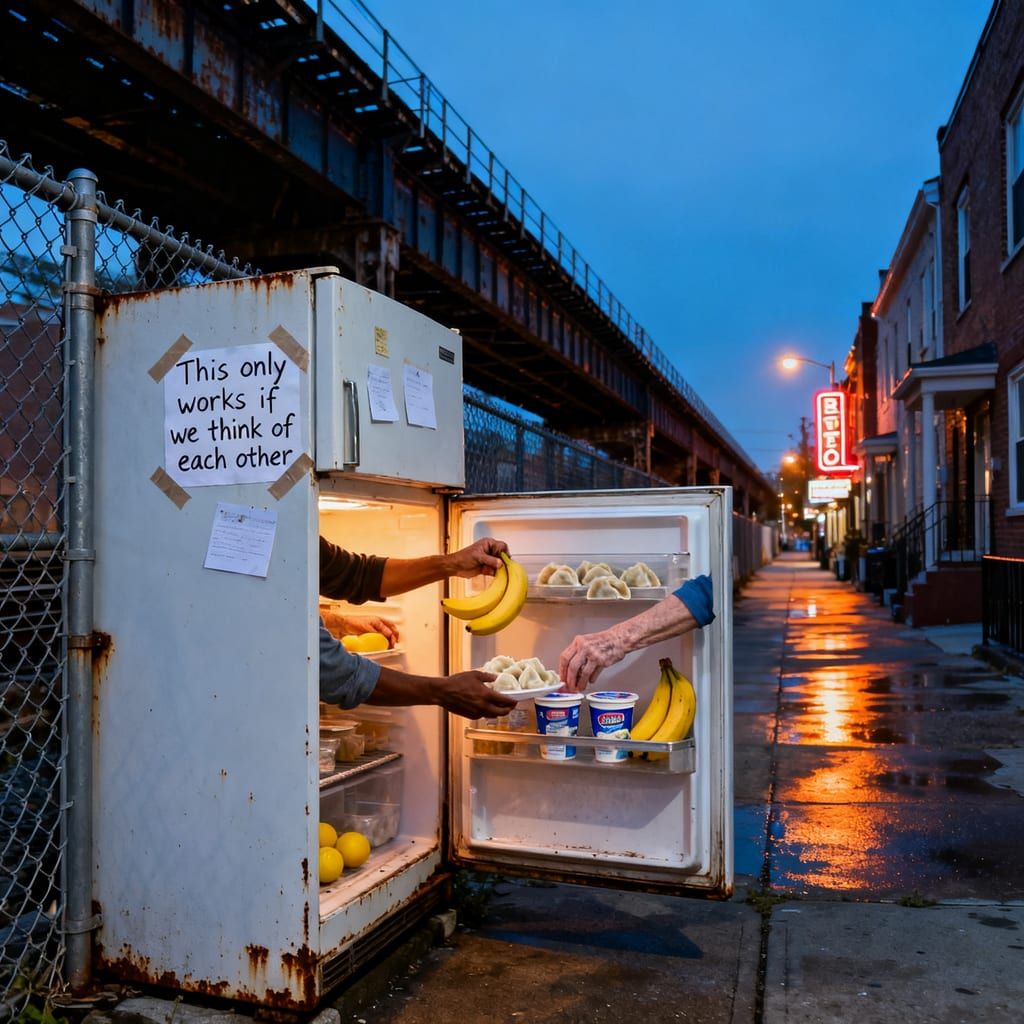
The first morning the fridge goes live, the El sighs overhead like a sleepy dragon and the air smells faintly of fry oil and wet cardboard. Lina flicks the switch, hears the compressor catch, and watches the inside light settle into a steady glow. She's bolted the old white unit to the alley fence, leveled it with shims pilfered from a bookshelf, and taped a sign to the door in sharpie: Take what you need. Leave what you can.
A fruit basket sat on her counter for a week after the layoff-apples waxing over, pears bruising under their own perfume-like a cheerful witness to failure. When she finally composted it, the idea came as if from the peelings: a cold box on the block, where people could help each other without paperwork or pity.
Lina is thirty-five and good at lists. She sets a rotating schedule, texts neighbors she knows from the block association, talks the bodega owner into saving unsold milk, and posts to the neighborhood group with a practical bullet list and a hopeful heart. She buys a cheap padlock, then hides it in a drawer, as if to keep herself honest.
For a week, it's chaos. Food vanishes faster than it arrives. Someone leaves a lasagna uncovered in August; by noon, it's a biology experiment. Comments online bloom like mold: You're enabling freeloaders, and, Why should people who work hard subsidize those who don't? A neighbor from the second floor shouts down one morning about lines forming before dawn. Cartons of eggs disappear minutes after delivery. She prints a new sign-Limit one per person-tapes it over the old one, and feels the tape snag her skin when she smooths it. She thinks about the padlock.
That evening, a summer storm stamps through, lifting trash can lids and cologne off stoops. Lina stands inside her doorway and watches the fridge bead with rain, lit up like a small shrine under the flicker of the streetlamp.
The next morning, before the neighborhood unclenches, she meets them-the ones who come in the soft hour before the first bus.
Angel rolls up with a shopping cart that squeals at every fourth step. He splits a bunch of bananas along the seam and leaves half, his hands quick and deliberate. "First learned to do this on a loading dock," he says, not looking at her. "Get more miles out of a bunch."
Ms. Hsu arrives in slippers, hair net still in, a tote clutched to her chest. She moves like a question mark, then straightens when she sees Lina. "Too much rent," she says by way of explanation, eyes kind. From a container, she slides two perfect dumplings into a bag, writes on it in careful block letters: For the next person.
Tasha appears with the sun, scrub pants whispering, badge turned backward. She tucks a note behind yogurt cups: If you take two, tell me your favorite song. She grins at Lina's puzzled look. "I like a soundtrack," she says. "Plus, folks like to be asked something that isn't 'What's your policy number?'"
Their presence steadies Lina. She brings a small notebook the next day, not to tally but to remember. Angel's sharp elbows, the way he hums when he counts. Ms. Hsu's dumplings-steam caught in translucent pleats. Tasha's laugh, low and cracked from the night.
On a Wednesday, Lina catches him: gaunt in a too-big army jacket, hair flattened into a question of last night's rain. He moves fast, like a person who thinks in exits. His backpack yawns open, then swallows meal after meal. Two sandwiches. Yogurts. Egg salad in deli tubs.
"Hey," Lina calls, and the word sounds wrong-too big, too bright. He looks up with an expression that is not guilt so much as bracing, like he's waiting for the swing. "Limit one," she says, pointing to the sign.
He hefts the pack higher on his shoulder. "I know," he says quietly, and his voice has the worn softness of an old shirt. He doesn't argue. He just turns toward the narrow run between rowhouses, boots quick, and Lina, ridiculous in her house sandals, follows.
He cuts east, past the bodega with the metal gate still half down, then ducks under the El, where the steel ribs crowd the sky. The air tastes metallic. Pigeons fuss at a spill of stale chips. He stops at a cluster of people sleeping on flattened boxes, bodies arranged instinctively to make a kind of home in a place that refuses to be one.
"Breakfast," he says, too loud for dawn but exactly loud enough to make a world shift. He crouches. Distributes the sandwiches, then the yogurts, like dealing cards. A woman sits up, one hand on the hard hill of her belly. "Got you the egg salad," he tells her, and the way she looks at him is a blessing.
Lina watches from the shadow of a pillar, that stupid sign of hers hot in her mind. The man turns and sees her. He looks down, sheepish, like he's been caught at kindness. "Name's Slim," he says. "I don't come in the day. Some folks won't. Cops. Eyes." He makes a gesture that means everything and nothing. "Figured I could... I got legs."
Her rules crumble quietly. "I-" Lina starts, then stops. The El thrums overhead, a commuter-laden animal waking. "Do you... need anything for the rounds?"
He considers. "Ice," he says. "If it stays this hot."
The heat arrives like a wet hand on the back of her neck. By noon the next day, it's humming in the brick. Somewhere, a transformer gives up with a bang like a bad idea. The fridge's light winks and goes out. Inside, the air starts to relax into warm.
Panic rises in Lina's throat. She texts the schedule list, then her old coworkers out of muscle memory, then the bodega owner, who shrugs and says the city's grid has moods. She pulls out the padlock, stares at it, then puts it back.
The people with the least organize the most. Slim reroutes ice from the gas station with a nod to a cashier who pretends not to see. Ms. Hsu appears with a tangle of extension cords, appliances dangling from her arms like jellyfish. "From my nephew," she says. "Don't ask." Tasha taps so fast on her phone her thumbs blur, then looks up. "Union's bringing coolers," she says. "And fifty dollars' worth of premade sandwiches some cafeteria guy messed up the label on."
By dusk, the cord snakes through a neighbor's window (the grump from the second floor, grunting as he holds up a screen), the fridge hums its familiar prayer, and a row of bagged lunches-peanut butter on squashed bread, last cans of tuna, celery sliced into hopeful sticks-lines the shelf. Someone's toddler drops a grape and crows. Someone else hangs a pair of clean socks from the handle like a flag.
Lina wipes her forehead with the bottom of her shirt and, for the first time in weeks, laughs without checking who's listening.
It comes in a white envelope that looks like every other bill. Permit violation, three crisp paragraphs, numbers that make Lina's stomach tip. She reads it twice at the kitchen table while a fan skitters hot air around. She calls the number, listens to hold music that is aggressively cheerful, and hangs up. She stands at the sink and thinks about shutting the whole thing down before the city does it for her.
When she steps outside, there's an envelope taped to the fridge with painter's tape. Inside: crumpled singles, a bus pass with two rides left, and a note written in a tight, earnest hand: For the cold box that made my brother's birthday cake possible. The o has been colored in like a moon.
She knows the handwriting. The kid in the oversize hoodie she'd scolded the second week for taking too many Capri Suns. His face that day-flat, then burning. "Rules exist for a reason," she'd said, and he'd rolled his eyes so hard she thought they might never come back.
That afternoon, he shuffles up with a chipped bundt pan held like contraband and hovers six feet away. "My bad," he mutters. His ears go pink. "About the juice. We shared 'em at the court." He jerks his chin at the fridge. "Thanks for the cake space. We hid it behind the yogurts." He looks down, then up. "You want the pan? It, like, makes anything look fancy."
"I do," Lina says, and means everything.
She posts an update-not a plea, not a scold. Just a photograph of the envelope, the note with the round moon of an o, the bundt pan catching late light on her stoop. "We got a fine," she writes. "We'll figure it out."
The flood doesn't look like money. It looks like circulation. A recipe in Gujarati, ballpoint on an index card soft from being touched: ways to stretch lentils into comfort. A mechanic from down on Washington Avenue who leaves a Post-it: Free fridge repairs. Don't tell my boss. A pair of socks pegged to the fence with a clothespin. Ms. Hsu adds a list of where to get legal help, written on a napkin. Someone ties a silk scarf around the handle because "the fridge wanted to dress up."
The grump from the second floor-he of the doorway complaints-comes down and scribbles his number under If it dies again, call me. "I got a generator," he says, daring her to fight him. "Bought it during Sandy for attention." He squints at the bundt pan. "My mom had that one."
Angel starts a chalkboard tally: Bananas In / Bananas Out. Tasha adds playlists, writes them in scalloped handwriting, sticks them under the magnet shaped like a crab. Slim appears in the middle of it all, quietly, like early fog. He starts making rounds again, now sanctioned. He doesn't take a bow.
Rules are easy. Life isn't. Lina stands with the city's letter in one hand and the bundt pan in the other and realizes she's been managing this like a process. It isn't. It's a commons-messy, stubborn, and somehow cleaner for all the hands on it.
She peels the Limit one per person sign off the door. The tape pulls hair-fine paint, leaves behind a ghost of her certainty. She paints a new line, steadier than her breath, on the door: This only works if we think of each other.
The letters shine wet in the blue hour. A girl on a scooter rolls up, reads slowly, and nods. "Like group work," she says solemnly. "But with food."
Lina laughs, and the laugh feels like a door opened on purpose.
Some mornings, Lina still wakes in the gray seam before light, heart tight with what-ifs. She ties her hair up, slides her feet into sandals, and goes out anyway.
Angel is there, peeling brown dots off a banana with the seriousness of a jeweler. Ms. Hsu tucks dumplings into a bag marked For after school. Tasha leans against the fence, eyes closed, headphones on, lips moving around a lyric no one else can hear. Slim slides by with a nod, the pack already full, the street under the El not yet awake.
"Favorite song?" Tasha asks a woman choosing between yogurts. The woman grins shyly. "Anything with a good beat," she says, then names one. Tasha adds it to the list.
Lina stands with a hand on the cold door, listening to the compressor whisper and the city breathe. The shelves are often empty by noon now, miraculously full again by evening, a tide without a moon. She thinks of the fruit basket, the pears going to slush on her counter while she tried to figure out what to do next. She thinks of the envelope with the colored-in o, of a generator grumbling to life like a boast softened into help, of a bundt pan making a sheet cake look fancy.
The El rolls past, windows catching the new day. The sign on the door dries to a flat matte, the words readable from the sidewalk, from a bus, from a thought away. Lina rubs a thumb over a bristle of paint, then steps back.
It's the simplest kind of magic-cold shelves at the curb, humming; warm hands at dawn, moving what they have to where it's needed. She doesn't lock it at night. She doesn't count. She lets it circulate, and in the circulation, she recognizes the shape of a life worth getting up for.
A daughter learns to read between the lines of a life split in two
Read more →
A fog-draped night, two souls found, and the quiet shape of a life
Read more →
Story audiobooks for children of all ages — a new one every day on Smarter Way Stories.