What Fire Left, We Painted
In the burn unit’s quiet, color found its way back to her hands
Read more →
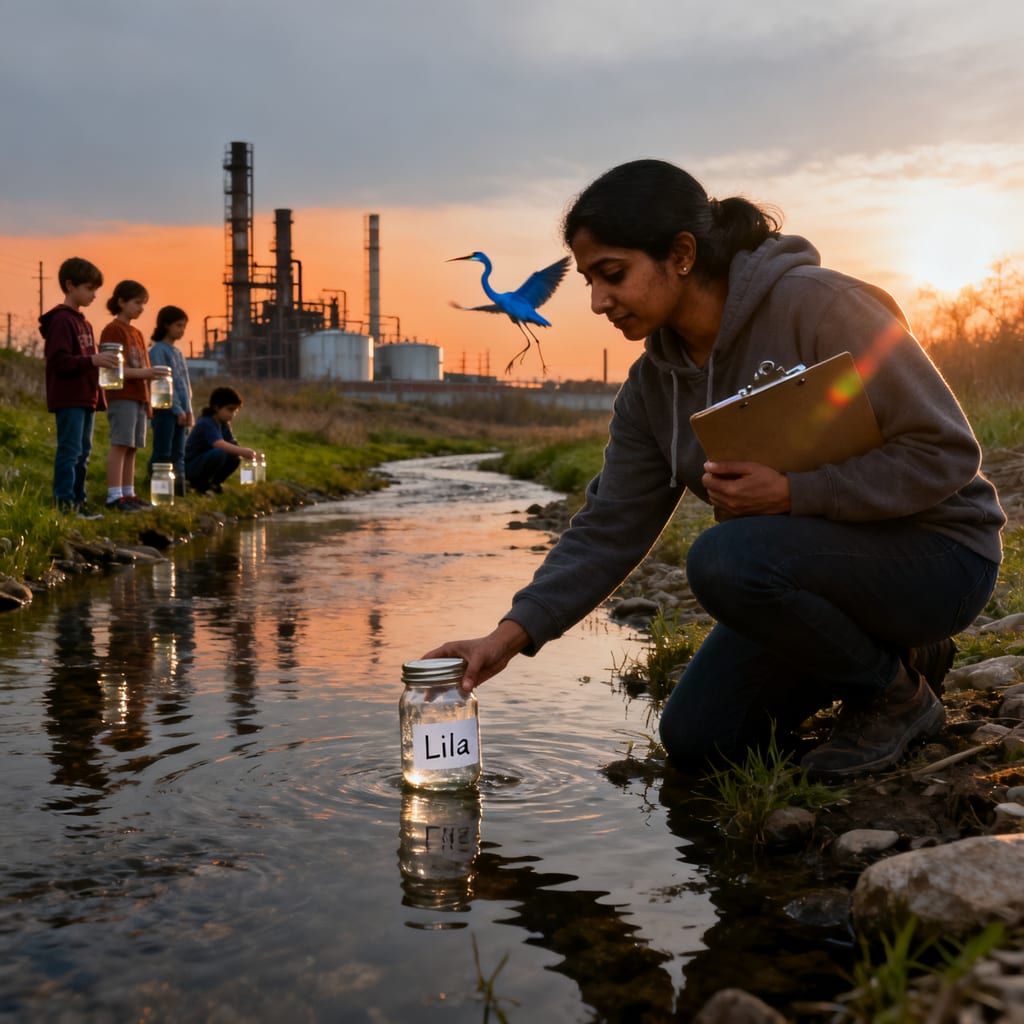
The sky over the refinery never learned the clean blue of childhood drawings. It blushed a tired orange just before the sun, as if someone had been up all night scrubbing but could never rinse the stain.
Aisha parked beside the chain-link fence and killed her headlights. The air monitor hummed in the passenger seat-borrowed, like most of her tools-and her notebook glowed in the phone's weak light. She set the canister on the gravel and listened: the clank of a distant ladder, the low breath of the stacks, a ripple from the creek where a heron lifted itself like a folded letter being opened.
She pulled the collar of her sweatshirt over her mouth. Sweet. Sharp. Stings the eyes. She wrote it down.
By eight, she'd showered twice and still caught diesel in her hair. Ms. Alvarez waited at her kitchen table with a pot of tea and a cough that began in the cups and ended somewhere in the ribs.
"Benzene," Aisha said softly, turning the laptop to show the graph. "It's a kind of gasoline vapor. It's not supposed to be this high."
"I don't want the Latin," Ms. Alvarez said, smiling without warmth. "Just tell me if it's the thing making the nights feel heavy."
Aisha nodded. "Yes."
In another house the tap ran rust-brown, and Coach Daniels filled old pickle jars until the counter looked like a row of cheap whiskey. The Miller twins sat on the couch with their inhalers lined up between them like silver pens for signing papers. Their mother, wearing her church blouse though it was Tuesday, rolled the fabric between her fingers and asked, "Will the judge listen? Or is this just for our files?"
Aisha folded the grant rejection in her bag into a smaller square. "Both," she said. "Sometimes the paper needs to see itself."
At night, she drove the old sedan along the fence line, dropping air canisters at the corners they'd mapped with sticky notes and hope. She talked to her late father in the driver's seat where his smell used to live-machine oil and spearmint. "I know you did what you could," she whispered into the empty air. "I'm trying to do the rest."
The church basement smelled like coffee and floor polish, a room that had seen potlucks and storms. The mechanic everyone called Tito unfolded a map across the folding tables. A teenage poet named Sade rehearsed under her breath beside the bulletin board: her hands trembled and then stilled at the end of each line. Someone's toddler pressed purloined stickers onto a plastic chair, coronating it.
That's when the first envelope arrived-no return address, the paper rough as paper bags. Inside: a photocopied permit with a date that didn't match the refinery's claims. The next week, a map with red circles and a margin note in a careful hand: Check the night shift logs. After the third envelope, Aisha's mother held it at arm's length like a small animal.
"Enough, beta." Her mother's eyes were tired, fierce. "Rest. Your father lost his lungs by that place. Don't let them take your sleep too."
"I'm okay," Aisha said, not okay. She made a quiet ledger in the back of her notebook: nights lost to headaches, mornings gained to small victories, a school bus route moved away from the plume.
On the last line she wrote, simply, We continue.
When the coalition finally forced the county to hold a public hearing, the courthouse unfurled itself into something solemn and bright. Neighbors arrived in their best. Ms. Alvarez wore a brooch that could catch the light and fling it back. Coach Daniels's tie was crooked in a way that said his hands were better with pipes than silk. Tito, who had lent his rooftop for sensors, had grease moons under his nails that soap never touched.
The refinery's attorney set up sleek charts and spoke with polished vowels, syllables scrubbed free of place. Behind him sat a line of suits, faces arranged into the kind of sympathy that left no fingerprints.
Sade stepped to the microphone and wove a poem that tasted like rain on metal. Her voice trembled on the first word-and didn't on the last. Aisha felt it land, a bead of rightness on the fabric of the room.
Then an elderly woman stood in the third row, palms shaking as if carrying something hot. She wore a security guard's uniform that had been washed thin at the elbows. The pin on her chest read ROSA.
"My name is Rosa," she said, voice barely above a whisper. "I worked the south gate starting '94. I'm the one who sent the papers."
A murmur rippled. The attorney glanced down as if at a splinter.
Rosa pressed her hands flat on the back of the chair in front of her. "We had a spill one night. No report went out. They told us to burn the logs. The wind was wrong." Her eyes flicked to the window, to the slow line of the river. "It blew toward the water."
Silence-then a sound like the room inhaling.
Rosa pulled a folded page from her pocket. "Dates. Who was on. You can check." She looked at Aisha then, with something like apology and something like permission. "Make them listen."
That night the house felt too quiet, the refrigerator's hum a small accusation. Aisha pulled her father's dented toolbox from the hall closet and sat cross-legged on the rug like a kid preparing for a magic trick she only half believed.
He had left it as if he'd be back after lunch: pliers nested like sleeping birds, a stub of pencil, strip of duct tape with a fingerprint frozen mid-press. At the bottom, under a folded rag, she found a sealed filter cartridge, the kind that clipped into masks. The casing was blackened, the date written in his square, stubborn handwriting. Next to it, a label: "South fence line-smell sweet, stings eyes."
Aisha ran her thumb over the note, the letters carved into the paper just enough to feel. The room swam for a second. She closed her eyes and breathed.
"Abbu," she said to the empty room. "You knew."
She didn't sleep. At dawn, she drove the cartridge to a lab two counties over where a tech agreed to rush an analysis "for community research." She watched the morning peel the orange back to gray in the rearview mirror and felt the hinge of something giving way.
The judge ordered emergency monitoring, citing the coalition's community data-graphs drawn at kitchen tables, notes scrawled in margins, rooftop sensors humming over Tito's garage. The attorney's polished vowels stumbled.
Aisha did not cheer. She thought of how long bodies hold what they are given, how rivers scribe memory into mud and cattail.
That evening, an envelope without a return address lay on her porch mat like a leaf that fell from no known tree. Inside, only a note in the same careful hand: "The river remembers. Make them listen."
She texted the coalition. "Bring the jars."
The next morning, children lined the creek with glass jars she'd passed out months before, each labeled with a name and the day the water changed. "It was slippery on my ankles," one girl said, nose wrinkled. "Like the water had lotion." A boy held his jar up to the sun and turned it like a question. "Smells like my dad's shed."
Parents stood behind them, arms crossed or hands on shoulders, as dragonflies stitched brief blue seams above the reeds. Sade read the dates aloud like a roll call. Tito crouched, his palm dipping in, bringing up a sheen that caught the light and broke it.
"Don't touch your face," Aisha said gently, passing wipes, writing down times, noting wind.
She felt the town gathering itself-quiet as moss, relentless as water.
The lab called that afternoon. The cartridge held what the permits had sanded smooth with euphemism. It linked the night Rosa remembered to the chemicals in the creek and the headaches in their ledger. It linked the plant to her father's mask.
In the final hour of the second hearing, Aisha placed the cartridge's report beside Rosa's dates and the children's jars lined at the front like small lanterns. She saw the attorney's eyes catch on the label in her father's hand. A wrinkle passed through his expression, almost human.
"The company is prepared to discuss a consent decree," he said into the microphone, voice measured but thinner now, as if it were wearing shoes too tight.
People didn't clap. They exhaled. Ms. Alvarez fished a peppermint from her purse and slid it into her mouth as if to keep from crying.
In the hallway, the plant manager-a man Aisha had only ever seen from a distance, framed in tinted glass-stood with his hands in his pockets. His eyes were rimmed red, as if sleep had been wrestling him and winning.
"Ms. Rahman," he said. "Do you have a copy of the asthma action plan you translated? For kids." He didn't lift his head when he asked. "My son... he had an attack last night."
Aisha waited for anger and felt, instead, something steadier arrive. She reached into her folder and handed him the packet. "Green zone. Yellow. Red," she said, tapping the pages. "Keep the rescue inhaler by the bed. Teach him how to listen to his chest."
He nodded, swallowed. "Thank you."
"Everyone breathes," she said, not unkindly.
After the courthouse emptied, Aisha walked down to the river. The evening had cooled into something almost tender. A barge moved slow on the far side, slicing the surface into predictable, generous waves. She crouched at the bank where the kids had stood and reached her fingers in. The water felt like itself-no lotion sheen-just the steady slip of current around skin.
Her phone buzzed with messages: "We did it?" "What now?" "Potluck Friday?"
She thought of her father's handwriting, the square stubborn letters. She thought of Rosa's shaking hands flattening a secret at last. She thought of the jars on the courthouse table, glass catching and releasing the room's hard light.
At home, her mother was waiting with clean curtains that held only the faintest ghost of diesel. They stood on stools together, clipping fabric back to the rods, the cloth whispering against their wrists.
"You will rest now?" her mother asked.
"I will rest," Aisha said. "And then we keep going."
That night she slept without dreaming. In the morning, she woke to a quieter ache behind the eyes, a sky less stained. Outside, children's chalk drawings bloomed along the sidewalk: a fish with a crown, a house with windows, a river spelled in big block letters. They had written her name inside the bend-a curve of letters following water.
On her porch lay one more envelope. Inside, a small photograph: Rosa in uniform, younger, smiling into the wind, the river behind her. On the back, in the careful hand: "For when you forget what you already know."
Aisha pinned it to the fridge with a magnet shaped like a tiny blue heron and laughed softly to herself, the sound surprised from her like a found coin.
She grabbed her notebook and wrote the day, the wind, the smell. Then she wrote another line in the ledger at the back: A town that breathes a little easier.
She tucked the pen behind her ear and stepped into the day, the river close enough to hear if you listened for it-the low, patient sound of a place remembering its own true name, and offering it back.
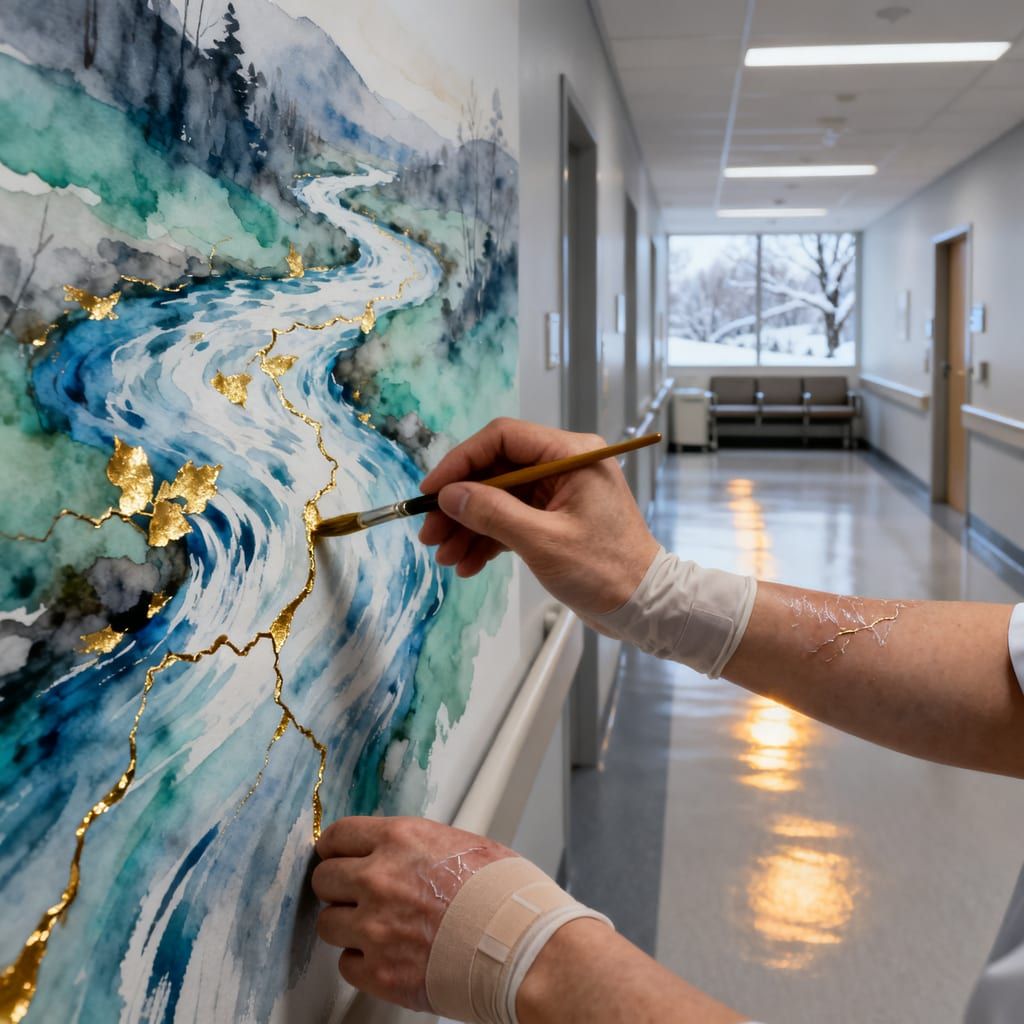
In the burn unit’s quiet, color found its way back to her hands
Read more →
Story audiobooks for children of all ages — a new one every day on Smarter Way Stories.