The Orchard Beneath My Mother’s Silence
What grows after the cutting
Read more →
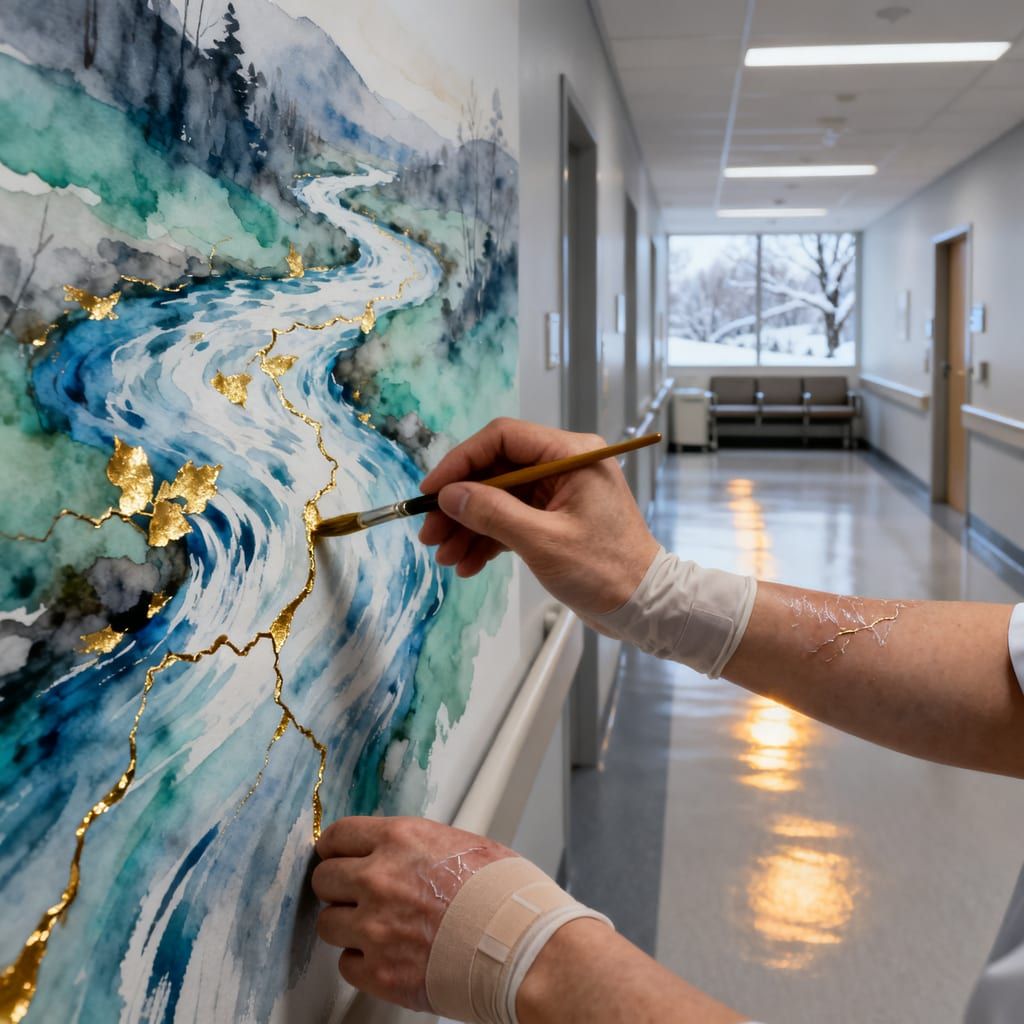
The burn unit's art room smelled like paper and saline and the faint lemon of hospital cleaner. Winter pressed its face to the window-gray, patient. Leila unlatched the metal cabinet, laid out jars and brushes, and pulled her sleeves down to hide the compression gloves she wore like a secret.
He arrived with a shoebox that flaked soot wherever his thumb touched. He stood in the doorway too long, deciding whether the air in here could be carried without breaking him, then came in with a tilt of his chin that said he'd already decided it could not.
"They're my recipes," he told her before she asked. "Or what's left. I'm not here to make pretty things."
Leila glanced at the box, the gray smudges settling like fine ash on the white table. "Good," she said. "Pretty isn't honest. Do you want to grind some pigment?"
He blinked once, unsure if she'd heard him. "From what?"
She lifted the shoebox lid as if she were opening a book. Charred index cards, edges burnt into lace. A lemon tart that had become a fire map. A stew that had eaten heat and been eaten by it. "From this," she said gently. "From what you brought."
By the time the others filtered in-Ruth with her cane that tapped out a steady tempo, Mireya shrugging a knit cap over hair still in its teenager's war with gravity, Walt with a toolbox out of habit and a bandage peeking from his collar-the table had gathered a small constellation of soot.
"I'm Amir," the shoebox said for him.
"Ruth," the cane said.
"Mireya," the cap murmured.
"Walt," the toolbox nodded.
Leila gave them paper the way you offer bread-something to hold, to tear, to know by hand. She spread a glass slab like a small ice rink and set down a muller, gum arabic, a few drops of water. When Amir hesitated, she folded a stack of blank cards toward him. "Label as you go," she said. "Pigment-making wants memory."
Walt whistled, low. "Never figured ash could be put to work."
"Everything wants a second job," Ruth said, and smiled at Leila as if they were in on something.
Leila held the muller. The glass hummed under it when she pushed in slow circles. Gray deepened to ink. The room settled into that rare silence that is not empty but listening.
The next week, and the week after, paper became skin. Leila taped long sheets at the seams to make space big enough for what they were ready to place on it. She spread watercolor pans, the mineral ones she loved for their patience-indigo that took and took water before it let go of color, an earthy green that needed coaxing. She set out gold leaf like breath held in squares.
"We'll map what changed," she told them, "and where it changed you." She lifted her sleeve to show the faint ridge of one glove's cuff, then let it fall again.
Mireya dipped her brush and watched blue bloom. "Coach says skin remembers," she said, not looking up. "Nerves like lanes. Sometimes my arm thinks it's still on fire when it's in cold water."
Ruth traced a line down her calf with a brush tip gone to a single hair. "I fell asleep with the space heater humming. Woke up when the nightlight popped. I used to sort mail by streets, you know? Now I sort days by the parts that ache."
Walt's hand hovered over paper. "My nephew pulled me out by my belt. The voice in the room was mine for a minute, and then it wasn't. Funny how quiet keeps shouting."
Amir kept to the edge at first, grinding soot with a care that bordered on reverence. He wrote at the margins of his burn map in small, insistent script:
Leila walked among them, attentive without hovering. She mixed a little gum into Amir's pigment and showed him the way soot settled when the binder said stay. She watched the way Ruth's wrist quivered and adjusted the table height. She heard Mireya's breath catch at a brushstroke and put a finger down to hold the paper steady.
When she passed an unused brush, her hand paused an instant too long. She placed it back without comment.
By the fourth week, their maps whispered to one another from the drying rack. Edges spoke across spaces: Ruth's calf line leaned toward Walt's shoulder arc; Mireya's blue pooled where Amir's gray met it and turned it stormy-green. Leila looked at the walls, the corridor just beyond, and felt what rooms feel before music starts.
"What if we leave the door," she said, "and go make the hallway tell a better story?"
They followed her out-cautious, queued by IV poles and winter's wool. The corridor ran past the waiting room where families read their own faces in plastic chairs. Leila held her tape measure like a prayer flag, marked the height where children's eyes would travel.
"We stitch what you made," she said, "into one river. Color threaded with gold. Something you can walk past and think: I might make it there."
Walt touched the wall's paint with two fingers, electrician even in the way he tested surfaces. "Hospitals need current," he said. "Let's run one."
They cut their maps into panels along the lines the water had suggested. They carried them down like careful gossip. Leila mixed wheat paste and set a step stool against the wall. She showed them how to press the paper flat from the center out, bubbles slipping to the edge like worries given someplace to go.
Amir stood back with his soot-ink and watched their fragments become neighbors. He marked the turns where his gray would ground their blues and greens. "We'll need the gold," he said matter-of-factly, surprising himself.
"You'll place it," Leila replied, and the answer landed in the room like a coat over cold shoulders.
Installation day drew them like weather. Ruth wore her bright scarf and a lipstick that announced its shade by sheer will. Mireya brought a thermos that steamed cinnamon when opened. Walt arrived with a roll of painter's tape, a utility knife, and a caution that sounded suspiciously like love: "Edges clean, capiche?"
They worked with sleeves rolled to elbows that remembered too much. Paper met wall. Color linked hands. The paste dried to a quiet matte and took on the look of forever.
Then it was time for the vein of gold, the seam that would not pretend there had been no break. Leila set out the leaf, the adhesive, the soft squirrel-hair brush saved for reverent work. The strip of gold on the table reflected the fluorescent lights in jittery halos.
"Okay," she said, but her throat closed on the last vowel.
"You want me to do it?" Amir asked. His voice carried no challenge, only recognition.
Leila lifted the brush and the room lifted with her. Her hand hovered, then-almost imperceptibly-stuttered. She lowered the brush to the tray again. The small sound it made might have been a dropped pin.
Walt cleared his throat. "You teach us to hold current," he said quietly. "Let us hold you."
Ruth stepped closer, her cane set aside so both hands were free. "We're all in this circle, querida," she said, the endearment soft as tissue.
Mireya reached for Leila's elbow the way a swimmer learns to reach for the wall-sure, practiced. "I count to three," she said. "Not fast. Your three."
Amir took the muller's weight from the tray, set it down, and picked up the brush. He pressed it into Leila's palm, covered her fingers with his, and felt the fine ridges of the compression glove beneath. "Final line should be the chef's call," he said, and the word chef landed between them like a bridge.
Leila exhaled, the kind that happens after you've been holding your breath for a year. "I haven't-" she began, and let the truth out. "I haven't painted for myself since the warehouse. I... step back. My hands remember smoke. They don't always remember joy."
No one spoke for a moment. The corridor hummed its hospital hum. Somewhere, a laugh broke open and was quickly covered.
Mireya began the count. "One."
Ruth found the spot where the panels misaligned by a hair and set her fingertip there with precision earned from years of sorting ZIP codes. "Two."
Amir leaned into Leila's back, a steadying presence, the way line cooks brace one another when a prep table wobbles. "Three."
Leila lifted the brush. The adhesive gleamed, waiting. She drew the line not as a suture, but as a river, letting it waver where the paper had torn, letting it swell where color pooled. The gold caught and then blazed-mercury turned to daybreak.
It was a seam that refused erasure. Where Ruth had marked the nightlight's flare, the gold kissed it. Where Walt's shoulder arc curved toward grief, the gold crossed it like a hand. Where Mireya's blue held breath, the gold threaded through and taught it how to exhale.
When the last leaf lay down, the seam held. Leila's hand fell into her lap, empty and buzzing. She laughed, surprised by the sound that came out: young, unguarded.
They stood back. Families on their way to vending machines slowed. A teenager in a hoodie stopped and said, "Whoa," before catching himself and pretending he hadn't. The river ran the corridor's length, brilliant and complicated, a path that admitted its own fractures and chose brightness anyway.
Amir reached into his shoebox for the jar he'd saved. The soot-ink was almost gone, heavy like the last pour of coffee. He dipped a thin brush, the bristles holding the dark with an intimacy that felt like trust.
"Don't," Leila said on reflex when she saw where he was headed-bottom corner, panel two, the place a muralist signs when no one's looking.
He met her eyes. His cheek graft shone like new bark. "You taught me to call a thing what it is," he said. "Let us call you here."
She didn't move to stop him again. He bent and wrote in careful, cook's script, the way you note a ratio you love:
Leila Ortiz.
The soot dried matte against the wall. Her name settled where the gold ended, not claiming the river, but acknowledging the hands that had taught it to run.
Ruth sniffed in a way that suggested dust, not emotion. Walt found something where there was nothing to fix and fiddled with it anyway. Mireya took a picture and pretended she was only checking the angle.
Leila touched the corner of the signature and felt it lift-not the ink, but the weight she'd been carrying. What fire left, she thought, we painted.
On her way home, winter finally surrendered a patch of blue between buildings. Leila stopped at the glass door to the hospital and saw the mural reflected-gold turning low sun into a rumor of spring. Her gloves peeked from beneath her sleeves like the borders of a map.
In the days that followed, she found herself reaching for brushes with less negotiation. In the studio, she and Amir argued amiably over the right proportion of gum for soot, tasted cinnamon in Mireya's tea, and listened to Ruth prescribe postcards to families who had forgotten how to write to one another. Walt wired a sense of humor into the waiting room lamp by taping a paper lightning bolt to its shade.
On a Tuesday late in the month, a woman paused at the mural and put her palm flat against the gold seam as if testing a fever. She breathed out something small and private, then took another step. Leila watched from the art room door, her own breath matching the woman's without trying.
She rolled back her sleeves. The skin beneath the gloves gleamed faintly-no longer hidden, not offered as spectacle. When a nurse placed a brush in her hand, her fingers didn't flinch.
"Again?" Amir asked from the sink, flecks of graphite on his cheek like stars.
"Again," she said, and meant it.
Outside, winter held on because that's what seasons do before they let go. Inside, the river ran down the corridor, bright and honest. People walked past and, sometimes, paused without knowing why. The gold thread caught a blink of light and stitched it to the day.
Leila stood with her circle-inside it, not apart-hands inked with what remained, and began again from there.
Story audiobooks for children of all ages — a new one every day on Smarter Way Stories.