The Silence Between First Cries
A night of rain, light, and belonging
Read more →
The day after the funeral, the house remembered her better than I did. Steam rose from the kettle though no one had turned it on-just a trick of the sun through the window-and the pantry breathed coriander and old paper, a smell that always made me feel like I was trespassing in time.
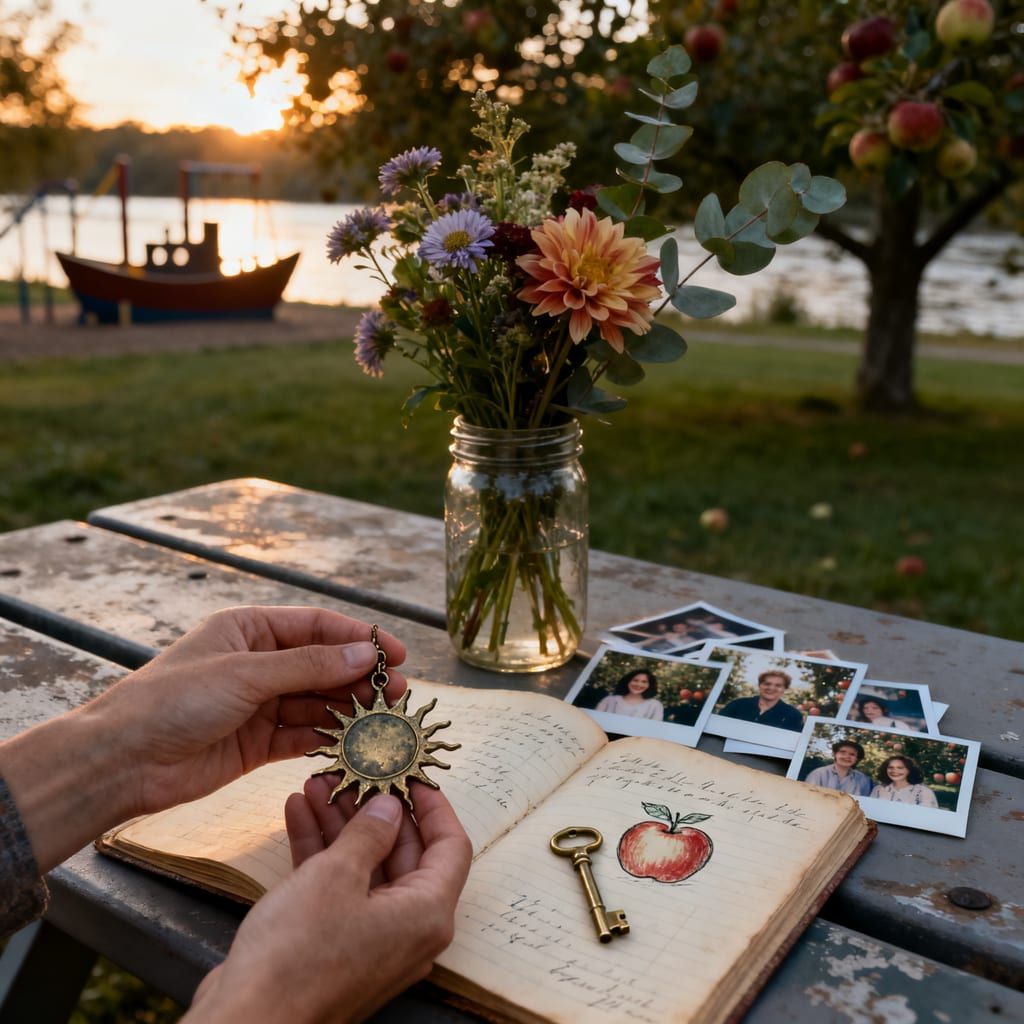
I found the recipe box buried behind jarred peaches and a crumpled bag of sugar, its lid lacquered with finger oils from years before I was born. The label said "Aster" in my mother's tidy handwriting, the A looped like a ribbon. Inside, where I expected index cards stained with soy sauce and sesame oil, a tarnished sunburst pendant lay on its long chain, and beneath it, a small brass key.
The key's teeth glittered like a threat.
The storage unit off the highway had a roll-up door that stuttered like an old man clearing his throat. I stood in the fluorescent aisle while a teenager with nail-biting thumbs checked my paperwork. He didn't look up when he said, "All set," and handed me a cart. I pressed my palm to the cold tin and listened to dust wake.
Polaroids slid out first-curling squares of people in an orchard, cheeks apple-pink, hands raised mid-laugh. The light made halos in the trees. I didn't recognize any faces. Behind them, cassette tapes with dates sharpied across their spines: 1987, 1988, 1989. Their labels meant nothing and everything. A ledger surfaced at the bottom, cheaper than the weight it carried: ruled columns, names written in pencil next to little apples sketched with loving imperfection.
There was an envelope tucked into the ledger with a business card: RUTH SONG, FLORIST. A Hudson Valley number. Inside the envelope, a receipt for a bouquet-aster and baby's breath-paid in cash, sender: ANONYMOUS.
At home, I threaded the pendant through my fingers, its points catching the light. My mother wore only a plain band and the same pair of pearl studs; I had never seen this star. I laid it on the kitchen table between the ledger and my phone, and called the number like I might call a ghost.
"Song's Flowers," a voice said, soft as fabric. In the background, water ran. Someone coughed.
"Hi. I-my name is Lena Park. I found your card with my mother's things. Hye-jin Park?" My throat tightened against her name. I was thirty-two and felt like a kid who had stumbled into the wrong classroom.
Silence filled, then shifted. "Lena," the voice said, the way someone says a thing that is both new and old. "I hoped you'd call."
"You knew her?"
"I know what she did," Ruth said. Water shut off. The line quieted. "For me. For more of us than you can count on two hands."
She told me about the Aster Family like you tell a story you've rehearsed to keep it from breaking you. A 'fellowship' that baked bread for town picnics, changed oil for single moms, picked up litter on Sundays. Service that asked for service, a circle that tightened until it cut off air. No shaved heads. No compounds. Just a widening we.
"You're thinking cult," she said, and let the word sit between us. "But we never used it. We used belonging. That's a softer trap."
"Was my mother-" I didn't finish.
"She was ours," Ruth said. "And she got us out."
I looked at the ledger, at the rows of names and apples. Heat pooled between my ribs. "There's a ledger," I said. "With apples next to names."
Ruth exhaled. "She kept count. Of who made it. Because of her."
I borrowed my neighbor's old tape player that smelled faintly of attic and peroxide. The first tape warped as if it had to remember how to be a voice. A chorus unspooled-dozens of throats humming a chant that lifted and fell like an orchard in wind. Words stitched themselves out of sound: family family family, aster aster aster, we are a ring that cannot be cut.
On the third tape, a woman's voice broke through, low and deliberate, a lullaby that asked nothing of the child. "If you hear this," my mother said, "then fear did not win. Pack light. Go to the pantry truck."
I stopped the tape. My hands shook so hard the player hiccuped. I pressed play again and clung to the cadence.
In the ledger, the apples multiplied after May of 1989. Aster blossoms sketched around four names, then eight. Next to 'RUTH S,' an apple shaded darker than the rest.
A letter slid out from between the pages-unsent, addressed to no one, or to me in some way that knew what I would need three decades later. In it, my mother wrote about an orchard not merely symbolic where a 'severing' was planned, apples tied to wrists with red thread like promises you can't outrun. "I was the one with keys to the pantry truck," she wrote. "Flour for bread. Boxes of canned peaches. A tank half full, and more courage than common sense."
Sable's name was on the next page, circled and bare. No apple.
I could hear my mother's breath as she wrote the rest. "I counted apples so I wouldn't count the one I dropped."
When I told Ruth what I'd found, she asked if I would meet her at the old orchard, the one that had become a public park with a playground shaped like a pirate ship.
The park was mostly empty when I arrived. A lean woman waited by the picnic tables with a scarf tied in her gray hair. She held dahlias that looked like fireworks trapped in bloom.
"Lena," she said, and pulled me into an embrace that lasted a heartbeat past comfort and into something gentler. "You have her eyes."
People have said this all my life. It never mattered until now. I had my mother's eyes and none of her maps.
We walked the shady path between trees whose fruit had gone wild and small. Ruth spoke in fragments the way memory does, filling in pieces around what she didn't say. "We called it The Aster Family because asters bloom in fall. Because we thought we were a last flourish against frost. We thought service would save us from ourselves." She told me about the leader's voice, the way kindness turned into currency, then into chains.
"And my mother?" I asked.
"She learned where the seams were," Ruth said. "She stayed long enough to tug them." She pointed to the road that curved around the park. "The pantry truck. I can still hear the rattle. She took fourteen that night. I was number nine."
"What about Sable?" The name pricked my mouth.
Ruth's eyes softened. "I never met her. I only know that your mother said her name like a prayer she was still owed."
We stood beneath a tree that bore exactly three bruised apples. I reached up instinctively and plucked one. It came off too easily, as if it had been waiting for me.
With Ruth's help, I texted numbers that felt like trespasses. We wrote a notice to pin on the bulletin board at the co-op: A simple invitation to meet at the park to remember those who made it and those who didn't. We didn't use the word cult. We used the word orchard.
On a Saturday that smelled like rain and cut grass, a dozen people came. Some I recognized from the Polaroids-not their faces, which had aged into maps of their own, but the way they held one another's elbows. They brought stems-aster, of course, and hydrangea heads the color of old postcards, eucalyptus that smelled like a clean slate.
We set a mason jar on a picnic table and said one name at a time as each stem slipped into water. Sable's name lifted and landed, a bird that didn't quite trust my hand.
An older man in a denim jacket approached me after, twisting his cap in his hands like a boy. "I think your mother used to call me," he said, eyes bright with embarrassment and something sturdier. "Every year on my birthday. 'Wrong number,' she'd say. But then she'd tell a joke only I knew the end to. I stayed sober on the worst day because a wrong number told me if I could get through one more hour, she'd call again." He looked at the jar, the stems making a quiet forest. "It was her voice, wasn't it."
I thought of the anonymous orders to Ruth's shop. The therapy sessions someone paid for in cash. The ledger of apples adding up to a kind of math I'd never learned. "Yes," I said, and my throat loosened on the word. "It was."
We stayed until the light thinned and the children abandoned the pirate ship. Laughter clipped through the trees like swallows. A woman with a crescent moon tattoo wiped her face and pressed a folded receipt into my hand-one of Ruth's, years old, stamped Aster in purple ink. "She saved my life twice," the woman said. "Once when she drove. Once when she sent me to someone who could help me speak again."
Late that night, I sat at my mother's kitchen table with the ledger open. The house exhaled onions and soap. I returned the brass key to the recipe box, tucked the sunburst pendant beside it, and closed the lid. The tape player sat silent on the counter, the pause button a mouth held just so.
I sharpened a pencil. The page waited.
I drew an apple next to my own name-LENA PARK. It felt both stolen and earned. Not an escape, not exactly. A small fruit to mark a different leaving: the way I would stop inheriting her silence as if it were an heirloom pot and start using it like compost-layered, turned, warmed by things breaking down into feed.
I dialed my father. It rang six times. He answered with a cautious "Hello?" as if hello could crack the floor.
"It's me," I said. "Do you have time to talk about Mom's recipes? The ones she never wrote down."
He was a quiet man under the best of lights. Our relationship had been a series of courtesies, small offerings-he took my coat, I asked about his knees-set out like appetizers no one revealed an appetite for. On the line, I heard a chair scrape. He cleared his throat. "I don't know them," he said. "But I know the way she held the knife. I can show you."
In the background, a train horn thinned against the river. I pictured him at the table with his hands arranged like he was ready to say grace and not quite remembering the words.
"Okay," I said, and my voice steadied. "Tomorrow? I'll bring apples."
He laughed-surprised, small. "We still have the good peeler," he said. "Top drawer, left."
After we hung up, I opened the window. The night carried the sweetness of late fruit and damp leaves. Down the street, a dog barked and then apologized with quiet. I thought of my mother driving a rattling truck toward a road that could close behind her, cheeks stung raw with cold, calling a wrong number on purpose just to keep someone here.
I washed an apple and cut it into thin fans. The knife remembered her hand. Or maybe I only wanted it to. Juice slicked my fingers. The first bite snapped and flooded my mouth with sugar and something tart. The star inside the core lit up like a secret finally doing the only thing a secret can do when it's tired-become a story.
When I went to bed, I left the ledger open on the table, pencil resting across it like a small bridge. In the morning, I would drive to the park with a new mason jar and place it beneath the sturdiest tree. I would ask Ruth which therapist needed paying. I would call the numbers that used to be called on birthdays and ask if anyone wanted cake.
Outside, the orchard I didn't know I had was learning me back.
Story audiobooks for children of all ages — a new one every day on Smarter Way Stories.