Two Houses and One Quiet Heart
A daughter learns to read between the lines of a life split in two
Read more →
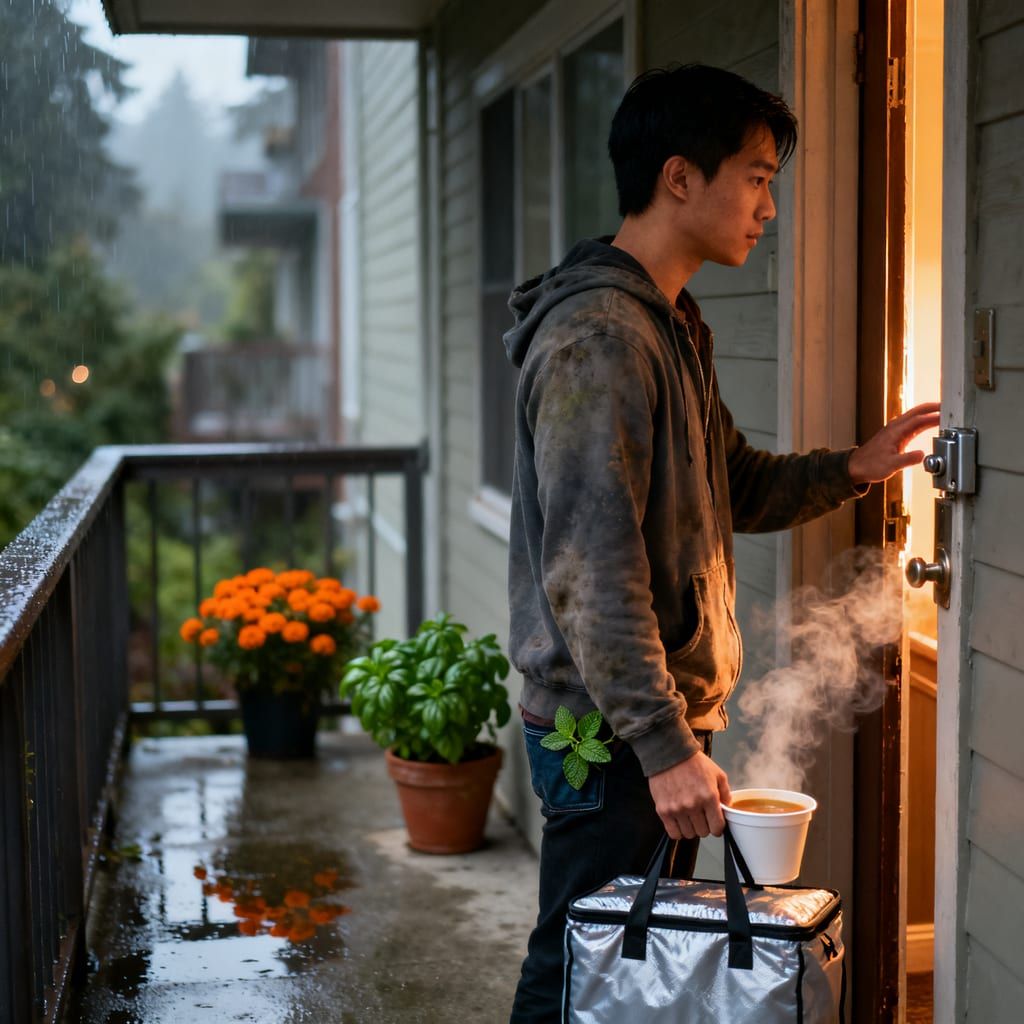
The first week, Jordan wears his old company hoodie and treats the city like an interface.
He prints the map, color-codes stops, and taps the steering wheel at red lights the way he once tapped progress bars-impatient, precise, measuring the invisible.
Rain lifts off the Willamette like steam. Portland smells like coffee grounds and wet cedar. He starts with Mrs. Patel because she's first on his grid, not because of her marigolds, their soaked orange heads nodding in buckets on the stoop.
"Beta, come in out of that weather," she says, already fishing for a sprig of mint. Her bangles chime. The apartment is turmeric and cumin and the low hum of the window heater.
"Can't," he says, smiling anyway, balancing hot and cold in his hands like a puzzle. "On a timer."
She tucks mint in his palm like a secret, and he slides out, stopwatch in his head ticking.
Mr. Alvarez is next, a fourth-floor walkup that makes his calves burn. The retired math teacher stands in socks with the toes darned, thin hair stubbornly combed back. The hallway smells of lemon cleaner.
"What is full of holes but still holds water?" Mr. Alvarez asks, taking the bag without looking.
"A sponge," Jordan says, already pivoting toward the stairs.
Mr. Alvarez's face, knotted with the gravity of too many empty afternoons, smooths. "You're quick," he says. "My Emilia used to hate riddles."
Ms. Greene-always Ms., always a chain across the door's gap-is third. The building is dim as a resting theater, carpets swallowing sound. One brown eye takes him in through the slot.
"You're early," she says.
"That's kind of my thing," he says, finishing his dreaded small talk in two sentences and the app's green check.
He trims seconds the way he used to trim pixels. He balances soup lids so they don't weep onto the salad, memorizes who lives near who to cut cross-street time. He keeps possum-quiet when clients try to pull him into stories, gentle deflection part of the flow.
Then the storm arrives like a rumor that gathers weight. Wind scrubs the trees. Lights burp once, then stay gone.
The screen in his hand goes dark at Ms. Greene's door. He stands in the hallway with rain beading on his jacket, tongue-tied without his timer. The emergency lights paint the corridor with monkish yellow.
"Hold on," she says from behind the chain. "Can't read the label they gave me."
He lifts his phone, flashlight a small lighthouse. Thumb and forefinger pinch the bottle in the wobbling beam.
"Metformin," he reads. "Take with food."
"Food," she repeats, almost laughing. "What a concept."
At Mr. Alvarez's, the clocks all blink nothing. "The fuse box's in the dark," Mr. Alvarez says, pointing toward a closet with the wariness of someone who has slipped before. "Come on, then-count with me."
Jordan moves slow. Counts the steps to the closet. Hears a story about a rain-delayed baseball game in '78, a hot dog gone cold, a wife who threatened to write the commissioner. The story keeps stretching, long past the approved window. He hears his own voice join it: "My dad taught me to keep score with a pencil. Every diamond a small prayer."
Mrs. Patel is outside in the wet, in socked feet, arguing with the wind. Basil pots wrinkle under a hard slant of rain. She leans, stubborn and tiny, trying to drag a pot with both hands.
He pops his umbrella, holds it over them both, bearers of a ridiculous ceremony. His hoodie darkens. His shoes squelch. The basil smells like June.
"My husband," she says, grunting, "carried these seeds in his wallet from Bombay-no, Mumbai, you children are correct now-so our kitchen would smell proper. He swore by basil for life and love. He had a wallet like a suitcase."
When the power finally returns like a late apology, something in him won't plug itself back in. The next day, with skies scrubbed clean, he finds his thumb not tapping so fast. The way eyes meet him at the door catches. The way they change when someone stays.
It begins as an experiment. He writes it that way in his head, to keep himself safe.
He brings Mr. Alvarez a postcard of a bridge, St. Johns shrouded in mist. "Emilia loved bridges," Mr. Alvarez says, thumb worrying the card's edge like it might fray open the past. He sets it against a plastic-framed photo of a woman with a stubborn, radiant chin.
He asks Mrs. Patel for a chutney recipe and actually uncaps a pen. Cardamom, coriander, cilantro-names that rhyme on his tongue as she dictates from memory, eyes half-closed.
He learns that Ms. Greene prefers being called Arlene, and that Tuesdays feel like a mountain she climbs in her head before she opens the door. He practices saying "Arlene" until it sounds like belonging in his mouth.
His route time balloons. The app gnashes its digital teeth.
Warning: route inefficiency detected.
He breathes. He still hustles the hot food. He still angles soup lids and eliminates double-backs. But he starts timing his presence, too-the way steam lifts off conversation, curls around a room, disappears slowly.
A week in, a bigger red banner appears: Consider Reset.
His thumb hovers. Old reflex. Clean it up. Make it sleek. Ship the update your manager wants.
He almost does.
Then a Thursday arrives with silence.
He knows Arlene's hallway scuffed pattern now, the voices in nearby units, the TV that usually murmurs game shows. Today, quiet. The kind that makes your ears create their own noise.
He knocks. He waits. He knocks again, longer.
Protocol says: mark undelivered, proceed.
"Arlene?" he tries, feeling foolish using the name like a key.
A thread of sound unspools from behind the door. "Could you-?" Embarrassed. Fragile as a paper cut.
Jordan tests the handle. The chain catches. He hates that he's going to, but he shoulders the wood gently until the screws complain, gives just enough. The door weeps open two inches. He sees her on the linoleum, the blue throw blanket like a tide she's failed to outrun. Pale elevator-light skin. Eyes lit with apology.
"I'm so-"
"Shh," he says, kneeling. "Let's not do sorry right now."
He calls 911, breaks a bigger rule to wedge himself inside, brings the straw of a juice box to her lips. He counts with her, like with Mr. Alvarez to the fuse box, except now every number is a grip on a cliff.
The EMTs show in a fizz of radio and Velcro. "She's dehydrated," one says, almost to reassure him. "Blood sugar's scraping bottom. You called fast."
"Protocol says-" he starts, but they're already moving her, and he's already filed something in himself under yes, and do it again.
Days later, the hospital window puts a neat square of cloudy Oregon on Arlene's bed. The IV pump clicks like a tiny metronome. She has color again, the kind people mistake for health when it's really relief.
"I have something," she says, conspiratorial, and asks him to pull a shoebox from under the chair.
Inside: napkins. Deli paper. Backs of grocery lists. His doodles-a smiling bowl of soup wearing sneakers, a calendar where Tuesday sits with a sherpa's pack, speech bubbles like comic weather.
"'Tuesday is just Monday's kinder cousin.' I kept that one," she says, a small triumph. "You left these without meaning to, I think. Or maybe you meant to a little."
He lifts a napkin. His own pen stutters looking back at him. Something tight in his chest eases.
"Doorbells are my holidays," Arlene says. "I don't get many holidays anymore."
Word spreads along the route like yeast in warm water. Mr. Alvarez mentions at his next doctor's appointment that Jordan stays. Mrs. Patel calls the nonprofit and asks for "the one who writes things down." An hour later his coordinator texts: quick check-in at the office?
He sits in a plastic chair that lists slightly left. Wonders if he should have pressed Reset. The wall clock drips. He imagines a slap on the wrist, a lecture about benchmark adherence.
Instead, Mara-the coordinator, hair always escaping its bun-slides a manila folder toward him. Her eyes soften.
"There's a note in your file," she says, amused and a little moved. "Signed by half your clients."
His stomach drops. He imagines signatures under the header Complaint.
"'We ask that Jordan's minutes be counted differently,'" she reads. "You made a fuss, Lee."
"I didn't-"
She shakes her head. "It's a good fuss. We ran your route numbers against hospitalizations. Fewer ER trips when visits linger. It's not magic. It's human. Our funders even like those graphs."
Outside, a delivery van honks. Inside, Jordan feels the odd dignity of being caught doing something the inefficient way and being told to keep at it.
"Time the hot food, yes," Mara says, tucking hair behind her ear. "But time the person, too. We can build with that."
He still aims the car so it kisses the curb quick and true. He still builds routes like patterns to be admired from above. But now he lets conversations breathe in the gaps between the plan. He remembers the rain on the basil like a benediction.
On a clear morning that smells oddly of metal and magnolias, he brings Mr. Alvarez a second postcard, this one a truss bridge in Vermont. Mr. Alvarez holds it up to the light. "Emilia would have argued about its load capacity," he says, voice snagging on her name.
"At least it's pretty," Jordan says.
"At least," Mr. Alvarez agrees, and they let the silence have weight but not sting.
Mrs. Patel presses a spice-stained index card into his hand. "Your writing is like ants," she says, affectionate. "But you listen like a grown child."
Arlene opens the door before he knocks sometimes now, chain already off. She wears lipstick the color of old berries. "Tuesday looks shorter from here," she says.
He learns the names of cats and grandchildren and the nicknames for weather events in three languages. He learns to carry an extra umbrella and a roll of tape for the letters that won't stay on doors. He learns that a hallway can be a room if you stand in it long enough.
In the evenings, his old hoodie dries on a chair. His phone pings with app metrics: on-time deliveries, surveys, the occasional green check of approval. He still likes green. But now the measure he trusts is the one that doesn't show up on a dashboard-the ease in a laugh, the way shoulders drop when he reminds someone of their own bridge.
He writes Arlene a new note on a napkin that comes back crumpled, as all true things do: "Tuesdays owe you rent." She sticks it on her fridge crooked.
There are mornings when he wakes with a panic that he's fallen behind, that somewhere someone is waiting hungry because he let a story go on too long. He drives a little faster. He breathes a little deeper. He remembers the shoebox.
He has stopped saying, "On a timer," at doors. He has started saying names like they belong to him for a second-then back to their rightful owner.
Once, a man in a suit jogs past on a downtown sidewalk, coffee splashing in precise arcs, phone doing its urgent quiver. Jordan feels a familiar tug toward that rhythm-sprint, ship, sprint. It had meaning once, and it might again. But in the rearview, he sees Mrs. Patel's marigolds, drooping and radiant after a night rain, and he thinks how some schedules hold your hand back to yourself.
At home, his mint collects in a glass on the counter, stems leaning, a small forest of gifts. He takes a leaf, bruises it with his thumb, lifts it to his nose. It smells like sunlight found its way here, even on a Portland day that can't quite decide.
He writes down the next day's route, knowing he will ignore it a little. He draws a tiny bridge in the corner and a bowl of soup with running shoes, steam scribbled like someone laughing.
He is still a builder-only now his blueprint includes the unmeasurable: the five extra minutes at the door, the way a voice steadies with company, the sound of another person's name on a regular afternoon.

A daughter learns to read between the lines of a life split in two
Read more →
A fog-draped night, two souls found, and the quiet shape of a life
Read more →
Story audiobooks for children of all ages — a new one every day on Smarter Way Stories.