Two Houses and One Quiet Heart
A daughter learns to read between the lines of a life split in two
Read more →
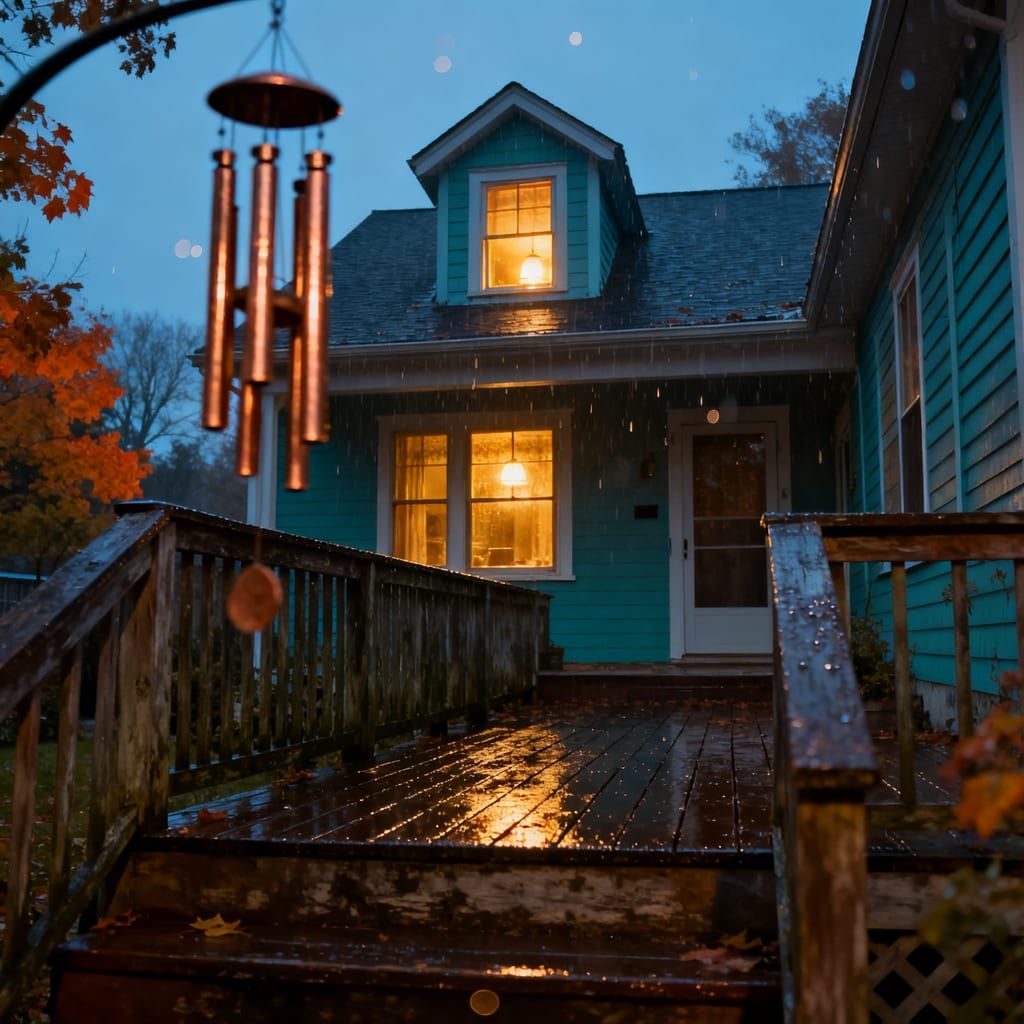
The power died on her first night, taking the furnace hum and the veneer of certainty with it. Ana stood in the bungalow's dark belly with a box cutter in one hand and a camping lantern in the other, breath fogging as the temperature dropped by respectful degrees.
Wind nudged the loose door to the basement. Somewhere outside, a metallic clink-those copper wind chimes, tangled from neglect-answered like a neighbor clearing their throat. Welcome, or beware, she couldn't tell.
She climbed the narrow stairs to the attic, each step shallow and particular, a choreography the house insisted she learn. The lantern swung over rafters and spidered beams, over a cradle of dust that stirred as if waking from a long nap.
Under a lifted board-her boot had rocked it by accident-she found the spiral-bound journal. The cover was softened by years, the cardboard feathered at the corners. A felt-tip "Lila" bled in one corner like it, too, had weathered storms.
The first pages were lists-milk, cumin, lightbulbs. Then notes for a parent-teacher night. A recipe for pan dulce annotated with a splotch of cinnamon sugar that had set like varnish.
"I fixed the leaky sink myself," Lila wrote on a Tuesday. "When Miguel left for college, I slept in his room for a week to wean the house off his laughter."
Ana sat cross-legged on the rough boards, lantern warming her knees, and read until her fingers went numb. She rationed the entries after that-one or two each night at the kitchen table like medicine you don't want to build tolerance to. I'll stop at the recipe, she'd promise. Then she'd turn the page.
There were bank letters that stacked like ice. A neighbor who mowed the lawn out of pity and left a six-pack of the cheap stuff on the stoop. "I didn't tell Miguel how close we were to leaving," Lila wrote. "I painted the hall instead-yellow so the house wouldn't know."
The last entry cut off mid-sentence on the day the movers didn't show. The ink broke at the bend of an m, as if she'd looked up and never came back.
On a margin, a half-finished list: "Things I want the house to remember: the smell of oranges in winter, Wednesday night dominoes, Miguel practicing trumpet, the way we clapped when it rained."
Ana traced each comma like a bead.
Daylight revealed the bungalow's honest face-honey oak scarred by decades, a slouch to the porch rail, radiators primed to hiss grievances. It wasn't pretty, not yet, but it was hers in a way her string of apartments had never been. Those had felt like borrowed air, the color of someone else's decisions.
Between classes, she stopped at the hardware store that smelled like twine and forgiveness. She bought a plumber's wrench because Lila had, a can of penetrating oil, a handful of skeleton keys whose teeth meant business.
In the back yard, she loosened the gate hinge until the squeal rounded out into a sigh. She slit paint from the bedroom window sash and felt it release, a breath held too long. She took the copper wind chimes down and cleaned them with lemon and salt until their dark returned to honest gleam.
In the evenings, she set her stool under the western window and sketched the rooms at dusk-the long patient light that lay across the floorboards like a cat; the radiator's ribs catching sun like an instrument; the way dust revealed drafts no eye could see. Her charcoal flitted, found a rhythm. There you are, she thought, palms blackened, the old ache of making settling back into her shoulders.
In a later entry, Lila mentioned a mural she'd painted at the community center-a river of hands passing bowls of fruta to one another-and a barista job under her maiden name. Ana set the journal down and looked at her own hands. Paint had worked itself into the half-moons of her nails.
The café was tucked beside the bus depot, steamed milk fogging the windows, a chalkboard promising extra shots for fifty cents and mercy for free. The barista wore her hair in a tight braid. Lines etched careful parentheses around her mouth.
Ana placed the journal on the counter, touch light as if it might bruise. "I'm looking for Lila," she said. "I think she used to work at the community center. Mural program?"
The woman's eyes flicked to Ana's hands before they went to the worn cardboard cover. "You brought your sketchbook," she said, wry. "Or you fix sinks."
"I try," Ana said, and waited for anger to arrive.
Instead, the woman-Lila-rested her palms on the counter as if meeting an old acquaintance. A wash of something passed through her face: recognition, fatigue, the private relief of not having to translate. "I couldn't face that house with the sign out front," she said at last. "Rust ran like blood down it. I told myself if someone opened the attic, they deserved to read."
They took their coffee to a small table. The espresso machine sighed into its cooldown. The buses outside yawned and departed with the damp finality of apologies.
"I left the journal there on purpose," Lila said, fingers around her cup. "Not to haunt. To keep the house from going quiet all at once. You don't turn off a song mid-chorus."
"It felt like a baton," Ana said. "I was ready to give it back to you."
Lila shook her head. "Keep it. Finish the list. Ring the chimes when the first storm comes-don't let them tangle. And if you can, teach the house your laugh." She lifted her gaze, and the edge of shame in it softened into something like invitation. "Tell me what you've fixed."
Ana told her-about the stubborn window, the gate, the way the kitchen faucet no longer coughed before it sang. She confessed she'd begun sketching again. Lila's mouth gentled. "Good. The house likes to be looked at with love."
When they rose, Lila touched the journal once more. "Miguel's around," she said quietly. "Working nights at the hospital. He pretends he doesn't drive past sometimes."
"Come by," Ana said, and meant it in the bone-deep way you mean a thing when you have no idea how to pull it off and decide to try anyway. "I'm thinking about a small porch thing. Neighbors. If it rains-better."
Winter edged in with its sweet brutality. The first ice skimmed the birdbath like glass you wanted to lift and tuck in your pocket. Afternoons shortened. Students dragged boots and stories into Ana's classroom, their shoulders haloed by breath.
She brought them outside on a blue-sky Friday, scarves tucked under chins, and pitched an idea she'd been circling: a mural for the community center. A line of small bungalows, each shouldering the next, paint windows lit like secrets kept warm, one attic bright as a lighthouse.
"Whose houses?" a sophomore asked, suspicious of metaphors.
"Yours," Ana said. "Ours." She left it there.
At home, she made flyers for hot cocoa on the porch-bring a mug, bring a story. She slid one under the door of the man who snow-blowed sidewalks at 5 a.m., taped one to the laundromat's plexiglass, left one at the café between the tip jar and the stack of sugar packets.
On the afternoon the sky darkened and the air turned electric, people came. A woman with a terrier under her coat, a teen in a knit cap who came for cocoa and stayed to coil extension cords, Mr. Delgado from two doors down with a bag of oranges he said he'd overbought-"It happens," he shrugged.
Lila arrived with a pan of still-warm conchas, Miguel at her shoulder, taller than the doorframe and apologetic about it. He set the tray down carefully like a new father. "Hi," he said, and his voice held the trumpet Lila had written about.
Ana introduced people until names felt less like labels and more like known routes. Rain came tentative, then sure. Everyone looked up at once as if catching the beginning of a song they loved.
"Now," Lila said, and held out her hand for the cord of copper chimes. The metal glowed where it had been freed from tarnish. Ana nodded and together they lifted it, letting the first drops find their note.
The chimes rang-not bright like glass, but warm, like a bell in a small chapel. The sound braided with rain and neighbor laughter and the hiss of water on the old porch light that still thought it might work without power.
They clapped, because that was on the list. Someone peeled an orange, and its winter smell cut cleanly through wet wool. Dominoes clicked under a towel where a spontaneous game had begun, because that, too, was on the list. Miguel leaned against the railing, eyes tracking the eaves like he was reading sheet music only he could hear.
Ana felt, suddenly and without drama, the house exhale. Not for her alone-never that-but for the gathering of them, for a sound it recognized. She touched the journal in her pocket like a pulse.
Later, when the porch had emptied and the floorboards retained a damp gloss, Ana sat at the kitchen table with a towel under her elbows. The clock over the stove ticked industriously like a small, optimistic heart. Outside, rain softened to a private conversation the house seemed to be following.
She turned to the margin with the unfinished list and, below Lila's handwriting, began a new page.
"Things I want the house to learn:"
"To wake before me and show me where the light falls best."
"To hold the smell of oranges and cocoa as well as it held worry."
"To keep the laughter of that boy who arrived apologizing and left humming."
"To make space for work-the messy kind, with paint under nails and charcoal on wrists."
"To accept apologies spoken into plaster and promises kept in small screws."
"To trust storms."
She capped her pen and listened to the rain's diminuendo. In the attic, a drop found an old metal bucket and pinged like a metronome. The house kept time.
The mural went up in stages, Saturdays studded with thermoses and paint trays. Students argued about rooflines and found agreements in the blue you get when you mix the department's last two leftovers. Neighbors stopped by and pointed-"That one looks like ours," "Put our cracked step," "Make this one's porch big enough for six."
On the far end, Ana painted an attic window glowing. It took three tries to get the light right-not lemon, not butter, but something you feel on your eyelids when you nap on a Sunday. When she finally had it, she stepped back and saw her students' reflections in it, their gestures caught mid-motion, their breath small clouds.
Lila stood beside her, scarfed against wind, hands in pockets. "You made it hold," she said. Not praise. An observation.
"Someone taught me," Ana said.
They didn't say baton or blessing. They didn't say loss. The paint dried in good time, and the first snow held off just long enough for the clear coat to set.
On a later morning, back at the bungalow, the furnace clicked convincingly to life and did its old job. Light braided through the same window she'd first sketched, lay down again like a cat in the same stubborn place. The copper chimes outside knocked once against each other in a wind that had someplace to be.
Ana set the journal on the windowsill, open to her new page. She pressed her palm flat over the words and thought, not of having won the house, but of having been invited into its watch.
From the porch, a neighbor called her name, drawn by the smell of oranges. She wiped her hands on a towel, went to the door, and opened it into rain-polished air.
The house, alert and familiar, kept its lookout. Inside, the light found her where she stood.
A daughter learns to read between the lines of a life split in two
Read more →
A fog-draped night, two souls found, and the quiet shape of a life
Read more →
Story audiobooks for children of all ages — a new one every day on Smarter Way Stories.