Two Houses and One Quiet Heart
A daughter learns to read between the lines of a life split in two
Read more →
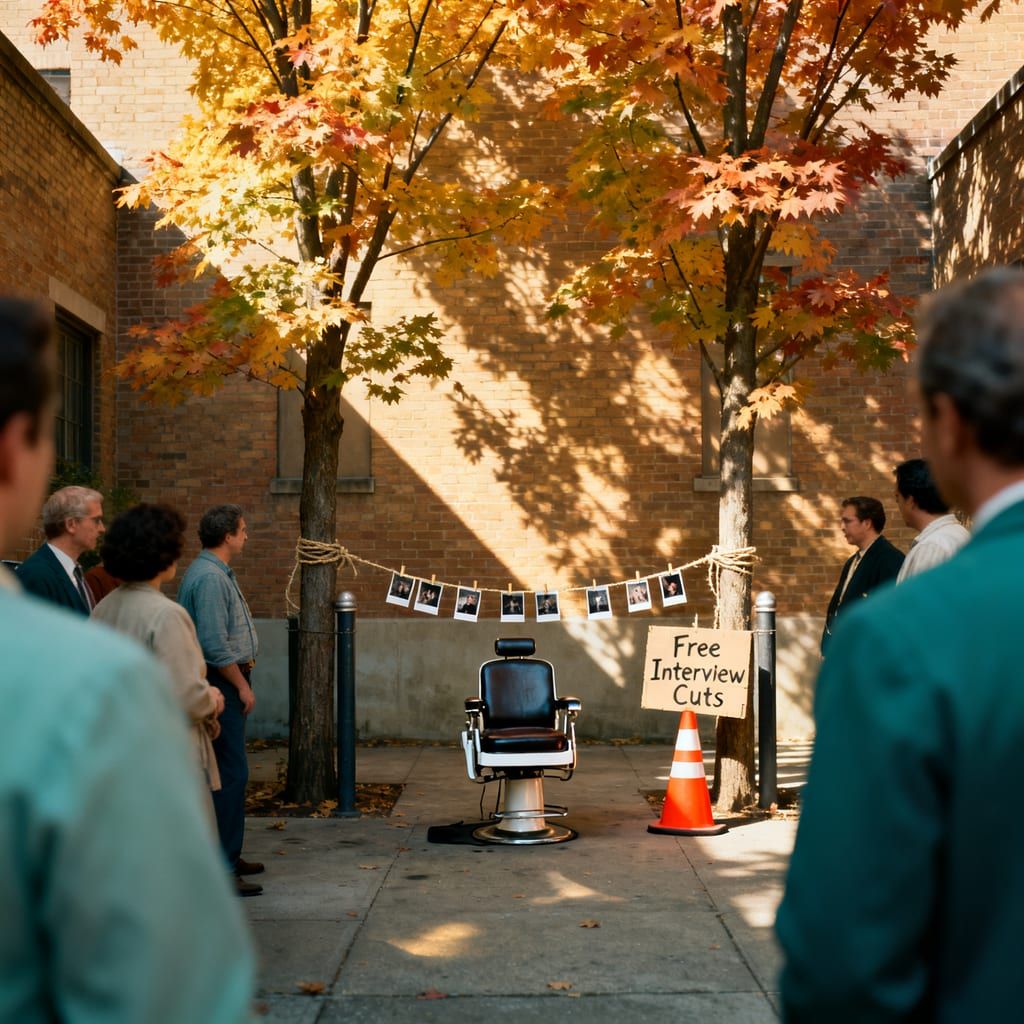
The first time he parked beneath the maples, the leaves trembled like hands unsure where to settle. Saturday light gathered in the windshield's cracks. Marco Alvarez killed the engine and listened to the car shiver into silence.
He set the orange cone by the curb. He taped the cardboard sign to its shoulder-Free Interview Cuts-and waited for the ink to stop bleeding.
He'd rescued the chair from a salon going under. It had a rip on the arm where someone had worried at the vinyl, and it tilted slightly left, as if remembering other floors. He placed it on the sidewalk outside the closed bakery with the sugar-dusted ghosts pressed into its glass. From the trunk, he lifted a battered tackle box, the kind you'd expect to smell like lake water. Inside: clips and combs, a cape, a brush whose bristles had learned patience.
He stretched a length of jute from one parking meter to the other and pinched two clothespins along it. Then he leaned against the car, hands tucked into his jacket, and watched the slow braiding of a city morning-dog walkers, joggers, someone cursing a parking app.
They noticed. Or maybe the sign noticed them. A woman passed, double-backed, and smiled without stopping. A courier asked if he did beards. The second person to sit was a man with a grocery bag and a nervous cough. The first Polaroid shook itself into being on the stoop of the bakery. Marco used a dull Sharpie to write at the bottom, in letters that leaned like him: First Day Soon.
He didn't only cut.
"Tell me about a time you solved a problem you didn't own," he said, draping the cape, fastening it with a softened snap. "Say it like you already belong there."
His hands knew the choreography-thumbs steady, clippers speaking in a low, industrious hum. He worked in the mirror-less present, letting faces remake themselves by feel. Stray hairs trembled on his wrist, caught in the sweat of concentration. He brushed them away with the backs of his fingers like a blessing.
They arrived with pockets of clipped classifieds, with rent notices that had learned to fold small. People came because hair was cheaper than confidence, because sometimes a stranger holding your head steady is the only way to stop the tremor in your voice.
There was Dev, graying and careful, whose warehouse had downsized the way a winter shrinks a river. "Been a while," Dev said, lowering himself into the tilt. His beard was an argument with itself. When Marco finished, the beard had become a sentence that knew where it was going.
"Again," Marco said softly, as Dev practiced. "Don't apologize for your own spine."
There was Aisha, quick hands folded so tightly her knuckles blanched. Two kids in a stroller beneath a knit blanket, the blanket the exact blue of the sky when it forgets to cloud. Aisha's smile was practiced the way you practice a swear you never use in front of your mother-ready, tight, a little shameful.
"Gaps," she said, like a confession.
"Bridges," Marco said. "Say bridges." He lifted her hair, let it fall like a curtain. "What do you do without a schedule? You make one."
And Connor, hoodie drawn up as if the day might rain words. He looked at his sneakers when he talked, as if they were the ones applying. "Tech," he said. "Used to be."
"Used to be is a floor," Marco told him. "Not a future. Chin up."
He snapped a Polaroid after each cut. The little square unfurled its ghosts, then found its edges. He wrote First Day Soon at the bottom, and pinned them to the jute. The gallery climbed the air like a laugh learning to trust itself.
Marco slid the tackle box under the car at night and rolled a jacket into a pillow. He knew where the gym kept its guest passes, which cashier wouldn't ask twice. His sedan smelled like talc and lemon cleaner and the slow sweetness of things that used to be bread.
He avoided mirrors after dark. Reflections were too honest then. The bell on the old shop door had chimed like laughter-he could still conjure that sound by tapping his ring against the car's dashboard. Dignity had once been a fresh towel, a warm shoulder to drape it over. Now it was someone calling his name like it matter-of-facted the air.
Aisha asked him where he worked, and he flicked hair from the cape as if brushing away the question. "Here," he said. It was true and not the whole truth.
The city noticed. On the fourth Saturday, an inspector approached with a clipboard held like a shield and a voice careful as a handshake that doesn't want to be too much.
"Complaints," he said, and Marco nodded because he knew the numbers. He had read the permits and the penalties by dome light at 2 a.m., tracing each line with his finger to keep the words from floating. Loose hair in the gutter. Unlicensed public setups. Sanitation.
"I can pack," Marco said, already reaching for the jute.
Before he could unpin one square of hope, Aisha arrived in a slate-blue suit the color of clear intentions. A badge hung at her throat-HR coordinator, not manager yet, but like a sunrise in low-rise glass. She took her place beside the chair, planted like a second sign.
"I got the offer," she said, loud enough for paper to hear. "Because of this."
Dev stepped forward with a folded schedule. The penciled hours made a small, ordered city of his week. Connor lifted his chin-just a lift, but you heard it in his voice when he said he had remembered how to answer without apologizing.
The inspector's jaw worked. He looked at the pictures pinned between the parking meters, small squares of faces that had dared to imagine themselves differently. He cleared his throat.
"My boy sat there," he murmured. "Three weeks ago." He glanced down at his clipboard and then past it. "There's a courtyard at the library. Shade. Outlets. If we can get a permit, there's your-" He gestured for a word he didn't need to say.
"Legitimacy," Marco supplied, tasting it.
A week later, beneath the bronze gaze of some city founder astride a horse forever pausing, the jute-string gallery reappeared. A volunteer rolled out a book cart labeled Interview Help. The cone got a partner sign-Please check in at the desk for your time-and the Saturdays moved a block but kept their heart.
The twist arrived folded into a white envelope tucked beneath the cape, not unlike a tip but shaped like a door. Marco found it when he reached for the next neck strip.
From: a nonprofit workforce center. Language that tried to be both official and kind. They had heard about the free chair-Aisha's doing, he suspected. They wanted to formalize what he did.
Confidence and Appearance Coach. Community Barber-in-Residence.
A stipend. A schedule. A room with a mirror that wasn't the shiny side of a food truck. The job was his if he would accept it and let others take care of him the way he had taken care of them.
His chest went tight where air usually moved. He looked around. Saturday was in full bloom-voices braided over the fountain, the smell of cut hair peppering everything. He imagined walls closing around the sky. What if the ceilings felt like failure? What if acceptance rewrote the story into charity when he had carved it-with cone and cape and jute-into purpose?
A man approached in a paint-splattered hoodie, cap crumpled in one hand. He was all apology and angle until he lowered himself into the chair.
"Can you make me look like a person someone would hire?" he asked, voice feathered thin.
Marco draped the cape. The clippers found their hum and spread it up the man's neck like a small, reasonable storm. Halfway through, Marco set them down.
He sat-really sat-in his own chair. The courtyard sound tilted, as if the fountain had leaned in to listen. In the library's tinted glass, he caught Aisha's reflection, her badge bright as a coin.
He nodded toward the scissors.
"Take the first snip," he said.
She hesitated only a breath, then stepped forward with a steadiness that had learned itself out of doubt. The blades whispered. One clean strand fell. The man in the hoodie watched it drop and did not flinch.
Marco's eyes stung. He wasn't sure if it was the hair, the lemon cleaner, or the shape of the moment as it settled.
The permit hung in a plastic sleeve by the librarians' office, the ink a little crooked because the printer jammed and someone laughed and printed again. The Saturdays thickened, the courtyard knitting itself into a ritual-cones and cords and a jute string that now curved along the brick like a smile not yet ready to leave.
He moved his milk crates into a small room with a mop sink that smelled like lemon and a hook for his jacket. A mirror faced him, steady as a witness. He wrote a note and taped it at the bottom where only he could see when he leaned in to comb someone else's courage into place: Dignity is not a service; it is a circle.
People kept arriving with hair that needed taming and stories that didn't. They sat and tried sentences on in the chair like suits, shrugging into futures that pinched at first and then fit. Marco coaxed them forward-backs a little straighter, eyes that held the room longer. He learned the quiet artistry of stepping aside while being exactly where someone needs you.
On a weekday afternoon he didn't used to have, he walked past the bakery. The ghost-sugar was gone; a For Lease sign had been replaced by a paper with a logo and an opening date. He let himself imagine a bell chiming again, not like laughter now, but like welcome. He didn't hurry the thought. He let it ride with him to the library, across the flagstones, under the maples that had learned the shape of his car and didn't need it anymore to cast their shade.
He arrived early the next Saturday, long before the clippers would hum. The courtyard was a rectangle of cool morning, the statue guarding its forever question. He ran the jute string and pinned yesterday's Polaroids to make room for today's. The first one to arrive was Connor, who didn't hunch as much. He touched his hair like he remembered it belonged to him.
"Offer came through," Connor said lightly, as if telling the weather. "Week after next."
"First day soon," Marco said, and held out the marker.
Connor wrote it himself. The letters were cautious, then surer. He pinned the square and stepped back.
When the paint-splattered man from last week returned, he looked-there was no other word-hireable. Or maybe it was that he looked like himself with the apology taken off. He brought a coffee and set it near the tackle box like an offering.
"For you," he said, cheeks pink with a kind of relief.
Marco sipped it and let the warmth confess its way down. He thought of the envelope, the room, the mirror, the way Aisha's hands had not shaken. He thought of his sedan sleeping in a lot near the gym, of the kind-eyed cashier, of the line between purpose and pride that had turned out to be less like a line and more like a door.
"I'll need to build a schedule," he said to the empty air that wasn't empty. "Block time for walk-ins. For practice interviews." He wrote it down. The words felt like fitting a guard back onto a razor, a small safety clicked into place.
At noon, the inspector wandered through on his lunch break, eating a sandwich that dripped a sincerity of mustard. He raised his sandwich in a kind of salute. Marco lifted his comb. Somewhere inside the library, a printer started and stopped, laughter catching it and setting it right.
The afternoons sloped toward evening. The Polaroids divided the sun into neat little squares until the wall itself seemed to glow. People kept leaving with something hard to name and easy to see. Heads a bit lighter. Voices with a new edge of belonging.
When Marco locked the small room and slid the key into his pocket, the maples offered their green hush. He stood in it a moment longer than habit, thumb on the key's head like a promise. He wasn't in a hurry to move the car that would, soon, be a car again and not a room.
He traced the cardboard sign with one finger, as if re-inking what the weather had faded: Free Interview Cuts. He thought of all the ways free never meant without cost, and how sometimes the price is simply showing up where you can be seen.
He turned toward the street, toward whatever comes after soon.
A daughter learns to read between the lines of a life split in two
Read more →
A fog-draped night, two souls found, and the quiet shape of a life
Read more →
Story audiobooks for children of all ages — a new one every day on Smarter Way Stories.