Two Houses and One Quiet Heart
A daughter learns to read between the lines of a life split in two
Read more →
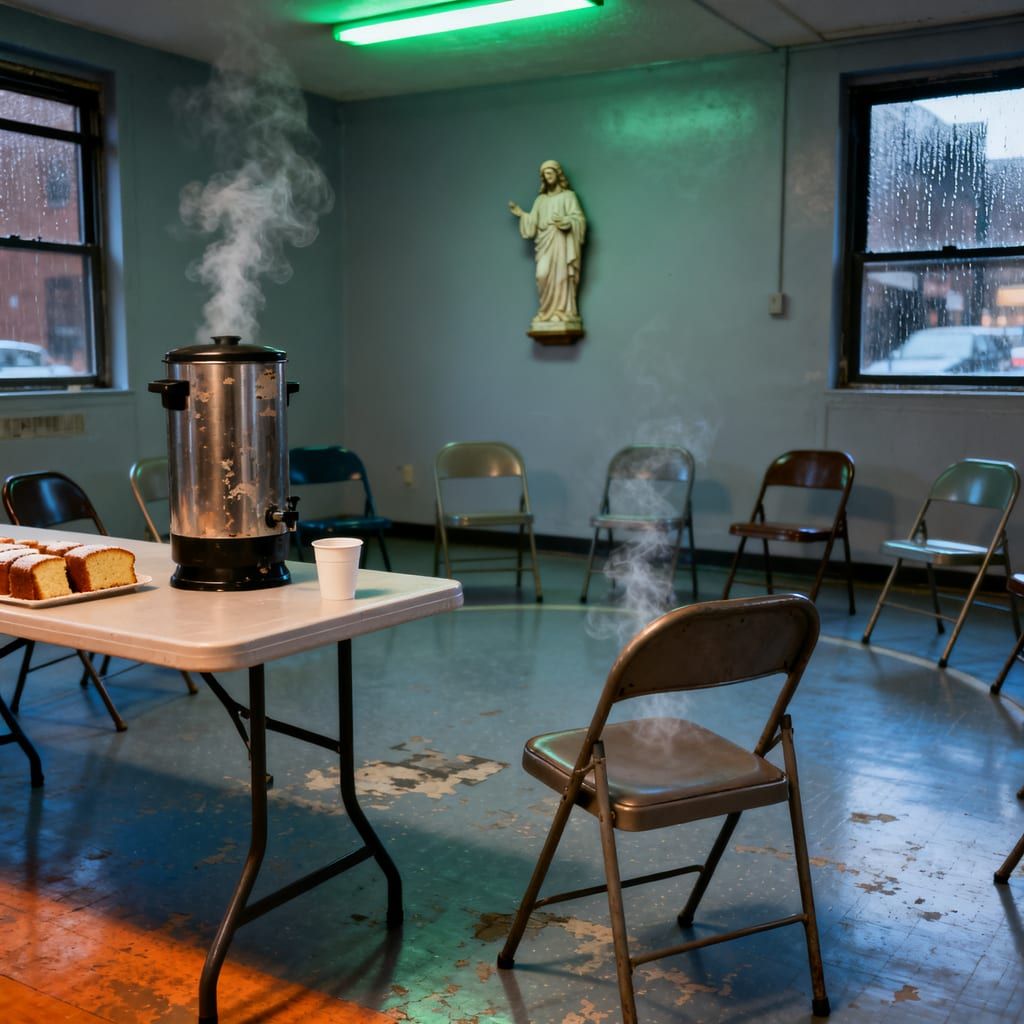
The first thing Leo noticed was the dent in the coffee urn. It had the soft, sunken look of a bruise, the kind that takes weeks to fade. Steam wandered up as if unsure of the route. Somewhere above, a radiator hissed like a tired animal.
He wrote "Leo P." on the paper sign-in sheet with a pen that had to be coaxed. Metal chairs scraped. A plaster Jesus watched from the far wall with the kind of patience that made Leo want to apologize to someone and wasn't sure who.
Phones went face down. Someone set out slices of pound cake, pale and uniform as siding.
He told himself: field research. He told himself: it's not exploitative if the end product helps someone.
The room smelled like coffee, church polish, and rain leaking from umbrellas. A nurse spoke first, hands wrapped around a chipped mug. "He said he was fine," she said, and the word fine seemed to lose its outline midair. "And then he wasn't."
Leo wrote: said he was fine / then he wasn't.
A barista with a septum ring talked about her job like it was a stage set. "Smiles on command. My face hurt. I left when my mouth felt like somebody else's." Leo wrote: performance of happiness.
An older woman-white bob, knit sweater with a tidy row of pilling-said that after her son died, the washing machine saved her. "It was dumb," she said, and it wasn't. "The sound of it. Like the world was still doing the next thing. That thrum kept me from unraveling."
Leo wrote: kept me from unraveling. He wrote: thrum. He wrote: next thing.
Silence didn't feel empty here. It felt like dishwater-warm, a place to put your hands and not freeze.
When they went around the circle, the facilitator-a man with a wide forehead and laugh lines that suggested past life as a camp counselor-gestured to Leo. "Anything you want to share? No pressure."
Leo cleared his throat. "I'm actually here as part of a... volunteer program," he said, flicking his badge from another nonprofit just high enough to register. "I'm-observing, mostly. Just to help us learn how to, you know, support."
He heard himself as if from two rooms away. He collected a handful of safe sentences-"we all need spaces like this," "language matters," "gratitude to everyone who shared"-and stitched them together like an apology made of other people's words.
Nods came, faint and polite as the sound of a dryer ending. No one pressed. He felt both seen and given a pass, which is a particular kind of mercy.
During coffee and cake, he stood by the urn and waited for something like inspiration. The older woman from before drifted over, her plate holding a slice she was dismantling carefully, the serrated fork sawing through sugar. Up close her sweater had a tiny stain near the cuff, the honest kind life gives you when you stop checking for lint.
She glanced at his open notebook. "You sound like that founder kid from six months ago," she said, and her voice was kind the way a kitchen light is kind. "He tried to turn us into bullet points too. It didn't work for him either."
Leo's face burned so fast he worried it might leave a mark. "I'm-" He shut the notebook. The slap of paper on paper sounded louder than it had a right to. "I shouldn't have... I'm sorry. I had this deadline and-"
"I know deadlines," she said. "What's your name?"
"Leo."
"I'm Nora." She broke off a corner of cake and then another, as if the right size would eventually appear. "You're allowed to sit in the circle like a person, Leo. Just so you know."
He almost laughed because that sentence shouldn't have been revolutionary. It rattled anyway.
After the break, the circle pulled back together. Someone set their crutches against a wall with a click-clack. The facilitator folded himself into his chair and looked at Leo the way you look at a door to see if it's unlocked.
"Before we close," he said, "I want to check in with Leo again, because... sometimes the words we have aren't the words we need. When's the last time you let yourself be comforted?"
The room shifted. It wasn't a threat-more like a seat being offered at a crowded table.
Leo didn't have a good answer. He had a hundred deflections. He had jargon and timelines and a draft of onboarding copy in his head. He also had a name he hadn't said outside of lists and to-do items, the way you say 'milk' or 'trash' or 'pharmacy.'
He looked at the gray carpet and the scuffed linoleum beyond it. He looked at his own hands, which were not shaking but might. He felt something in his chest find a hinge.
"My brother," he said, and the room rearranged itself around the word. "Max. He died last year. Everyone called it an accident. I designed the slideshow for the service. I did the programs, the playlist, the catering. I made a spreadsheet for... condolences." The absurdity of that last word landed late. "I think I treated grief like a project. If I did it clean enough, quick enough, no one would have to look at me and see-"
He stopped because he could feel the sentence about to turn into a plea.
Nora's hands were still, cake abandoned. The nurse tilted her head in a way that made space. The barista nodded without rhythm.
"-see that I couldn't..." He swallowed. The swallow was the loudest thing he'd heard all week. "I haven't said his name when there wasn't a task. I haven't...
"When's the last time I let myself be comforted?"
He hadn't meant to repeat it. He hadn't meant to answer. He stared at his lap like it might have advice. A dot of coffee had bled into his jeans like a small country on a map.
The tear came like weather. No wrenching, no gasp. Just moisture collecting, then traveling. He felt it on the outside of his face and the inside of his lungs. He exhaled. The breath had miles in it.
No one moved in to fix anything. No one said "stay strong" or "everything happens." He had designed entire flows to avoid the awkwardness of moments like this, the way an app can be a hand someone holds when no hand is available. But here were hands not reaching, pulsing their quiet yes.
He sat in it. It did not kill him. It did not even drown him. It was rain on a day that had been waiting.
"Max," he said again, just the name. "Max."
In the corner, the radiator clicked. Somewhere, the washing machine in the church's back closet started, a low persistent thrum like a remembered promise.
He came back the next week. And the one after. He brought no notebook. He learned the names that arrived and left. He didn't quit his job. He changed the way he held it-palms up instead of pinched fingers.
When his boss asked for "the voice of the user" for the pitch deck, Leo deleted the slide. "We're not mining people," he said in the Monday meeting, voice even, like a road without potholes. "We can listen without extracting."
There was a silence in the conference room that felt nothing like the church basement. He saw fear flick across a product manager's face-the fear of losing ground. He felt his own fear taper because there was a floor under him he hadn't known he was standing on.
He built one small feature. It was not a breakthrough. It was, if anything, suspiciously gentle. A pause-and-breathe timer that showed a coffee cup and a chair. Not a streak, not a flame-no bright currency that punished a missed day. Just a small animation of steam curling up from a mug like it had nowhere better to be.
He asked Nora, "Is that silly?"
"Silly would be pretending we don't need chairs," she said. "Pauses saved me. Give someone a chair when they don't know they're standing."
He mailed the group an apology note he didn't read aloud. He included, tucked into the fold, a printout of the screen with the cup and the chair, as if to say: I heard you.
Weeks rippled. New stories joined, circled, loosened. A man whose wrists had still-raw edges. A teenager who measured days survived in playlists. A widow who had started labeling Tupperware for one. Leo listened without trying to find the lesson in their sentences. He learned the texture of their pauses. He noticed how they sometimes laughed right before crying, or after.
On a Wednesday when the rain had the color of nickels, someone new arrived. They were twenty-something and nervy, their hoodie damp around the cuffs, a badge from some city program lanyarded at their sternum like a shield.
"I'm here for research," they said fast, as if bracing for the bruise. "Just observing for this initiative."
The room held.
Leo felt the echo travel through him, old embarrassment warming his ears, new tenderness making room. He slid a spare pen toward the empty chair next to his. The pen bumped the metal seat with a small, hopeful click.
"I'm Leo," he said. "You can just sit. Or you can talk. Or you can have cake. It's good cake."
They smiled, a brief solar event. "Thanks."
He wanted to ask for their story. He didn't. He watched the facilitator ask for names in the gentle rhythm that worked best-no prodding, just a hand set near a ledge in case someone needed it.
When it felt right-when the room had found its breathing-Leo turned and asked, not as a test or a prompt, but as if it were a place to put a heavy thing for a minute: "When's the last time you let yourself be comforted?"
It was the question that had unlatched him. Saying it felt like pointing out a chair to a tired person and not making a speech about chairs.
The new person's eyes flicked toward the plaster Jesus, then to the pound cake, then to the circle. They made a sound like someone deciding to trust their own weight.
"I don't know," they said, and their voice didn't break so much as bend. "I don't know."
Nora nodded. The nurse sipped cooling coffee. The barista, now working at a bookstore where no one asked her to smile, crossed her ankles and listened like it was a job she wanted.
Leo sat with his hands open. A radiator clicked. The washing machine started up again, steady thrum under everything.
He thought of Max the way he did now-in the present tense of memory, not the spreadsheet of duties. He felt the room leaning toward its own work, toward naming without labeling, toward being a place someone could come and then come back to.
He had arrived certain he would leave with data. He left every week with a different kind of artifact: a sentence softened by breath, a pause that didn't reach for a fill, a name that no longer needed a task to be spoken.
On the sidewalk under the nickeled rain, he pulled up the app he'd helped make. The coffee cup steamed on his screen, a chair waited, and for once he let the minute keep him-counting not toward anything, only through.
Above the church, the city groaned and glittered. Below, in a basement that smelled like sugar and old wood and the patience of radiators, a room had named him, and he said yes.
A daughter learns to read between the lines of a life split in two
Read more →
A fog-draped night, two souls found, and the quiet shape of a life
Read more →
Story audiobooks for children of all ages — a new one every day on Smarter Way Stories.