Two Houses and One Quiet Heart
A daughter learns to read between the lines of a life split in two
Read more →
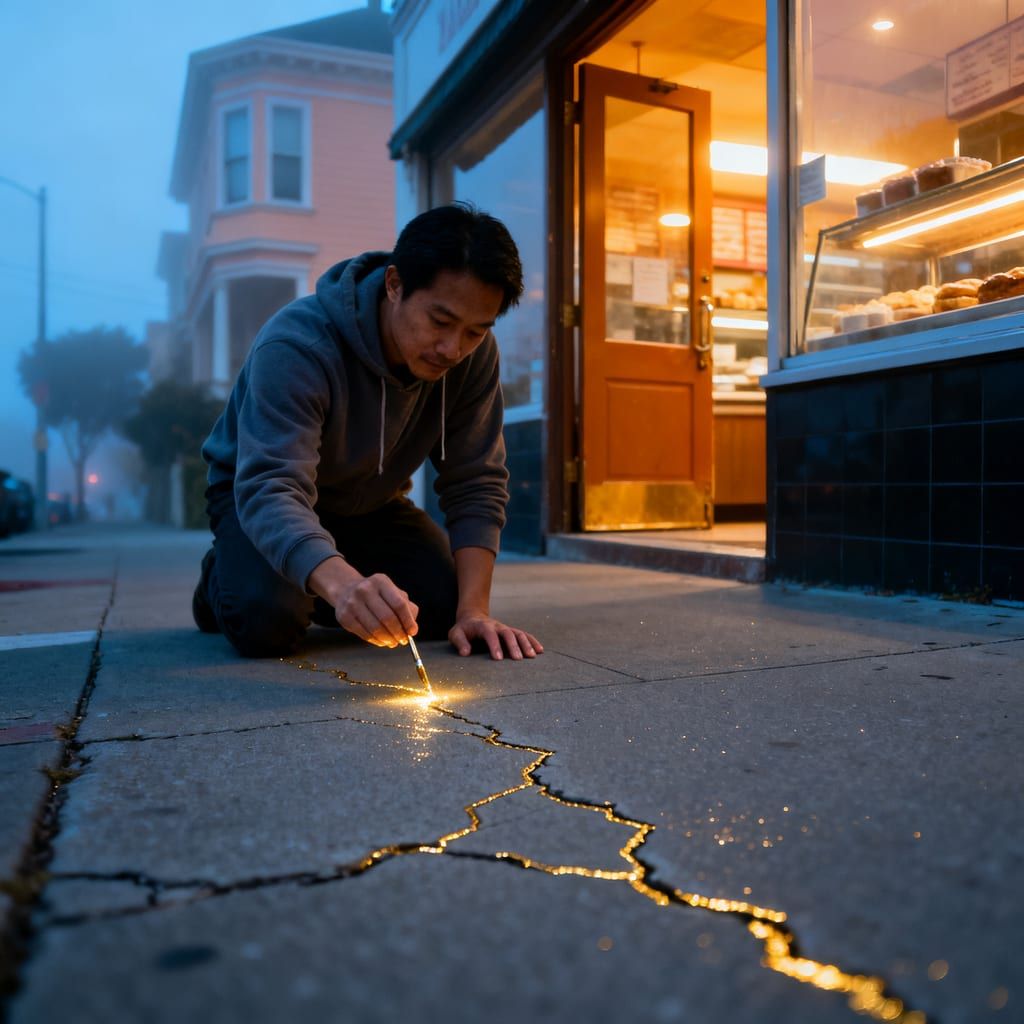
The morning the city goes quiet, Evan wakes to the small sound of his own breath.
No hum of the refrigerator. No elevator cables sighing. His phone is a cold mirror-black screen, no numbers, no pings. The window holds a muted blue, the kind of color that makes you exhale without meaning to. He pulls on jeans and a hoodie, slips his dead phone into his pocket anyway, habit heavier than glass.
On the stairs, a neighbor opens her door and pauses, as if listening to the space they share. She smiles without words. Outside, the street feels like a room where everyone has agreed to whisper.
He walks the same six blocks he's walked for years toward the N Judah stop, but this time the world arrives unmediated.
The bakery's warm breath is louder than traffic. It rolls out of the propped door-brown sugar, yeast, the faint sting of cinnamon-until Evan's stomach flutters with an old childhood hunger he can't place. The corner house, the one he's passed a thousand times, is not beige at all but a peach so tender it reads like a blush. A woman on the second-floor balcony waters strings of pearls and rosemary with a yellowed plastic can. He has never seen her plants. He has never seen her.
He looks down to avoid staring and notices the crack beneath his shoe.
It glints.
A thin seam of gold runs along the hairline fissure in the concrete, catching the new light as if it remembers fire. He crouches, presses a fingertip into the seam. It is not paint exactly-slightly raised, slightly rough. Handmade. It leads forward like a drawn breath.
A lamppost wears a taped note in tidy block letters: Bring what's broken.
He straightens, scans the block as if the city is telling a joke he's slow to catch. On the next corner, a sandwich board leans against a dark storefront window: Repair Café. Hand-painted, letters squared off with someone's careful patience. He has passed this shop for years and never seen it open. Maybe it never was until his attention opened it.
He follows the gold-laced crack to the threshold.
Inside, the air smells like solder and coffee. Card tables hold small worlds: a radio disemboweled but dignified; a chair on its back, legs akimbo and ready to be forgiven; a toaster with its belly showing wires like noodles. A bell tinkles when he closes the door.
"Morning," a voice says. "We're cash-poor and patience-rich. Bring something you want to try saving."
The man is older, hair a wash of gray that still refuses to lie flat. He wears an apron that's seen things-tiny burn marks, a faint constellation of paint. His eyes are kind in the specific way of people who notice what your hands are doing.
"I-saw the sign," Evan says, hearing his own voice as if it belongs to someone better at mornings. "I don't have anything. On me."
"That's all right." The man gestures to a stool. "Stay, help, watch. I'm Kenji."
"Evan." He sits.
People arrive. A teenager with a chewed headphone cable, cheeks red with the embarrassment of asking. A woman in scrubs with a radio that hums at a frequency like grief, then clears into a local jazz station when Kenji coaxes its insides with a toothbrush and a whisper. A man with a chair that wobbles, the leg's joint loose like a promise. The small victories feel outsize in the room, each click and re-thread a small gold thread in the morning.
On the table nearest him, a chipped mug waits with its lip bowed inward, a soft V where sorrows collect. White ceramic with a ring of blue near the rim. Evan's heart gives a sudden, precise thump.
"My mother has one like this," he says, before he can help it. "Same ring. She keeps it at the hospital. Says the coffee only tastes right from that one."
"Bring hers," Kenji says. It is not a suggestion so much as a permission.
Evan thinks of the hospital down the hill, the sunless waiting rooms with televisions always a few seconds out of sync. His mother's nights of non-answers and lab coats; his own afternoons offering compact words to the family group chat like he can compress fear into bullet points.
He looks at the seams of gold he's been following all morning and asks, "The sidewalk-did you...?"
Kenji smiles into his hand, as if trying not to show off. "City mends with slurry. I...invite it to remember. Kintsugi, but for concrete." He shrugs, his apron whispering. "I wake early."
"Why?" It comes out rougher than Evan intends, and he immediately wants to apologize for asking for reasons in a world that doesn't have to offer them.
Kenji checks the heat of a soldering iron with the back of his hand. He thinks longer than the question requires. "Because it's what I know how to do. Because when I don't, I forget I belong to the street. Because people trip." He glances at Evan, a glint of humor. "And because I like how the sun rewards me at seven-oh-three."
Evan breathes something like laughter. He feels his pockets lighten in a way that has nothing to do with a phone.
He brings the mug that afternoon.
He half-runs down the hill from the hospital, both cradling and hiding the wrapped ceramic under his jacket as if it has its own weather. In radiology, a nurse had said his mother would be back in an hour. He needed air; he needed a task. The mug is cracked in a parenthesis that cups your mouth if you don't drink carefully-a small cruelty his mother has learned to negotiate.
Kenji lays the mug on a folded towel like a patient on an operating table.
"So," he says quietly, hands steady. "Tell me where it hurts."
Evan surprises himself by answering with too much truth. "Hospitals. Waiting. Talking around the thing. Screens telling me bad news I can swipe away. Feeling like I should be doing something and not knowing what." He stops, heat crawling up his neck. "Also, there's a crack right here." He points.
"Good," Kenji says. "Start with what you can point to."
They clean the break, his hands mirroring Kenji's-swab, sand, breathe. The resin has a warm, medicinal smell, like sap and pennies. They mix a tiny jar of metallic powder into the glue until the swirl resolves to a soft gold. They paint the fracture line, not hiding it but brightening it, the way you underline a sentence you don't want to forget.
While the resin cures, they stand in the doorway and watch the block.
A father in a suit stoops to tie a child's shoe. A bus sighs, even without its usual whine. The bakery owner-Hana, the painted nametag reveals-leans in the frame of her door and cups a paper cup in both hands, eyes on the sky like she's reading it.
"My mother played piano," Kenji says, unprompted. "Wasn't famous. Didn't need to be. She tuned pianos at night for money when I was little. The city will forget to listen unless you give it a reason not to."
Evan feels the thud of that, the soft fatalism and the stubbornness braided through it. "I don't know how to do any of this." He lifts his gold-dusted fingers.
"You already are." Kenji nods toward the mug on its towel, the seam settling into itself. "Attention is a glue. The gold just brags about it."
The bell tinkles. Another chair arrives with a leg that won't commit. A boy with a skateboard missing two screws hovers in the doorway like a sparrow. The day swings forward.
By two, Evan's fingertips hold a shimmer that refuses soap. He doesn't mind.
When the mug is ready, the line catches light even in the shade. He wraps it and carries it back up the hill the way people carry promises they are learning to trust.
The power's back the next morning. The city wakes with a start. Cables hum, traffic clears its throat, phones wake to a flood of yesterday's insistent needs.
Evan leaves his earbuds on the dresser.
He walks the six blocks and the bakery breathes on him by name. "Evan," Hana says, as if it's a word she's practiced. He learns hers, offers it back with a smile that feels less like performance and more like something shared. On the third block, he notices a violet struggling in a square of dirt no bigger than a napkin. He kneels, sets the dirt around it with the concentration he once saved for product roadmaps.
He brings a small vial of gold paint in his pocket-color-matched to Kenji's recipe as best he could-because the curb by the bus stop keeps crumbling. He is not a perfectionist. He is a beginner. He kneels anyway and nudges the line forward, cautious, imprecise, earnest. People step around him with a kind of reverence he doesn't expect, as if he's said grace for the pavement.
At the hospital, his mother turns the repaired mug in her hands, thumb brushing the new seam.
"Looks like a scar," she says.
"Yeah," he says. He does not explain further. She doesn't ask.
Downstairs, the lobby holds a piano he has not really noticed before. It wears a soft shine; the bench cushion sags in the middle like a well-told joke. One of the nurses-Robyn, whose French braid never loosens-mentions casually that it plays nice this month. "Anonymous donor gets it tuned on the regular," she says, flicking a postcard from the counter back into its stack. "Every time, same tidy handwriting on the receipt. Like a teacher." She laughs. "Whoever it is, they care about Wednesdays at three when Margot from oncology plays 'Autumn Leaves' for the volunteers."
Evan picks up the receipt without thinking. The letters are squared and patient. Repair Café, he thinks, with a small shock you feel in your knees before your brain.
He heads down the hill in a hurry that doesn't taste like panic.
The storefront is dark. The sign in the window reads, in that same steady script: Closed for a while. Watch the cracks for news.
Beneath the hand-painted sandwich board, his name waits on a folded note, weighed down with a key that has earned its dullness honestly.
For when you notice, it says. The loop of the J in Kenji's signature closes with confidence. Back soon.
Evan stands on the sidewalk longer than he means to. The world moves around him-a dog asking to cross, a box truck arguing with a loading zone, a child dragging a stick along the fence like a zipper-but for a moment there's a bell jar of stillness over him. He puts the key in his pocket. He looks down.
The seam along the curb looks like a sentence that stopped to think.
He kneels.
He does not have the recipe perfect, but he has the impulse and the patience Kenji loaned him. He brushes dust away with his sleeve. He leans the vial between his knees and coaxes a thin line into the crack, letting it find its own path, not overfilling, not rushing. The gold inks its way forward, a whisper of light in a scuffed city.
A boy on a skateboard stops and watches. "Cool," he says, reverent. "Is it...okay to do that?"
"It helps," Evan says. He doesn't know if it's a rule. He knows it's an answer.
He works until the vial is mostly gone, until his legs tingle from the kneeling and a leaf has glued itself to his shin. He sits back and the seam winks up at him like a secret shared.
Later, he unlocks the café. He sweeps. He sets the soldering iron in the light but does not turn it on. He writes, in his own imperfect hand, a small card: Back open next week. Bring what's broken. He doesn't sign it. He doesn't need to.
Days fold into their own practiced shape, but they do not fit him the way they used to. Slack pings still ping. Meetings still circle their predictable drain. The bus still complains when it kneels to let someone on. But the street holds a new grammar, and he reads it with a different mouth.
He finds himself early more often. He notices the sound the crosswalk makes when it changes to walk, a small bird behind a wall. He buys an extra croissant and leaves it on the steps of the corner house with the peach skin, because the woman watering rosemary has a laugh he wants to invest in.
Sometimes, at seven-oh-three, if the sun does what it always does and he is lucky enough to be the kind of person who notices, the gold in the sidewalk looks like a promise from beneath the earth. It does not ask him to praise it. It asks him to keep going.
He carries the key on a string around his neck for a while and then learns to forget it's there until his fingers find it.
On a morning when the fog lifts clean from the park and the bakery's door squeaks a little in the way he has grown to love, he kneels by the bus stop and continues the line he didn't start. His fingertips glimmer against the gray. He does not try to scrub it off.
A bus sighs to a stop. A child with shoelaces untied hops down, stares, then looks up at him as if asking a question he already knows how to answer.
Evan smiles. He presses the brush to the concrete. The gold finds the crack and settles into it, bright as attention, quiet as breath.
And the city-imperfect, loud, stubborn-remembers itself for a moment in the seam of morning.
A daughter learns to read between the lines of a life split in two
Read more →
A fog-draped night, two souls found, and the quiet shape of a life
Read more →
Story audiobooks for children of all ages — a new one every day on Smarter Way Stories.