Two Houses and One Quiet Heart
A daughter learns to read between the lines of a life split in two
Read more →
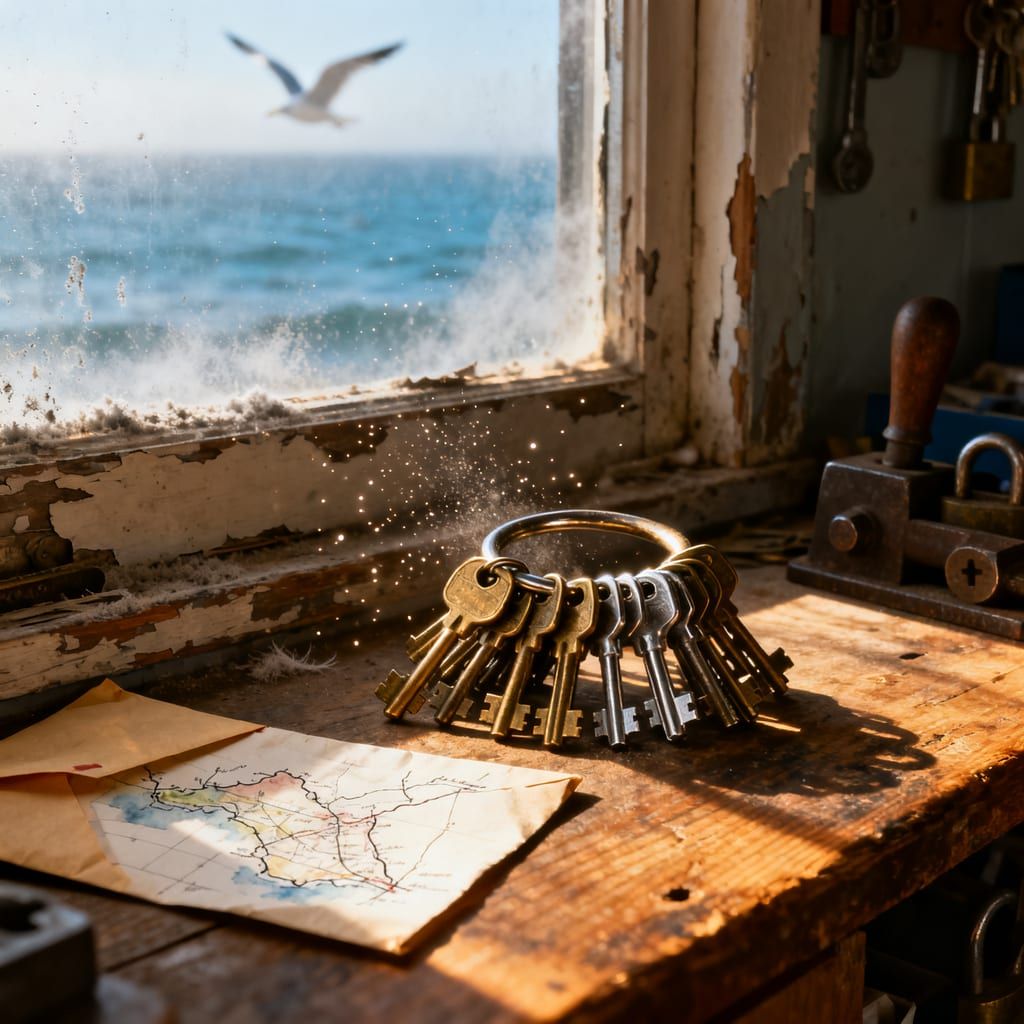
The keys clinked in Lena's palm like a small bell choir-deep brass notes, a bright nickel chime. Sea air licked the shutters of Ortiz Lock & Key, peeling paint in long curls as if someone had started a story and never finished it. The hand-lettered sign swung once and settled. Above the door: Est. 1969. Below her breath: "Okay. Let's see."
She was thirty-three, sleep still snagging the corners of her eyes from the red-eye and the year before it. The will-two crisp pages in a manila envelope-had offered only this: the shop deed and a heavy ring of unlabeled keys. No instructions, no explanations, no map.
Lena fit one key into the shop lock and tried not to look at the framed certificates on the wall-the ones with her grandfather's name, the man who had taught her to listen for tumblers the way some people listen for thunder.
The door resisted, then relented with a tired click.
Inside smelled like a pocket: old pencil shavings, machine oil, the salt-damp of a hundred foggy mornings. A dust coat lay loosely over everything-vices, files, a coffee can of brass shavings, a little tin labeled oddments in shaky ballpoint.
Her grandfather had never believed in computers for the counter. He'd kept a weather-stained logbook instead. Lena slid it open to a page where the ink had bled in from a stormy week. Names, dates, lost stroller key for Delgado, locker 18?-nothing that announced itself as a breadcrumb.
She slept on a cot in the back room that first night, the keys under her pillow like some late, pragmatic fairy tale. When the gulls started up, she woke to a tide sound only small towns make-distant hammers, a kettle, someone's radio catching the news.
"I guess we start small," she told the ring. It flashed dully in the gray light. She had a product manager's itch to sort and label, to make Kanban columns out of people's lives. Her thumb found a long, corroded key with squared shoulders.
The back room door had always stuck. She slipped the squared key in. It turned with a cough. The door swung to reveal a shelf of coffee tins, each with a scratch-card of masking tape: screws, washers, miracles. A small victory, and a smack of grief.
"Hi, Lito," Lena said to the room. "Message received."
She took the ring to the park, autumn light combing the grass. Old men in caps played chess under the sycamores. The maintenance gate stood chained. On a whim, she tried a slim brass key whose teeth looked chewed by time. Click. The gate swung. A groundskeeper glanced up.
"You with City?" he asked.
"Family," she said, gesturing at the shop logo on her borrowed hoodie. "Just-clearing out."
He nodded toward the gate. "Your abuelo used to let in the kids who forgot the ball. Said games shouldn't stop at a lock." His upper lip trembled in the way of men who are used to swallowing salt.
Later, at the post office, she tried half a dozen shapes before a corroded little one sang inside a tiny door. Box 47. The metal mouth opened on a stack of letters, rubber-banded and addressed in tight blue ink: Dear Lupe-as if the writing itself leaned in.
Behind the counter, the clerk with the flowered scarf peeked at the return address.
"That's Mr. Camacho. Comes Tuesdays, asks if we've heard from heaven," she said softly. "He lost her five years ago."
Lena carried the letters to the window where the light thinned like tea. She didn't open them. They sounded like a man doing laundry in his empty house. She wrote a note-Found. Safe. If you want them, come by the shop-and left it at the desk.
A mug of coffee appeared before noon. "Ortiz?" A woman with paint under her nails introduced herself as Nina from the community theater. "Your grandfather used to show up with a screwdriver when our door stuck. We heard you were back. If you're looking to make trouble..." She smiled, half-daring.
Lena blurted, "Do you have any storage with a stubborn lock?"
An hour later, they stood before a corrugated metal door with a chain like a bad personality. Lena massaged a key with a triangular bow into the rusted padlock. It opened as if relieved. Inside: a riot of costumes on sagging racks-capes, feathered headpieces, a dress that had learned to shimmer even in dusty daylight.
"We lost our fundraiser during the pandemic," Nina said, hands hovering over a child-sized lion suit. "He told us he'd 'hold a few things' until we found our feet."
Lena fingered a gold button, the size of her thumbnail. "He always liked a good second act," she said.
They told her where to go as much as the keys did.
At the seaside pavilion, wind combed her hair back and left salt on her lips. Gulls swore elegantly overhead. The bench at the end of the pier had a rusted little compartment beneath it, nearly sedimented shut. She pressed a thin key into its mouth. The hatch spat up a tin stamped with a tulip. Inside: coins; a folded stack of bus schedules; a note in her grandfather's block lettering: For a ride home when your head is too noisy to walk.
A trio of teenagers in wet hoodies lurked nearby, pretending they weren't rubbernecking. One of them-a lanky boy with a chipped front tooth-watched Lena count the coins.
"He put that there for us?" he asked slowly.
"For whoever needed it," Lena said. "Do you?"
He checked his friends, then shook his head, a blush hiding badly behind a smirk. "Nah. But that's...that's tight." He kicked a bottle cap into the wind with more gentleness than the gesture required.
At the church, a side door under stained glass resisted until a flat iron key taught it manners. The piano bench yielded dog-eared sheet music. At the top of each, children's names in pencil-Ana. Jay. Luz-with little notes beneath, Left hand strong, Ask about her turtle.
The custodian, Mr. Patel, found her there, the bench yawning open like a small treasure chest. He pressed two fingers to his lips, then reached for a page. The graphite had smudged where tiny fingers must have rested.
"My Mina," he said, voice a reed in the wind. "She wrote her name this way." He held the paper not to his chest but a little away from it, as if making room. "I thought it was lost when they changed the benches."
Lena placed the sheet in his hands. Her own hands smelled faintly of brass.
By week's end, the old bus station-vacant, echoing-gave up a locker to a square-toothed key with a worn head. Inside waited a battered suitcase, the handle taped in a few places with blue painter's tape. Photographs spilled like minnows: Polaroids of school plays, a girl kissing a fish on a dare, first apartments with leaning bookshelves, fishermen with their morning catch balanced like astonished punctuation.
A retired driver ambled over. "Your granddad worked the city when they cleared out lost-and-found," he said, eyes moist in the particular way of men who pretend it's just the draft. "Said memory shouldn't get auctioned off. He took it in to hold. Said, 'One day someone will need to see themselves.'"
Lena spread the pictures out along the bench, new constellations forming around faces she only half-remembered from growing up here-Mrs. Delgado's hairnet on a windy day; Erica from homeroom doing a cartwheel that decapitated a daffodil. She took a photo of the photos and put it on the shop window with a sign: If you see your past, come inside.
People came. For coffee, for pictures, for the excuse. They left her with stories that hung in the air of the shop like good smoke. "He fixed our sliding door at midnight when the baby came early." "He kept a key to our old classroom, said we could always rehearse there." "He pretended to break into my car just to show me how easy it was, then taught me how to make it harder."
And between the clatter and quiet, the keys dwindled.
Only one key refused to be known. Plain nickel, no burrs, the kind you'd skip over in a dish at a thrift store. Lena took it to the marina, to the lighthouse bristled with peeling paint, to the green metal lockers at the tennis courts where, once upon a sweaty childhood, she'd hidden a sweaty popsicle. Nothing.
By the time the sun fell flat against the water, her patience had gone thin as thread. She went back to the shop, flipped the sign to Closed-half an apology-and sat on the workbench where her grandfather's butt-print had polished the wood into a shine. The ring of keys had grown light in her hand. The one holdout blinked under the fluorescents, dumb as an unthreaded needle.
"Fine," she told it. "Fine. You win."
The floorboard under her boot squeaked. It had squeaked all week in the same irritated syllable. She stilled her foot and looked. There, near the leg of the bench, a knot like a blind eye. The sort of thing a man who made a living out of notice might design.
Her hands had already memorized the weight of the stubborn key. She pressed it into the knot and felt-not a turn, exactly, but a yielding. The wood sighed. A drawer thin as a breath slid out from the bench.
Inside lay an envelope papered soft by time, her name on it in blocky print that had always made grocery lists look like commandments.
She sat straighter and broke the seal.
The map inside wasn't a map. No streets or neat grids. Just watercolored smudges that could be the foamy edge of waves, dark green like the park's old trees, a square the color of church light. In the margins, notes: Ask Mrs. Delgado about the November wind. Try the bench when the gulls are loud. If you can't find the lock, make one.
Below the map, one more thing: a blank key, cool and weightless in its way, ridgeless as a thought. A small note wrapped around its throat: Your first original cut. What you open next is up to you.
Lena read the lines twice, the way you read a text you hope you misunderstood, then once more, the way you reread the truth. Relief arrived like a tide you'd thought had forgotten you. He hadn't removed the labels to test her cleverness. He'd given her a reason to wander, to ask names, to listen for doors.
She laughed, an unglamorous honk that startled the shop. "You old show-off," she said. The room warmed a notch.
The next morning, Lena propped the shop door with a rubber wedge that had seen years of summers. She taped the watercolor map in the window and next to it a new sign, neat block letters like a genetic echo: Ortiz Lock & Key-Open.
Below it, smaller letters: We keep safe what you forgot to guard. We make what you need when you don't have it yet.
Business, if it could be called that, arrived in the shape of people.
Mr. Camacho came holding a bouquet of grocery store daisies and his hat in the same hand. "For Lupe," he said, tapping the letters she'd found. He took them the way you take communion-two hands, eyes wet. "You look like him when you smile, you know."
Nina brought a stack of programs and a roll of gold tape for labeling costumes this time. "We're not losing these again," she said, and Lena watched her write names carefully, owning the arithmetic of a community: add, don't divide.
Teenagers slouched in to borrow the bench tin and sometimes to return it heavier. The church custodian brought the piano bench keys so Lena could copy them, then stood at the counter while the grinder threw orange sparks like small meteors. He closed his eyes and hummed a bar of something that sounded like hope learning to walk.
Some afternoons, Lena mended old latches just to listen-to an old fisherman explain the tides, to a hairdresser describe the triumph of getting a cowlick to behave. She kept a log, because that's what you do when meaning starts to multiply: November 12-made a key for St. Mark's side door. Jay's mother cried; gave me empanadas. November 16-found whoever left the coat with the red patch. Gave it back. Got a story about a first date in exchange.
She learned not to hurry when someone stood at the counter with hands that didn't know where to go. She learned to say, "Let's try," instead of, "That won't work." She learned the sound of a tumbler giving up because it was tired of being alone.
The blank key lay at eye level on a small shelf, not framed, just waiting. Some nights she turned it over in her palm and pictured what its teeth might look like. A door with a bell that chimed for people who preferred to knock. A locker for the high school photography club to store the cameras the school board wouldn't fund. A little free library, locked so only kids could open it-a secret shared like a password.
On the first real frost, when the town smelled faintly of chimney smoke and fog sat out on the bay like a stray cat, Mrs. Delgado shuffled in, scarf wrapped to her chin, and put a paper bag of pan dulce on the counter.
"Your grandfather told me once," she said, "that the November wind knows your name if you listen close." She smiled at Lena's startled face. "You finally heard it, m'ija."
Lena poured coffee, sugared it the way Mrs. Delgado liked. The bell over the door dinged again. Two more people. Then the teenagers. Then Mr. Patel with a thermos. The shop filled with the ordinary bustle of a town remembering itself.
The day slid toward dusk. Before flipping the sign to Closed-just for the night-Lena took the blank key down, held it up to the window where gulls lifted and fell like white stitches against the dark. She slid it into the grinder, felt the wheel shiver awake. She thought of maps that are really invitations, of drawers that hide under your hands for years, of doors you don't know you own until you open them.
She made the first cut, small and sure.
The bell sang once more as if to answer.
A daughter learns to read between the lines of a life split in two
Read more →
A fog-draped night, two souls found, and the quiet shape of a life
Read more →
Story audiobooks for children of all ages — a new one every day on Smarter Way Stories.