Two Houses and One Quiet Heart
A daughter learns to read between the lines of a life split in two
Read more →
The fire alarm began as a thin mosquito in the wall, then escalated into a metallic scream that turned the hallway to a river of shoes. Doors banged, voices rose, a child cried-someone dropped a bowl that rolled in uneven half-moons until it kissed my ankle.
I stood with my laptop still warm under my palm, blinking at the stutter of people. The red exit sign pulsed like a heartbeat. Across the hall, 4C stayed closed-just that quiet door with the scuffed paint where I'd traded nods with its owner, the man who made eye contact the way some people hold a gate: spare and careful.
I crossed and pounded. My knuckles sang against wood. The alarm stabbed the air; a neighbor shooed me down the stairs with a frantic wave. I pounded again.
The lock turned. He stepped into the hallway the way you step into cold water-braced, composed. His face searched mine. My mouth moved: "Fire alarm-" I pointed to the ceiling, then to the stairwell. His eyes read the corners of my lips, sweeping the crowd, the way a sailor reads a sky. He nodded once and followed me down, not rushed, not slow, his breath even as the hall trembled with noise.
On the sidewalk we pooled, panting and laughing the nervous laugh. The building hiccupped more sirens. He stood beside me, head tilted like a question. He was holding a paperback-inked hands on the cover. He looked for faces, and I realized how long this building had spoken without ever showing.
That night, after the all-clear and the tired elevator, I Googled until the search bar felt like a confession. Deaf, without a capital, then backspace, then capital D. Fire alarms with strobes. My building: no strobes.
I wrote the landlord an email with sentences like, "safety compliance" and "urgent," and when I hit send, the screen threw back my own reflection-hair escaping, eyes tired, mouth set in the line I used for productivity metrics. Compelled by something I couldn't name, I downloaded a beginner ASL app and let it fill my quiet apartment with soft-voiced prompts.
Mornings took on a new choreography. Before stand-ups and Jira tickets, there was the mirror, the alphabet stubborn as a twist-tie. My hands tripped over letters-R sulking into P, K refusing to compute. I signed my name until my wrists hummed. Elena: the motion smoothing a corner inside me I hadn't noticed was sharp.
The app showed cheerful hands, and I followed: WATER-index finger flicking my chin. CAT-thumb and index finger drawing whiskers. LATE-flat hand tipping like a boat. I labeled my world with sticky notes that dropped to the floor like dry leaves. KETTLE. WINDOW. DOOR. The cat wore PURR like a tiny banner until she chewed it.
When the email from the landlord answered itself with a form letter-"We'll look into it"-I folded a piece of paper with more care than necessary. I wrote: "Hi-4B (Elena). I'm sorry about the alarm. Are you okay? I'm learning ASL. If there's anything I can do-"
I slid it under 4C and felt ridiculous, like the hallway camera-if there was one-would catch me in an unflattering crouch.
His reply arrived under my door an hour later. The paper was heavy, the ink even. "Thank you. I am fine. Yes: Deaf (capital D). Name: Mateo." Below, a neat drawing of his name sign-M at the temple, a quick curve-signed by a hand sure of its own lines.
The next time we met in the hallway, he lifted a hand in greeting, and I lifted mine. Our smiles misfired, then settled, and with small, respectful space, we started.
He taught me the rhythm of eye contact-how looking away was not shyness but interruption, how a pause could be a place to breathe. On the stoop, he showed me the way questions lived in eyebrows and the weight of nods that meant, Yes, I'm with you. Keep going. My hands felt like new shoes, stiff then sweet.
Between potted basil and the landlord's chipped paint, we passed stories in pieces. Mateo showed me photos on his phone of old signs he had painted: hand-lettered windows for a bakery, a dance studio's script that curled like music. His palms told me the way paint meets glass-slow, holding itself, the bristles leaving a sentence.
I told him my job as simply as I could-product roadmaps, user stories-and when the jargon failed, he tapped his temple and then waved a flat hand outward. "Idea-becomes-share," his signs said, and I felt something inside me unclench at the translation.
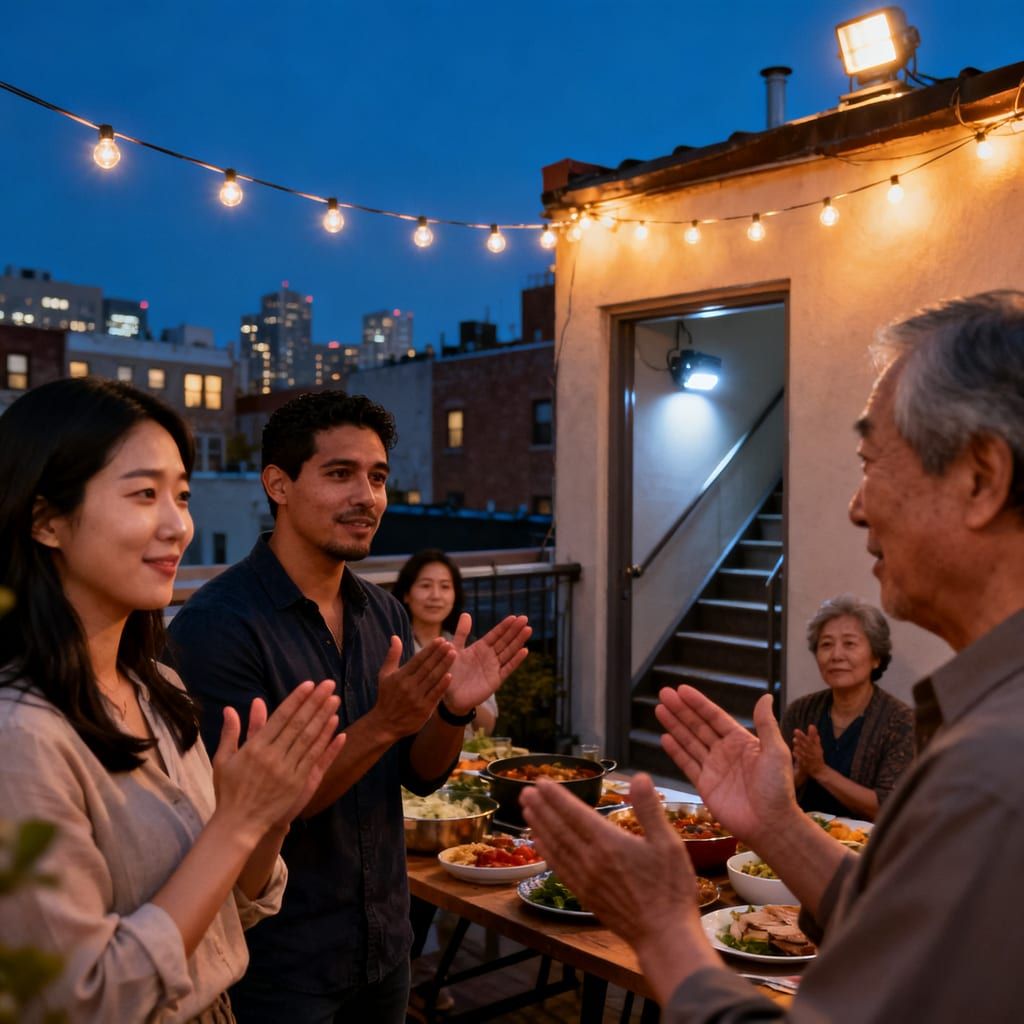
One evening a month into this, he invited me to a "silent potluck" on the roof. I climbed the last stairs with a bowl of strawberries and the nervousness of a transfer student. Under string lights, a circle of neighbors-Deaf and hearing-traded food and stories with their hands. The air held a soft electricity: the scrape of plates, the laughter that was visual first, sonic second. Someone signed a joke that rippled through the group with shoulders tipping and mouths opening in that quiet way joy opens them.
There was basil in the potato salad and cumin in the beans. The city's hum wrapped us like a long chord. Beside the ledge, a woman whose hair had gone white signed a story from childhood, her hands making fish that darted and rain that fell in silver. I watched the way everyone watched-bodies angled, eyes steady, small mm-hmms threaded through like knitting.
Later, Mateo led me to a tactile poetry night in the back of a bookstore, where poems were felt on the wrist like weather. I stood there, eyes closed, as a stranger's fingers spelled a storm. Another weekend, a Deaf-friendly dance swelled with bass that found my bones without asking. The floor trembled; our chests answered. I learned, without irony, to answer my mom's FaceTimes with my phone held lower so my mouth was visible, and I practiced saying, "One second," with a hand, not a shush.
I was learning, and it was not heroic. It was a slow clearing of fog.
One night, our conversation slid into a room I kept closed. The air on the stoop had the weight it gets after rain-clean, slightly metallic. My cat's fur clung to the cuffs of my sweater. Mateo asked about my family with an open palm.
I signed back-clumsy, careful-about my father. How he had always loved jazz records measured in feet of vinyl and Sunday phone calls timed to the laundry cycle. How the calls had thinned when his hearing did. How he'd laughed off captions at first, then turned them on, then stopped mentioning them, then stopped calling. Shame had threaded through our last conversations like fishing line. My signs broke, caught. I had to pause, palms up, a gesture I was learning meant: Wait with me. I'm searching for the word.
He nodded, the kind of nod that said he would still be there when I found it.
He reached into the small dark between us and taught me a sign that fit perfectly in my palm. STAY-fingers pressing into the air as if to say: remain, don't run, this is a place. He showed me slowly, and I repeated it until it felt like a promise.
We made a video in my kitchen with the fern and the sticky notes as accidental set dressing. Mateo stood where the light made my face even, and I signed a simple message to my father. "Hi Dad. It's me. I'm learning. I want to talk-with hands, or captions, or coffee. Stay."
We watched it back. The part of me that measured features and flaws softened at the sight of my hands speaking. I sent it with my thumb on the screen's trembling blue.
A week later, men in hard hats arrived with ladders and boxes that clicked like puzzles. They moved through the building with the competence of people who fit things to other things for a living. I stood in the hallway and watched a new strobe plate the wall with a metallic rectangle.
I texted Mateo to come see. He leaned against his doorframe, taking in the new hardware with a small, unreadable smile. I spilled about the emails I'd sent-the calls I'd made on hold music that looped. "I think it worked," I mouthed, habit now making my jaw clear and deliberate.
He lifted a shoulder. Then he unlocked his door and brought out a folder thick enough to fan. Inside: printed emails to the landlord dated months back. A letter from the city's accessible housing office, stamped and stamped again. Photos of the hallway taken on his phone with the date in the corner, the bare wall where a strobe should be. Notes from tenants up and down written in his ink, collected like signatures in a yearbook.
He tapped the city letter, then the strobe, then me, then his own chest. His hands said, gently, This has been in motion. He turned a page where my own short, urgent email lay clipped in the back like a latecomer to a long meeting.
Heat rose to my face in a way embarrassment always does-as a tide you can't argue with. I had believed my outrage had lit a fuse. I had wanted, perhaps, to be the kindling.
His hand brushed the air, casual as sunlight. "Together," he signed, index fingers meeting, then splaying outward with an easy grace. Then he pointed to the heaviest sign on the page: the city's. His fingers flickered: They finally listened.
The hallway felt new. The shape of what I had stepped into rearranged-less rescue, more welcome. He had not needed me to open a door. He had built the room and invited me in.
That evening, the strobes were tested. For one bright instant, the hallway filled with a white coin of light that blinked like a new lighthouse. I blinked back.
The night my father came to the potluck, the sky wore that early-summer navy that makes the city glimmer like a laid-out circuit board. He climbed the stairs slower than I wanted. We had texted first, then tried a call with captions that lagged just enough to be funny. His thumbs had punctuated each sentence too carefully, as if striking matches.
On the roof, I introduced him with hands and then voice. The circle opened to make room the way good circles do. Mateo greeted him, then looked to me, and I gave him my father's name sign-something we'd made up in the kitchen, a small record spinning over the heart.
We ate watermelon that leaked down our wrists. Lights strung between planters bobbed in a soft breeze. A toddler climbed into her mother's lap and signed MORE with a ferocity that required strawberries. My father's eyes took in the languages around him-English carried on breath, ASL carried on light-and I saw the exact moment he reached for it instead of stepping away.
I signed to him slowly, elbows tucked, not hiding the pauses. He mirrored me, hesitant but laughing when his F kept becoming 9. Mateo signed stories to him with calm patience, letting the arc of a joke land even if it took extra air. A teen showed my dad the sign for BASS with both hands hitting the chest, and he tried it, and the teen said, "Yes!" in a voice that was mostly applause.
As the sky darkened, the new strobes in the stairwell flashed their test in the distance, a pulse against brick. For once, no one flinched.
I stood between my father and Mateo, between sound and sign, between the woman who measured days by sprints and the one who now measured them by palms pressed and eyebrows lifted. The city spread itself below: laundromats humming, late buses sighing, somewhere a saxophone climbing a fire escape of notes.
My father touched my elbow. He signed STAY-tentative, dear. He smiled, and it was the old Sunday smile that belonged to the crackle of vinyl and the smell of coffee. It had always been there, just waiting for a language I'd never thought to learn.
When the breeze tugged at the napkins and someone passed a bowl, I reached out in thanks, and the circle caught the motion and returned it-hands lifting, faces bright, a rhythm I'd only just begun to hear.
Down the hall below us, a light blinked once more, then settled, as if to say: we are ready now. And under the strings of warm bulbs, our hands kept talking long after our voices rested.
A daughter learns to read between the lines of a life split in two
Read more →
A fog-draped night, two souls found, and the quiet shape of a life
Read more →
Story audiobooks for children of all ages — a new one every day on Smarter Way Stories.