Two Houses and One Quiet Heart
A daughter learns to read between the lines of a life split in two
Read more →
The stroller pitched toward the gap just as the train exhaled and the doors began to close. Noor's hand went out before thought, palm on the handle, shoulder braced against the rattling carriage. A sneakered foot behind him cursed under its breath. The driver dinged. Noor mouthed a sorry and held on until the back wheels bumped over the lip.
He missed the train. He watched the cars roar off, glanced at the dark reflection in the window glass - thirty-six, late again, shirt collar soft from too many mornings. He checked the time and didn't check it again. The mother nodded, breathless, hairline damp. 'Thank you,' she said, the vowels long, the stroller's canopy quivering.
'It happens to all of us,' he said. He read her relief as if it were printed. The platform wind came and went like a mood. His phone buzzed in his pocket; he let it.
It had started as a habit so quiet he couldn't hear it. Maybe it was his mother in Queens, pausing a long time between soup and spoon to look at neighbors through lace curtains and say, People need little things, mijo. Or maybe it was the way a city always had a corner where someone was stuck - a suitcase snagged, an elevator full, a wheel catching on a crack in the curb - and Noor believed motion should pause until the stuck person was unstuck.
He lugged a space heater up six flights in January for a woman with red hands and a short laugh. The hallway smelled like fried onions and radiator heat. At the fourth landing she said, 'You don't have to,' and he said, 'I already am.' Together they found the door that stuck at the top. He left before the thank you could find words, fingers smarting, breath up around his ears.
He stopped into the corner bodega for seltzer one afternoon and stumbled upon a ledger so full it made his own spreadsheets blush. The owner leaned on the counter with a pen behind his ear and diagrams in the margins. 'They say I should put things - what is it - online.' He said 'on-line' like a tightrope.
Noor pulled his laptop from his backpack and showed him how to take pictures that didn't look like ransom notes. He walked him through inventory like a poem, making columns into conversations. They ate gummy mango strips while waiting for an email verification. Business by business, the bodega learned to appear on phones as if it had always been there.
A tourist on the subway held a map like a life raft and asked the car, 'Is this Downtown?' It was a Queens-bound G. Noor said, 'Not for another four stops, but I've got you,' and he did his gentle choreography of pointing and smiling and leaning his shoulder so a couple could shuffle past. The tourist laughed when he realized he'd been going the wrong way for twenty minutes. 'That's a charming mistake,' Noor said, and meant it.
He stood at the cafe counter and watched the barista's hands shake over the milk pitcher. She looked nineteen, maybe twenty-one, with a nametag that said D. 'Double shift?' he asked. 'Triple,' she said. He showed her how to bold the verbs in her resume, to leave out high school trophies, to write the hospital's name like she already worked there. 'Front desk to start,' he said. 'People remember faces before they remember emails.'
He walked Mrs. Lin's dog during her double shifts at the nursing home, twice around the block, once around the sycamore that had learned to grow around a street sign. The leash handle fit his palm like a ritual. He nodded at other dogs. He scratched between wiry ears and listened to the click of a mouth chewing on a squeakless toy.
These were beads on a string. He did not call them that. He only walked from one to the next and stopped when someone struggled. He believed in the math of small kindnesses the way you believe in the MetroCard that pings you through the turnstile - not with faith, but with daily practice.
Months turned to years like the slow roll of a bus at a stoplight.
The mother from the platform found herself in a supermarket line months later, her child sticky with a purloined grape, her cart rickety again. The man ahead berated a cashier for moving slower than his impatience. 'You're stealing my time,' he spat. The mother stepped forward, steady in the ribs. 'She's doing her job,' she said, and placed her body between voice and target. The line adjusted around her like a school of fish.
The cashier, twenty with a braid like a rope, counted the remaining bills in her register that night. She thought of quitting. Instead, she found a 'Help Wanted' sign taped in the bodega window down her block and, later, far later, she remembered how the owner had once soft-stepped into her line to exchange a smile for a quarter. He hired her for nights after closing, showed her how to stock with quiet feet, how the back room could smell like hope and oranges.
The barista named D became Danielle at the front desk of a hospital in Cobble Hill, where the florescent lights made everyone look a little unreal. She wore a blazer like a borrowed word. Her first week, a man in a stiff suit barked about forms and lost time. She glanced down and saw the verbs she'd bolded, and she took a breath between them. 'I can help you,' she said, hearing in her own voice someone else's calm.
Mrs. Lin's neighbor borrowed the spare dog-walking key and pressed it into the palm of a gig worker whose rent skated the edge of due. 'Take the noon shift for a week,' she said. 'I'll say I sprained my wrist.' The worker nodded like swallowing a pill, and in that week, the wolfdog-who-wasn't grew to trust him, and he grew to trust days that ended without the panic of a door buzzer that might mean too much.
The tourist - French or Swiss, his vowels rounded like stones - posted a thread on a rainy afternoon about New York kindness: a man who'd rerouted him with patience, a woman who'd held a turnstile open with a laugh, a deli that threw in an extra pickle without asking. A reader three neighborhoods away, who built things in public for a living, sent a small donation to a park advocacy group with a note that said, 'Charging station by the B41 stop would change my commute.' Three months later, a steel pillar with tiny green lights appeared near Noor's bus stop. He didn't connect the math. He plugged in his dying phone and thought, Huh.
It was July when the sky over the city had that wet paper look - heat pasted on every surface, clouds not moving because the air had decided to sit down. Noor took the bike lane home because the subway was a kiln. His front tire hit a broken grate, the sound a hard clack that echoed in his teeth, and then asphalt came up and took his skin like it had his name on it.
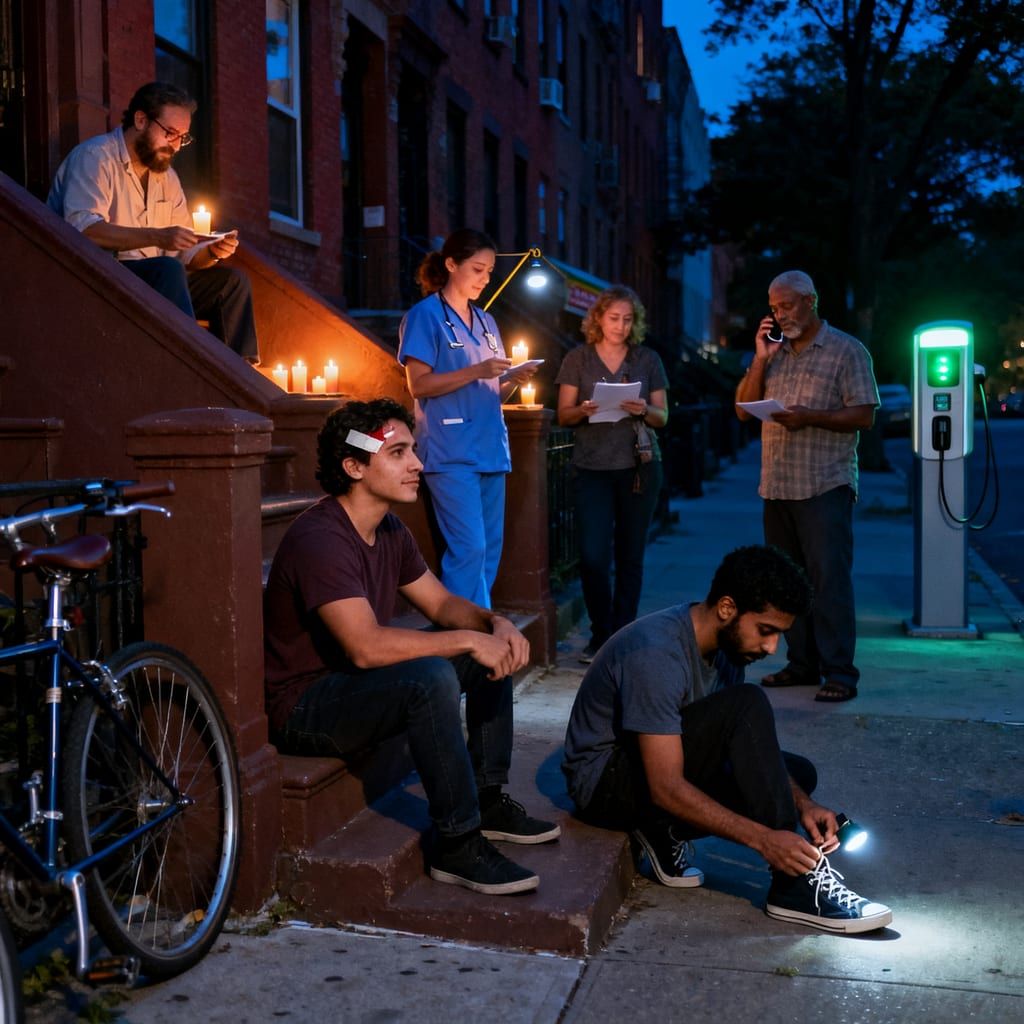
He lay on his back and saw a rectangle of white sky framed by a fire escape and a few leaves. His phone was a dead rectangle in his pocket. Somewhere, not near, a siren wound around a corner and went on without him. Traffic slowed to a sticky standstill as lights at the intersection blinked once and surrendered. A blackout rolled over the avenues like someone had simply decided to close their eyes.
A cafe owner locked his door with two clicks and turned to the street, squinting. He saw a man on the ground, a bike nesting in itself, and he recognized the hairline, the way the chin tucked. 'Hey-' he said, kneeling. He'd last seen this man hunched over his laptop, setting up online orders during the pandemic, showing him how to turn lattes into URLs when the front door had been a hazard. 'You're him,' he said, unnecessary and true.
A couple paused. The woman wore scrubs with small suns printed near the pocket. The man - whose coat Noor had once returned in a snowstorm, walking half a block shouting 'Sir! Sir!' with a dampness he never explained - knelt with the cafe owner. 'I'm a nurse,' the woman said, and Noor's laugh came out as a cough. 'I never get tired of that sentence.'
They lifted him with the care of people who had lifted many things. Someone passed a water bottle like a sacrament. A teenager with a skateboard ripped a sheet of paper from a notebook and wrote, in all caps, NOOR? INJURED. CALL ME. He stuck it with tape to a deli fridge that hummed in darkness.
'I've got a landline,' a doorman called across the sidewalk like throwing a rope. The cafe owner jogged to borrow it, dialing numbers remembered by hands. 'Do you know him?' he asked anyone who would listen. 'He's the guy who showed me how to do curbside.' A woman on a fire escape shouted down: 'The one who helped me carry my heater? On six? That guy?' News traveled the way it used to - mouth to ear, ear to mouth - and it had direction because people pointed.
By the time the nurse stitched Noor under the beam of a camping headlamp, the sky had gone from white to blue to the kind of deep where you see your own breath even in summer. He sat on a stoop with an ice pack crinkling like new bills against his temple. Someone delivered a casserole as if there were any part of him that hadn't been held yet that day. He recognized no one all at once. He recognized them in parts: a laugh, a jawline, the slope of a wrist he'd once steadied as a train door slid open.
'You okay?' the cafe owner asked. His own voice had emptied of coffee and filled with something older.
'I'm good,' Noor said, and this time when his phone buzzed to life off the charging pillar two days later, he let it. Names stacked across the screen like a list that had been waiting its turn.
A web thread appeared that week, posted by a handle with a picture of a dog in sunglasses. It was a map of green dots - a scatter of small beacons over Brooklyn and Manhattan, pulsing where someone typed in a moment a stranger had stopped for them. At first it was the nurse, tagged by the cafe owner: 'The guy from the pandemic - fixed his bike, stitched his head, still owes me a cappuccino.' Then the bodega owner: 'He taught me to post my plantains online. They got famous.' The cashier-turned-stock-clerk-turned-night-manager: 'He told my boss I was good with people. Turns out I am.' The tourist from far away, the neighbor with the dog, the mother whose child had long since learned to swing his own backpack over his shoulders.
The lines didn't all trace back to Noor. Some traced to the mother at the supermarket, to the cashier who'd learned not to flinch, to Danielle at the hospital desk who now took an extra minute to print a form in bigger font for an old man squinting. They moved forward, not just toward him. They made their own corners and crosswalks, their own paused distances.
Noor read for a while until the words blurred. He closed the tab. It was late afternoon, the hour when the city remembered what shade meant. He tied his shoes with the care of a person who had been unmade and remade recently, laces crossing like anything else that holds.
At the door, he hesitated. The sirens were fewer today, softer, like someone had turned the volume down on emergency. He stepped into the hall and thought of the people who had said his name through apartments and across streets, who'd made signs and texted landlines, who had lifted and stitched and stayed. He thought how none of it had been loud while it was happening. The city had simply paused, which in the heat of July felt both small and holy.
On his block the afternoon was an aquarium of slow bodies. At the station, past the new charging pillar with its green points of light, a suitcase wheel had wedged itself against a turnstile, angle wrong, handle bucking. The woman tugged, frustration like a shadow on her cheek. Noor's palm was already up before the thought.
He steadied the handle. He pressed the release with his thumb, that old choreography. The turnstile clacked in apology as the suitcase slid free.
'You're a lifesaver,' she said, breathless.
'It's not that dramatic,' he said, and smiled. He watched her go, then went, too. The train arrived as if it had only ever been coming.
A daughter learns to read between the lines of a life split in two
Read more →
A fog-draped night, two souls found, and the quiet shape of a life
Read more →
Story audiobooks for children of all ages — a new one every day on Smarter Way Stories.