Two Houses and One Quiet Heart
A daughter learns to read between the lines of a life split in two
Read more →
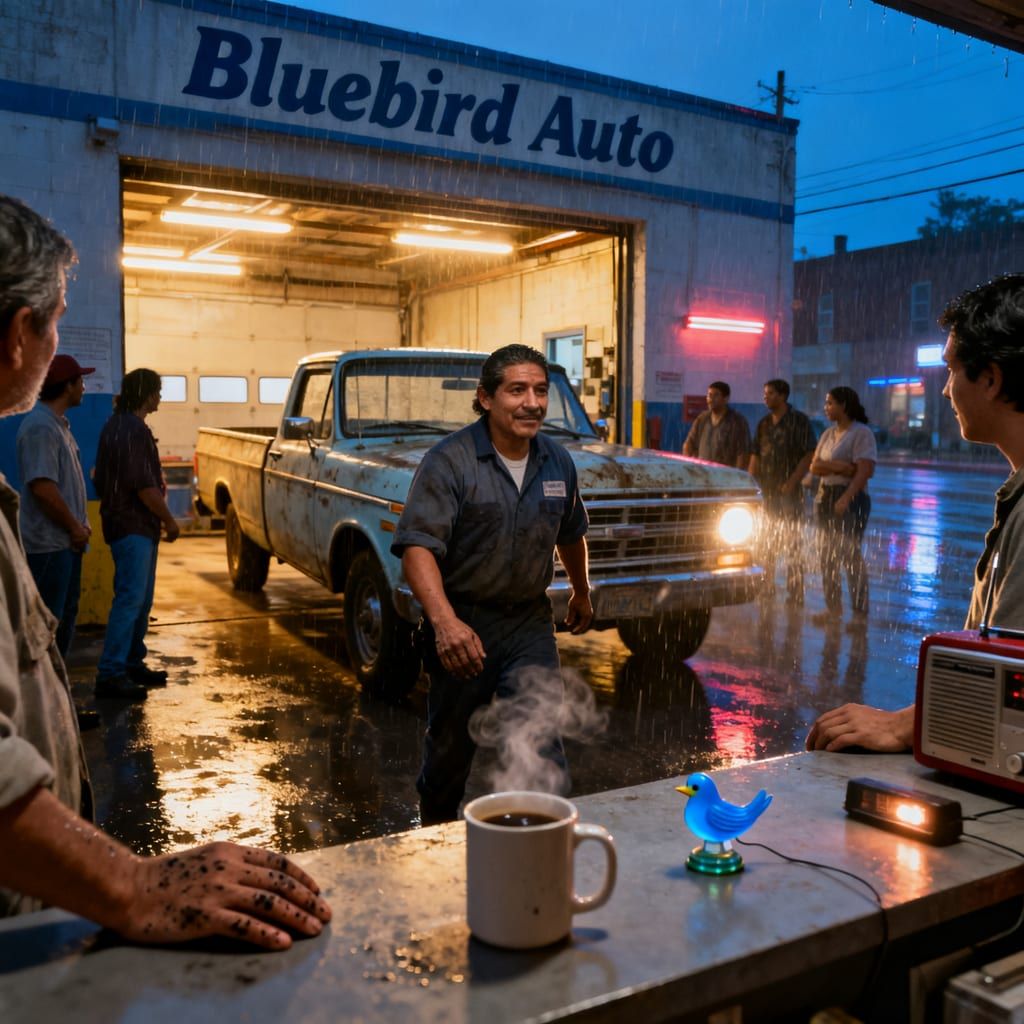
The rain stitched the morning together-fine, persistent threads that made the street shine like a fresh coat of thought. Inside Bluebird Auto, the coffee steamed in a chipped mug, the radio murmured an old soul station, and the roll-up door lifted with a sigh that sounded like relief.
Leo Morales touched the button with the heel of his hand and watched the gray day fold itself into the garage. He wore a navy shirt clean at the collar and blackened at the pockets. The smell was familiar as breath: oil, wet asphalt, the burnt-toast tang of an overworked alternator drifting in from somewhere he'd meet soon enough.
A bluebird air freshener dangled from a hook above the counter. A faded photo-curly-haired girl, wide as a laugh-was taped to the side of the tool chest. The coffee stayed hot. The radio stayed low. People came in heavier than they left, though most wouldn't be able to say why.
The rideshare driver came first, cap tugged down, shoulders bunched. His brakes skirled at the corner like shoes on a gym floor. He parked crooked, then straightened, then crooked again-an apology in reverse.
"Busy morning?" Leo asked, wiping his hands on a rag.
"Been busier," the driver said. "Brakes squeal. Passengers hate it. Tips drop." He didn't meet Leo's eyes. His phone jittered on the dashboard with new pings he ignored.
Leo slid into the driver's seat, listened the way a musician leans into a note. He tapped the turn signal. The rhythm wasn't right-hurried, uneven. He pressed the brake, heard the high, thin complaint that said metal was greeting metal, overdue.
"Pads," Leo said. "Rotors I can salvage. And your rearview's cracked. Surprised you haven't got a ticket yet."
The driver grimaced. "Didn't notice."
"You noticed," Leo said, gentle. "You just had other things to look at."
While the car lifted, Leo set a chair by the bay door where the morning light softened faces. He brought the man a Styrofoam cup of coffee and an old umbrella with a wooden handle in case he decided to smoke.
They didn't talk at first. The rain spoke for them-tap, hush, tap.
"My ex moved across town," the driver said finally, as if confessing to the rain. "Weekend visits now. Feels like I'm braking into her life. She's seven. She hates braking." He half-smiled. "Wants to go always."
"Stopping takes just as much courage as going," Leo said, tightening bolts in a rhythm that matched the radio. "More, sometimes."
The driver looked at the bay light as if it had turned warmer. When he rose to leave, his brakes no longer asked questions. He noticed, too, a new rearview mirror catching rain like mercury. From it hung a tiny bluebird.
"On the house?" he began.
"On the road," Leo said.
The executive arrived between calls, the car's idle uneven-like someone skipping stairs on the way down. He wore a watch with a face large enough to measure a life and a hoodie that tried too hard to be casual.
"Misfiring ignition," he said, not bothering with hello. "I have a pitch at two, a board at four, a thing at-" His calendar chimed, as if to underline the sentence.
Leo popped the hood. Corrosion clung to the battery posts in chalky blooms.
"How long since you've let this run without asking it to be somewhere?" Leo asked, fetching a wire brush.
The executive blinked. "What does that mean?"
Leo didn't answer. He scrubbed until the metal shone, then tested and tightened, his hands moving in sure, unhurried lines. He wrote something on a grease-smudged index card, then hesitated.
He tucked it under the wiper.
The engine turned. Caught. Smoothed.
The man exhaled like he hadn't known he was holding breath. His phone buzzed. He ignored it long enough to pluck the card and read: What are you hurrying past?
He stared at the thin block letters-the kind of writing you use when you're trying to be understood.
"I should-" he started, and for a heartbeat his eyes landed on the photo taped to the tool chest. He looked away, swallowed, and pulled out his phone not for email, but for a text. His thumb moved slower than usual.
"Thanks," he said, voice sanded down. "For the... brush." He lifted the card. "And this."
"Keep your terminals clean," Leo said, one corner of his mouth tilting. "They'll return the favor."
The young woman rolled in near noon, hair damp at the temples, Civic coughing out a rattle like a loose thought.
"It's time," she said, knuckles white on the wheel. "I'm selling it. I'm driving west before-" She stopped, bit the word off. "There's this rattle. Makes people think I didn't take care of it. I did."
"I can hear that," Leo said.
He pulled the dash, chasing the sound along plastic seams and old screws until the origin revealed itself not as a bolt or a clip but a thing that didn't belong: a cassette deep behind the panel, wedged like a message.
He turned it in his palm. Handwritten in purple ink: City Map, Mom.
He didn't say, I'm sorry. He didn't ask anything. He cleaned the dust from the tape with breath and the hem of his shirt and placed it in her hand like you put something fragile back where it belongs.
"The rattle's gone," he said.
Her mouth opened, closed. "I don't have a player," she whispered, eyes finding the bluebird above the counter as if it could answer.
Leo reached below the radio, pulled a small cassette player from a drawer labeled Misc, and threaded the tape in-no flourish, just quiet care. He pressed play.
A woman's voice filled the garage, warm and amused. "We used to call the bakery on Fifth the Cinnamon House," she said. "The man there gave you flour on your nose when you were little, like a blessing." The rain gentled. The radio hushed beneath a stranger's geography turning into a map of love.
The last story petered to waves and gulls and the soft knock of rigging. "End at the pier," the voice said, fading. "Dusk is best. Count the freighters like stars. We'll go again."
The young woman leaned into the sound as if it produced gravity. When it ended, she wiped her eyes with her sleeve and stood. "How much?" she asked, voice stitched back together.
"For the rattle?" Leo said. "Consider it paid for." He nodded at the tape. "Costs are what they are."
She laughed then, the kind of laugh you catch like a tossed set of keys.
Between cars, the shop grew quiet enough to hear the tick of the office clock and the cough of a storm-drunk gutter. Leo poured another coffee and looked, as he sometimes let himself, at the old pickup in the corner. Dust powdered its windshield. The registration stickers ended three summers back. A slip of mail-Final Notice-sat tucked beneath a wiper as if that could hide it from the day.
He lifted the hood once a month like a ritual. He closed it again without touching a bolt. He told himself it was a kind of penance. He told himself many things.
The photo on the tool chest curled at the edges. In it, his daughter's hair made its own weather. On the back he knew-because he had written it in a moment of specificity that felt like a promise-was the date of a recital.
He had worked late that night. He had fixed what he could fix. Then the terrible call, the intersection at dusk, a driver whose light had gone red.
Sometimes, engines stalled at the right time. Sometimes, they didn't.
Near closing, a city sedan pulled in, coughing like a confession. The inspector stepped out, hat in hand-same man who'd waved a citation last spring, clucking about permits and drainage.
"Afternoon," he said, voice lower than Leo remembered. "Thought I'd bring this by before it leaves me somewhere worse." He tried a smile. It failed. "Wife is-uh, we're waiting on results. House is too quiet. Can't stand the thought of stalling."
Leo nodded. He lifted the hood, listened. "Coil," he said. "Number three." He swapped it with number one and the engine stuttered differently, confession corrected; then he pulled a new coil from the rack, the motion practiced as breath.
He tightened what was loose. He ran a hand along the fender as if smoothing hair. He closed the hood with care.
"Sometimes a stall is the car's way of keeping you from the worst intersection," he said, meeting the inspector's eyes. "I've learned to respect a stop."
The inspector swallowed. "I've learned to fear them."
"Different lessons," Leo said. "Same road."
When the man drove off, the cough gone, he lifted a hand at the door and didn't look back. The rain had thinned to mist. The light outside had gone blue and clean, like the first breath after a sob.
Leo wiped down the counter. He turned the radio lower still. He stood by the old pickup the way you stand at a grave you keep visiting because language won't do the work.
He pressed his palm to the hood. In the metal's cool curve, his reflection blurred. He could pretend it was his daughter's, if he didn't wear his glasses. He could pretend anything in that soft light.
He turned the key half a thought, then let it go.
The street outside filled with sound-quiet, then swelling. Tires whispering. Door hinges. Voices not trying to be confident.
He stepped to the bay and saw them: the rideshare driver with his new mirror catching dusk like a coin; the executive in his hoodie, phone pocketed for once; the young woman with a cassette in her palm and her jaw set like a small ship's prow; the inspector, hat damp; and behind them a constellation-neighbors and customers whose cars he'd steadied, whose names he always remembered on the second try.
No one made a speech. Someone lifted a pizza box like an offering. Someone else set a crate of socket wrenches on the floor with a clatter that sounded like possibility.
"Evening," the driver said, as if they lived here and had always done this. "Heard you might need a hand."
Leo opened his mouth, then closed it. He looked at the truck. He looked at their hands.
They rolled the pickup into the light, rain beading on dust and making constellations. The engine was a body at rest. They made a circle around it without planning-a geometry of witness.
"Plugs first," said the young woman, surprising herself. "And, uh, I can hold the light."
The executive took off his watch and set it face down on the counter, time willingly blind. "Battery," he said. "Terminals." He reached for a brush.
The inspector found the coil pack and tapped it like a greeting. "I know a cough when I hear it," he said, half-smiling.
Leo handed out wrenches the way a priest passes bread. He let other hands work. He listened-metal on metal, breath in unison, the soft language of people who mean well.
"Ready?" the driver asked, palms black, grin white.
Leo slid into the bench seat, the vinyl cold where memory had kept it warm. He curled his fingers around the key. The radio was off. The street was a held breath.
He turned.
The starter spun, caught, stuttered. He turned again, foot steady, eyes open. The engine trembled like someone considering the truth.
Then it came alive-not loud, not triumphant, but even and willing, a heart remembering its job. The bluebird above the counter turned on its string in the draft and faced the door.
No one cheered. They let the sound do the speaking. The executive put his hand on Leo's shoulder. The young woman set the cassette player on the dash where it could keep telling a map. The inspector adjusted the idle and nodded to himself.
Leo looked at them-their faces lit by the soft engine glow, rain polishing the night beyond-and felt something rethread in him, a small screw finding home. He didn't call it forgiveness. He didn't name it.
He only listened.
The coffee on the counter had gone cold, but the room felt warmer than morning. Outside, the blue hour held. Inside, the radio came back up a notch on its own, as if deciding the silence had done enough work.
When he finally switched off the lights, the street kept its shine. Engines turned and faded into the city like good advice taken. The bluebird swayed, then settled, as if choosing a direction and trusting the wind to do the rest.
A daughter learns to read between the lines of a life split in two
Read more →
A fog-draped night, two souls found, and the quiet shape of a life
Read more →
Story audiobooks for children of all ages — a new one every day on Smarter Way Stories.