The Thread Between Unfamiliar Kin
Pieces of a puzzle, chosen into shape
Read more →
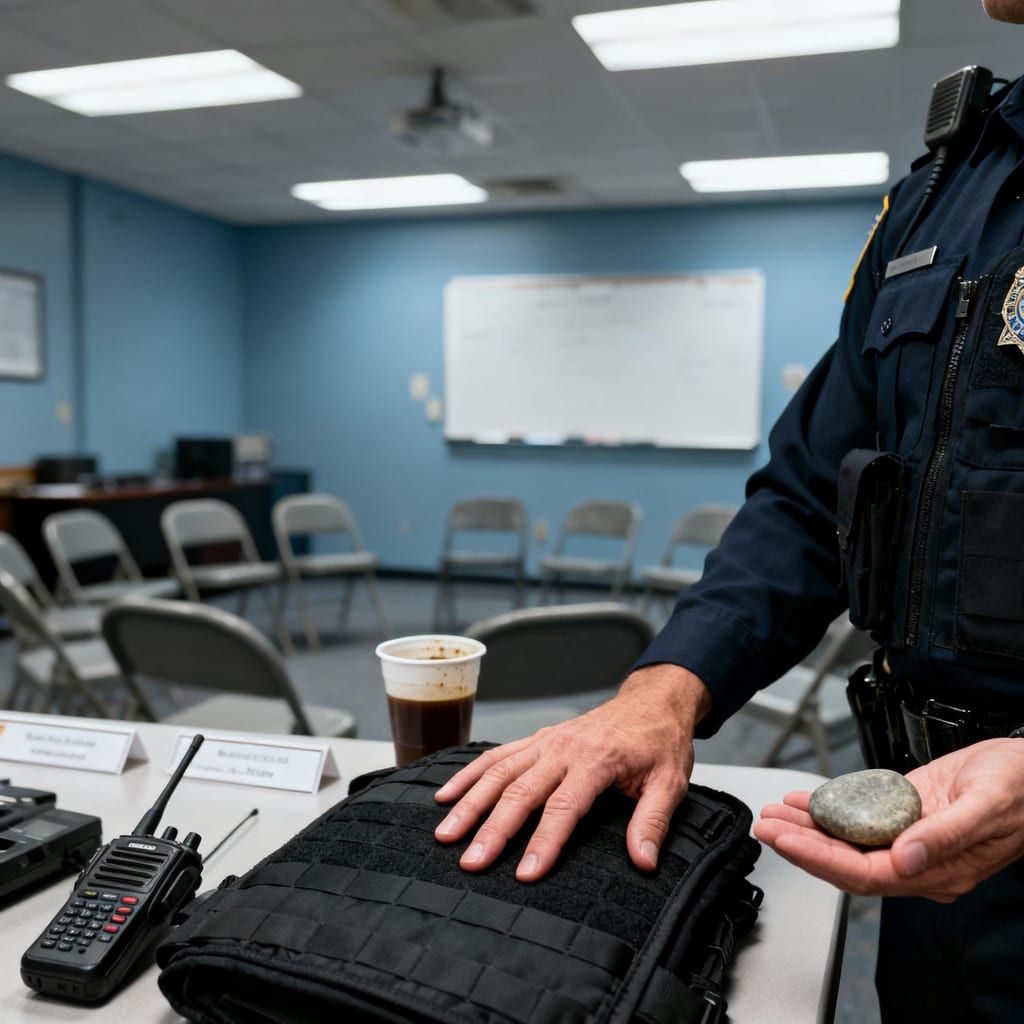
The first thing Lena noticed was the hum - fluorescent lights filling the training room with a thin, nervous frequency. The coffee on the side table had a shine like engine oil. Chairs scraped concrete like a small argument.
She set her bag down and took her own three breaths before anyone arrived. Hand on her sternum - where a vest would be. Feet planted. The floor held. The air went out and came back.
They trickled in under the same weather: folded arms, joke armor, eyes that had seen too much and refused to blink first. A whiteboard on wheels, someone's Sharpie cartoon of a cruiser grinning.
"I'm Lena," she said. "We're not doing bliss."
A snort from the back. "Tragic," said a man with forearms like cable and a haircut that looked like a dare. His nametag read MADDOX.
"We're doing three breaths that fit inside a shift," she continued. "Hand on your vest, feel the weight. Notice your feet. That's it."
A rookie kept checking his phone with an anxious thumb, screen lighting his face every twenty seconds. A sergeant with a round belly and a stone jaw sat in the front row, expression smoothed to unreadable.
Lena held up a square of felt. "Your radios will crackle. The door might bang. We'll work with it."
She showed them. Hand on chest as if on Kevlar. Pressure, warmth. The floor pushing back. Breath like tide just reaching the shore and sliding away again.
"Why the hand?" Maddox asked. He leaned back like he already had his answer.
"Because your body believes touch sooner than it believes words," she said. "The hand says we're here."
"Some of us would like not to be," someone muttered.
They laughed, the sound metallic but loosening. She smiled and didn't try to fix it.
By the second week, the room knew how to settle half an inch faster. Stale coffee, buzzing lights - but fewer chairs screeched. The rookie still glanced at his phone. The sergeant still stone-faced. Maddox still performed his skepticism like a bit he couldn't quite retire.
"I'm not into crystals," he announced, watching her lay out smooth river stones like humble planets.
"These aren't crystals," she said. "They're weight."
Phones vibrated like small hearts. Radios hissed and clicked.
"Hand on vest," she said again. "Feel the weight. Notice the floor."
Firecrackers popped outside - a staccato that was never simply celebration in this part of the city. Maddox froze mid-laugh, mouth open, knuckles going bloodless against the chair. Someone reached for a radio. The rookie jolted so hard his phone clattered under a table.
The air went thin for a moment - then thinner.
Lena didn't raise her volume. "Stay," she said softly, talking to their bodies as much as to them. "Hand on vest. Feel the weight. Notice your feet. Three breaths in all that noise. Inhale one - count it. Exhale - count it."
A radio spit a code she once could have translated on instinct. She let it pass through.
"Inhale two. Feel the fabric. Exhale two. The floor is the same."
The pops fizzled away. The rookie's shoulders dropped a centimeter. Maddox's jaw unlocked. The sergeant blinked.
"Inhale three," she said, "with the sirens coming or not. Exhale three."
No one spoke for a length of time that felt like respect.
After, they moved through the rest of class like people climbing down from a roof in the dark - careful, a little stunned to be alive.
They lingered, packing slowness into their bodies as if it were contraband. Maddox waited by the door until the others had filed out, making a show of tying and untying one bootlace.
"That noise," he said. His mouth tried a smile then decided against it. "Took me back."
She waited.
"I almost fired my weapon at a kid," he said, each word a footprint on thin ice. "Phone in his hand. Night like a bruise. He lifted it, and I saw a gun that wasn't there."
"What happened?" she asked.
"I didn't shoot," he said. "He ran. Dropped the phone. Cried like I'd broken him anyway." Maddox looked at the floor, then at his hands. "The almost - that's what wakes me at three." He rubbed his chest where a vest would catch a breath. "Your count... it was like someone turned the volume down one notch. Just one. Felt like a miracle."
She had worked nights where her voice had to be a rope. A girl whispering from a closet while footsteps went past. A man wheezing through a heart attack, his dog barking into the phone. She'd learned to keep her own shaking in her calves where the caller couldn't hear it.
"Three is enough sometimes," she said. "It doesn't have to be forever."
He nodded once, like a truce.
By week four, no one made a joke when she pulled the river stones from her bag. They were dark and cool, the kind of smooth you want to keep in a pocket. She passed out a slim marker.
"Write a word you never say out loud," she told them. "Hold it. Don't argue with it."
A chorus of uncapped markers - tiny clicks like rain. The room smelled faintly of solvent and the sweat of men who'd stopped pretending they weren't sweating.
Maddox printed something with large, blocky care and flipped the stone over, face down. The rookie stared at his stone for a long time like it was a test he hadn't studied for.
They breathed. Hand, vest, floor. Words hidden on their palms, heat leaving dark ovals on the stones.
The door opened hard enough to flex the glass. A young officer stepped in - uniform skewed, eyes wide and hollowed. The room's attention turned like a school of fish.
"In here," the sergeant said, voice even.
The young officer - the rookie's rookie - sank into a chair. His hands shook like they were remembering a different person. His radio was silent but still loud in the way silence is after alarms.
"Call didn't go," he said to no one in particular. "Infant. We did-" His mouth wouldn't make the rest.
Lena didn't stand over him. She pulled a chair beside him, lower than his fear.
"Hand on vest," she said, quiet enough to be a secret. "Feel the weight. Notice the floor. Three breaths in the room where it didn't go."
He tried. The first inhale was a broken wing. The second held. The third went in and came out as a low sound he probably wouldn't have let anyone hear if he'd had more strength.
His fist around the river stone was white. He opened it by degrees to show a single word: Helpless.
No one corrected him. Chairs made a soft map around him. The room's breath got sturdy enough to carry him for a minute.
Lena felt something in her own chest unclench - not release, not forgiveness, just the acknowledgment of a hand gripping a stair rail at last.
That night, walking home past the laundromat where every dryer was a porthole of light, she realized: she'd been carrying a word too, unmarked but heavy. Years ago, a child's whisper had threaded her through a call where sirens found the address too late. Since then she'd heard footsteps when there were none, phantom urgency always the next room over.
They were halfway through the pilot when she told them. The admission arrived as cleanly as a weather report.
"I hear footsteps sometimes," she said, palms open. "Empty hallway, empty apartment - I hear running."
No one moved. The sergeant's face made a new shape, almost soft.
"I was a dispatcher," she added, for the ones who hadn't read her bio. "My job was to keep people breathing until you arrived. Sometimes you didn't. I carried those rooms with me like spare houses in my lungs." She smiled without her teeth. "Your breaths - these three - are the first thing that's made the footsteps fade."
A silence that wasn't avoidance opened in the room. It felt like a circle with her inside it for once, not just at the edge holding a rope.
Maddox cleared his throat and let the stone in his palm turn over: Guilt.
The sergeant's hand found the table twice before settling. His stone read Father.
The rookie's was small handwriting, crammed near the edge, like he'd tried to make himself less: Fraud.
They put the stones back in their pockets, not to hide them but to keep them as ballast.
The pilot ended the way good weather does - not with a speech, but with a day that simply felt less heavy. They made a loose circle and didn't stand on ceremony. No certificates. No motto printed on a banner. Someone brought in cut oranges, and the room smelled briefly like summer breaking through.
"Three breaths," Lena said. "That's all we promised."
They bowed their heads without being asked. The rookie's phone stayed facedown. The sergeant's arms unfolded. Maddox - hands open. They inhaled together, and in the exhale was a city's thin, stubborn hope.
A week later, she found the note slid under the community-center door, curl at the corner like a tongue.
Ortiz -
Used your thing at a stop. Guy was wired, I was tired, my hand was doing a thing my head hadn't caught up to. Three breaths, hand on vest, floor, count. My hand moved away from the holster like it belonged to someone better. I don't want to quit anymore.
She read it once leaning against the doorjamb, then again sitting on the cool linoleum, shoes off, feet bare to the floor she kept telling everyone to feel. She pressed her palm to her chest and felt a pressure not of fear but of something like reprieve.
In the months that followed, the changes didn't arrive in parades. They showed up the way mornings do - a little lighter, then a little more.
The logbook in the precinct showed fewer sick days, a margin note here and there: slept, finally. A domestic call ran its course without anyone shouting - an officer later told Lena he'd pressed his palm to his vest in a kitchen that still smelled like last night's onions and counted with the radio crackling in his ear.
At a protest that leaned toward a boil, the rookie touched his partner's shoulder. "Vest-breath," he said, and they stood in the ribbon of shade cast by a bus stop, three inhales while a hundred different angers washed around them.
The sergeant who never spoke much led a mother through five steady breaths at a crash site, his voice so gentle it surprised the younger officers and himself.
And Maddox - the man who used to fill the quiet with jokes - started filling it with space. He laughed, still, but there was a pause behind it, a choice. He stopped buzzing his own edges just to feel alive.
Lena found her own evenings changing. The footsteps that had stalked her hallway dimmed to creaks she could name - pipes, settling wood, her upstairs neighbor's late-night water glass. She slept sometimes with the window open and didn't startle at every siren.
On a Tuesday, a man in line at the bodega shouted into his phone, and she didn't feel her body rise like a dog to a whistle. She felt her feet and the sticky tile, and her mouth filled with the taste of mint gum and the smell of overripe bananas, and she breathed the way she'd taught them to, the way they'd taught her right back.
A city is a chorus of emergencies and almosts. The miracle was never in the silence; it was in the way they learned to tuck breath inside the noise - a pocket of weather they could carry into any room.
When she thought of the pilot now, she didn't picture the fluorescent lights or the stale coffee. She pictured hands lifted briefly to chests, eyes softening mid-habit, the invisible thread of counting that stitched them into the present long enough to choose again.
On nights when the sirens rolled low down the avenue, a sound as familiar as her own name, she listened for the moment they passed. Her breath went out and came back.
Quiet enough to hear a city deciding not to break itself for once.
And inside that quiet, Lena returned - not to the rooms she'd carried, but to the one she was in, feet on the floor, hand on her heart, exactly here.
How we stand beside one another when the answer won’t fit in a sentence
Read more →
Story audiobooks for children of all ages — a new one every day on Smarter Way Stories.