Two Houses and One Quiet Heart
A daughter learns to read between the lines of a life split in two
Read more →
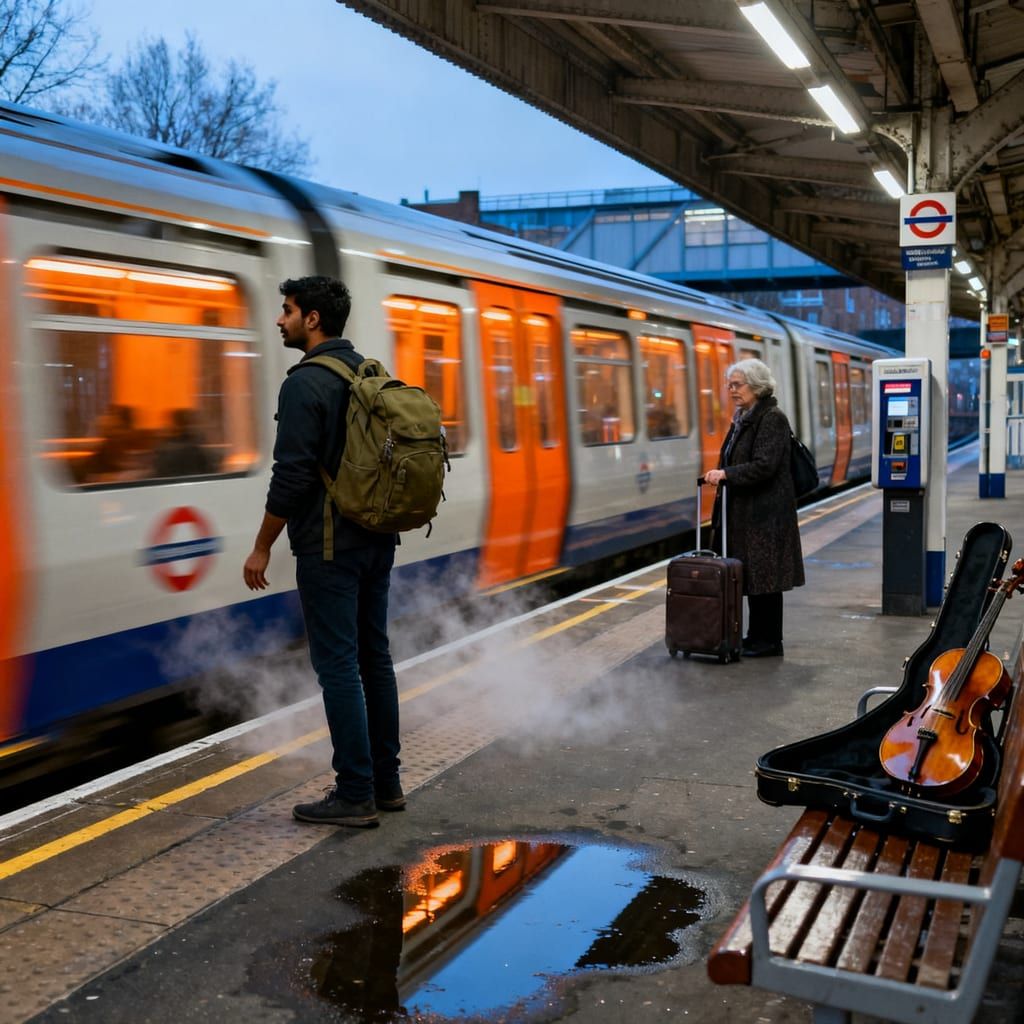
The doors blinked their indifferent orange and scissored shut an arm's length from his chest. A blur of faces behind the glass, a smear of fluorescent light, the train slipping away like a sentence he couldn't catch.
Arjun stood on the Overground platform, breath fogging in the early chill, hand still out as if the doors might pity him and reverse. They didn't. The carriage windows became mirrors. In them he saw himself: thirty-two, the kind of tired that coffee didn't negotiate, shirt buttoned wrong at the wrist, a neat olive rucksack that had felt like a promise when he bought it.
He let his arm drop. A soft announcement droned; somewhere near the stairs a pigeon hopped like it had plans.
Shame arrived as a hot coin in his throat. It wasn't the train. It was the pattern-rushing and still late, careful and still off-balance. He texted the recruiter: "Running behind-can we push 30 mins?" The reply pinged-polite, brisk, not actually accommodating.
By the ticket machines, an older woman battled a rolling suitcase with a mind of its own. The wheel caught the lip of tile, jerked sideways, and the handle snapped down with a clack. She muttered, short and precise. The machine spat her card out with bureaucratic disdain.
Arjun hesitated, because he always hesitated before being decent-then hated himself for the hesitation.
"Let me," he said, stepping in. "The tap needs a pause. It's dramatic like that."
She smiled at the joke as if he'd given her a stool to stand on. He guided her hand, waited through the beep-beep-please-wait that never sounded patient. The ticket printed. He righted the suitcase, wedged the wheel back into its bracket with the heel of his palm.
"Bless you," she said, voice softening. "I would've thrown the thing on the tracks."
"You and me both," he said, and surprised himself with the warmth in it.
When she shuffled away, he found himself on a metal bench that had absorbed the night's cold. Beside him, a violin case rested between a pair of scuffed ankle boots. Their owner-late twenties, hair tucked into a faded beanie-watched her phone's cracked screen breathe its last.
"Do not die on me," she murmured, London in the vowels but seasons of elsewhere in the consonants.
Arjun cleared his throat. "Battery?" he asked, holding up his charger, a slim grey brick he'd once justified as essential on a tax form.
She looked at him like a problem had just, improbably, solved itself. "You're a saint."
"I'm a man who missed a train." He offered the cable. "Arjun."
"Amaya," she said, already clipping the cable in, relief easing her shoulders. "You're saving my set list. And my dignity."
They fell into the quiet of people sharing something small and practical. The platform thinned. December breathed under their coats.
"You play here?" he asked, nodding at the case.
"Between places," she said. "Busking after rehearsals. Side gigs to fund the thing I actually care about."
"What's the thing?"
"A community arts nonprofit. Music in clinics and shelters. Sounds fluffy, turns out to be logistics and permission forms." Her smile was quick, not apologetic. "We're not selling a dream. We're building a timetable."
He liked the unshowy certainty of that. "I build things too," he said. "Screens, mostly. Flows. Buttons that are meant to feel like doors."
"Designer?"
"Product designer. Recovering from caring too much about things that didn't care back." He winced. "That sounded more poetic than I deserve."
"It sounded true." She checked the donation page on her phone and groaned. "And this-sorry-this button that is meant to feel like a door? It's a wall. The 'Donate' link's been chewing people's cards. I keep getting DMs like I'm scamming them. I'm not."
He took the phone, reflexes inside him waking like a dog hearing a key in a lock. He scrolled, tapped, saw the bug in the black-and-white of it: the redirect loop, the currency format, the missing callback. "Your payment processor updated," he said. "You probably unchecked a thing and it exploded a hundred small ways."
"Can you-" She paused. "I can pay-"
"No." He shook his head. "This is a two-minute fix. I've missed the 8:12. Time's suddenly cheap." He tethered his own phone, thumbed through the backend with the patient speed of someone who'd broken these things enough times to respect them. The platform hummed. A gull wheeled above the tracks like a piece of loose paper.
Amaya watched him work without hovering. "There's a local grant night this evening," she said, casual. "Near Dalston. Small money, five-minute pitches, room full of people who remember your name because there's no green room to hide in. You should come."
He laughed. "I have a final interview. Health-tech startup. Lots of equity, lots of verbs." He heard the cynic in him and flushed. "Maybe I should be grateful."
"Maybe," she said. "Or maybe you should see who claps when you aren't selling anything."
He hit Save. The button turned a truer shade of blue. He pinged a test donation; it sailed through, breezy as a sigh. "Fixed," he said, watching her eyes round at the confirmation email that arrived like a clean note.
"Saint," she repeated, and this time it sounded like a benediction, not a joke.
A new train thumped in, doors punctuating the platform with little exhalations. They rose in the same beat. He handed her the charger.
"Keep it," he said.
"I have to give it back," she countered. "Come tonight."
Arjun looked at the orange line on the overhead map, the way it branched towards his part of the city. His thumb hovered over his phone. Fate or cowardice-he couldn't tell. He typed the recruiter: "Apologies-can we reschedule? Family matter." The lie laid itself down like a rug over a spill.
He pocketed his phone and followed the white arrows to a different train.
The community hall near his flat smelled faintly of boiled kettle and floor polish. Folding chairs dug into his back with honest, municipal conviction. A corkboard near the door glittered with flyers: choir call-outs, a secondhand pram for sale, a lost scarf drawn with a child's conviction.
Amaya waved from a cluster near the back. She'd changed into a black dress that made her look like someone who had decided on a color because there were decisions that mattered more.
"Five minutes each," she said. "No slides, no fireworks. Just tell us what's broken and what you're mending."
He hadn't planned to pitch. He'd brought a notebook because notebooks suggested he wasn't a person who had stumbled in. But when they called for last-minute additions, his arm was in the air before his doubt woke up.
On stage, the mic smelled like other people's breath and peppermint. He didn't sell. He explained: months ago, in a waiting room where the clock hid behind a fake plant, he'd watched nurses shuffle paper with the despairing efficiency of people who couldn't afford inefficiency. He'd sketched a triage tool on a receipt, then forgotten it in the churn. A small thing: OCR for handwritten referrals, a tag system that matched forms to urgency with less cursing, a dashboard that released an hour from a day like a small miracle you could prove.
He said the word clinic and three heads in the second row came up as if someone had called their names. He didn't use the word disrupt once. He used the words help and boring and works on a cheap laptop.
People nodded. Not the nod that says yes to please you. The nod that says yes because the thing you said fits a problem they stepped over this morning.
When he finished, the room clapped in a warm, municipal way. Someone put a cheque in his hand that wouldn't pay a month's rent but would cover a domain, a few late nights, some takeaways. Three clinic directors pressed cards into his palm, the paper thin and important.
He walked out under the sodium glow with his heart quieter, not louder. It felt like oxygen. Steady. Unsurprising.
January edged in with the white breath of trains and the soft rasp of gloves against a keyboard. Arjun coded at odd hours. He joined Amaya's nonprofit for Saturday mornings that smelled like damp coats and instant coffee, tuning the app in the corner of a church kitchen while she rehearsed with a violinist who'd borrowed a bow and a kid who'd brought a drum no one had sanctioned.
He sat in a clinic office with a space heater aimed at his shins and watched a nurse tap through the interface he'd designed. "It's... not awful," she said, which landed like a champagne cork. "If you can make this button bigger, I'll name my next child after you."
He laughed and made the button bigger. He learned which screens asked questions at the wrong time and which needed silence. He noticed his shoulders spreading away from his ears. He slept.
Amaya chased forms and funding and rooms with radiators that worked. She texted him pictures: a row of toddlers banging mismatched percussion instruments with surgical focus; an older man crying quietly while a cello swam through a hymn. "We're not changing the world," she wrote once. "We're changing the hour."
He kept the charger she'd insisted on returning in his bag, its scuffed corner like a private joke. They learned each other's coffee orders. They didn't call it anything.
In late March, his phone exploded with messages like popcorn.
You dodged a bullet, one friend wrote, attaching a link. Another: Are you seeing this? Mate?? A third: Good thing you're bad at trains.
He clicked. The health-tech startup he'd nearly joined had detonated in public-investors backing away like a tide, a thread of screenshots unraveling into a noose. Manipulated outcomes, contractors unpaid and tweeting their receipts, a non-compete so vicious it trapped people in legal amber. Photos of a beaming founder under a headline that felt like a quiet rebuke to charisma.
He read the article on a bus with the upstairs nearly empty, morning light shearing over the Thames like someone had unrolled a ribbon. Relief arrived like a bad joke that was also true. He'd rescheduled the interview and never rescheduled it back. His calendar had simply grown around the absence.
He didn't call it fate. He texted Amaya: "Remind me to thank your broken donation page." She sent back a photo of the charger, staged on her palm like a reliquary.
That night, he stood in the clinic as a nurse showed him the hour they were getting back. "We close on time," she said, blinking as if the sentence needed proving. "I go home and the sky's still light." She looked at him, then at the screen. "It's not dramatic. It's a thing that works."
He nodded. The word dramatic had been a currency for too long. He was glad to be broke.
Months later, he still used the Overground, still missed the odd train. The platform's paint flaked in the same slow, municipal way. A gull still played the fool with a crisp packet.
He had meetings in rooms with hot radiators and mugs that didn't match. He had a tool that saved nurses an hour a day and gained a new feature because someone texted him a photo of a form he'd never seen before. He had evenings that were not breathless. He had the steadiness of weekends that did not arrive like ambulances.
Sometimes he would glance up as the 8:12 slid past, doors closing with their small, practiced sigh. He didn't ascribe anything mystical to that day. He credited the smallness of it: a missed door; an older woman's suitcase; a battery pack with its scuffed corner; a flyer on a corkboard; a cheque that didn't bounce; an email that was answered with a yes.
He met Amaya at the hall one Sunday as rain worried the windows. She tuned her violin with the gravity of a surgeon. "You okay?" she asked, catching him looking like a man who'd remembered an old version of himself.
"I'm-" He searched for a word that wasn't grateful in the way greeting cards are. "Aligned," he said finally.
"Good," she said, and smiled like a metronome finding the right tempo. "We start in five."
They stepped into the small bright of a room that asked for less than it gave. Outside, a train pulled in, paused, and left, on time and unremarkable, carrying people toward lives that would tilt for reasons they might never notice. Inside, they began.
A daughter learns to read between the lines of a life split in two
Read more →
A fog-draped night, two souls found, and the quiet shape of a life
Read more →
Story audiobooks for children of all ages — a new one every day on Smarter Way Stories.