Two Houses and One Quiet Heart
A daughter learns to read between the lines of a life split in two
Read more →
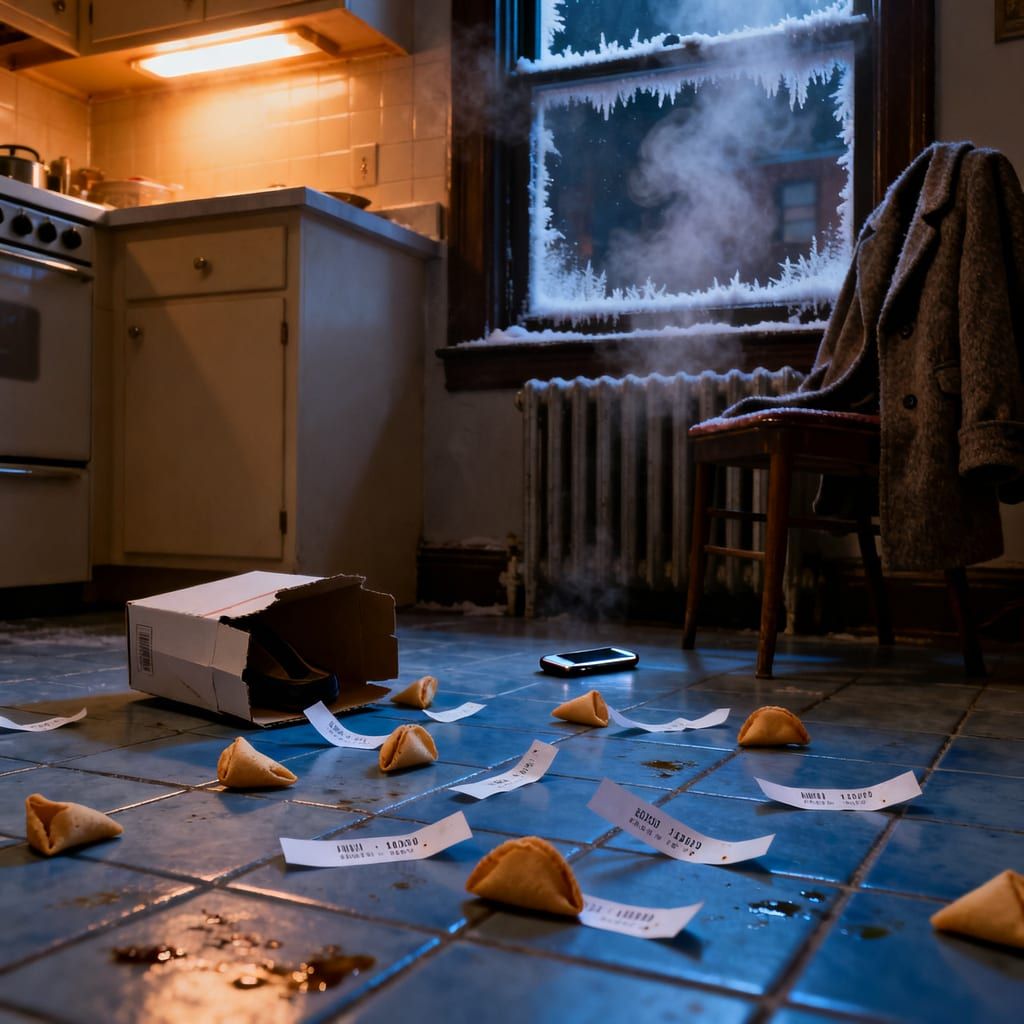
The shoebox hits the kitchen tile with a slap that sounds like a door deciding something. Paper flurries up, slips catching the under-cabinet light, drifting like blunt snowflakes over the rug and the mat and the toe of Nora's left boot.
It is late. The radiator hisses without warming much. Her phone still hums on the counter-two messages above the wrist-high pile of takeout menus: one from HR with a subject line that flattened her afternoon, one from Michael, eight words long, tidy as a receipt. She silenced it, then, for once, put the phone face down.
Nora sinks to her knees. All the fortunes she has kept since college wink up from the floor. Some edges are glossed with old sesame oil. Some are soft at the fold where her thumb has learned their words by heart. She cups the mess like a snowdrift and laughs-a single, surprised sound-when the laugh wants to be a sob.
She begins to pick them up. Muscle memory sorts them into stacks: hope, joke, platitude, almost-prayer. In the quiet, she notices what she has never really seen. By the bottom corner of the print-so faint it looks like a shadow-there are tiny batch symbols, little moons and triangles and asterisks, and along the edge a run of minuscule numbers, as if a printer whispered to itself.
She holds two slips close. Asterisks on both. Oil smudges like thumbprints in the same place, as if someone had turned a lot of cookies with the same hand. She lines three, then five, then eight of them up by code. Read in order, they stumble into a kind of cadence.
"Reach out with warmth; the world answers."
"Return what isn't yours, and something returns."
"Old doors open when you see them as doors."
They aren't predictions. They sound like someone on a porch, speaking calmly to a child who has dirt on her knees. They sound like a voice I almost know, Nora thinks, and feels ridiculous and steadier at the same time.
Outside, Chicago is blue with cold. On the window, a crust of frost feathers inward. Her coat hangs from the back of the chair the way it does when she is pretending she won't need it again tonight. She looks at the three slips. Her phone turns its face up by itself when another alert trembles through. She ignores it.
She puts on her coat.
On the stairwell, her breath washes the unpainted rail. The hallway light hums with a filament's stubbornness. Nora tucks the first slip into her pocket and thumbs through her contacts until she reaches a name she hasn't pressed in months: Devin-the intern who used to hum absentmindedly while he aligned pixel grids beside her, who worried out loud about rent and whether the office LaCroix counted as water.
Her text is simple: "Hey. You okay?"
It bubbles. It does not bubble. She's halfway down the block, snow chewing under her boots, when his reply lands.
"No. Also yes? Got laid off today. Thought no one would notice." Then, like a breath he's been holding: "Thanks for pinging me."
She stops under a streetlight. Yellow light pools at her feet. "Want to talk now?"
"Please."
They keep it to ten minutes, because her face is going numb. Devin's laugh is thin, like a string plucked once, but it's a live thing. When they hang up, she can feel the shape of his relief in her palm as if she held it there. It is small and unexpectedly warm.
She takes the second slip from her pocket. "Return what isn't yours, and something returns."
In her front hall, a hand cart leans against the shoe rack like a tired uncle. She borrowed it two months ago to move plants in from the first frost and never brought it back. It belongs to Mrs. Alvarez in 3B-the kind of neighbor who hands you a bag of tomatoes without requiring you to admire them first.
At 10 p.m., the hallway carpets swallow sound. Nora knocks softly. She's embarrassed, rehearsing an apology to an empty door, when the lock turns. Mrs. Alvarez opens it in a sweatshirt with the hood up and eyes that have not slept. Behind her, a mother-smaller than Nora expects, with hair like a cloud of ash-sits on the couch with a wool blanket over her knees.
"Ay," Mrs. Alvarez says when she sees the cart. She touches it with a kind of gratitude that makes Nora's throat sting. "They released her today. She wanted to see I still had my things." Mrs. Alvarez wheels the cart in, and her mother smiles at the sight of it, then pats the seat beside her, inviting no one and everyone all at once.
Nora stands in the hall, then steps forward. Someone brings her inside-a hand at her elbow, the way you help a person onto a boat-and she stays five minutes. Long enough for the tea to steep and the old woman to press a thanks into her palm that feels like an apple core: used, sweet, core-strong.
Back in the cold, Nora tucks the third slip between her gloves and palms. The numbers on its edge glint like thin ice. "Old doors open when you see them as doors."
She cuts east, then north, letting the cadence choose her turns. The wind comes off the river and scours the bridges. She keeps her head down, face wrapped in a scarf that smells faintly of last week's dumplings.
Albany Park carries its own night light-the neon sign at the currency exchange, the red lantern string over the shop where the owner tapes up lost-dog flyers in three languages, the bakery with the front dark but a low light on in the back. Cho's, says the ghost of a sign she has known since her knees barely cleared the display case. Shrimp fried rice came in foam clamshells. Cookies came free, tipped into the bag with the receipt. On Saturdays, the bell would clatter and a man with flour in the hairs on his wrist would hand Nora one extra, like a secret handshake.
Nora had not planned to knock. The handle is cold and does not move. She steps back to tap the glass lightly. From the back room, a shape passes, then returns. The bolt slides with the resignation of old metal.
"We're closed," the woman says, then sees Nora's face and tilts her own. "Ah. You were small. Now you are not."
"Mrs. Cho?" Nora says, as if asking permission to use the name.
Mrs. Cho smiles that small, precise smile Nori remembers: a parent of lilies, a keeper of receipts. "Come in. Don't tell the inspector."
The bakery smells like it did when Nora was ten-vanilla, old oil, the clean dust of flour. Display cases sleep under white cloths. In the kitchen, the mixers stand quiet as moon landers. Mrs. Cho puts water on because that is what she does for every problem.
They talk in the flour-dusted office, where the calendar still shows last month and a photo of a husband lost six winters ago still looks surprised to be loved. Mrs. Cho remembers Nora's grandfather immediately, which makes something in Nora untie.
"Mr. Park," she says, opening a drawer that sticks, then lets go. "He had ears like a radio-knew how to tune people. We ordered fortunes from California then. They came with sentences like broken broom handles-useful if you had nothing else. He said the neighborhood needed softer ones."
"Softer ones?" Nora says, and hears the morning's email clang against it.
"He said: words that help are like warm towels, not umbrellas that go inside-out." Mrs. Cho pulls a dented tin from the back of the drawer. It is the kind of tin cookies arrive in when they're really sewing kits. She sets it on the desk between them and opens it as if it might remember to sigh.
Inside are handfuls of slips browned with time. On the backs: pencil marks, erasures, someone's small careful English. Mrs. Cho passes one to Nora. The paper is thin as a winter leaf. She reads the Korean quickly, and the translation below it, clumsy and earnest. The next one is in English only-steady letters she recognizes not because she has seen them but because her bones remember how he held a pen.
"Knock for someone else, and the door will open for you too."
Her grandfather said that when she was six and shrank from ringing a neighbor's bell to sell school wrapping paper. He bent so his face was level with her hand on the cold knocker and whispered it into the wood. She has moved with those words in her pocket for thirty years like a linted penny.
Now she flips through the tin and finds it again, printed in the exact phrasing, on a slip with a faint asterisk near the edge and a grease thumbprint in the corner. She reaches into her own coat and pulls out its twin from the shoebox stack she pocketed. The batch symbol matches. The numbers almost hum.
Her muscles go hot, then light. The feeling is not magic, exactly. It is the recognition of a familiar footpath seen from a higher window. The fortunes that trailed her grown life weren't prophecy. They were guidance stowed inside something sweet and ordinary by a man who believed advice travels faster when you give it a sugar coat.
She looks up. Mrs. Cho is watching her with the politeness of someone who has witnessed small miracles and knows to let them finish. "He said to make them simple," she says softly. "Not small-simple."
Back on the street, the wind has dropped, as if the city took a breath she had been waiting on. Nora walks with her hands in her pockets, rubbing two slips together like sticks to spark a thought. The cadence does not carry her farther than a few more blocks. It doesn't need to. She picks up trash blown against a fence and tucks it into a bin. She buys a hot tea from the only bodega open and hands it to the guard at the clinic who is standing too straight for this temperature. She texts Devin one more sentence: "I have an idea."
By the time she climbs her own stairs, the apartment looks less like a place where a life stopped and more like a place where a life hit pause to find its glasses. She kneels again, gathers the scattered fortunes into an order that isn't an order so much as a chorus. She takes a photo not for social media but so she can listen later.
Morning tongue-taps at the blinds at 7 a.m., gray and damp. Nora's inbox already holds pitying dots and practical questions. She writes one email, then two. She texts neighbors, old colleagues, the woman from yoga who once cried through savasana but stayed to put away blocks for everyone else. She clears her tiny table and drags a folding one up from the storage unit. She wipes them both with a cloth until they squeak.
The first Friday of the month arrives with a sleety ache. Eight people wedge themselves into Nora's living room, flaking off scarves and the day. Shoes stack like short stories near the door. Foam clamshells sweat on the table. The radiator tries its best.
Devin brings scallion pancakes. Mrs. Alvarez appears with her mother and a pot of arroz con leche that fogs Nora's glasses when she leans over it. The yoga friend arrives with a bottle she calls "bad wine but honest." A man Nora has seen in the laundry room but never spoken to brings paper cups like a peace offering.
At the center of the table, Nora sets a plain white bowl. Inside: fortune cookies from Cho's, the last batch of the night. She does not make a speech. She tells them only this: "Pick one. Read it out loud if you want. Or don't. Let it start a story about a time you did the thing it suggests. Or hope to."
They crack cookies. Shells surrender with soft clicks. Paper whispers out.
"A humble step still covers ground," Devin reads, and flushes.
"Plant the question you wish you'd been asked," the yoga friend offers, then asks Mrs. Alvarez's mother about the cake she used to bake.
Laughter comes in quickly, thin at first, then stronger. When it drifts into quiet, the quiet is not empty. It holds what has been said, and what hasn't, without asking for more.
Nora waits. She chooses last. Her cookie splits down the seam. She slides the slip free. The paper is new, bright, uncreased. The batch code winks in the corner like a small, approving eye.
"Share the light you saved for a rainy day."
She folds it once, neatly, and pockets it. Outside, the weather does whatever it wants-sleets, sulks, tries on snow. Inside, the room is warm with boots steaming at the edges and stories pooling in the middle. She looks at the bowl of empty cookies and the dented tin waiting on the shelf as if it knew how to climb there, and she feels something simple lifting-a corner of tarp, a curtain, a lid.
She moves to refill cups. Someone knocks, late, uncertain. She smiles, already on her feet.
Because sometimes a night spills everywhere, and you discover the floor was a map.
A daughter learns to read between the lines of a life split in two
Read more →
A fog-draped night, two souls found, and the quiet shape of a life
Read more →
Story audiobooks for children of all ages — a new one every day on Smarter Way Stories.