Two Houses and One Quiet Heart
A daughter learns to read between the lines of a life split in two
Read more →
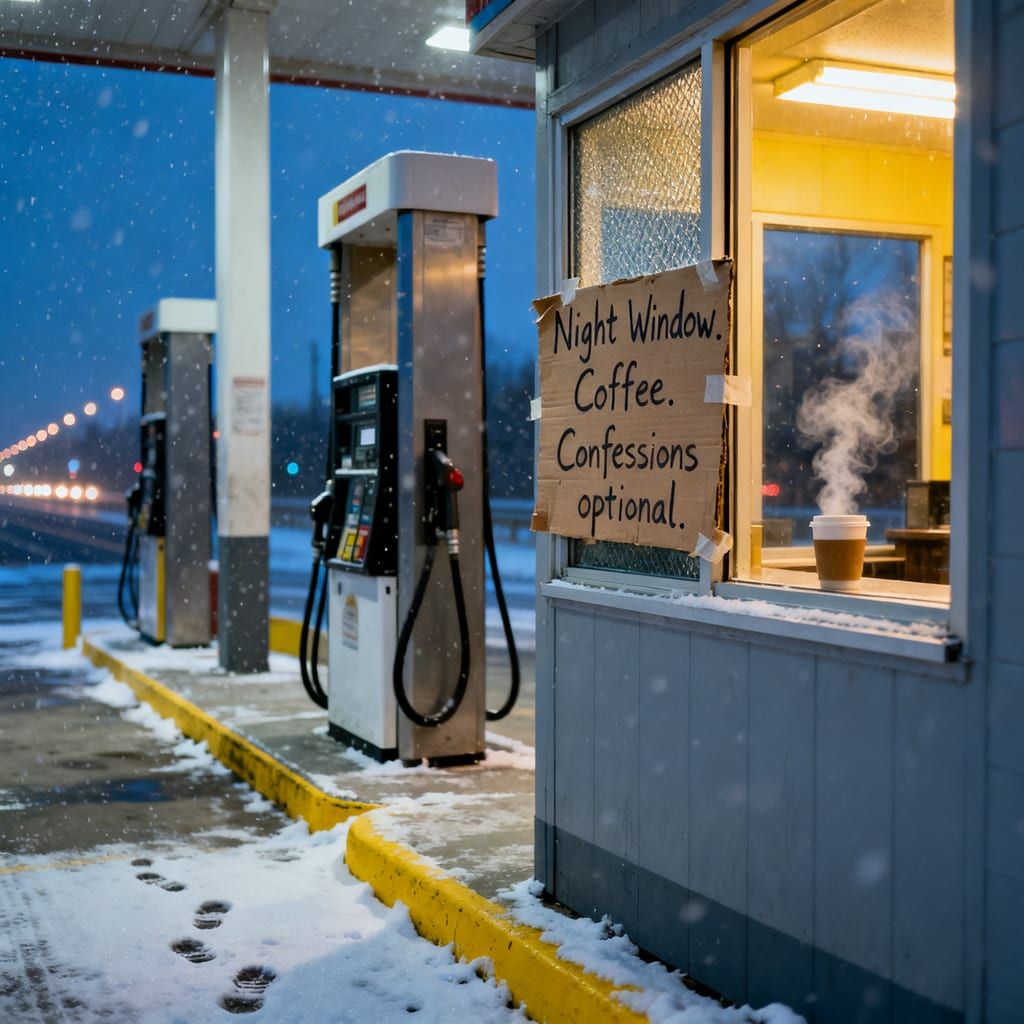
On his first real winter behind the bulletproof glass, Eli Vargas taped a bent rectangle of cardboard to the night window with a strip of packing tape. The Sharpie bled in the cold, the letters a little ragged: Night Window. Coffee. Confessions optional.
The fluorescent wash made the sign look like a dare. Outside, the pumps hummed their tame electricity. A thin snow skittered across the concrete like static, collecting where the wind lost interest. The bell above the door had gone mute from weather. Eli liked the quiet-liked knowing who arrived before they arrived by the crunch of tires on salt.
He laughed when he wrote it, a private joke to keep his eyes from closing. But the cardboard hung there all night, a small open mouth.
The first to test it was a nurse with her hospital ID turned backwards, cheeks raw from the wind, hands chapped into topographies. Her scrubs were the watery blue of early morning. She slid a five through the tray. "Coffee. Whatever doesn't taste like burnt penance."
Eli poured from the fresh pot, steam curling like questions. "Cream? Sugar?"
She hesitated, then leaned close as if the glass could hold a secret. "I did something." Her voice barely disturbed the bright, humming air. "I charted a med wrong. They caught it. No one... nothing happened. But I can't stop hearing it. Like a metronome."
He set the lid tight and slid the cup back. He didn't say it's fine, because she already knew it wasn't. He didn't say it happens, because that would make her small. He reached for the roll of register tape and a pen. On the stripe of paper he wrote: sleep eight hours, call your dad, forgive the version of you who was surviving.
He folded it once and pushed it through behind her change. "Receipt's on me," he said.
Her eyes did a minute's worth of blinking in a second. She tucked the slip into her scrub pocket like a talisman. "Is this, like, a thing you do?"
"It is now," he said.
By two, a long-haul driver in a jacket shiny with road salt stood with his fingers flat on the ledge. His beard was a gradation of years. He asked for black coffee and a pack of spearmint. Then, staring at the reflection of his own eyes in the glass, he confessed how he let the calendar choose for him: "Odd months I call my kid. Even months I can't. Predictable hurt, you know? You can plan around it."
Eli wrote on the register tape: call her this morning, say the month out loud if you need to. He slid it with the spearmint. The driver laughed once, like a cough clearing.
A teenager came next, denim jacket frayed at the cuffs, hair smelling faintly of smoke and someone else's laundry detergent. He palmed a Snickers while browsing the beef jerky, caught Eli's eyes through the glass, and laid the bar down again, wrapper crackling like an apology. "I sleep in my car," he said, chin up the way you'd hold it while swallowing back winter. "Warmest aisle is the candy."
Eli didn't break eye contact. He passed hot chocolate, no charge, extra whipped cream by way of dignity. On the tape, he wrote: ask N. at Shelter 12 about bunks; warm hands, then decisions.
He didn't know if the kid would go. But he knew this: sometimes the smallest specific was a bridge that held.
Word moved stranger-fast. People started showing up at blue hour-those narrow minutes when the horizon knows the sun is coming before anyone else does. They came for coffee and for the kind of listening that doesn't angle toward fixing.
A woman bought a red plastic gas can and trembled, the trembling not from cold. "If I stay," she said to the glass, eyes on the reflection of brake lights behind her, "I become the background in my own house."
On the tape: drive, then breathe twice in the station three towns over, choose a song to begin with you.
An EMT with her hair knotted under a watch cap pressed fingertips to the pane like it was a pulse. "Sometimes," she said, "the hands tell me too late who belongs to which side of the night. The lines blur."
On the tape: name the living out loud for an hour; count them like stitches.
A painter drifted in with flecks of teal on his hoodie. He spent too long lingering over bungee cords. When he finally reached the window, his voice came out like paint thinned with turpentine. "I almost brought something that looked like a gun last week. Was gonna scare you. Not for money, for... I don't know." He swallowed. "Power, I guess. Stupidity. Both."
Eli took in the twitch of the man's fingers, the quickness in his eyes-the way shame makes you dart. He studied the curb outside, blackened with old oil, salt-white at the edges. "You any good with a brush?"
The painter blinked. "Yeah."
"Curb's a mess. You paint it next week, I make sure there's coffee and a place to be that's not a bad idea."
The man exhaled like he'd been holding air for three winters. He nodded. On the tape: repaint the curb on Tuesday; write your name like it belongs to a wall.
It became what Eli never meant it to be: a chapel with a cash drawer. Light on ritual, heavy on benches for tired bodies. The bathroom door turned into a palimpsest-ink layered on ink-names and dates and fragments of ache. Someone slapped a sticker under the hand dryer, a black-and-white grid that went to a blank white page when you scanned it. Within days, the page bore posts like Post-its: "Slept nine hours (mostly)." "Called her. She said 'Hi, Dad' like it was any month." "Took the exit I wanted."
He read them on his breaks, his back against the stacks of windshield wiper fluid, the whiff of clean chemical biting his nose. Proud swelled against a hollow place in him, the feeling you get when you water other people's plants and come home to a dying fern you keep walking past.
Eli knew the catechisms. Once, he could parse a Greek verb until it gave up its ghost. He'd studied how words become ladders and how ladders turn into escape routes. He was good at it-making language into shelter.
He also knew what shelter he'd been avoiding. Across town, in a room that smelled of antiseptic orange and murmured machines, his father lay beneath a blanket that might as well have been woven from pages of family arguments gone quiet. Hospice was an address he kept not looking up.
At four one morning, on a break he didn't deserve, he clicked open the Night Window Notes. Someone had posted a photo of the newly painted curb-fresh yellow, straight as a breath held-signed with a single initial. Beneath it, a second comment: Go now.
He closed the page. He counted the cigarettes in the locked case like a prayer. He watched flakes drift sideways in the wind tunnel between pump three and the ice chest. He wrote on tape for others: let the living hear your voice. He stuck the tape to the drawer where he couldn't not see it. He did what humans do-kept circling the thing that mattered until he could mistake circles for progress.
At 3:17 a.m., the bell made a lonely sound it hadn't made in weeks-someone actually opening the door. Eli looked up to see the painter, his hoodie clean, hair damp as if he'd rinsed it just for this. Behind him, the EMT unzipped her jacket and shrugged it off, draping it over the counter with official-looking weight. The nurse with the metronome mistake stood at the slot with her palms flat, eyes steadier now. The teenager wore a clean hoodie and the tired, proud face of someone who'd found a door that opened. The woman with the gas can lingered at the edge, her red can now just plastic doing its job, not an emblem.
They didn't order. They slid a stack of register tape back toward him, the white coil unspooling across the ledge like spilled light. Each line was something he'd written, in his hand-his words, his homework, now mirror-held to his face.
Sleep eight hours.
Call your dad.
Name the living out loud.
Drive, then breathe twice.
Let the living hear your voice.
The EMT lifted her chin toward the pumps. "We got it."
"You can't-" he began, the practical man in him surfacing, the one who knew you can't just hand off a gas station like a baton.
The painter tapped his heart with two fingers. "I owe you a curb and then some."
The nurse glanced at the clock, eyes flicking like a metronome now keeping steady time. "Four hours until shift change," she said. "I can count meds and change just fine."
The teenager held up a rag and a squeegee like sacrament. "I know pump three's card reader sticks."
The woman with the gas can smiled in a way that landed like a palm on a shoulder. "Go."
Something in Eli's chest-something braided and tight-loosened with a painful, bright pop. It was ludicrous. And holy. He reached under the counter for the keys, for the worn parka on the back of his chair. The door's bell sounded different when you were the one walking through it; not a warning, not a welcome. A small benediction.
The road knew his tires. Salt had turned the world to grayscale, broken only by neon convenience and the slap of billboard encouragement. He drove without the radio. The snow sifted down like someone erasing a chalkboard the long way, soft rags in slow circles. He rehearsed and un-rehearsed what he would say.
By the time he pulled into the hospice lot, the sky had remembered it could soften. He stood outside the sliding doors, watching his own breath braid and drift. He thought of the sign on the window back at the station, letters bleeding a little where the Sharpie had swallowed cold: Confessions optional.
Inside, the nurse at the desk had a face like all night people do-equal parts mercy and humor. She led him down a corridor where the carpet didn't dare squeak. Machines hummed in a key he'd been living with.
His father was smaller. That's the thing no one tells you. Men you argued with arrive at their final forms like time-lapse flowers closing. Eli sat. He didn't touch the call button. He didn't check his phone to see whether pump four had jammed again. He watched the rise and clever pause of a chest that had once heaved laughter over a grill in summer air, the clink of tongs on the grate when they bickered about whether burgers needed more time. That memory came out of nowhere and lodged under his tongue like a seed.
"Hey," he said, when the room had accepted he was staying. "It's me."
The eyelids fluttered. The eyes found him-took him in, not as a tidy ledger of wrongs and rights, not as the son who left seminary and never explained it right, just as a man sitting in a chair that groaned when you shifted.
Eli did what he'd done in a hundred blue hours-he witnessed. He held the air around the words as carefully as he held the words. He let the sorrows name themselves. He let the good things come with their full bodies: the way his dad taught him how to change wiper blades in a sleet storm, the dumb jokes that still worked, the exact pattern of a knuckle scar from a bicycle chain.
He said the apology he'd been hydrating with coffee for months. He said the forgiveness he hadn't known he had, the kind that arrives wearing your father's old flannel and sits on the edge of the bed, heavier than it looks.
When the breathing shifted-from labor to something like looseness-he didn't measure it against a catechism. He let it be exactly what it was. Leaving. Staying. Both.
Dawn leaned pink into the edges of the world as he turned back onto the interstate. The road's familiar hum found a note under his ribs he hadn't known was there. He didn't know what to do with his hands at red lights; they curled on the steering wheel like they finally had a place to rest.
At the station, the pumps were wiped down and gleaming in a way they hadn't since October. The painter was sweeping the front mat like he was coaxing it into a better version of itself. The EMT slid his keys back across the counter with a competent nod. The cash drawer balanced to the cent, a row of coins so neat it made his chest ache. There was a Styrofoam cup by the register with SHIFTCREW scrawled in marker and four sets of lip prints.
In the bathroom, under the fevered collage of confessions, a new square of tape held a new message in a dozen different hands, the letters sharp and leaning, messy and perfect: The window goes both ways.
Outside, the cardboard sign on the glass had drooped at one corner. He smoothed it, pressed the tape down with his palm until the cold bit through. The pumps hummed their old song. The sky found its daylight.
He made a fresh pot, the smell warming everything it could reach. He stacked register tape by the window like communion. He waited for the first crunch of tires on salt, for the bell to pronounce the hour, not as a sentence but as a beginning.
He didn't know who would show up next, what private metronomes would click time under their ribs. He knew only this, and it was enough to anchor him: when the living came, he would let them hear his voice.

A daughter learns to read between the lines of a life split in two
Read more →
A fog-draped night, two souls found, and the quiet shape of a life
Read more →
Story audiobooks for children of all ages — a new one every day on Smarter Way Stories.