Two Houses and One Quiet Heart
A daughter learns to read between the lines of a life split in two
Read more →
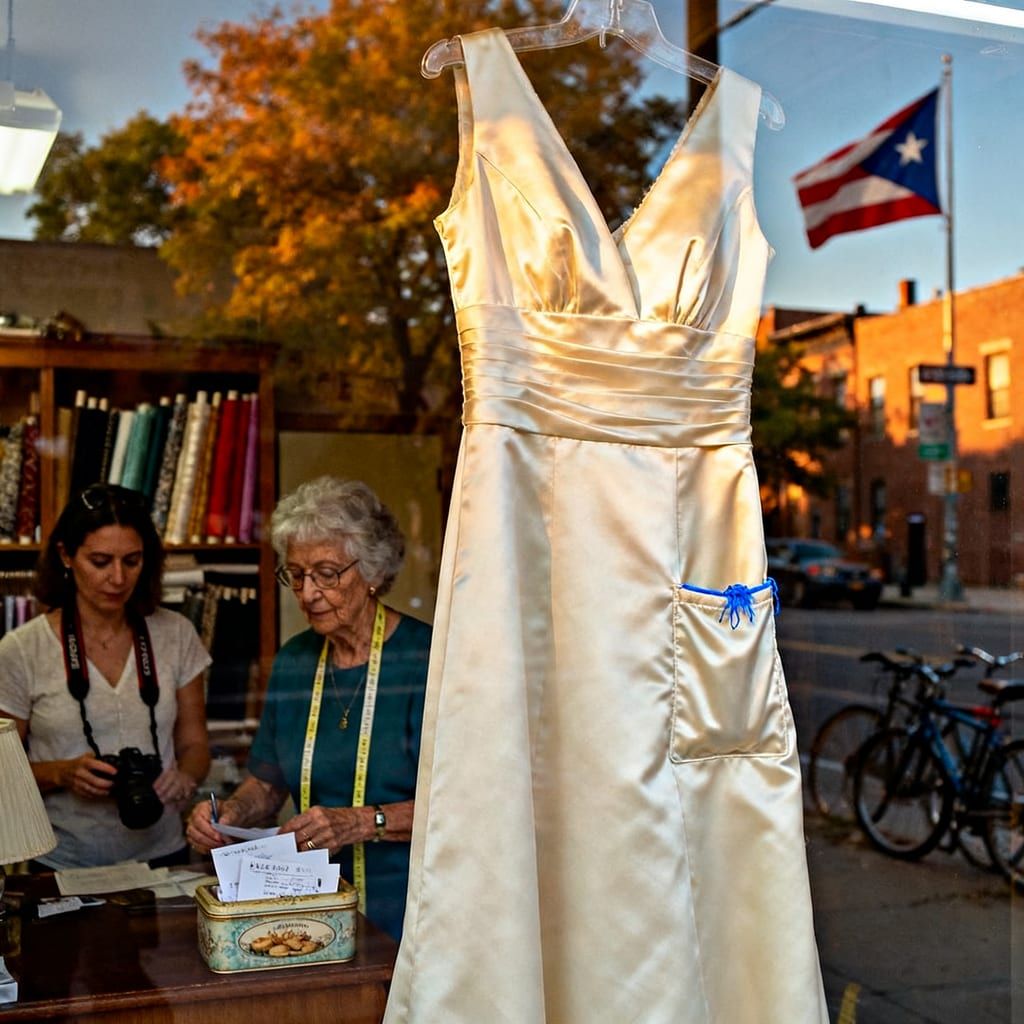
The dress winked at Lena from the thrift-store rack, a quiet dare amid polyester prom explosions and sequined nostalgia. Satin gone soft with years, it held a sheen like lakewater-muted, faithful, unshowy. She wasn't even supposed to be there for herself.
She lifted it anyway. The weight surprised her-heavier than it looked, like a secret you chose to carry.
She was scouting props for a food shoot-vintage linens, mismatched plates-and the Satin Siren simply materialized between a stack of taffeta nightmares. The tag said $48 in someone's apologetic handwriting. The size wasn't one she'd usually try, but when she stepped into the narrow dressing stall and tugged the zipper, the gown slid into place as if the room itself exhaled. The mirror was a little cruel, fluorescent and streaked, yet something in her shoulders relaxed.
A pocket. She hadn't known wedding dresses had pockets.
Her fingers slipped in and met a crisp edge, then the snag of a single thread-blue as a vein. The small folded square emerged like a conjurer's trick, its crease-lines soft as eyelids.
"To the woman who needs a sign: you are allowed to change your mind. -R."
The words landed like a hand on her shoulder, warm and startling. Three months ago, she'd said no to vows already printed, seating charts already argued over, toasts already drafted. She'd watched her mother fold napkins with a soldier's efficiency and then fold her face when Lena said she couldn't. She'd watched friends tilt their heads with sympathy that felt like pity. They kept saying you'll know, meaning love, meaning certainty. She had known-just not in the direction anyone wanted.
She looked back at herself in the dress. It wasn't a hallucination. It fit like permission.
Inside the seam, a tiny label, half-loose: R. Silber & Daughters, Humboldt Park. A longitude and latitude. A route.
She bought the dress. The cashier wrapped it in tissue with a reverence that made Lena want to tell her everything and nothing.
Humboldt Park in late afternoon had a light that flattened and gilded in turns. Pastel bakeries, Puerto Rican flags in the breeze like slow applause, boys on bikes carving slaloms between parked cars. The storefront she found had its letters ghosted on the window: R. Silber & Daughters. In the glass, her own reflection overlapped with painted vines curling around a faded calligraphy of dresses.
Inside, the front room smelled like dust and lemon oil. Mannequins stood as if taking a breath. A bell clanged somewhere in the back, and a voice called, "One moment!"
Ruth Silber appeared from behind a navy curtain, a tape measure slung like a stole across her neck. She had the compact energy of someone who'd spent her life telling fabric who was boss. Her hair was the color of new steel, combed back brutally and then softened by a ribbon.
"We're closed," she said, and then she saw the garment bag on Lena's arm. Her eyes jumped. "Unless you're bringing me trouble."
"Maybe," Lena said, and smiled in spite of nerves. "I found this. There's a note sewn inside. I thought-" She didn't know how to finish. I thought you might have left it there for me, a time traveler with impeccable aim.
Ruth's mouth made a shape like recognition and denial at once. "You bought her," she said, and reached for the bag. Her hands were steady, the backs map-lit with veins.
In the back room-warm, permanently late July-bolts of fabric leaned like tall girls. A dressform wore pins like rain. A radio hummed an oldies station under the sound of the park beyond the back door: a dog, a basketball thud, someone's laughter splitting open and spilling everywhere.
"I used to do it," Ruth said, not looking up from the dress. "Notes. Small ones. Only sometimes. For the ones whose hands trembled. It wasn't anything professional." Her finger found the seam with the blue tack stitch and tugged it loose like she'd been waiting years to do it.*
"Why blue?" Lena asked.
"Something borrowed, something blue, something true," Ruth said. "My own addition." She shrugged. "You read it."
"I did. It felt like being blessed and scolded at the same time," Lena said, and Ruth laughed once, bright and brief.
Ruth pointed to a tin on a high shelf, the kind that had once promised biscuits and now, by law of grandmothers, promised thread. "Would you hand me that?"
Inside, not buttons. Letters.
Creased envelopes addressed in looping hands to R. & Daughters, to the Dress Lady, to Dear Ruth (if that's your name). Return addresses in Oak Park, Little Village, a P.O. box in Indiana, two with only no return written in pen like apology.
"They wrote back?" Lena whispered.
Ruth nodded. "Some did. Some brought the dress back. Some sent photos. Some sent nothing except the next girl, which is the most honest answer of all." She slid a letter free; the paper was the texture of thin wafers. "Here's one. She married. She writes that on the way down the aisle she felt like a choir walking with her, because she could have turned around and didn't. Another wrote that she decided to keep her apartment and her last name. One sent a postcard from Madison after her first night class, saying, 'I said yes to me.' I kept them because who else would?"
Lena read with her palms tingling, as if the ink held some shallow current. They were all over the compass and yet within speaking distance of one another. She felt the shape of her own relief thrum along the table-like a glass pitched when a subway passes near.
"I called off my wedding," she said finally, half to the letters, half to the hum of the ceiling light. "And I've been walking around like a noise I can't place." She surprised herself by not crying.
Ruth threaded a needle in one move. "Then you heard it," she said simply.
They made a bargain: photographs for stories. Lena would stand in Ruth's back room on Saturdays, camera in hand, catching the light that fell like a benediction through the high windows. Ruth's clients-girls with glitter nails, women with practical shoes, mothers with their own memories like salt under their tongues-stood in front of the lens and loosened. In exchange, Lena asked questions that weren't exactly about dresses.
"What's the loudest thing in your life right now?" she'd ask. Or, "What's the quiet you hope for?"
The biscuit tin filled with new paper. Ruth kept the old and the new together, elastic bound, like a family.
When the idea came, it felt inevitable. A one-day pop-up, a neighborhood invitation: Borrowed & Chosen. They pushed the mannequins to the walls, strung twine for prints, polished the bell. The dress sat center stage, draped like memory, with a small card by its pocket: Read me.
People came like water through a narrow gate-steady, accumulating. A grandmother in a floral blouse stood in front of her own photograph and dabbed her eyes with dignity. A teenager in an oversized hoodie pressed her fingers to the satin like it was an animal you had to greet with patience.
Lena moved through the room, catching chins, hands, the space between breaths. Ruth sat by the door like a conspirator and a queen, her tape measure replaced with a small dish of lemon candies.
Kayla walked in near the end-a ring flashing on her hand because the light found it mercilessly. She was tall and soft-shouldered, her ponytail stern from being asked to do too much. She stood in front of the dress for a long time like a person listening through a wall.
"Try it," Ruth said, not unkind, from her chair.
In the back room, Kayla's voice was a form of wind-gentle at the beginning, then collecting. "I've been waking at three. The name I say isn't his. It's not even someone I know well; it's a name that opens a room where I can breathe." She laughed like she couldn't apologize for how that sounded and also she had tried.
"You don't have to be sure today," Lena said, adjusting the hanger strap. The dress slid over Kayla with that same held breath.
Kayla found the pocket. Her fingertips knew where the blue bite of thread would be. The note was there still because they kept replacing it-always the same sentence in Ruth's judicious hand, always the same small shore to pull up on when the water swelled.
Kayla read. She didn't crumple. She didn't glow. She closed her palm around the paper with a deliberate tenderness and said, "I need time."
"Take it," Ruth said, and for all her age her voice had the muscle of something forged. "You can return what doesn't fit."
Kayla handed back the dress with care. She left without a print or a promise, just the note hidden in the hinge of her fingers.
September crisped. Leaves organized themselves into decisions. Lena and Ruth kept working, in less of a rush, as if the pop-up had taught them how to count to ten between the impulse and the stitch. The dress hung in the window now, not for sale, not for anyone and somehow for everyone, a lantern with a full belly of light.
The postcard arrived on a Tuesday that smelled like rain before rain. A glossy shot of a night classroom-plastic chairs, a whiteboard so clean it already wanted to be messy. On the back, in an earnest, careful hand:
"Dear R. & L., I asked for time and then I took it. I didn't marry him. I got a studio with a window that squeaks and I enrolled in night classes. I'm learning to draw hands. Turns out, they're harder than faces. Thanks for the permission to practice. -Kayla"
Lena read it twice, handed it to Ruth, and felt the small click inside-two pieces aligned so simply you wondered why they'd ever been apart.
That afternoon, Ruth made tea and told the story she kept at the bottom like you keep your sharpest scissors at the back of the drawer.
"The first note," she said, and tapped a fingernail on the tin the way one might wake a sleeping pet. "It wasn't because I'd read a book about empowering anyone. It was a selfish thing."
She leaned back, the chair complaining and then settling.
"I almost didn't come back from the bus stop once. Long time ago. He was good. Not spectacular. He carried groceries and fell asleep during movies and never mocked my sisters. He was safe and small, both. I stood on the curb with my bag, five dollars in my pocket, and I counted buses until a driver looked me in the eye and gave me a small nod like you decide. I went home. I sewed. He held the hem while I worked. For fifty years he did that. He died without drama. At the end, he said, 'You made so many strangers brave.'"
Her eyes shone in a way that wasn't performative. "I never regretted staying," she said softly. "But it mattered to me that the girls knew that either choice required courage. That staying wasn't cowardice and leaving wasn't crime. So I wrote what I needed once and what some of them needed later." She smiled, a half-crescent, private and public at once. "I suppose that's what we get to pass down-our small permissions."
The kettle shivered, and somewhere on the street a boy whooped at a basket making the clean sound of net.
That night, Lena walked home along the edge of Humboldt Park where the geese made their emphatic personal declarations. The sky laid itself out like silk pulled from a storage box-wrinkled, forgiving. Her apartment was still arranged for two in forgetful ways: cups on the wrong shelf, a spare pillow like a hesitant guest. She didn't move them. Not yet.
The empty side of the bed had felt accusatory for months, a vacancy others could populate with advice. Now it felt like an aisle she could walk down without an audience. You are allowed to change your mind, the note had said. She thought of it expanded: You are allowed to take your time. To make a mess. To try a class. To say a name at three a.m. and then say your own.
She placed her camera on the dresser, lens cap off so the morning could fall right in and get trapped-light in a small room, light with ambition. On her table, the biscuit tin-on loan until forever-glinted under the lamp. She slid the latest postcard in with the old letters, elastic snapping lightly into place.
Across town, the dress held the window like a mouth holds a story before the telling. People would press their faces to the glass and see themselves superimposed on satin. Some would try it on and laugh. Some would cry and not know why. A few would find the blue bite of thread and tug, and the seam would give with that satisfying, dangerous sound.
Lena lay down, listened to the old pipes discussing themselves, and watched the rectangle of streetlight on her ceiling. It was enough for now. Not a finale, not a montage, just the hum a city makes when your ear is pressed to its sleeve.
In the morning, she'd go back to Ruth's and photograph a girl who swore she hated dresses until one didn't hate her back. She'd buy empanadas from the place on the corner where the cook wrapped them like presents. She'd start a class someone suggested, maybe not because of a postcard but because of the space it had made in her head. She would build a life that fit in ways that weren't loud.
In the window, the blue thread caught whatever sun Chicago could spare and threw it back graciously-a thin line, a vein, a sign you could follow without hurrying.

A daughter learns to read between the lines of a life split in two
Read more →
A fog-draped night, two souls found, and the quiet shape of a life
Read more →
Story audiobooks for children of all ages — a new one every day on Smarter Way Stories.