Threads for Chosen Names
A room, a red blazer, and the courage that fits at last
Read more →

The wind on Milwaukee Avenue had a way of finding the seam between your collar and your resolve. Lena hunched tighter into a borrowed hoodie, breath fogging white, cheeks prickling. She'd been laid off on a Tuesday that felt like a disappearing train-doors sliding, an empty platform, the faint scent of something she couldn't name burning in the air.
A thrift store's bell clanked when she pushed inside. Heat rose from the vents smelling faintly of dust and oranges from a plug-in somewhere. Racks ticked as someone flipped through hangers. The sorts of objects that outlast people were everywhere: glass ashtrays, a brass picture frame holding its stock photo couple, a teapot with a chip that felt deliberate.
She slipped a hand down the line of coats. Most were polyester, slick and apologetic. The wool one stopped her. Dark gray, heavy, a cuff worn smoother where someone had worried it with their thumb. She slid it on, the weight a small kindness.
In the right pocket, her fingers met paper-stiff, wrinkled, edged with the sugar-crystal crunch of old receipts. She unfolded it carefully.
On the back of a Jewel-Osco slip, in careful blue ink: If you find this, please call me. I don't think I can do this alone. -Ruth, Apt 3D, 773-555-0198. Jan 18, 2002.
Lena's laugh came out soft and sideways. Twenty-four years too late. But the plea didn't tilt with time. It sat there, alive as wind.
She paid cash-sixteen dollars and a smile from the cashier with glitter nails-and stepped back into the cold with the coat wrapped around her like a plainspoken hug.
At home, the radiators clicked to themselves. She draped the coat on a chair but kept the note. The apartment smelled faintly of detergent and something lemon her grandmother used to use. It was only in the quiet that her layoff lined itself up with other losses-her grandmother, Inez, gone eight months; friends busy with babies and deadlines; the shape of her days suddenly water without a glass.
She dialed the number because doing something felt better than sitting. The automated voice told her the line was disconnected. Of course it was. Still, the address was a few blocks away. She sat a moment with her feet on the cold floor, the note a thin weight in her palm.
Curiosity threw up both hands. Loneliness murmured, Go.
She put the coat back on, tucked the note into the inside pocket like a compass, and walked.
The building had been buffed into an assisted-living facility, the old scrollwork over the entry door painted cream. A flock of plastic snowflakes hung in the lobby, twirling in the heated air. The receptionist had peppermint lotion on her hands and a gaze that took Lena in and didn't look away.
"I found something in a coat," Lena said, holding out the note. "I'm probably being ridiculous."
The receptionist read it twice, lips parting slightly, then glanced toward the elevator. "I think you're being brave," she said. "We do have a Ruth on three. Would you like to see if it's her?"
The elevator creaked upward like an old man talking to himself. Lena smoothed the wool across her knees, the hem itching pleasantly. She could hear her grandmother in her head: If something keeps tugging, m'ija, you let it tug.
On the third floor, the hall smelled of clean linen and chicken soup. A TV further down burbled about the weather. The receptionist knocked on a door with a paper snowman taped to it.
"Ms. Novak? There's a young woman here-she found a note."
The door opened to a room warm with lamp light. A woman sat by the window, knitting sky-blue yarn. Her hands trembled just enough to make the yarn sing softly against the needles. White hair parted in obedient lines, a cardigan buttoned wrong at the third. Eyes sharp as clean glass.
"I'm Ruth," she said. "And you've found a relic."
Lena placed the note in Ruth's palm. Ruth blinked, and her mouth made a tiny O. She put the paper on her lap like something fragile that might slide away.
"I wrote dozens," she said, voice smoothing out with the memory. "Back when Walter was sick. Early on, before we had real help. I'd tuck them into coats I donated. It was-" She looked toward the window, where branches knocked their quiet code against the glass. "It was my mouth to the world when my own had gotten too tired."
"You were asking for help," Lena said.
"I was drowning politely," Ruth said, with a small smile that acknowledged the absurdity. "One woman came. She had a voice like a kettle about to sing. She knocked on a Sunday morning when Walter's face had gone-oh, like the left side had forgotten how to be a face. She called 911. Sat with me while the ambulance wove through traffic. Her scarf-" Ruth pinched at the air as if pinning a color. "Red. A beautiful, bossy red."
Lena felt something in her chest go soft. Her grandmother had worn a red scarf every winter for years, a Christmas gift from a neighbor. "Do you remember her name?" she asked carefully, though the answer was already moving toward her like a tide she hadn't noticed coming in.
Ruth's mouth trembled-not the hands now, the voice. "Inez. She said her name was Inez. Short woman, didn't waste words. I've never believed in coincidence. Not really."
The room was very quiet. The heat clanked and settled. Lena reached into the pocket of the wool coat, pressing her fingers into the seam as if steadying herself on a subway.
"That was my grandmother," she said, and the word broke on the second syllable. "Inez Ortiz."
Ruth's eyes filled in a quick, clean way. She covered Lena's hand with one of her own. The skin was thin but firm, a map of rivers. "Of course she was," she said. "Of course you're wearing the coat that led you back." She laughed softly, an astonished sound. "Walter always said gratitude leaves crumbs. Maybe we've been following them."
Ruth shuffled to a small bureau and pulled out a tin with a painted strawberry on the lid. It clinked faintly with what it knew. She eased out photographs-square, scalloped edges, the colors a little melted by time.
"There," she said, tapping one. "That morning."
In the photo, a woman in a red scarf stood by a hospital bed, her smile tilted like she'd been caught between sentences. Her dark hair was pinned back with a barrette Lena recognized, absurdly, like a shout across a crowded room. She had the same soft half-moon dimple Lena saw in the mirror when she forced herself to laugh.
Lena touched the corner of the photo where a piece had been bent back and now would never lie flat. The hospital wall behind them was pale green. Walter lay propped up with a blanket cinched around his hips, a newspaper half-folded in his lap, a look on his face like someone who had nearly been erased and now wanted to write in large letters.
"She made soup," Ruth said. "And she told me to breathe like I was blowing up a stubborn balloon. She kept saying, 'One thing at a time, sweetheart. One thing at a time.' Walter lived five more years. Soft ones. We collected them like marbles."
"Soft ones," Lena echoed, the phrase fitting in her mouth like something it had been waiting to hold.
Ruth reached into the bureau again and drew out a leather-bound notebook, worn smooth at the corners. She offered it with both hands. "He wrote his gratitudes in here during those years. The nurses, the way the window made squares on the floor, the taste of peaches in July. It steadied us."
"I can't-" Lena began, because the impulse to refuse what is precious is a way of asking to be convinced you're worthy of it.
"You can," Ruth said, eyebrows lifting. "And you must. Things like this aren't meant to stay in drawers." She looked at the coat. "I sent those notes out so they'd keep working. Seems like they do."
They talked until the light outside went from pewter to blue to the scraped-bright of evening. Ruth told her about Walter's conspiracy theories regarding the squirrels in Humboldt Park. Lena found herself saying things she hadn't said out loud yet-that she felt like she'd been walking the same hallway all year looking for doors that refused to be doors; that being laid off made her feel weightless in a way that wasn't freeing.
Ruth listened with the patience of a person who has sat beside hospital beds and waited for small numbers to change. "Write three things," she said finally, nodding at the notebook now tucked near Lena's ribs. "Every day. They can be terrible, small things. The way the bus driver waits for the woman with the cane. The sound of the kettle first thing. The exact color of this foolish blue yarn."
"I will," Lena said. And she meant it with the uncomplicated certainty of a promise made to a stranger who had become, so quickly, necessary.
At the door, Ruth pressed the note back into Lena's palm. "Keep that," she said. "Proof that our hands reach further than we think." She squeezed once, a quiet benediction. "Tell your grandmother that I kept the red scarf in my mind all this time."
Lena smiled. "She'd like that."
The night met her in a way that didn't feel hostile. Streetlights threw coins of gold on the sidewalk. The wool coat held her warmth instead of stealing it. Inside the coat, the notebook rested, patient as a heartbeat.
At her kitchen table, she opened it. The first page was Walter's thick block letters: Today: coffee that tastes like morning; Ruth's humming while she burns the toast; the miracle of elevators. A laugh snuck up on her-the kind that uncurls something knotted.
She turned to a clean page. The paper was faintly lined, the sort that forgives slant. Her hand hesitated, then moved.
Today: a note that crossed years to find me. The sound of knitting needles like rain on a tent. A red scarf in a photograph; proof that love is not done yet.
She closed the notebook, then opened it again, because the habit was already tugging her toward morning. The apartment hummed. The radiator ticked. Somewhere outside, a siren dopplered east then gone.
She draped the coat over the back of a chair. It looked taller than it had in the store, as if standing up straighter now that its work had been named. She ran a hand over the cuff someone else had worried smooth. Thank you, she thought, not sure if she meant Ruth or Inez or Walter or the stranger or the coat or all of them braided together.
When she finally slept, her dreams were practical. Doors that were doors. Elevators that arrived. A street where the wind cut clean but not cruel. In the morning, she would walk to the lake with a thermos of soup she didn't quite know how to make yet. She would look for the places where gratitude left crumbs and try to be brave enough to follow them.
And somewhere three floors up on Milwaukee Avenue, a woman in a blue cardigan would pick up her knitting, light catching on the needles, and hum a song only the old heaters knew. Between them, a thin piece of paper, a coat, a red scarf, a notebook. The net already there, holding.
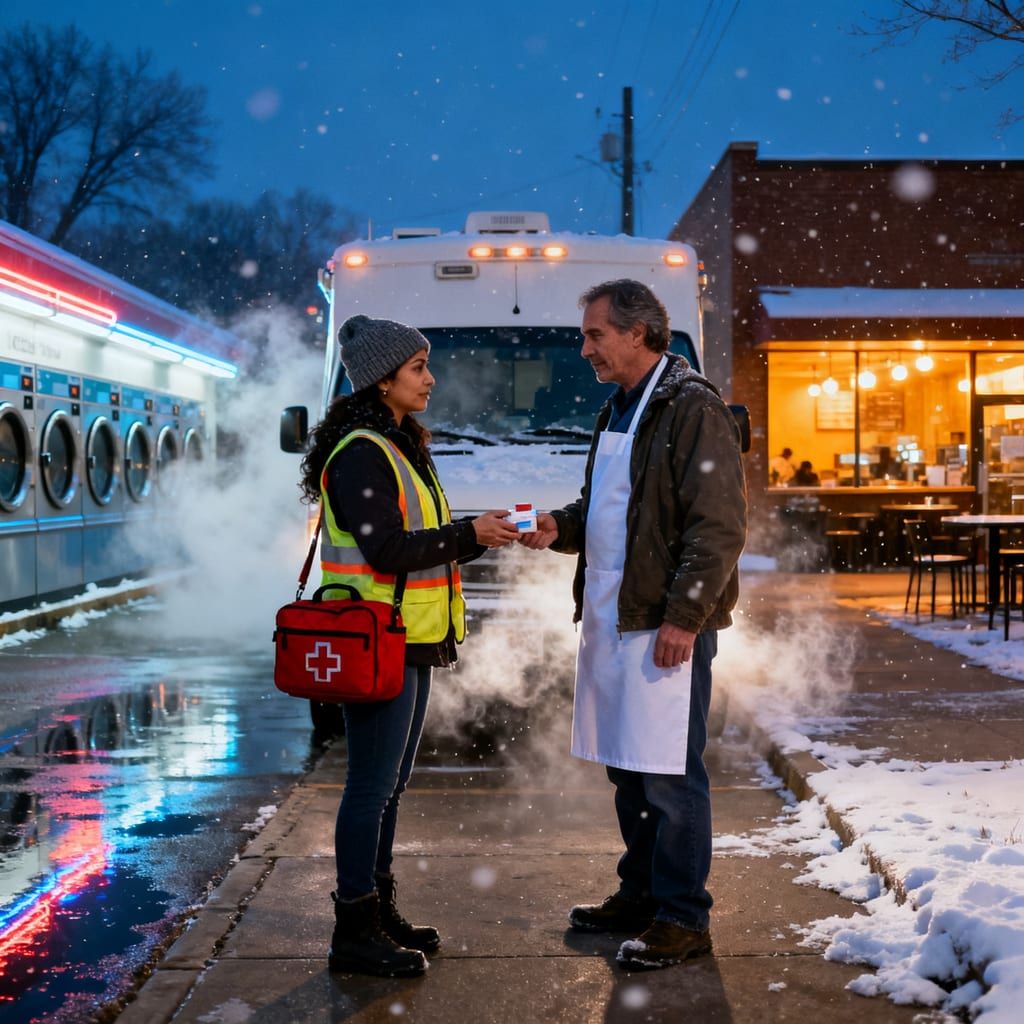
Between a laundromat's hum and a café's light, a van keeps score another way
Read more →Story audiobooks for children of all ages — a new one every day on Smarter Way Stories.