The Quilt With No Border
A crooked line, a direction home
Read more →
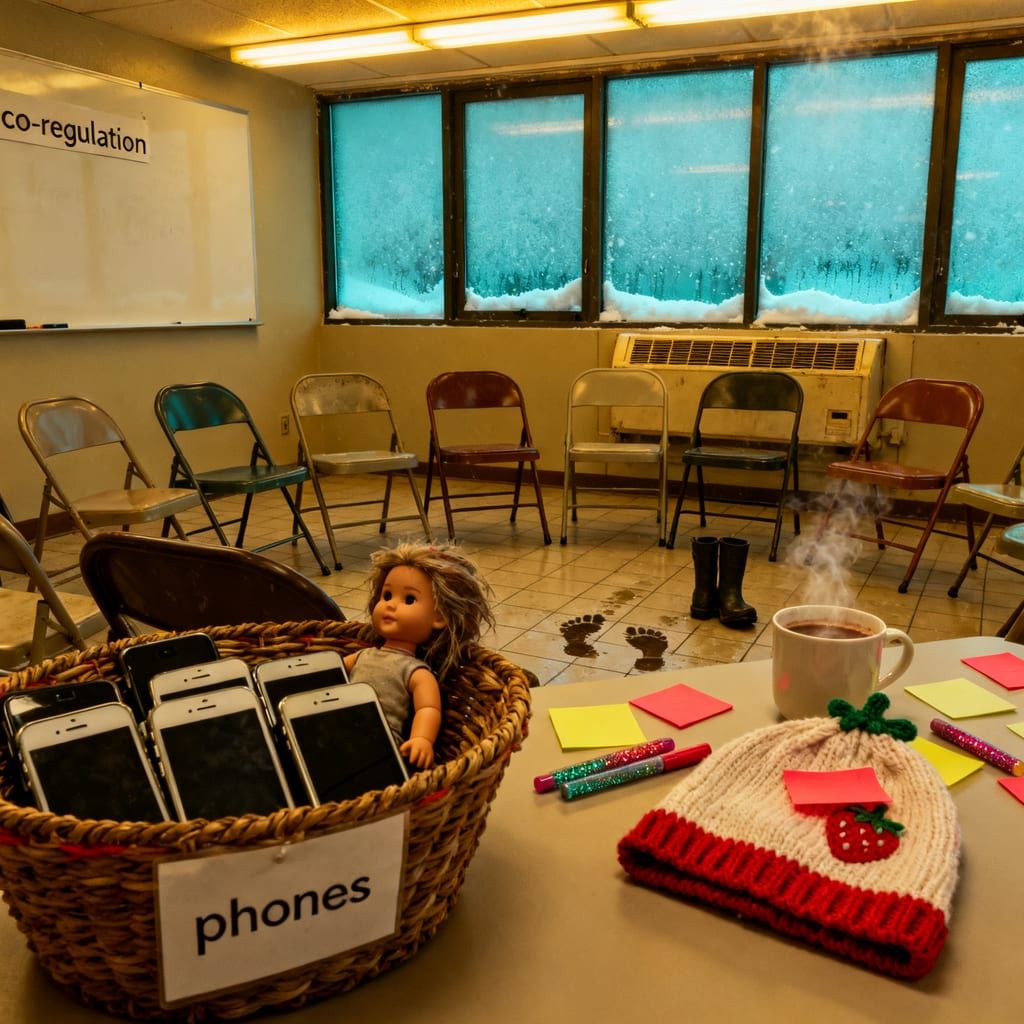
On the first real night of winter, the kind of cold that nips through jeans and finds the soft skin at the back of the knees, Lina props the community center door with a salt-stained brick and lays a folded blanket over the vent that never stops groaning.
The classroom smells like instant cocoa and lemon disinfectant. She sets out paper cups, orange slices, and a basket with a handwritten sign: Phones rest here. Brains rest too. She tapes the evening's topic to the whiteboard-co-regulation-then rubs her fingers, warming them before the babies arrive.
"Hey Miss A," Tasha says, one hip canted to balance a car seat, a fatigue so deep it reads like a second expression. Nova's hat is a knitted strawberry, green leaves wobbling with every breath. Eli follows two steps behind, hoodie up, hands jammed into his pockets like they owe him money.
Mateo is last, shoulders dusted with fine snow, cradling diapers under one arm like contraband. In his phone's lock screen-flashed when he drops it in the basket-he's beaming in a graduation gown, a tassel tilted over one eye. The baby carrier on his chest makes him look like a knight with a soft, snoring shield.
"No grades tonight," Lina says, the line that makes their shoulders relax a fraction. "Just warmth and snacks and a few sticky notes." She winks at Nova, whose yawn shows more gum than tooth. "And glitter pens, if we're feeling reckless."
Eli smirks despite himself. "Reckless is my middle name."
Tasha rolls her eyes with the loose affection of someone who has stood beside a particular boy in a particular parking lot at three a.m., trading a hoodie for a blanket. "Your middle name is 'what now.'"
They drop into folding chairs. Lina passes around a soft practice doll-brown acrylic hair matted from years of gentle hands. They always laugh when she says the doll's name is Dolores after her high school counselor. She keeps the joke light, the surface smooth, while beneath it something old knocks against her ribs.
"Okay," she says. "Co-regulation. Fancy word for borrowing someone else's calm. Tonight we learn the thirty-second hold." She demonstrates-chin tucked, chest lifted, pressure of her palm firm enough to say I see you, not so firm it says I will fix you.
Nova fusses and Tasha's shoulders jump, like someone smacked a ruler near her ear. Lina nods toward the clock. "Take thirty. I'll time you. No talking. Just breathing together." She points to a sticky note where she's written, in the same even print she uses on every board: Name it before you fix it. The only thing faster than panic is shame. Slow both down.
They breathe. In, out. Lina counts in her head. The vent rattles. The snow on their boots liquefies, leaving small wet moons on the tile.
By break they're unzipping coats, passing the doll like a dare. Eli fumbles with the tiny Velcro diaper, swears under his breath, and then grins when the tabs line up.
"Under a minute," Mateo cheers in a hush, as if applauding in church.
"Don't clap for that," Eli says, though he preens. "Clap when I get Nova back to sleep."
"Names first," Lina reminds him, gently. "Then needs."
Eli sighs, looks at Nova's small, trill-tremble mouth. "Hey, little strawberry. You look mad as hell." He meets Tasha's raised eyebrow. "What? I named it."
They all laugh, the kind that fizzes through the skin. They practice tiny scripts Lina has printed on sticky notes-they start with I feel, not You never; they avoid words like always, never, lazy; they tuck in a we if they can find one.
"They're training wheels," Lina says. "Eventually you swim." She mimes paddling, a ridiculous breaststroke that makes Mateo's baby hiccup in his sleep.
When the formula runs low-a fact that arrives not like an emergency but like a new bill slid under the door-everything inside them twangs. Tasha's mouth goes thin. Eli counts on his fingers and the math keeps smirking at him. Mateo pulls a bottle from his bag, cheeks burning with a secondhand shame he can't place. The air grows heavier; even the vent sounds like it's breathing hard.
"Thirty seconds," Lina says, not as an order but as a rope thrown across a gap. "Holds, now. Then sticky-note scripts. I'll call the food pantry."
They practice anyway. They breathe. The hunger doesn't vanish; it steps back a half-inch and lets them look at each other again.
The next week, Eli is gone.
Tasha arrives alone, Nova asleep and pink, a hospital blanket swaddled too tightly, grief's neatness. She drops her phone in the basket and then retrieves it immediately, thumbs littering the screen, the way some people pray.
"Where is he?" Lina asks softly, and Tasha's head shakes so hard her ponytail whips her cheek.
"Cops took him," Tasha says, voice a dry leaf. "At the Walgreens. They said-he tried-he said it was just-" She stops. She is shivering. The heat clicks on and off like a nervous habit.
Lina does what she teaches. She sits near without touching, keeps her voice low enough to invite and high enough to keep the room's air from crouching on their backs. "You're scared," she says. "And mad. And Nova's okay."
Tasha nods so violently it looks like she's agreeing to a lifetime.
Lina's own old breath rises in her throat, stale and county-issued. She swallows. "We'll go tomorrow," she says. "Courthouse. You don't have to do this alone." She taps the sticky note on the whiteboard without looking at it. "Naming first."
That night Lina lies awake in her small apartment three bus stops away, snow stacking on her sill like white books. On her nightstand: a wallet with a soft seam where one pocket bulges.
The courthouse smells like old coffee and winter boots. A TV blares a cooking show with the volume off, and everyone is either whispering or talking like thunder.
Tasha's knees bounce. She watches the door as if it owes her a person who walks through it forgiven.
Lina takes out her wallet. The paper is so folded it remembers its shape. She has carried it for years, a page photocopied from a thicker file once handed to a caseworker in a navy skirt with coffee drips down the front.
"My name was here," she says, tapping a line where you can almost see the indentation of a pen. "And here. And here." The dates stack. The notes use words like noncompliant and placement. "The system-" She inhales. Frosted breath vanishes. "-learned my name by heart."
Tasha looks at the paper, then at Lina. Some soft spot moves in her. "You?" It comes out halfway between a laugh and a moan. "You're-" She makes a rough circle with her finger, encompassing the board, the doll, the snacks.
"I don't tell it much," Lina says. "I keep this to remember who I teach. And why the scripts matter. And that repair works," she adds, careful. "Not to erase the bad. To steady the good."
When Eli's hearing is set, Lina calls the store manager herself. She matches her words to the man's rhythm-tired, irritated, human. "We're arranging a payment plan," she says. "From a teen job fair. He'll come in. He'll apologize. We can set him up stocking weekends."
"You vouching?" the man asks, a tobacco cough tucked into the question.
"I'm co-signing with presence," she says. And somehow it lands.
In the plastic chairs under a laminated poster about civic duty, Lina teaches Tasha to write a letter. They begin with a feeling. They avoid a courtroom's favorite word-sorry-and find instead the marrow. I felt scared when the can was empty. I felt stupid and small. I took something because I didn't see a door. I see it now.
"Short," Lina says. "True. It's not a performance." She taps the middle of her chest. "It's a repair."
Nova wakes and roots. Tasha unbuttons one layer, then another, and looks at Lina over the small head. "Why do you do all this?"
Lina folds the case file page along its seam. She tucks it back. "Because someone did it for me," she says. "Not perfectly. Just-enough." She smiles, the quiet kind. "This is me returning the library book late."
The class shifts after that, as if a door has opened onto a soft, lit hallway. Trust comes not in a rush but in threads. Mateo offers his stroller to Tasha for a week while he borrows a carrier; Tasha sends back a photo of Nova asleep, legs frog-splayed, captioned We owe you fries forever. Midnight texts ping in the group chat and get answered not with advice but with breathing counts. When a dad nails a diaper change in under a minute, they applaud with mittened hands.
On a Tuesday swollen by snowdrifts, Mateo brings a shoebox from his closet. The cardboard is soft and smells faintly of fabric softener, or memory. He lays it on a table like an altar.
"Found this," he says. "In my mom's stuff." He pulls out a sun-faded Polaroid-white border gone tea-stained at the corners. In the photo: a circle of teens, some with babies, some with that could-be-anybody look. A paper banner sagging behind them: YOUNG PARENTS CIRCLE. The faces are wide-eyed, brave with terror.
He taps one. "That's my mom." A girl with a bruise-yellow sweatshirt and a jaw you could slice bread with.
Then his finger moves. "And that-" He looks up, a little incredulous, a little kid at a magic show. "That's you."
Lina sees the girl she was: hair snatched into a high ponytail so tight it made her eyes look a fraction larger, arms around a practice doll like wrapping a present you hope won't slide open. The room tilts. For a second she feels the exact heft of a hope she once carried like contraband.
No one speaks. The vent shudders. Outside, a plow throws up a wave of snow that splashes the high windows.
She swallows. "I was sixteen," she says. "Miss Morales ran that group. She brought oranges and let us fail in small, safe ways." Her smile is wet at the edge, but it holds. "I thought if I pretended hard enough to know what I was doing, I could keep everything from breaking."
Tasha leans forward. "Did it work?"
"No," Lina says, softly. Then: "But it made me brave enough to repair. That's different. That's...better." She presses her palm, briefly, to the table as if to anchor the room.
Something quiet passes among them, an understanding that has weight and warmth, like a blanket tucked to the collarbone.
On the final night, boots steam in a ring by the heater. Someone has brought a tin of cookies. Someone else has brought a baby who refuses to acknowledge bedtime as a concept.
The door opens and Eli steps in, cheeks raw from the wind, a folded paper in his hand. He drops his phone in the basket without being asked. The motion is simple. It makes Lina's throat sting.
"I got the schedule at the store," he says, holding out a wrinkled printout like a diploma. "Saturdays. And-" He holds up another sheet, different paper, different font, the one he has worked on with his tongue out, writing careful as if the pen might explode. "Can I practice? The thing. The apology."
Lina nods. She stands at the board, doesn't touch the marker. "Take your time."
Eli clears his throat. His knees look briefly too new for him. He looks at Nova, at Tasha, at the outlet with the childproof cap that he snapped on last week with exaggerated care.
"I felt scared," he reads, voice low. "When the can was empty. I felt angry at the world and like the world was laughing at me. I took something because I didn't see a way to get it and make it through the night." He breathes. The vent sighs with him. "I'm not asking you to forget. I'm telling you I saw a door. I'm walking through it."
He looks up. His face is open in a way it hasn't been in months. Tasha is crying like it's a private event her face hosted without permission. She laughs, scolding herself, and then she stands.
"Thirty seconds," she says, almost teasing. "Come here."
He steps into her arms, into Nova's strawberry hat, into the small domestic geometry of three souls trying.
Around them, the room hums with small tasks. Mateo times the diaper change and everyone claps under their breath. A baby squeals. Someone spills cocoa; someone else is there with a towel before it hits the floor.
Lina writes one last thing on the board, then thinks better of it and erases it. She watches them instead.
At the end, when the basket is empty of phones and full of orange peels and bent sticky notes, when the windows have fogged so much the night can only press its nose to the glass and peer in, she lingers by the door.
"Same time next week," she says by force of habit, then catches herself. "Open study hours. For repairs."
They nod as if accepting a secret map.
After the last stroller bumps over the sill, after the vent finally unclenches, Lina sits in the quiet. She takes out the Polaroid Mateo brought and rests it beside her own folded page. The girl in the photo looks like a question asked into a dark room. The woman holding the photo looks like the answer isn't perfect but persistent.
She tucks both away. She straightens the basket. She flips the sign to Closed and props the brick back anyway, a door that never learned to close all the way even when asked nicely.
Outside, the snow is the kind that hushes a city. In the silence, if you stand still long enough, you can hear people breathing together in apartments stacked like shoeboxes-new parents counting to thirty in the dark, a boy forming an apology like a snowball that will not melt in his hand, a woman whispering thank you to the space where a girl once sat, arms wrapped around a practice doll like a promise.
The heat kicks on one more time, and Lina smiles at the sound.
Some lessons grade themselves. Some just keep you warm enough to try again.
Story audiobooks for children of all ages — a new one every day on Smarter Way Stories.