Two Houses and One Quiet Heart
A daughter learns to read between the lines of a life split in two
Read more →
The saliva tube rests on the counter like a dare. Lena circles it, imagining her father's crooked grin in the reflection of the stainless steel sink. Two weeks since they lowered him into wet ground in Queens; two weeks since casseroles and folded chairs and the refrain of "He was a good man"-a phrase that lands like a hand on the shoulder and then vanishes.
She clicks the plastic cap shut. It makes a small pop in her empty kitchen. The radiator hisses. Outside, a siren threads through the seam of the window-Brooklyn's life insisting on itself. She slides the kit into its prepaid box, licks the paper closed, and thinks of her mother's side-blurry in family lore, East Berlin a smudge at the edge of the map no one ever colored in.
The results arrive on a gray Wednesday with a green bar inching forward and a confetti animation that feels obscene. Names cascade down the screen, percentages, a cluster of matches with umlauts.
She makes coffee and opens tabs like windows in a stuffy room. A genealogy forum. An archive portal with a stern seal. A message board where avatars argue about old borders as if they could still be moved by posts.
Her fingers find rhythm. Ortiz-Klein. Klein as in her father. Ortiz as in her grandmother who left Havana with a suitcase of linen and photographs. And then-another name: Ulrike. A cousin in Berlin, third degree, sends a polite email in the precise English of someone who wants to be kind without assuming intimacy: We may be related through the line of your Großmutter's sister. I have a box.
The box arrives dented, the customs tape a scar down its side. Inside: onionskin letters that whisper, brittle photographs in gray sweaters and stubborn haircuts, a cookbook glossy from use. Brot und Kuchen, its spine mended with green thread.
Lena lays everything on the kitchen table, an atlas of ghosts. The cookbook opens on its own to a stained page: Roggenbrot mit Sauerteig. In the margin, a looping S leans into the recipe like a conspirator. She knows that S. She has seen it clinging to notes on birthday cakes her mother baked: "add orange zest" in that same hand.
Later, at midnight lit by the benevolent glow of her laptop, an elderly archivist in Berlin responds to her request. His name is Vogel. He signs with a fountain pen wavering across the scan. He sends a link: Stasi records, party memos, digitized in a dull interface where history wears gray.
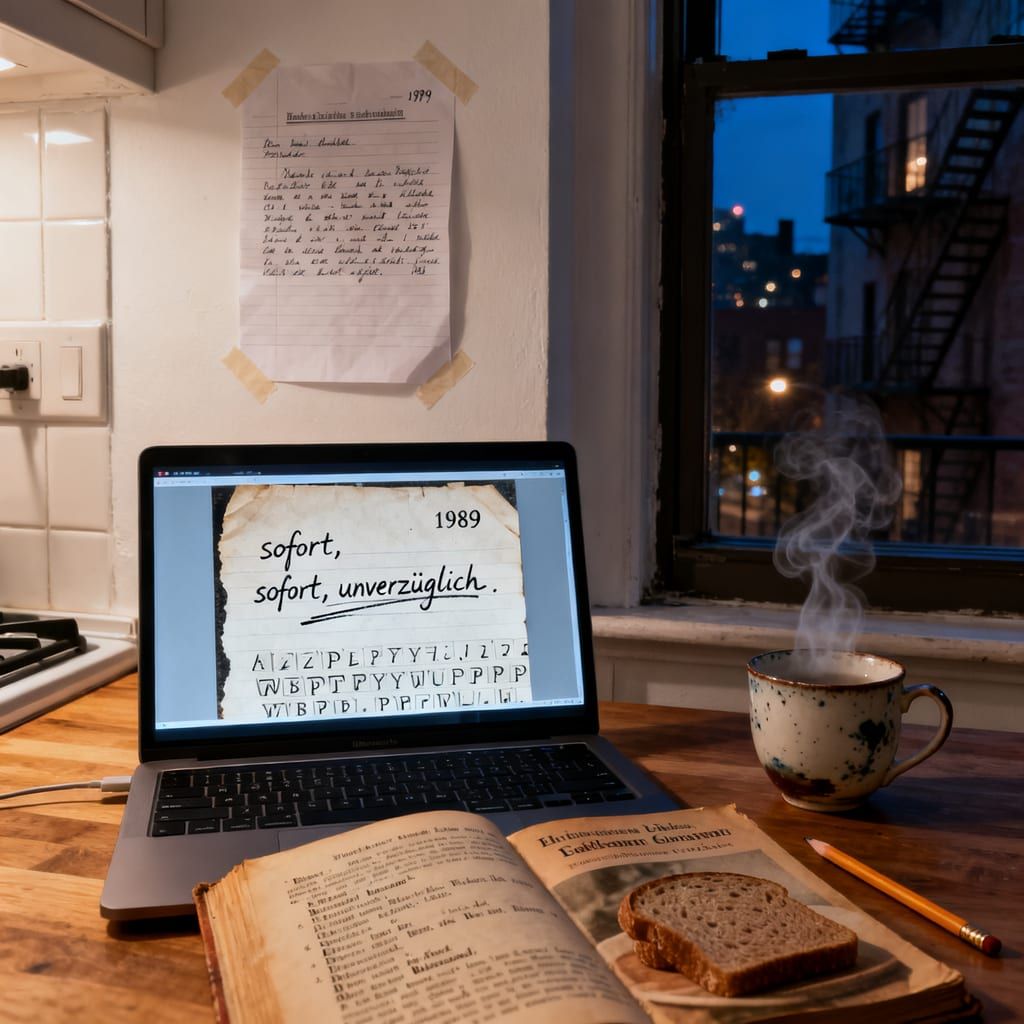
Click. Click. And then-there it is. A scanned notice dated 9 November 1989. Typewritten lines about travel permissions, cross-border visits. At the bottom, in pencil: a handwritten note with that same looping S. sofort, unverzüglich. Effective immediately.
Lena's breath stalls. The room seems to tilt, the steam from her mug twisting and then vanishing.
They build it together across emails-Lena in Brooklyn with coffee breath and the glow of a second monitor, Vogel in Berlin with his methodical paragraphs, and a retired press officer who replies at odd hours, each message like a pebble thrown from an old well. He was there when a man named Schabowski fumbled and then read, and the word sofort slipped from the page into the world.
The press officer remembers a quiet clerk with meticulous penmanship who sometimes made notes on drafts when the day grew too hectic. Ulrike, he thinks. Ulrike who spoke like someone stepping around puddles to keep her shoes dry. His memory tilts toward her like a plant to a window.
Letters from the box fill the gaps. Ulrike writes of queuing for oranges, of the way the sun fits in a winter courtyard at four in the afternoon. She writes of ration cards and neighbors, of rye bread and a tiny room where a guitar sounds like contraband laughter. She writes to a sister who left for the West and then farther still, says, I keep a kettle on in case- and then a blot where the ink must have flooded her hesitation.
One photo refuses to stay still: a woman at a window, a cup in her hand. Her hair is pulled back in a way Lena has seen in the mirror on rushed mornings. The background rises in that blocky way Lena has learned to recognize, concrete that believes in itself too much.
Lena reads a dispatch, watches a video that's been played a million times-crowds pressing forward, faces shocked into joy. The press conference with its stumble and the question repeated three times. Effective when? Sofort. Unverzüglich. The room rustles like a field giving way to wind.
She touches the screen as if it will answer. She thinks of her grandmother's margin notes, of the pencil whispering in a kitchen on a different continent, a different year. She imagines Ulrike at her desk that afternoon, pen tucked into a bun or a pocket, correcting spelling, adding commas, writing the smallest, truest word she has.
That night, the letters say, Ulrike stood at her window and watched the road swell with strangers. She went downstairs with a tray and a teapot and a stack of chipped cups and stayed there until dawn, pouring and listening as people said words they had not said in public in years. She learned the names of crossing points-Bornholmer, Staaken-and how a gate sounds when it swings, not as a squeal but like breath finding a way out.
On Monday, Lena sits in a bright room where potted plants try and fail to hide the edges of a glass wall. Her title-Product Designer-sits on a plastic badge she keeps forgetting to tuck away. A project manager is speaking about a new feature. New users must request access for full functionality. There is a form. There is a button. The button currently says: Apply.
Lena watches the cursor in the Figma file pulse like a heartbeat. She thinks of the dozens of small places where a word leans a little to the left and suddenly the room changes temperature. She thinks of her great-aunt's pencil.
"Can we try default-on for read-only?" she asks. "Let people see before we ask them to ask. And maybe not 'Apply.' It's a gate-word." Her voice shakes a little-too much coffee or too much lineage.
The engineer shrugs. "Security will have opinions."
"They always do," the PM says, dry. "What would you call it?"
Lena looks at the screen. The rectangle waits, a tiny field ready for a crop. "Welcome," she says. After a beat: "Or 'Start exploring.' Something that opens instead of judges."
Silence, then the click of someone typing. On the big monitor, the word changes. It is small and certain. Something loosens under Lena's breastbone.
That weekend, Lena brings the cookbook and the printed memo to her mother's apartment in Elmhurst. The hallway smells like cumin and bleach. Her mother stirs a pot on the stove and taps her spoon twice on the rim before setting it down-a habit that Lena has, from childhood, folded into a comfort she cannot articulate.
"Mami," she says, when the tea is poured and the dead are hovering politely in the quiet between them. "Do you know this handwriting?"
Her mother takes the page with two hands. She leans toward it, glasses at the end of her nose. A careful breath. "My aunt," she says softly, not looking up. "Your abuela's sister. We never..." She swallows words like pills.
They sit with the papers like a campfire between them. The kettle steams again without being asked.
"They said she was a clerk," her mother says. "Good with forms, with the patience to wait in lines. I was named for her best friend-the one with the guitar. Leni. She taught me how to tuck courage inside ordinary gestures. Like..." She searches the air. "Like leaving cake slices by a neighbor's door. Like answering the phone like it mattered."
Lena nods. Tears move behind her eyes like weather. "Vogel says she might have written-" She touches the margin. "This."
Her mother presses her palm to the memo as if to check its pulse. "She would have chosen a true word," she says, and then laughs a little. "Always did. Your father-" The name hangs like a pendant. "He used to tease me for choosing too many."
They laugh, and in laughing, they let something go. The walls of the apartment do not move, but the lines that cut through their family history shift, rethreading themselves quietly.
On the day the new feature ships, Lena writes two emails. The first is to her team: We are default-on for preview mode. Language shift: 'Welcome' replaces 'Apply.' She explains the rationale in bullet points-reduced friction, increased trust-but in the space between the lines she hears her own pencil.
The second is to three people. To her brother, because he will keep an old box safe without understanding why. To Herr Vogel, with a photo of her grandmother's cookbook and a thank-you that feels like it should be in a better font. And to herself, scheduled for ten years from now: A short family history, no grand claims, just the shape of a word that grew a door.
After work, she stops at the bodega for tea-loose leaves in a tin that smells like grass after rain. At home, she prints the memo again and tapes it above her desk. The wall is the same cheap drywall it has always been, painted landlord white. The paper flutters once in the slow current of the heater.
There is a knock. New neighbor-eyes like commas, pausing the sentence of the hallway. A cardboard box in his arms, a question on his face.
"I'm Lena," she says. "Welcome. Do you want tea?"
He smiles like someone who has been waiting a long time to cross into a room.
In the quiet after, cups on the table and a damp ring slowly expanding, Lena writes a note with a pencil she has sharpened to a careful point. A grocery list and a reminder to call her mother. She adds one more thing: Share the rye bread recipe with the building.
She opens the cookbook. The margins breathe. Flour dusts the counter like fallout from a kind explosion. She mixes and folds and waits for the dough to rise-patience performing its slow alchemy-while in her inbox a reply blinks from Berlin.
We do not always know who moves the world. Sometimes it is the ones who look like they are holding it steady. Thank you for letting me meet your Ulrike again.
Lena leans her hips against the counter and closes her eyes. In her mind, a street fills with people. A kettle sings. A pencil lifts from paper, the smallest word already on its way.
The wall on her printout does not disappear. But now, when she looks at it, the lines run through it-paths, arrows, routes a person might take if given permission. She does not say her relative changed history. She pours more tea. She chooses "Welcome" over "Apply." She puts a slice of rye on a neighbor's napkin, steam ghosting the air between them, a border dissolving where it meets breath.
A daughter learns to read between the lines of a life split in two
Read more →
A fog-draped night, two souls found, and the quiet shape of a life
Read more →
Story audiobooks for children of all ages — a new one every day on Smarter Way Stories.