Two Houses and One Quiet Heart
A daughter learns to read between the lines of a life split in two
Read more →
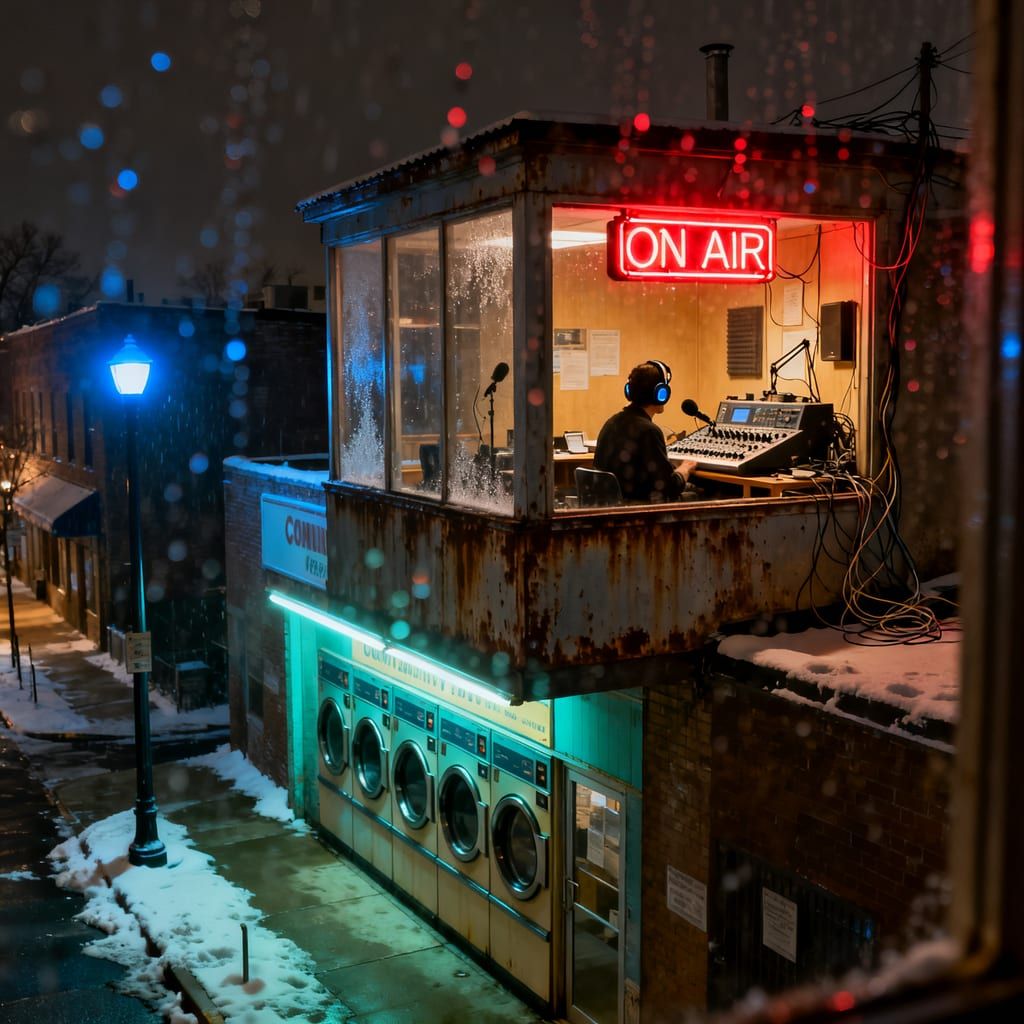
At two in the morning the laundromat below the station hummed like a tired animal, a soft churn that traveled through the floor and into Eli's feet. The fluorescent over the board had a tremor-its own pulse-and if he stood too long beneath it, he could feel the flicker in his molars.
KORA was tucked above the dryers like a secret: one low room lined with egg cartons and old carpet, a thrift-store couch, a tangle of cables jealous of each other. Eli cued the weather and watched the red phone for any sign of life.
"High of thirty-six," he said into the foam, "low of still winter. Sidewalks are honest ice. If you're walking home, walk like you mean it." His voice, he knew, could coat an empty hour without breaking a sweat. He could free-associate his way through a snowstorm and never say a thing.
He reached for half-remembered trivia about a song that had just ended-something about the drummer's cousin owning a bakery-but the board's studio line startled into attention, a red bead blinking in the corner of his eye.
Eli glanced at the clock, at the playlist he'd stacked like a Jenga tower, at the station manager's note-sponsors love predictability-still wedged like a threat under the fader. The line kept blinking, patient as a turn signal.
He took it.
"KORA, midnight run," Eli said, toggling the delay with a practiced thumb. "You're live."
A breath. Thin, careful. "Good night. My name is Arman. I would like to read a short note, please." His accent held its own rhythm, words set one at a time on a rail.
Eli's throat tightened. Dead air's a sponge, the manager liked to say. It soaks up money. He nearly redirected the man-requests, birthdays, shout-outs-but something in the steadiness held him.
He slid the fader open. "Go ahead."
Paper rustled. The room's hum got louder, as if leaning in. "Thank you to a person on Bus Fourteen last winter," Arman read. "You left a cup of hot tea on the empty seat. I was cold down to my bones. I didn't drink it because it was not mine, but I held it in my hands until my stop, and for twenty minutes I remembered summer. If you hear this, I hope your hands are warm."
He hung up before Eli could say anything. The studio seemed to exhale.
Eli hit the cart for a song he loved and rarely got away with-slow, a voice like an attic window opening. He leaned back, let his fingers push patterns into the arm of the chair, felt something unnameable happen to the room.
Before the last verse, the red phone pulsed. Then again. And again.
"KORA," he said, breathless now, riding the delay like a bike. "You're on."
"There's a nurse at St. Catherine's who hums when she takes blood-'Moon River' maybe-" a woman said, quick. "If she hears this: thank you for making a needle sound like my grandmother's kitchen."
Click.
"My neighbor on Harlan shoveled my stoop when my back was out. You're the one with the red scarf and the tiny dog. I baked those cookies. They were for you." A man's voice, shy.
Click.
A teenager, words tumbling: "I was cashiering at the RapidStop and I saw this guy crying in the lottery aisle. Sir, if you're listening, I pretended not to notice because I thought you wanted to be invisible, but I wiped the scanner extra slow so you could have time. I hope you got home okay."
Click.
Eli looked at the playlist, the careful scaffolding of songs and spots he'd built to carry him to three a.m., and he let it all fall. "We're going to do something a little different tonight," he said, the sentence tasting illicit. "Three sentences into the darkness. Gratitude or apology. First names only. No cussing, no sales. You've got forty seconds."
The hour didn't just tip over-it spilled, generous, past anything he could mop.
By Thursday, the station manager stood in the doorway, arms crossed over his KORA hoodie, blinking at the light like it was misbehaving on purpose.
"Sponsors pay for predictability," he said, low. "They like knowing when their spots hit. Not... whatever this is."
Eli gestured at the monitor. Late-night streaming numbers had climbed like ivy in just two days. The inbox swelled with voice memos that began, "Is this too weird to put on the radio?" and never were.
"Three minutes," Eli said. He held up three fingers like he was promising a child. "Every night. Same time. I'll write it up."
He printed the guidelines in Sharpie on a slice of cardboard cut from a paper towel box: first names only. no sponsors. no hate. max 40 seconds. gratitude or apology.
He propped the sign behind the board with a mug.
The segment bloomed like a bruise and then like something else. A butcher called to thank his choir teacher for teaching him to breathe-the same way he now breathed before slicing into a stubborn bone. A woman apologized to a librarian for never returning a book in 1998; "I still have it. It's 'A Tree Grows in Brooklyn.' I'll bring it tomorrow." A busker thanked a dog: "You with the one droopy ear. You stop every day and listen to me finish the bridge. I'm writing a song called 'Droopy Ear' for you."
Every night at two, Eli opened the line, and for three minutes the city pinned its heart to the air.
Near the end of the second week, Arman again. Eli knew his breath by then-thin but steady, like a metronome in the next room.
"May I dedicate a line?" Arman asked. "To the elevator mechanic at St. Catherine's. He stayed after his shift when the lights were not correct-flickering like a disco-and rode up and down with me until the elevator remembered itself. Thank you for not letting me be alone in the moving box."
Eli smiled without meaning to. "You're the custodian, right? The nurse with 'Moon River'? She listens."
A small laugh. "I practice my English with your station on. You say a word I don't know, I write it. I make a notebook from food wrappers. My boss laughs."
"Come up and read live," Eli said, impulsive. "I'll make coffee."
"Maybe," Arman said after a beat. "When the night gets softer."
He never came. Instead, a nurse called two nights later-voice bright as if trying to beat back fluorescent fatigue. "Arman keeps his notes in his pocket. They're greasy like fries. He shows me sometimes. He says he trusts the radio because it doesn't look back."
After that, when Eli played Arman's voice at the top of the segment-the clip of the tea on Bus Fourteen-callers spoke as if he were listening, as if he were on the other end of their sentences. He had become the door they'd walk through.
Weeks layered and the cardboard sign softened at the corners. Eli learned to count forty seconds by feel. He learned to hear a lie and invite it to turn into a truth halfway through a sentence. He learned the names of the regulars-the woman who called only on Thursdays to apologize to her son ("You know who you are"), the man who rang from his car after plowing the West Side, his voice full of snow.
On a Tuesday, at 2:07, the line stayed quiet.
It wasn't that nobody called. It was that he didn't.
Eli left the fader where it was and did not fill the half-minute with weather or trivia. He let the silence sit. It expanded, patient as a held breath. The building's hum stepped forward. Somewhere below, a dryer banged one sock against the drum.
The red light blinked.
"KORA," Eli said softly.
A nurse, the same one, this time with her voice frayed at the edges. "He died two nights ago," she said. "His lungs finally... after all the bleach and the winters. He left something for you. For the station. A voice memo on my phone. He said you'd know when to play it."
Eli felt the room tip slightly, as if the building had shifted to let the night through. He opened his email, clicked the file. Arman's voice arrived soft as the buzz in the walls.
"If you're hearing me," Arman said, "I didn't get to say all my thank-yous. So here's my last one: to whoever keeps the night from swallowing our small words. Keep the line open."
Eli didn't breathe again until the file ended. Then he aired it, palms damp on the wood of the desk, and the city lifted its head.
The lines flooded. People cried into the handset, confessed things with the privacy only two a.m. could offer, said thank you by name to a boy from eighth grade who shared a sandwich, to a woman in a blue coat who pressed a quarter into a hand at the bus depot, to the man who fixed a crowded shopping cart wheel at the market without asking.
The Open Line became KORA's spine. The manager stopped standing in the doorway and started standing behind Eli, listening with his arms at his sides. Night-shift workers planned their breaks around 2:00. Students wrote scripts they tore up on air. Insomniacs built small shrines of receipts and Polaroids on their nightstands and dialed with shaking fingers.
A year later, the segment anchored a weekly simulcast with two partner stations. It outlived sponsors who wanted morning joggers instead of midnight souls. It outlived a part-time DJ who moved to Denver, and a set of headphones that disintegrated at the ears.
Eli printed Arman's words-Keep the line open-in block letters beneath the cardboard rules. He taped them down until the tape yellowed and learned the shape of the wall.
Storms came; one August, lightning hit the transformer up the block and the station hiccuped. Eli threw the breaker, prayed to nothing, and took calls from people sitting in their fogged-up cars, reading from napkins by dome light while rain made water theater on their windshields.
"I'm in the Aldi parking lot," one woman said, laughing and crying at once. "If anyone sees my headlights, forgive me. I look like a lighthouse. Thank you to the kid at the register who packed my eggs like treasure."
Eli rode each small word across the night like a ferry.
Sometimes, after the scheduled three minutes, he'd steal an extra thirty seconds and play Arman's memo again. Not every night-just when the room felt thin and the world convinced itself that mouths were only for shouting.
He learned to recognize the sound of someone standing under a streetlight. He could hear the tin of a service stairwell, the rustle of uniform cloth, the shyness that had nothing to do with shame and everything to do with awe.
Arman did not call again. He didn't have to. He had made a room and left the door propped with one shoe.
Eli turned down the overhead and worked by the small glow of the board. The laundromat sighed below. The city shifted its weight.
At 2:07, a red blink, as reliable as breath. The exact minute Arman had once missed.
Eli hit play on the memo. He let the voice of a man who cleaned corners the rest of the world didn't see set the key for everything that came after.
"Keep the line open," the speakers said, soft as a hand to the back.
Eli looked at the cardboard-wrinkled, held together with tape, rules bleeding at the edges like they'd been rained on-and thought, Okay. We will.
He slid the fader up to meet the next caller's breathing and waited.
The city answered itself.

A daughter learns to read between the lines of a life split in two
Read more →
A fog-draped night, two souls found, and the quiet shape of a life
Read more →
Story audiobooks for children of all ages — a new one every day on Smarter Way Stories.