Two Houses and One Quiet Heart
A daughter learns to read between the lines of a life split in two
Read more →
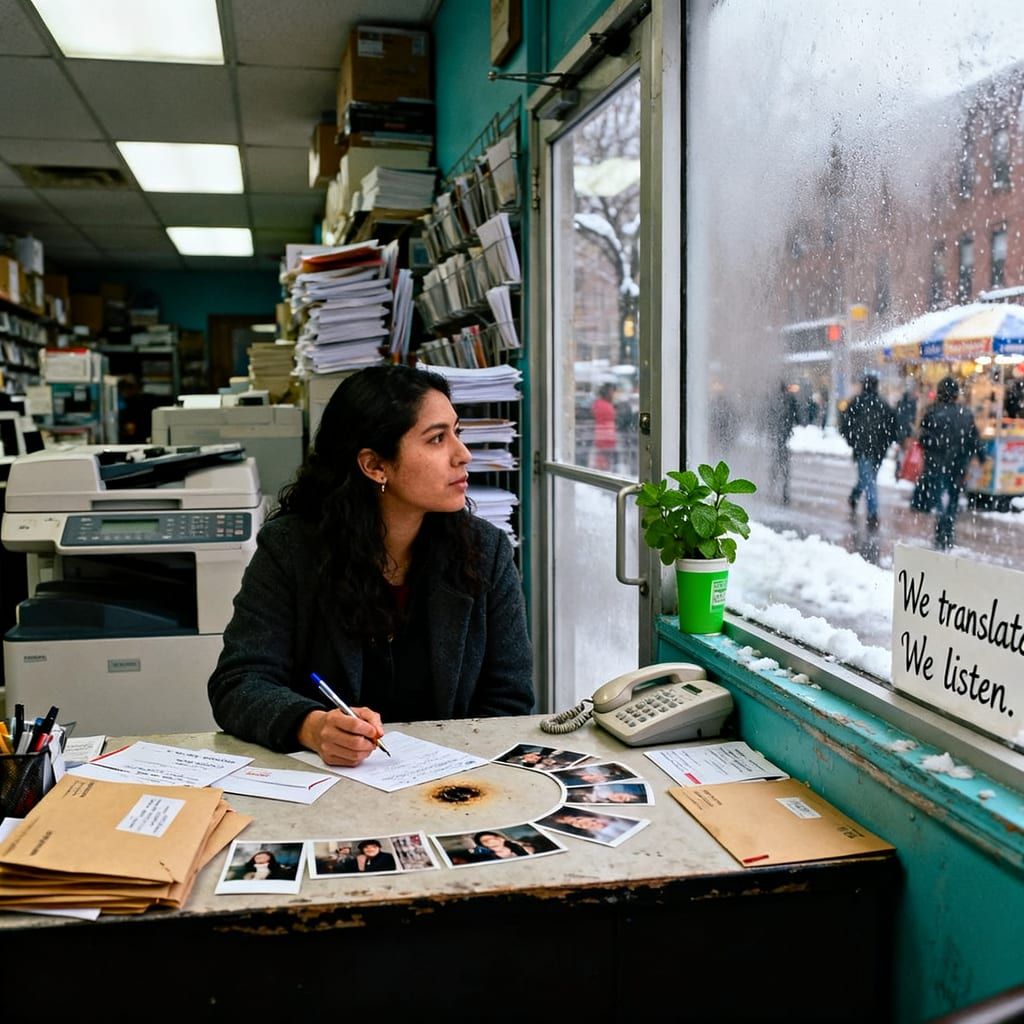
On Eighty-Second Street, winter scraped its nails against the copy shop windows and left a skin of salt on the glass. The machines hummed like bees behind a wall, steady and slightly irritated, and Lina Morales sat at the battered corner table with the cigarette burn no one could sand away.
People slid their lives toward her in envelopes and folded papers. She translated the heat out of threats, tucked warmth into apologies, braided sense where sense had been torn. She knew how to breathe between syllables so that fear didn't set like concrete.
"Mi niña," said the Guatemalan seamstress every other Friday, placing Western Union slips like prayer cards. "Write for my nietos. That I am good. That abuela's hands still work."
Lina wrote, read back, underlined a date.
The delivery biker came with a municipal ticket, helmet hair matted, fingers pink from the cold. "Is this, like, a big deal? I was in the bike lane except the lane was... not there."
"It's a first warning," Lina said after scanning the legalese. "Pay the fifty. Don't ignore it." His shoulders loosened like a coiled rope.
There was the Pakistani cabbie who stood exactly two feet from the copier and waited. He would not believe a letter until he heard it aloud in Lina's voice. "Say the part about the inspection," he'd ask. She would, twice, and he would nod, lips moving to the beat of her words, practicing.
Accuracy mattered to Lina the way a handrail matters on ice. But there was the other thing she had learned in the muffled spaces between words-the way of holding someone's story so it didn't split at the seam. A note on her desk in block letters reminded her: Name them the way they name themselves.
Her own father's number lived in her phone, unsaved and unlabeled. When the shop fell quiet-between a passport photo and a ream of ivory cardstock-she would feel for it, thumb hovering, and tuck the phone away again before the sound it might make could decide anything.
Doña Rosa arrived on a Tuesday with dice of snow clinging to the hem of her black skirt. She set down a letter fat with bad air. Her hands were puffed red from dishwater, a ring biting into her finger.
"Lee, por favor," she said. Her voice had a gravel edge. "It says my Mateo is... detained. They move him. No address works. I write and it returns."
Lina unfolded the English letter: a detention transfer, a list of rules knuckled into bureaucratic type, a mailing address with a nine-digit alien number. Failure to include full name may result in returned correspondence.
"Let's write again," Lina said, and listened while Doña Rosa dictated in Spanish, the thread of a proverb from Zacatecas woven into the lines. Del otro lado del puente también hay mañana. On the other side of the bridge there is also tomorrow.
The next day, a quiet line cook in a grease-sweet hoodie brought a letter with the smell of onions still peppering the paper. He called himself Mat, avoided the fluorescent light as if it could stamp him.
"I got this," he said, tapping the envelope. "From a woman saying she's Mamá Rosa. It keeps bouncing back when I try to answer. The address is... it doesn't stick."
He slid the page to her. Perdóname. The same proverb in the second paragraph. A lullaby caught at the end like a shirt on a nail: Duérmete, mi niño...
Lina read aloud, slowly, as the copy machines exhaled. The words stepped out of the paper and breathed on the table. In Mat's face a flake of relief fell, melted, and was gone-fear was quick like that. "I need to say I'm not mad. That I got moved. That I-" He stopped, jaw set.
"We'll write," Lina said. "We'll make the address behave."
Winter pressed its forehead to Queens. Wind turned corners with knives tucked in its coat. The shop thrummed; Rosa came back with photographs-Mateo on a soccer field at six, shin guards too big; Mateo in a paper crown made of a McDonald's bag, chocolate on his chin. Mat arrived with pay stubs, a crumpled receipt from a midnight bus, a small passport photo in which his hair rebelled.
The envelopes kept returning like stubborn pigeons. One had a scar of footsteps across it where a package had crushed it underfoot. Lina corrected a misspelled street. She flagged a missing middle name. She called the detention center number and waited through a moan of hold music.
"You give me the A-number again," the woman on the line said, bored as a season. "He's been transferred."
"To where?"
"Another facility," the voice said. "No, I can't say. Mail follows. Eventually."
That night, the radiators at home clanked like bones. Lina tried her father's number and hung up at the first ring, pulse in her throat. She practiced names in the dark until they settled on her tongue. Mateo. Rosa. Mat.
She kept hearing the same lullaby end on a held, frayed note. She kept seeing the same proverb grip the page. Del otro lado del puente...
Mat placed his legal name on the table like contraband. "Look, I didn't- I mean, my papers say something different. My boss thinks I'm Mat. But it's... it's Mateo. With an R in the middle. Castillo." He said his whole name as if it could break a window.
Lina felt the pieces line up with an audible click that seemed to start in her ribs. "R. For-"
"Rosa," he said. "I keep moving kitchens. I'm paying a lawyer. I didn't tell Mamá because- I thought if she knew... I don't want her to be ashamed."
"Is she your grandmother?"
"She raised me. My mother, she-" He shrugged. "Rosa's my only home."
On the table, the photographs and pay stubs and envelopes formed a bridge even a blindfolded person could see. It had been there, shingled out of paper, all along.
Lina reached for her old canvas bag and fished out a folded business card the way a magician feels for silk. A volunteer attorney she'd translated for on Saturdays, fine-lined and sleep-starved. She stepped behind the racks of printer cartridges and dialed.
"Ethan Meyer," the voice said, already chewing something bureaucratic.
"It's Lina. I have a case that's not a case. A person who is two people, only he's just one, and a grandmother who's been practicing grief. We need a three-way, and we need mercy."
He sighed-the good kind. "Give me ten minutes."
Ten minutes became twenty and two more calls. Lina kept both clients in the shop with a pot of mint tea made from a handful of leaves she grew in a chipped mug under the windows. Snow thinned its shoulder on the curb, turning gray and then a translucent nothing. The copy shop's hum pitched up to a chorus.
When the phones finally nested in her palms and the clicking began-detention center, then Rosa's cell, then Lina's own on speaker-Lina set them side by side like small, square birds.
"Bueno?" said a voice that had been worrying itself raw.
"Mamá Rosa," Lina said carefully, rolling the R the way Rosa did. "Soy Lina, la traductora. I have someone here."
"¿Quién?"
Mat's hands trembled on his hoodie strings. He looked at Lina. She nodded past the knot in her throat.
"Soy yo, Mamá," he said. Not Mat. The full name choosing him. "Soy Mateo."
The line breathed. Then a sound like a dish set down and both hands flying to a mouth. Then a sob that unfolded into a laugh that tripped and stood up as a scold.
"¿Dónde carajos estás?" Rosa cried, and then, softer: "Mi niño. Mi Mateo. ¿Comes? ¿Duermes?"
Lina translated when words snagged, fast when they needed to be fast, slow when syllables wobbled with tears. Ethan's voice threaded in with codes and addresses and the way a letter must be labeled to find a human in a maze.
Between the legal knots came the ordinary stitches. "I burned the rice last week," Mateo confessed, and Rosa laughed through a cough: "You always stir too late." They anchored dates to a calendar like tent stakes. They pronounced names until they felt right in the mouth again.
The machines in the shop did their steady work-spitting, swallowing, stacking. Outside, the snow loosened into rain so light it seemed invented. The air changed. Lina could feel it, an unclenching.
When the call ended, Rosa stayed on the line an extra second as if air itself could be held. "Gracias, hija," she said. "You kept the bridge from breaking."
Lina pressed the phones to her chest for a heartbeat. "De nada," she whispered to no one and to every piece of paper on the table.
In the days that followed, the copy shop shifted by degrees you could only see if you stood still for a long time. The condo board member who had come in frowning to complain about delivery bikers rattling the grate at midnight returned with a box of envelopes, those creamy ones that make pens glide.
The delivery biker-the ticket guy-showed up on a Tuesday afternoon and spent twenty minutes teaching Rosa how to video call without hanging up on her own face. At the third try, Rosa lifted the phone and kissed it by accident. Mateo laughed from his borrowed room two boroughs away.
Mat-Mateo-started leaving empanadas on the counter when Lina stayed past closing. He never said they were for her; he said, "These might get cold," and then would go mop the puddle everyone walked through.
The Pakistani cabbie began folding extra napkins into his pocket after he paid for a copy of a summons. "For tears," he said, pretending he was talking to his future passenger.
Lina wrote a sign in tidy block letters and taped it to the door with green painter's tape: We translate. We listen.
Spring arrived the way it does in Queens-in a clap. A stretch of seventy-degree days opened the windows and let music spill in from car stereos idling at the light. The mint plant on the sill grew new, ridiculous leaves. Someone brought a box of marigold seedlings and left them near the laminator as if heat were sunlight.
The work didn't shrink the world. It never could. But the air changed when people finally heard one another. You could weigh it in your palm if you tried, like a letter that had made it across.
One evening, with the sun still insisting at eight o'clock, Lina's phone buzzed with a number that was not saved and never would be. She let it ring twice and then answered.
"Lina," her father said, careful with the i. The radio behind him fuzzed a cumbia into tin. "You still at that place?"
"I am," she said.
"What do you do there, m'ija?"
She looked at the table with the cigarette burn, at the envelopes in their box, at the sign taped crooked in the door's glass. A woman was laughing on a video call, someone else was punting a swear word into a joke so it wouldn't bruise, a machine was counting flyers for a birthday party that had become a reunion.
"I listen," she said. "I get words to the right ears."
On the line, something eased. "Then good," her father said, his voice going soft. "Then you are busy."
After they hung up, she copied the letters R-O-S-A in neat capitals on a new stack of addressed envelopes and pressed her thumb to the ink before it dried, leaving a smudge that looked like a petal.
Outside, on Eighty-Second, the street vendor shook a plastic bag open like a sail and paper napkins jumped, then settled. The bridge they'd built held in the wind, which was all it had to do.
By the time the first summer thunder argued with the subway, the burn mark on the table had begun to look like something else to Lina-a small river, maybe, drawn wrong and right at once. She traced it with the edge of her palm and smiled without realizing.
Another letter slid toward her, and another voice asked for a crossing. Lina picked up her pen and made space in the middle of the busy hum, the way a hand makes space in a crowd for someone to pass. She breathed on the words and watched them learn how to walk.

A daughter learns to read between the lines of a life split in two
Read more →
A fog-draped night, two souls found, and the quiet shape of a life
Read more →
Story audiobooks for children of all ages — a new one every day on Smarter Way Stories.