Two Houses and One Quiet Heart
A daughter learns to read between the lines of a life split in two
Read more →
Eli Novak carries his case like a small animal and listens on the threshold the way other people take a breath before diving. The hallway hums in F-lights in a tired fixture, the far-off elevator's sigh. His right ear catches it. His left ear feels it along his jaw.
Inside the loft, footsteps have an echo, and the plants are the only things that rustle. Everything else is curated into smoothness: white counters, a brass kettle, a metronome posing like an ornament at the edge of a shelf. It ticks once when the HVAC sighs, then goes still, a precise heart refusing to spend itself.
"Thanks for coming," the owner says. She is bare-footed and camera-ready, a wellness influencer who turns her vowel sounds into soft-edged stones. "The D above middle C is sharp. It's been driving me crazy." Her voice is bright-her room is brighter.
The Steinway baby grand gleams like a compliment. Eli circles it with his fingertips, pressing the board lightly to feel the answer. There is a brittle hush beneath the polish, a silence with edges. The fridge holds a stubborn B-flat, the radiator exhalation hangs in D, and the ceiling fan offers a tremolo that can't decide if it's content. He leans closer until the vibrato of the house rises into his palm like a cat meeting a hand.
He starts with temperament, all the middle notes that teach the others how to get along. The strings argue in metallic whispers-octaves fighting small wars of pride-until his mutes make lanes between them. He adjusts the hammer angle as if coaxing a child out of the doorway. The highs are so glassy they threaten to pierce the quiet; he softens them by hair's breadths, shaving hard light into silk.
"Will it sound less... harsh?" she asks, as though harshness is an unphotogenic mood.
"It'll sound like the room intends to be heard," he says, and she nods as if she'd always meant that.
When he leaves, the loft is still slick with its own reflection, but the metronome has a faint tick in it now, like a secret admitted under breath. The high notes no longer cut. They glow.
The bungalow sits with its shoulders hunched under the sun. A nurse opens the door in scrubs patterned with tiny moons. The living room smells like lemon oil and microwaved coffee. Curtains take the edge off the day.
"Sorry about the mess," she says, although the mess is just life: a backpack like a collapsed tent, a pair of shoes facing different futures, a stack of bills with a coaster marking its place. Photographs lean on the piano top, glass winking. Two kids grin gap-toothed at the ocean. Beside them, a frame with nothing inside except the paper insert-a placeholder smile.
The spinet has a damper rail that squeaks like chalk on asphalt. Each pedal press leaves a little yelp, and the A below middle C wobbles like an ankle.
"I work nights," she says. "I try to play quiet, after. Helps me... settle." Her face rearranges three times and chooses a half-smile.
He sets the case on the floor and lets his tools clink soft hellos. The damper felt is worn to a thin confession. He oils the pedal rod until even the hinge sigh sounds grateful. He shows her how to raise the bench a notch to save the ache that's woven into her back. Her thank-you is unshowy and solid, the kind that builds a bridge you can drive over.
When he strikes a single note, the house hums under it-an E that seems to live inside the drywall. He spreads his fingers across the soundboard and feels the overtones climb his wrist in damp warmth. The photos watch. The missing frame watches harder.
He tunes toward gentleness. The highs surrender their squeal. The bass steadies its breathing. When he tests a lullaby with the soft pedal half-depressed, the nurse leans in the doorway and rests her head against the jamb. The chords lift the weight of the hour just enough that a person might walk under it.
"You can play late," he tells her. "The walls will keep the secret."
A townhouse whose brick holds a day's heat like soup in a bowl. Inside, steel stairs and a rug that wants to be a conversation starter. An upright with a lid that complains when lifted.
"We don't need anything fancy. Just make it normal," the husband says. He is a shoulder ahead of his words, impatient with sound's reluctance to obey.
"Whatever you think," the wife adds, folding a towel that has been folded once already, then again, making order and remaking it.
Eli plays the middle register and hears it instantly: a beating between G and G-sharp that shimmers like something said and unsaid, two frequencies close enough to bruise each other. The pulse lives in the space over the keys, a faint tremor against his palm, the polite violence of a note refusing agreement. He doesn't look up.
He moves with the patience of clockwork. A quarter turn. A breath. He leans into the hammer's grain and coaxes the metal toward its neighbor, away from pride. The argued interval relaxes by degrees until the wobble disappears like a held tongue finding somewhere else to rest.
He plays a simple progression, the kind without heroics-C to F to G, back to C-a sequence the body recognizes as a hallway it's walked since childhood. He doesn't play to speak for them. He plays as if the room has something to say and needs his hands as ears.
They end up at the doorway without meaning to. The husband's arms fold, then drop. The wife's towel becomes only a towel. They breathe together, in the same bar line. He hears them not as notes but overtones: hers in the air just above the melody, his in the floorboards. No apology, no speech. Just the absence of the earlier pulse.
Before he leaves, he tightens the bench screw that has been rattling like a nervous habit. The silence that follows feels like humility rather than lack.
Between calls, Eli rides the bus with his case braced against his shins, collecting the city's key like a conductor. Crosswalk beeps in A. A cyclist's chain in E-flat. A child's laughter untempered and exact.
He has trained fingers and untrained losses. The left ear-an accident, sudden and unassuming as a door slammed on the wrong day-hears more in bone than in air. When he was a student, he reached for Liszt and found a fog. He learned, instead, the angle at which rooms admit truth.
He does not tell people that he hears with his hand on their soundboard, with his ribs against their silence, with the part of him that had to become quiet to keep from breaking. He does not tell them their overtones betray what they hide. He listens until the note stops arguing with itself.
In the evening, he sits at a diner counter and eats eggs for dinner. The plate hums in D from a hairline rattle between porcelain and laminate. He smiles. The waitress refills his coffee and asks if he wants pie. He says yes because the pie case has been singing B for the last five minutes and maybe B deserves an answer.
The building's stairs argue with each step, telling all their old stories as Eli climbs to the third floor. The hallway smells like laundry and last night's onion. When Marisol opens the door, her gratitude arrives before her name. She stands back to let him in, wiping hands on a dish towel the blue of a shallow sea.
The living room is a collection of lives trying to learn each other's rhythms. A plant bending toward a stubborn window. A stack of homework like geology. A boy-Nico-at the table with headphones that make a country of his head. In the corner, the spinet sulks in the shadow where you put things you don't know how to forgive.
"The piano was my dad's," Marisol says. "He died in February. I keep thinking I'll fix it, and then-" She gestures, the rest of the sentence hanging like a coat without a hook.
Eli kneels and presses his palm flat to the panel. The room hums in E minor, fatigue braided with tenderness. The action is gummy, keys that stick and gossip, low notes that call answers from somewhere they shouldn't. Inside the belly, something chatters at the bass like a coin in a dryer.
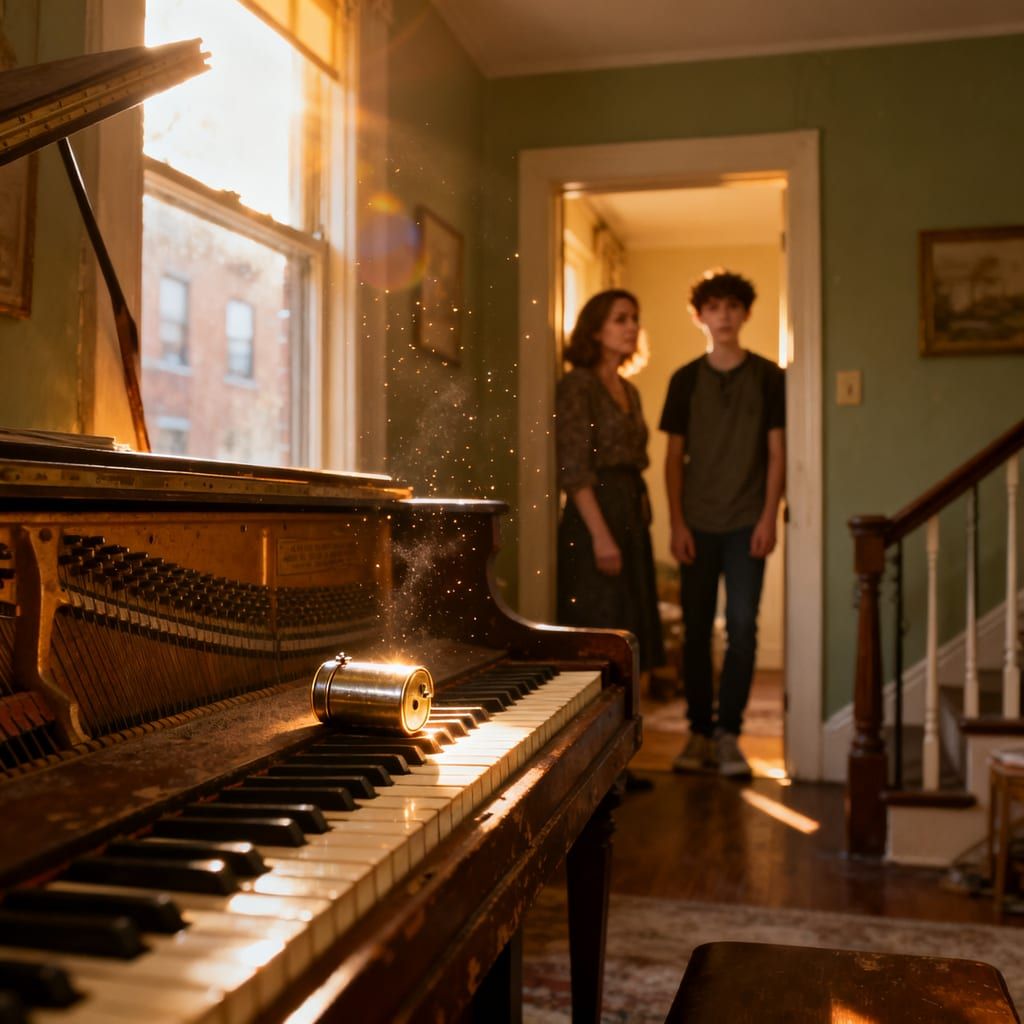
He lifts the fallboard and unhooks the front panel. Dust falls in soft avalanches. He sees it then: a sliver of metal wedged behind the bass strings, teeth along its length like the grin of something that knows more than it tells. He teases it free with needle-nose pliers, and the mystery drops into his palm with a soft, surprised weight.
A torn music box cylinder. Held wrong years ago. Lost while moving. Or placed during a moment of distraction-who knows. He rubs his thumb along the teeth and the air tries to be a melody.
He winds it just enough. A cracked tune wanders into the light, thin and stubborn as a fern between sidewalks. Marisol's breath catches in the kitchen, not loud but unmistakable. Nico's shoulders shift. On the third measure, the song remembers itself: a lullaby with a lift in the second phrase, the little reach that says again, again, and I will come.
"My dad," Marisol says, voice level as a sheet pulled tight, "used to sing that when it rained and the lights flickered. When the rent-" She stops, but it's in the room now, the way the note you don't play can be the most important one.
Eli takes out the action and shows Nico how hammers learn to behave. He replaces the worst felt, a rectangle the color of the inside of a shell. He wipes old dust that smells like attics and birthdays. He oils what asks to be oiled. He sets the tuning hammer to the first string of low E and breathes with it, turning until the wobble narrows to a line you could walk.
When the soundboard is tuned to itself, he plays the lullaby slowly, left hand steady as a heartbeat, right hand tasting the notes like someone relearning a street after the trees have been cut back. He rests his fingertips on the wood. He doesn't need the full sound to know he's found it; the resonance runs through his bones like rain down a gutter.
Nico peels off his headphones. The room ticks the way rooms do when everyone stops pretending not to listen. He watches Eli's hands the way a person watches advice they didn't ask for but might accept.
"Wanna try?" Eli asks him.
Nico shrugs with all the armor of seventeen. He sits. His fingers are cautious bridges. He misses the second note and frowns, then finds it. Eli doesn't correct; he keeps his palm over the board, letting the overtones tell him what matters. After the third run, Marisol hums the line that rises. Her voice is a little out of practice, a little perfect.
By the fourth, they have made a small raft of it. Not a declaration. A thing you can hold onto.
Eli leaves the music box on the fallboard with the teeth turned toward the light. He writes a note on a scrap torn from an old appointment card: Keep this where you can see it. For when the room forgets its key.
Nico looks up suddenly. "Did you-were you a pianist?" As if he can hear the ghost of Liszt in the way Eli touches legato.
"Once," Eli says. He smiles with one side of his mouth, the side that still rings true. "Now I tune the way houses think."
"Is that... hard?" Marisol asks.
"It's quieter," he says. He does not say it is easier. He does not say the city sings to him whether he wants it or not, that grief has the same overtone as metal warmed by the sun.
He packs the case. The tools nestle like spoons.
As he opens the door to the hall, he hears it-not with his ears alone, but with the floor, the walls, the old wood that has learned a thousand footfalls. The first notes of mother and son, finding the line between them, practicing the law of return: a phrase leaves, a phrase comes home.
On the bus, the city carries its small weather. Windows blur. A man argues gently into his phone. Two kids trade a game back and forth without words.
Eli rests his hand on his case and feels the week still ringing there: the influencer's aloof highs sanded kinder, the nurse's late-night chords with their soft pedal secret, the townhouse's uneasy interval released into air. And the walk-up where a broken cylinder rolled back into a life and made room for it.
He presses his thumb to the hinge of his tuning hammer, a familiar pivot. He knows the sound houses make when they forgive each other-the drop in pressure, the line that stops shimmering.
Outside, someone drags a suitcase along cracked sidewalk. The wheels play a cheerful D against the stones. He smiles and lets the city be a band without a conductor.
Sunday will be silent on purpose. He'll sit by his window with the radiator hissing its faithful D. He will not play. He will listen until the room shows him the shape of itself. Then, on Monday, he'll open another door, and another, and read the air the way his hands remember.
Because what houses sound like inside is another way of saying how people are, when no one is hurrying them to speak.
A daughter learns to read between the lines of a life split in two
Read more →
A fog-draped night, two souls found, and the quiet shape of a life
Read more →
Story audiobooks for children of all ages — a new one every day on Smarter Way Stories.