Two Houses and One Quiet Heart
A daughter learns to read between the lines of a life split in two
Read more →
The day the severance check arrived, the apartment felt larger, as if grief itself had pushed the walls back a half inch. Radiators clanged and coughed. Outside, Chicago wore its January like armor-sidewalks glassy, wind shearing past the eaves like a blade.
Lina Morales squinted at her pantry until the shelves steadied. Lentils, brown and ordinary as buttons. An onion soft at the neck. A wrinkle of tomato paste, a heel of cumin, a few carrots that had gone freckled and sweet. Soup, she thought, ridiculous and necessary. Her hands needed a task that could outlast the afternoon.
She signed her name on a scrap of printer paper with the last good pen in the drawer: Free hot soup, apartment 3B. Bring a bowl if you have one. She taped it in the foyer among realtor flyers and a missing mitten notice-then stood there a second, embarrassed by her own hope.
Back upstairs, she set the big pot on the burner and let oil whisper. Onion in. Carrot coins. Garlic until the kitchen smelled like something alive.
Three knocks came in the time it took for the lentils to lose their hard center.
First-a delivery driver with a scarf iced to his beard, helmet tucked under one arm. He hovered in the doorway until the steam clouded his glasses.
"Am I too early?" he asked, already inside. His hands trembled. He cradled the bowl she offered as if it had its own heartbeat.
Next, a woman with a sleeping bag rolled tight under her arm, hair snared back with two pencils. She set the bag by the radiator and didn't take off her coat. When Lina ladled, the woman nodded once, quiet thanks catching in her throat.
Then a teenage boy-hood up, eyes down-who ate the first bowl with two hands like a cat at water, then another, and another, apology barely forming on his face each time his spoon clinked empty.
Lina watched the pot, certain it would betray her. She measured each scoop like a prayer. Somehow, the surface hardly dipped. Heat lapped the rim, a slow tide.
"Magic pot," the delivery driver said, grinning into his steam.
"Lentils," Lina said, but a place in her chest listened.
By Wednesday, the sign in the foyer had gone soft at the corners. People started showing up early, then staying late. Boots made a wet garden by the door.
A retired health inspector named Agnes arrived with a clipboard she pretended she no longer owned.
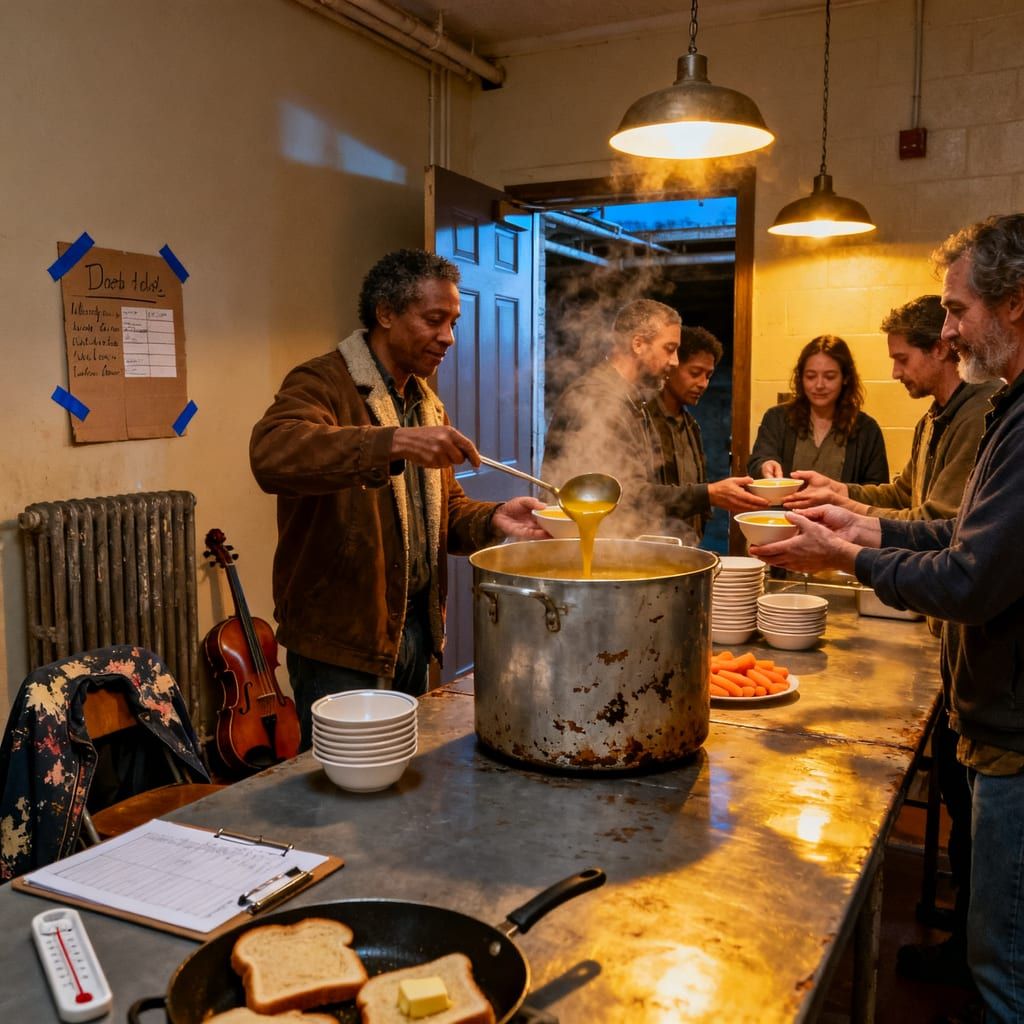
"I can't turn it off," she said, tapping a thermometer into the broth. "One-forty at least, dear. You don't want me as your cautionary tale." She left a note later, slanted and firm: Keep above 140°F. Label allergens. Consider hairnets (optional, but I sleep better).
A man with a paint-stained jacket worked in silence at Lina's wobbly shelf, the kind that had threatened to drop her plates in the night. He vanished before the soup cooled, leaving the wood leveled, screws sunk flush.
"Who fixed it?" Lina asked the room.
No one insisted on credit.
A teenager-the same boy, maybe, or another who stood beside him like a backup voice-tore a frayed piece of cardboard from a box and made a sign-up board with a borrowed Sharpie: carrots, cumin, bowls, time. He pinned it to the hallway wall with blue painter's tape and a knife nick.
Guests began to arrive with offerings folded into their pockets. A bag of carrots narrower than pencils. A heel of sourdough in a sandwich bag. A teaspoon of turmeric wrapped in wax paper, golden dust escaping like sunlight.
"Take it," they'd say, as if the thing didn't matter, as if their hands weren't shaking with the act.
Lina stirred and worried. She counted bowls against the arc of the ladle. She woke at night certain that tomorrow they would taste metal and apologies.
Still-when the crowd thinned and the radiator hissed its last breath before asleep, the pot held a thin inch of warmth. Enough to pour into an old yogurt container for breakfast.
That quiet abundance made her throat tight. It made her want to believe in something other than chance.
The envelope slid under her door like a verdict. Plain paper. City seal.
An anonymous complaint about operating a food service without a permit. She read the sentences twice, then sat on the cool floor in her socks. The radiator had gone still, the room gaining edges again.
She pictured the foyer sign, the wet boots, Agnes's neat handwriting. She pictured the boy's hands around the bowl, that first night. She folded the letter into a smaller and smaller square until it could disappear into her palm. Then she unfolded it and smoothed it on the table, because pretending had never kept a thing from being true.
She expected no one to come.
Instead, they arrived early-earlier than ever-with pencil stubs and lined paper. Agnes thumped down her old clipboard as if it were a gavel.
"Temporary permit," she said, already writing. "Community event. Nonprofit intent. We position this as mutual aid. I know the woman who processes these-Margie, hair like a fox. She owes me a coffee."
The paint-stained man cleared his throat. "Marco," he said, finally giving her a name. "You need a vent hood. Or to not use this stove. I'll measure. We can make a plan." He pulled a tape measure from his jacket pocket, steel singing as it extended.
A woman Lina had known only as the sleeping bag now lifted her phone. "I'm Bree," she said. "I posted about the soup nights. People watched. They asked how to help. Strangers. Like, a lot." Her eyes were bright and defiant, as if daring the city to notice them twice.
Bree's video spread. A nearby church offered their basement kitchen for a trial period-stainless steel counters, a vent that sounded like a distant sea, a wide table scarred by years of potlucks and funerals.
Lina tried to object. "This wasn't supposed to be a thing," she said, small in the doorway that had felt so full two nights before.
Marco scribbled measurements on his palm. "It already is," he said.
Agnes patted Lina's hand. "Let people help," she said. "It's part of the hygiene."
Lina laughed at that-relief and dread braided tight-and said yes.
March brought a sloppy snow that surrendered by noon. Lina spent the day in lines that moved like grief-slow, stop, shuffle. She misread a form and had to start over. She miscounted carrots by a dozen. Back in the apartment kitchen, she added water hoping it would taste like stock.
The room filled and filled. The radiator hissed triumphantly, as if it too had filed something on time. Lina ladled without looking anyone in the eye. Her wrist ached.
The metal of the spoon met metal.
She froze. The sound was intimate, a bell rung low in a chapel. She tipped the pot and saw what she hoped she'd imagined: bottom. A clean curve of steel. One more ladle left, maybe two, for faces she didn't have a word for disappointing.
Heads turned. Conversation thinned like broth.
"I-" she started, shame rushing hot and breathless.
Before it could spill, Bree reached into her tote and lifted out a small pot with a chipped rim, steam abandoning it as if insulted by the air. "Black bean stew," she said, grinning. "My aunt makes it when it's supposed to snow but doesn't."
Marco, who had vanished and returned like his own weather, set down a sheet pan crowned with toast, butter melted into a sheen. "Salvaged a bruised loaf," he said. "And someone left a stick of butter last week with a note that said 'for morale.' I figure this counts."
Agnes came in late, coat open, hair chapped by the wind, holding a plastic container of roasted vegetables-edges deep and sweet, rosemary like green rain. "Don't start without me," she said, and then saw Lina's face and touched her elbow, a permission.
The teenage boy pushed forward a grocery bag filled with paper bowls, their edges soft with reuse. "Neighbor's party," he said. "They threw a bunch away. I asked." His eyes met hers and did not drop.
Lina's throat softened. People shifted, scooted, made space. Bowls migrated like birds. Someone laughed in a way that made her want to cry. The room smelled like cumin and toast and a dozen kitchens.
There was enough. Then more than enough. A man with a violin case leaned it against the radiator and began to play something that didn't have a name but did have a window in it. Bree shoved her phone in her pocket and started ladling. Marco buttered with an engineer's precision. Agnes shooed away a cat that had appeared from nowhere and insisted on exploring under the stove.
Lina took a bowl and sat on the floor by the open oven, heat licking her shins. The first spoonful tasted like apology, then like relief. She let herself be served. It did not make the room smaller.
The church basement smelled like Lemon Pledge and old coffee. A cross leaned in a corner, waiting for Sunday. The vent's white noise held them like weather. The first night there, the wide, battered table collected what didn't fit anywhere else: job leads circled in pen, sheet music with rests cut out like swallows, scribbled poems that arrived without names, folded prayers that felt heavy.
A man in a suit too sharp for the room sat beside the teenage boy and helped him fill out a work permit. Bree coached a woman through setting up a cash app while a toddler slept face-down on her lap. Marco installed a wire rack with the joy of a magician revealing his hands. Agnes taught a dozen people how to hold a thermometer without burning themselves. Lina remembered to breathe from her belly.
Recipes rotated. someone's grandmother's minestrone with green beans cut on the bias. A curry that scented the stairwell all the way to the sidewalk. A pot of arroz con pollo that made Lina close her eyes from muscle memory when she tasted it, the way her mother had swatted her hand from the pot when she was small, saying, Let it sit. It has to sit to be good.
The original pot came along, dented now, its bottom scuffed to a soft shine. It never did the trick alone again. It didn't have to.
On a warm April evening, the radiator in Lina's apartment gave one final, ceremonial clank, as if acknowledging a change of season. She knelt to untape the original sign from the foyer wall. A mitten flyer fell behind it like a pressed flower.
She carried the paper upstairs and set it under a magnet shaped like a pear. The edges had curled. The ink had smudged where fingers had pointed.
That night, in the bright basement, Lina ladled stew made by a woman who introduced herself as Priya and who had never owned a stockpot before this week. People came anyway. They brought turmeric in sachets, a single bay leaf folded like an origami bird, time, stories, announcements that began with "I heard of a job-" and ended with a phone number written on a napkin. The teenage boy-Miguel, he said, finally-played a drum pattern on the table that made the violinist grin. Bree taught a stranger how to lace their boots tighter. Marco hung a crooked clock and pretended not to mind when everyone clapped.
Lina stood with her hand around a warm ceramic bowl and understood something that had been arriving in her, inch by inch, quiet as steam: the abundance had never been in her pantry or her pot. It lived in the space they made together. In the way people with almost nothing still found ways to give. In the way her own hands had learned to open-not just to fill, but to be filled.
She caught Agnes watching her with a look that felt like permission again, like a sign without tape.
Outside, snowmelt made the gutters sing. Someone propped the door open to the alley and spring came in-wet pavement, the bite of thawed earth, the city's particular promise when the wind forgets to be cruel.
The pot on the stovetop murmured. Lina dipped the ladle. She didn't check the bottom.
People were already lining up.

A daughter learns to read between the lines of a life split in two
Read more →
A fog-draped night, two souls found, and the quiet shape of a life
Read more →
Story audiobooks for children of all ages — a new one every day on Smarter Way Stories.